 The first thing I heard after Trent slapped me was laughter.
The second was the sound of my own heartbeat.
And the third was something my grandfather had taught me when I was seven years old.
“Never let an angry man decide how you move.”
I stood in the middle of a crowded Texas high school cafeteria with the back of my head burning, my ears ringing, and nearly two hundred students watching to see what I would do next.
Across from me stood Trent.
Six feet three inches tall.
Two hundred and twenty pounds.
Starting defensive lineman.
The kind of football player whose photograph hung in the school hallway beside championship trophies.
And the kind of bully who had never heard the word no without making somebody regret saying it.
He was smiling.
Not because anything was funny.
Because he believed he had already won.
“What’s wrong, little man?” he asked, spreading his enormous arms. “You gonna cry?”
His friends laughed.
Someone near the vending machines shouted, “Just apologize!”
I looked at my sandwich.
Half of it was still sitting on the tray.
A strange thing to notice when your entire future was about to change.
But that was the moment I realized I wasn’t going to be allowed to disappear anymore.
Three weeks earlier, disappearing had been my only plan.
My mother and I had arrived in Texas with two suitcases, a borrowed pickup truck, and just enough money to rent a small apartment above a closed furniture store.
We had left our previous city after months of financial problems.
Mom had found a better job at a medical facility, but better didn’t mean easy.
She worked long shifts, came home exhausted, and still somehow found the strength to ask about my homework.
On our first night in the apartment, we ate takeout chicken on the floor because we didn’t own a dining table.
She looked at me over the cardboard containers.
“Promise me something.”
“What?”
“Give this place a chance.”
I nodded.
She reached across the floor and squeezed my hand.
“I know starting over isn’t fair. But sometimes starting over is how we survive.”
I didn’t tell her how much I hated watching her apologize for things she couldn’t control.
Instead, I smiled.
“I’ll be fine, Mom.”
I meant it.
I wasn’t looking for friends.
I wasn’t looking for trouble.
And I certainly wasn’t looking for a reputation.
At my new high school, I kept my head down.
I wore the same oversized brown canvas jacket nearly every day. Its sleeves hung past my wrists, and the heavy fabric made me look smaller than I actually was.
I listened to podcasts between classes.
I sat near the windows whenever possible.
And at lunch, I chose a table in the farthest corner of the cafeteria.
Nobody bothered me.
For three beautiful weeks, nobody even remembered my name.
Then Trent noticed me.
It happened on a Thursday afternoon.
The cafeteria smelled of fried potatoes, disinfectant, and the strangely sweet chocolate milk the school served in little cartons.
A basketball game was playing silently on a television mounted above the vending machines.
Students shouted across tables.
Someone dropped a tray.
I was halfway through my turkey sandwich when a heavy boot slammed onto the bench beside me.
BANG!
The entire metal frame jumped.
I looked up.
Trent was standing there with three members of the football team behind him.
His dark varsity jacket stretched across broad shoulders.
White athletic tape covered two of his fingers.
His expression suggested that seeing me seated at that particular table had personally offended him.
“GET OUT OF MY SEAT!”
I glanced around.
There were six empty places at the table.
“I’m eating,” I said.
One of his friends made an exaggerated choking sound.
Trent leaned forward.
“What did you say?”
I put my sandwich down.
“I said I’m eating.”
His smile disappeared.
“You new here?”
“Three weeks.”
“Then somebody forgot to explain something.”
He bent closer.
“This is my school.”
I didn’t answer.
“And that’s my seat.”
I looked at the empty bench.
Then back at my food.
“Okay.”
I picked up my sandwich again.
That was my first mistake.
Not because I had insulted him.
Because I’d treated him like an ordinary person.
Trent wasn’t accustomed to that.
“HEY!”
His hand shot toward my ear.
Before I could move, his fingers closed around the cord of my earbuds.
He yanked.
The earbuds tore free and struck the aluminum tabletop.
A sharp sting traveled through my right ear.
I winced.
He noticed.
And smiled.
“There you go. Now you’re listening.”
Around us, conversations began fading.
People turned.
A few students lifted their phones.
Trent loved an audience.
I had learned enough about men like him to recognize that much.
“Say you’re sorry,” he ordered.
“For what?”
His eyes narrowed.
“For sitting where you don’t belong.”
I took a slow breath.
“I didn’t know it was your seat.”
“Then apologize.”
I looked at him.
“Can I finish eating?”
The slap came without warning.
SMACK!
His enormous palm struck the back of my head.
My chin snapped forward.
The ringing in my ear became a high, thin whistle.
For an instant, everything blurred.
Then the cafeteria exploded with laughter.
Someone shouted, “OH, HE GOT YOU!”
Another voice called, “Welcome to Texas!”
My fingers tightened around the edge of the tray.
I could feel something warm near my ear.
When I touched it, my fingertips came away with a faint trace of blood.
Trent looked pleased.
“Now show some respect, punk.”
I wanted to hit him.
That was the part nobody would ever know.
For one brief, ugly second, I wanted to make him feel exactly what he’d made me feel.
But wanting something and doing it were different.
I’d spent ten years learning that difference.
My grandfather had been a judo instructor long before his knees became too damaged for competition.
He believed that strength wasn’t measured by how much pain you could cause.
It was measured by how much pain you could prevent.
“Anybody can swing when they’re angry,” he used to say. “The difficult thing is staying in control when you’re afraid.”
And I was afraid.
Not of Trent alone.
I was afraid of what fighting him would do to my mother.
To our new apartment.
To the fragile beginning we’d worked so hard to build.
So I finished chewing.
Swallowed.
And wiped my mouth.
Then I stood.
The cafeteria grew quieter.
Trent watched me rise.
Even standing straight, I was several inches shorter than him.
My jacket made me look narrow and awkward.
He grinned.
“Finally got some courage?”
“Don’t touch me again.”
I spoke quietly.
He frowned.
“What?”
“Don’t touch me again.”
Behind him, his friends exchanged looks.
Trent threw his head back and laughed.
“YOU HEAR THIS?”
He turned toward the cafeteria.
“THE LITTLE NEW KID IS THREATENING ME!”
A few students laughed nervously.
I kept my hands open.
“I’m asking you to leave me alone.”
His face changed.
Something in my calm voice bothered him more than shouting would have.
“Make me.”
He shoved both hands into my shoulders.
I stumbled backward half a step.
My heel scraped against the floor.
His friends cheered.
But I wasn’t watching them anymore.
I was watching his feet.
His rear foot had planted heavily.
His shoulders were beginning to rise.
His breathing had changed.
He wasn’t trying to embarrass me now.
He wanted to hurt me.
I glanced toward the cafeteria entrance.
No teacher was coming.
The lunch staff had moved behind their counter.
A security guard stood near the far doors, but from where I stood, he appeared more interested in the sudden commotion than in stopping it.
I adjusted my footing.
Then I slid my left shoulder out of my oversized jacket.
The heavy canvas sleeve dropped empty against my side.
Trent stared at it.
“What are you doing?”
I kept my voice steady.
“Last warning.”
His cheeks turned red.
“YOU THINK YOU CAN SCARE ME?”
“No.”
I looked straight into his eyes.
“I think you should stop.”
He planted his foot.
His right shoulder pulled backward.
I saw the punch forming before his fist began moving.
It was wild.
Powerful.
Angry.
And aimed directly at my jaw.
I had one instant to decide whether to run or protect myself.
I moved.
Not backward.
Sideways.
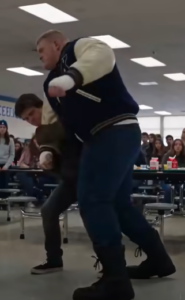
My body pivoted as his fist drove into the loose canvas hanging beside me.
The empty sleeve twisted around his arm.
I caught the fabric.
Trent’s momentum carried him forward.
His balance disappeared.
I stepped close, turned my hips, and used the movement he’d already committed to.
For a heartbeat, his enormous body seemed to become weightless.
His eyes widened.
“What the—”
Then he went over.
KRAAASH!
His body struck the aluminum lunch tables.
Metal legs folded.
Plastic trays flew.
Milk cartons burst across the floor.
The sound echoed through the cafeteria like a car collision.
I followed the motion down, holding his trapped arm and using my weight to keep him from swinging again.
My knee pressed against his upper chest.
He gasped.
His face changed from disbelief to panic.
“GET OFF ME!”
“Stop fighting.”
“GET OFF!”
I loosened my grip slightly.
“Are you done?”
For three seconds, nobody moved.
The cafeteria was completely silent.
Then everything happened at once.
Someone screamed.
Chairs scraped across the floor.
Students rushed backward.
And two powerful hands seized the collar of my jacket.
“GET YOUR HANDS OFF HIM!”
I was dragged backward before I could explain.
The jacket tore across my shoulder.
One security guard twisted my right arm behind my back.
The second caught my left wrist.
Pain shot through both shoulders.
“Wait!” I shouted. “He attacked me!”
“STOP RESISTING!”
“I’m not resisting!”
They forced me away from the table.
Behind them, Trent was still lying among the twisted metal.
Then the double cafeteria doors swung open.
Principal Davis entered.
He was a tall, heavy man in a dark suit, with silver hair and the unmistakable expression of someone accustomed to being obeyed.
He looked at the broken tables.
Then at Trent.
His face turned crimson.
“WHAT HAPPENED?”
Trent immediately grabbed his shoulder.
“I—I don’t know, sir.”
His voice sounded small.
Almost tearful.
“I just asked him if I could sit down.”
My mouth fell open.
“He hit me!”
Trent groaned louder.
“He went crazy!”
Principal Davis knelt beside him.
“Are you hurt, son?”
Trent nodded.
“I think he broke something.”
I tried to step forward.
A guard tightened his grip.
“Principal Davis, he slapped me first. Everybody saw it!”
Davis slowly turned.
He looked at my torn jacket.
My bleeding ear.
My arms pinned behind my back.
Then he pointed at me.
“Take that animal to my office.”
The word struck harder than Trent’s slap.
Animal.
Not student.
Not child.
Animal.
“Sir—”
“NOW!”
The guards started dragging me toward the exit.
I looked backward.
Trent was already sitting up.
One of his friends helped him stand.
He looked directly at me.
Smiled.
And winked.
Then Principal Davis pulled out his phone.
His next words made my blood run cold.
“Call the police,” he ordered. “I want this boy charged with aggravated assault.”
And for the first time since I’d entered that cafeteria, I understood something terrifying.
Trent hadn’t needed to beat me.
He had only needed to make sure I defended myself.

