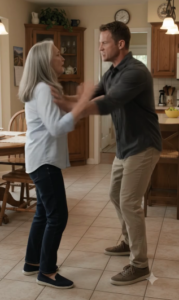
 Thomas Bell had never hugged me before.
When I walked into his office that afternoon, he did.
It was brief and careful because of my bruises, but it nearly undid me.
“You should be home resting.”
“I spent yesterday on the floor.
I’m finished resting.”
His receptionist looked away quickly.
She had seen the news.
Not television news.
Neighborhood news.
The kind that travels through text messages and doorbell-camera groups.
A police cruiser.
An ambulance.
Derek being placed in handcuffs.
Claire sitting on the curb while an officer spoke to her.
By noon, three people had called Mrs. Alvarez to ask what happened.
By one, someone had posted that I had “fallen.”
By two, another person claimed Derek had “saved me from an episode.”
A lie doesn’t need to be convincing to travel.
It only needs to be interesting.
That was another lesson I learned.
Thomas led me into the same conference room where Claire had sat two weeks earlier wearing diamonds and calling me Mommy.
I chose her chair.
Thomas noticed.
He said nothing.
A younger attorney named Rebecca joined us.
Thomas introduced her as someone in his firm who specialized in elder law.
I disliked the phrase immediately.
“Elder law makes me sound ninety.”
Rebecca smiled.
“I also represent sixty-year-olds who run marathons.”
“I don’t run unless something is chasing me.”
“Then we already understand each other.”
I liked her.
Thomas placed several documents on the table.
“First, let me reassure you.
Claire has no current authority over your finances.
None.”
“What about anything Richard signed?”
“Nothing gives her control during your lifetime.”
“And the house?”
“Yours.”
“The accounts?”
“Yours or held for your benefit, depending on the account.
She cannot simply take them.”
I breathed easier.
A part of me had known that.
Another part had spent the night imagining invisible signatures.
“What did she ask you exactly?”
Thomas retrieved his notes.
He had documented every call.
Of course he had.
Claire called four days after our meeting.
Not three times, as I thought.
Four.
The first call was framed as concern.
Mom seems overwhelmed.
She forgets appointments.
She isn’t eating.
She has always relied on Daddy for finances.
Thomas told her that grief could affect concentration without meaning incapacity.
The second call came two days later.
Claire asked whether a daughter could obtain authority if a mother became unable to manage property.
Thomas told her he could not advise her on a matter potentially adverse to me.
The third call came from Derek.
That surprised me.
“What did he say?”
Thomas read from his note.
“He said he was worried you might be vulnerable to outside influence.”
I almost laughed.
“Outside influence?”
“Specifically the veterans’ charity.”
My anger rose slowly.
They had transformed Richard’s wishes into manipulation.
“What did you tell him?”
“That the charitable provision predated Richard’s death and had been discussed extensively.”
“And?”
“He asked whether a court could invalidate it.”
Rebecca leaned forward.
“Thomas ended the conversation.”
“And the fourth call?”
Thomas’s expression darkened.
“Claire called yesterday morning.”
My skin prickled.
“What time?”
“Nine twelve.”
Two hours before she arrived at my house.
“What did she say?”
“She asked whether you had contacted me.”
I stared at him.
“Did you tell her?”
“No.”
“What did you say?”
“That our communications were confidential.”
“What did she say?”
Thomas looked at the page.
“‘Fine.
I’ll handle it.’”
The words sat between us.
Rebecca spoke gently.
“That does not prove what she meant.”
“I know.”
“But combined with the rest, the timing matters.”
I nodded.
Evidence.
Everything had become evidence.
It exhausted me.
I wanted to go back to a world where a phone call from my daughter was only a phone call.
Thomas removed his glasses.
“Margaret, I owe you an apology.”
“For what?”
“I should have been more forceful after the first call.”
“You couldn’t predict yesterday.”
“No.”
“Neither could I.”
I looked at the trust summary.
“Can Claire challenge my competency?”
“Anyone can file almost anything,” Rebecca said.
“Winning is different.”
“What would happen?”
“If someone genuinely believed you lacked capacity, there are lawful procedures.
Medical evaluations.
Hearings.
Evidence.
You would have rights.”
“Could they take the house while that was happening?”
“Not simply because they made an accusation.”
That reassured me.
Then she added, “But allegations themselves can create disruption.
Which is why documentation matters.”
I sighed.
“There’s that word again.”
Thomas looked at my bruised face.
“I’m afraid documentation is your friend now.”
So we documented.
The hospital records.
My blood alcohol result.
My cognitive screening.
The police report number.
Mrs. Alvarez’s recording.
Thomas’s notes about Claire’s calls.
The unsigned financial authorization papers recovered from my kitchen.
That last item mattered more than I expected.
An officer had photographed the pages where Claire left them.
They were not a simple authorization.
They granted broad financial power.
Not ownership.
Not inheritance.
But significant access if signed.
Banking.
Property management.
Transactions.
The kind of document that can be perfectly legitimate when created voluntarily and dangerous when placed in front of someone under pressure.
My signature line remained blank.
Claire’s name had already been typed as agent.
Derek’s name appeared as alternate.
I stared at it.
“He was next?”
Thomas nodded.
“That is what the document says.”
A memory returned.
Derek at my table.
You haven’t read it.
It’s standard.
No wonder he wanted my signature.
No wonder Claire said he promised it would be simple.
My hands shook again.
Rebecca closed the document.
“You don’t need to keep looking.”
“Yes, I do.”
“Margaret.”
“I spent too long not looking.”
So I opened it again.
Every page.
Every paragraph.
Every authority.
When I finished, I pushed it back.
“What do I do?”
Rebecca answered first.
“Immediately?”
“Yes.”
“Change every lock.
Revoke the spare key access.
Update home security.
Notify your banks that no third party has authority.
Consider adding verbal passwords to accounts.
Review your health directives.
Document who may and may not receive medical information.
And do not meet with Claire or Derek alone.”
I looked at Thomas.
“And the trust?”
“That depends on what you want.”
There it was again.
What I want.
Strange how powerful those words sounded after only one day of being told I was incapable of knowing my own mind.
I leaned back.
“What parts are fixed?”
Thomas explained.
Richard’s estate planning had created protections and charitable intentions, but the practical effect remained close to what I already understood: I controlled my own assets, remained beneficiary of what we had built, and retained meaningful authority over what happened to my share.
Claire had always assumed whatever did not go to charity would eventually go to her.
So had I.
Until yesterday.
Thomas stopped speaking.
“What are you thinking?”
“I’m thinking Richard was right.”
“About what?”
“Claire.”
He looked uncomfortable.
“Richard loved Claire.”
“I know.”
That was the painful part.
He had loved her deeply.
But near the end of his life, when pain and medication stripped away his patience for polite lies, he once asked me a question.
It happened three weeks before he died.
We were in our bedroom.
Rain tapped against the windows.
Claire had canceled another visit.
Richard stared at the ceiling.
“Do you think we made it too easy for her?”
I pretended not to understand.
“In what way?”
“Everything.”
“She’s our daughter.”
“That isn’t an answer.”
“She has a good life.”
“Because she built it?”
I became defensive.
“She works.”
“So did we.”
“Richard.”
He turned toward me.
“Margaret, I’m not saying we shouldn’t help our child.
I’m asking whether helping became the thing that kept her from learning gratitude.”
I had hated him for saying it.
Just for a few minutes.
Because mothers can hear criticism of a child as criticism of themselves.
“What do you want me to do?
Punish her?”
“No.”
He reached for my hand.
“I want you to promise me something.”
“What?”
“When I’m gone, don’t let guilt make decisions for you.”
I started crying.
“Stop.”
“I mean it.”
“You’re not gone.”
“Not yet.”
“Richard.”
“Promise.”
I refused.
I kissed his hand instead.
I changed the subject.
Three weeks later, he died.
Sitting in Thomas’s conference room, I finally whispered, “I never promised him.”
Thomas waited.
“Promised him what?”
“Not to let guilt make decisions for me.”
Nobody spoke.
I wiped my eyes.
Then I straightened.
“I want to make changes.”
Thomas opened a legal pad.
“What changes?”
“Not today.”
He paused.
“I want to know I’m deciding because I mean it.
Not because I’m angry.”
Rebecca nodded.
“That is wise.”
“But I want Claire removed from every position of authority she might have.”
Thomas wrote.
“Immediately.”
“Medical decisions.”
“Yes.”
“Financial backup roles.”
“Yes.”
“Anything that allows her to speak for me.”
“Yes.”
I looked at him.
“And Derek’s name should appear nowhere.”
“It won’t.”
I signed documents that afternoon.
Carefully.
Slowly.
Every signature mine.
Every decision explained.
Before I left, Thomas asked whether I wanted copies.
“Yes.”
“Physical or digital?”
“Both.”
He smiled faintly.
“Richard would approve.”
That hurt.
But it also steadied me.
When I returned to my street, a locksmith’s truck was parked outside.
Mrs. Alvarez had arranged it.
“I told him to change everything,” she said.
“You don’t live there.”
“I live close enough.”
The locksmith replaced the front lock.
The side door.
The garage keypad.
The back entrance.
I stood in the foyer watching strangers make my home mine again.
Every hammer tap echoed.
The kitchen looked almost normal.
A chair lay on its side.
One of Claire’s lemon bars sat on the counter.
The box was still open.
Yellow squares dusted with powdered sugar.
I stared at them for a long time.
Then I picked up the entire box.
Mrs. Alvarez watched.
“Trash?”
I carried it outside.
“Yes.”
Throwing away lemon bars should not feel like a funeral.
It did.
Inside, I found one of Claire’s earrings near the table.
Small pearl.
I placed it in an envelope for the police.
I found a broken fingernail near the hallway.
Mine.
I found a thin streak on the tile where my shoe had slid.
I found the C Claire carved into the table at eight years old.
That broke me.
I sat down.
Not because of pain.
Because I remembered that afternoon.
She had been doing homework.
Richard was cooking spaghetti.
I heard scraping.
“What are you doing?”
“Nothing.”
She hid the knife beneath a notebook.
Richard discovered the mark.
“Claire!”
Her little face crumpled.
“I wanted my letter.”
“On my table?”
“It’s our table.”
Richard tried so hard not to laugh.
Later he sanded around the mark but left the C.
“Evidence of ownership,” he said.
Now I traced that same letter with my finger.
Our table.
Our house.
Our family.
The word our can hide enormous differences.
Claire thought our meant she had a claim.
Richard meant belonging.
I had meant love.
Those were not the same thing.
The doorbell rang.
I jumped.
Mrs. Alvarez hurried from the living room.
“Stay here.”
“Elena, stop treating me like I’m—”
“Someone who was assaulted yesterday?”
I hated that she was right.
She checked the new camera monitor.
A uniformed officer stood outside.
Detective Patel was with him.
I let them in.
Patel looked around.
“Locks changed?”
“Yes.”
“Good.”
She sat across from me.
Mrs. Alvarez remained.
I expected an update on Derek.
Instead Patel placed a clear evidence bag on the table.
Inside was the blue folder.
My throat tightened.
“We’re returning this after photographing the contents.”
I touched the plastic.
“Thank you.”
“There’s something you should know.”
Those words had become my enemy.
“What?”
“Your daughter was arrested this morning.”
I closed my eyes.
The room went quiet.
Mrs. Alvarez touched my shoulder.
“What charge?”
I asked.
Patel explained that the recorded conduct, physical evidence, and statements supported charges related to the assault and attempted coercion.
Precise legal labels would be handled by prosecutors.
I listened.
I understood perhaps half.
One thought drowned out everything else.
My daughter had spent the night free.
Then someone came to her door in the morning.
Someone placed handcuffs around her wrists.
Because of what she did to me.
My stomach twisted.
“Is she in jail?”
“Processing.”
“Can she call me?”
“She may try.”
I looked down.
Patel continued.
“She has already told investigators you misunderstood the documents.”
“Of course.”
“She also claims you struck Derek first.”
I laughed.
It came out ugly.
“The video?”
“Contradicts significant parts of both accounts.”
“Significant parts?”
She understood my frustration.
“We say things carefully during investigations.”
“I’m learning everyone says things carefully except criminals.”
Mrs. Alvarez coughed to hide a laugh.
Patel almost smiled.
Then she became serious again.
“There is another reason I came.”
My shoulders stiffened.
“Yesterday you mentioned your daughter asking about your medications.”
“Yes.”
“Has she ever handled them?”
“Not regularly.”
“Ever?”
I thought.
After Richard died, Claire picked up prescriptions twice.
Once when I had the flu.
Another time after a dental procedure.
“Twice.”
“Recently?”
“Months ago.”
Patel nodded.
“Do you believe she altered, removed, or gave you medication without your knowledge?”
“No.”
The answer came quickly.
I meant it.
“No. I have no reason to think that.”
“Good.
I’m not suggesting she did.”
I appreciated that.
The detective was careful not to create crimes where there were none.
There had already been enough.
“Then why ask?”
“Because part of her narrative involves you misusing medication with alcohol.”
I stared.
“What medication?”
“She was vague.”
“Because she made it up.”
“Possibly.”
“Definitely.”
Patel nodded.
“Your hospital testing supports you.”
Another line through another lie.
She handed me a card with information about the case and possible protective orders.
“I recommend no direct contact right now.”
I looked toward the door.
“Can they come here?”
“Not lawfully if an order is entered and served.
Rebecca Bell has already contacted the appropriate office on your behalf.”
I glanced at Mrs. Alvarez.
“She works fast.”
“Elena called her.”
Mrs. Alvarez lifted her chin.
“You were sleeping.”
“I slept for forty minutes.”
“Exactly.”
Patel stood.
At the front door, she stopped.
“One more thing.”
I almost groaned.
She held out a small plastic bag.
Inside was the pearl earring I had found.
“We don’t need this.
Your daughter confirmed it belongs to her.”
I took it.
After they left, I sat at the kitchen table holding that tiny pearl.
Claire wore those earrings to Richard’s funeral.
I remembered adjusting one because the backing was loose.
“You look beautiful,” I told her.
“I look tired.”
“You are beautiful.”
She leaned her head on my shoulder.
At the graveside, she cried against me.
Real tears.
I knew they were real.
I refused to rewrite our entire history because of what she had done now.
That felt important.
Claire had loved her father.
She had loved me.
Maybe she still did in whatever distorted way she understood love.
People can love you and still harm you.
People can grieve and still become greedy.
People can carry sincere memories in one hand and entitlement in the other.
I put the pearl earring in a drawer.
Not the trash.
I wasn’t ready for that.
That evening I received the first message.
Unknown number.
Mom please don’t do this.
I stared.
Another arrived.
You know Derek pushed everything too far.
Then:
I was scared.
Then:
You were screaming too.
Then:
We can fix this privately.
Then:
Daddy would hate seeing our family destroyed.
That one burned.
My finger hovered above the screen.
I wanted to answer.
I wanted to write:
Your father would hate what you did.
I wanted to write:
Do not use his name.
I wanted to write a hundred things.
Instead I remembered Detective Patel.
You don’t have to answer.
I took screenshots.
Sent them to Rebecca.
Blocked the number.
Twenty minutes later another unknown number texted.
Mom.
I blocked that too.
At nine thirty, my home phone rang.
I almost didn’t answer.
Then I saw Thomas’s number.
“Margaret.”
“Yes?”
“I received an email from Claire.”
My eyes closed.
“What does she want?”
“She says she wants a family meeting.”
“No.”
“She says she wants to explain.”
“No.”
“She says Derek pressured her.”
I opened my eyes.
There it was.
The fracture.
The first attempt to move blame.
“What did you tell her?”
“That I represent you, not her.”
“Good.”
He hesitated.
“She also asked whether the trust can still be changed.”
I stared at the dark kitchen window.
My reflection looked back.
Bruised.
Tired.
Alive.
“Thomas?”
“Yes?”
“Schedule the meeting.”
He sounded surprised.
“With Claire?”
“Yes.”
“I don’t recommend meeting privately.”
“I won’t.”
“What do you want the meeting for?”
I looked at the blue folder.
“I want to hear her explanation.”
“Margaret.”
“I’m not forgiving her.”
“That isn’t what I’m worried about.”
“You think she’ll manipulate me.”
He didn’t answer.
“I know she’ll try.”
“Then why?”
Because there was one question I needed answered.
Not for the police.
Not for the trust.
For me.
I touched the carved C in the table.
“I need to know when my daughter started seeing me as an obstacle.”
Thomas was quiet.
Then he said, “I’ll arrange it through counsel if appropriate.”
After we hung up, I took the blue folder upstairs.
I placed it in Richard’s old desk.
Then I opened the bottom drawer.
Inside was his Navy photograph.
Twenty-one years old.
Thin.
Serious.
Impossible hair.
I sat on the floor with the photograph in my lap.
“You knew,” I whispered.
Of course he did not answer.
“I thought you were being too hard on her.”
Nothing.
“I thought love meant leaving the door open.”
The house creaked.
Wind moved outside.
For the first time since his death, I did not ask Richard what I should do.
I told him.
“I’m closing it.”
Then I put his photograph back.
The next morning, Thomas called.
“Claire’s attorney agreed to a meeting under strict conditions.”
“When?”
“Friday.”
“Where?”
“My office.”
“Will Derek be there?”
“No.”
“Good.”
I almost hung up.
Then Thomas said, “Margaret.”
“Yes?”
“There’s one thing Claire’s attorney asked.”
“What?”
“He wants to know whether the meeting is about reconciliation.”
I looked out at the hydrangeas.
Some of the blossoms had been crushed when I fell.
Others remained upright.
Same plant.
Same roots.
Different damage.
“No,” I said.
“What should I tell him?”
“The truth.”
Thomas waited.
I spoke slowly.
“Tell him it’s about clarity.”
Friday arrived four days later.
I wore navy blue.
Richard’s favorite color on me.
I put on lipstick.
Covered none of the bruises.
When I entered the conference room, Claire was already there.
No diamonds.
No cream-colored dress.
No careful makeup.
She looked smaller.
Her attorney sat beside her.
Thomas sat beside me.
Rebecca joined by video.
For several seconds, mother and daughter looked at each other across the polished table.
Then Claire began to cry.
“Mommy.”
I felt the word hit the oldest part of my heart.
I let it.
Then I sat down.
And for the first time in my life, I did not reach for her.
Part 4: WHAT MY DAUGHTER CALLED LOVE
“I never wanted you hurt.”
Those were Claire’s first words.
Not I’m sorry I hurt you.
Not I should never have touched you.
Not I lied.
I never wanted you hurt.
I had spent sixty-seven years listening carefully to language.
Teachers do that.
I taught high-school English before Claire was born and returned to substitute teaching after she left for college.
Words mattered to me.
Richard teased me because I corrected television advertisements.
He would look up from his newspaper and say, “Margaret, civilization will survive the misplaced modifier.”
I would say, “That is how decline begins.”
In Thomas Bell’s conference room, words mattered more than they ever had.
“I never wanted you hurt,” Claire repeated.
I folded my hands.
“But I was.”
She swallowed.
“Derek lost control.”
Thomas shifted beside me.
Claire’s attorney whispered something.
She shook her head.
“No, I need to say this.”
She looked at me.
“He pushed you.”
“And you pulled my hair.”
Her face twisted.
“I panicked.”
“You dragged me to the front door.”
“I was trying to get you away from him.”
The lie was so absurd that for several seconds I said nothing.
Claire rushed on.
“I know how the video looks.”
“How it looks?”
“I mean—”
“The video shows you dragging me out of my house.”
“I was scared.”
“For whom?”
“You were screaming.”
“Because your husband slammed me onto a tile floor.”
Her attorney raised a hand.
“Perhaps it would be productive—”
I looked at Thomas.
“I’m not here to negotiate facts.”
Thomas nodded.
Claire’s attorney stopped.
Claire stared down at the table.
I watched her breathing.
Fast.
Shallow.
She truly was frightened.
I did not enjoy that.
I expected to.
In the days before the meeting, I imagined satisfaction.
I imagined seeing her humbled.
I imagined saying something devastating and walking away while she finally understood.
Instead I felt grief.
The kind without a funeral.
“Tell me why,” I said.
She wiped her face.
“You know why.”
“No.”
“The trust.”
“That’s what you wanted.”
“It was Daddy’s money too.”
“Yes.”
“I’m his daughter.”
“Yes.”
“He worked his whole life.”
“So did I.”
“I didn’t mean—”
“Yes, you did.”
She looked up.
I continued.
“You always say Daddy’s money.
Daddy’s house.
Daddy’s estate.
As if I was a guest for thirty-eight years.”
“That isn’t fair.”
“I taught school.
I raised you.
I handled our home.
I cared for your father while he was dying.
I signed mortgages.
I invested.
I saved.
I contributed to that life.”
“I know.”
“No. You don’t.”
My voice remained calm.
That surprised both of us.
“You thought because your father handled most of the paperwork, I had no idea what we owned.”
She didn’t answer.
“You thought because he died first, the money became an inheritance waiting for me to get out of the way.”
“That’s not true.”
“Then explain it.”
Claire looked at her lawyer.
He said nothing.
Good lawyer.
He knew there are moments when saving someone from answering is more revealing than the answer.
She stared at me.
Finally she whispered, “It felt like you were giving him away.”
I frowned.
“What?”
“Daddy.”
Her lower lip trembled.
“All those years, everything was family.
The house.
Vacations.
Christmas.
His Navy stories.
Then he dies and suddenly half of everything goes to some organization.”
“Not everything.”
“You know what I mean.”
“No. I don’t.”
She leaned forward.
“Why do strangers deserve what he built more than I do?”
There it was.
Not debt.
Not emergency.
Not desperation.
Deserve.
The ugliest word in the room.
“Your father did not owe you an estate,” I said.
Her face hardened.
“I’m his child.”
“You had an education.”
“I know.”
“We paid for college.”
“I know.”
“We helped with your wedding.”
“I know.”
“We helped you with your first house.”
“I know.”
“We never let you go without.”
“I know!”
Her voice cracked across the table.
Her lawyer touched her arm.
Claire shook him off.
“I know what you did for me.”
“Then why wasn’t it enough?”
Silence.
I felt Thomas turn slightly toward me.
Claire stared.
I repeated the question.
“Why wasn’t it enough?”
Her face changed.
For one second I saw something beneath the anger.
Shame.
Then it disappeared.
“Because it was ours.”
“No.”
“It was family money.”
“No.”
“Mom—”
“It was our money.
Mine and your father’s.
You were loved with it.
Helped with it.
Educated with it.
But it was never yours.”
Tears slipped down her cheeks.
“You sound just like him.”
“Good.”
The word came out before I could stop it.
It landed hard.
Claire looked away.
I took no pleasure from it.
But I did not apologize.
“Did Derek tell you I was incompetent?”
She stiffened.
“No.”
“Did he suggest it?”
Her lawyer spoke.
“Margaret, there are pending legal matters—”
Claire interrupted him.
“Yes.”
The room went still.
Her attorney closed his eyes briefly.
I almost felt sorry for him.
“When?”
“After the meeting with Thomas.”
“What did he say?”
“He said you were making decisions emotionally.”
“Because I honored your father’s wishes?”
“He said grief changes people.”
“And?”
“He said you were vulnerable.”
“To whom?”
“The charity.
Lawyers.
Anyone.”
I nearly laughed.
“Except you.”
She flinched.
“That’s not what I meant.”
“But it’s what he meant.”
Claire rubbed her hands together.
“Derek said if you gave me financial authority, I could make sure nobody took advantage of you.”
“By taking control yourselves.”
“We didn’t think of it that way.”
“I did.”
“After.”
“No. At the kitchen table.
That’s why I refused.”
She cried harder.
I waited.
Eventually she whispered, “You made it sound like I was stealing.”
“You tried to leave my house carrying my trust documents.”
“They were copies.”
“You didn’t know that.”
She looked up sharply.
I saw the realization.
Thomas had never told her.
I almost smiled.
“The originals were never in my house.”
Her mouth opened.
“Your father insisted Thomas retain them.”
Claire stared at Thomas.
He said calmly, “Richard was very careful.”
A strange expression crossed her face.
Then she laughed.
Just once.
Broken.
“Of course he was.”
I suddenly heard the girl in her.
Daddy always checked the doors twice.
Daddy kept receipts.
Daddy labeled everything.
Daddy made emergency kits for road trips.
Of course he had protected his estate planning from his own daughter without ever knowing he needed to.
“Did you know Derek was going to take the folder?”
I asked.
Claire’s crying stopped.
Her eyes dropped.
“Answer me.”
Her lawyer murmured, “Claire.”
But she answered.
“Yes.”
Pain moved through me slowly.
I had already heard the recording.
I knew.
Still, hearing her say it mattered.
“Before he arrived?”
She nodded.
“You came to my house with papers you wanted me to sign.”
“Yes.”
“You had discussed what would happen if I refused.”
She hesitated.
“Not exactly.”
“The recording says, ‘You promised this would be simple.’”
Her face crumpled.
“I thought you would sign.”
“That isn’t an answer.”
She whispered, “We talked about taking the trust paperwork so we could understand what options we had.”
“Options for what?”
“To protect the estate.”
“From me?”
She said nothing.
“Claire.”
“Yes.”
My heart hurt so badly I pressed one hand to my chest.
Thomas leaned toward me.
“Do you need a break?”
“No.”
Claire started crying again.
“Mommy, I was angry.”
“I know.”
“I kept thinking about Daddy working his whole life and half of it disappearing.”
“Going to veterans.”
“People we don’t know.”
“Your father knew them.”
“Not those specific people.”
“He knew what service cost.”
She shook her head.
“You always took his side.”
I stared at her.
“This is not a marital argument.”
“You know what I mean.”
“No. Tell me.”
“You worshiped him.”
“No.”
“Yes, you did.
Even when I was little.”
That startled me.
The conversation moved somewhere I had not expected.
Claire wiped her face.
“Everything was Daddy.
Daddy sacrificed.
Daddy served.
Daddy worked.
Daddy built things.”
“He was your father.”
“And you always made him the hero.”
I leaned back.
“Claire, what does that have to do with dragging me out of my house?”
“I don’t know!”
She covered her face.
For a moment no one moved.
Then she whispered, “I don’t know.”
That was the most truthful thing she had said.
People want cruelty to have a clean origin.
One event.
One trauma.
One villain.
But sometimes bad choices are built from smaller things.
Entitlement.
Resentment.
Grief.
A spouse saying what you already secretly believe.
A lifetime of being rescued from consequences.
None of it excused her.
But I began to understand the shape.
Derek did not invent the part of Claire that believed she deserved our estate.
He encouraged it.
He organized it.
He gave it a plan.
Claire chose to follow.
That mattered.
“Did Derek force you to call Thomas?”
“No.”
“Did he force you to ask about my competency?”
“No.”
“Did he force you to bring the documents?”
She shook her head.
“Did he force you to pull my hair?”
A sob escaped her.
“No.”
I nodded.
“All right.”
“Mom—”
“No. I needed to hear that.”
“I’m sorry.”
There it was.
Finally.
“I am so sorry.”
I wanted the words.
I had imagined them.
But they did not fix anything.
Perhaps apologies are misunderstood.
We treat them like erasers.
They are not.
A real apology is only a description of regret.
The damage remains.
“I believe you’re sorry now,” I said.
Claire looked hopeful.
I hated what I had to do next.
“But being sorry because consequences arrived is not the same as being sorry before the police did.”
Her hope disappeared.
“That’s cruel.”
“No. It’s true.”
“You want me punished.”
“I want you accountable.”
“I’m your daughter.”
“Yes.”
“Does that mean nothing?”
“It means everything.”
My voice broke for the first time.
“That is why this hurts.”
I blinked hard.
“If Derek had done this alone, I could hate him and go home.”
Claire stared at me through tears.
“But you were there.”
I touched my hair near the stitches.
“These are from you.”
She looked away.
“Every time I walk through my front door, I remember your hand on me.”
“I know.”
“No, you don’t.”
“I’m trying.”
“I’m sure you are.”
She reached across the table.
“Please.”
My hands remained in my lap.
She stopped.
“Will you drop the charges?”
There it was.
Thomas inhaled quietly.
Her attorney stared at the table.
I should have expected it.
Still, I felt something inside me close.
“Is that why you wanted this meeting?”
“No!”
“Claire.”
“No. I wanted to see you.”
“And ask me to protect you.”
She cried.
“I could lose everything.”
I looked at her.
“You mean your job?”
“Maybe.”
“Your reputation?”
“Yes.”
“Your marriage?”
She hesitated.
“I don’t know.”
“Your inheritance?”
Silence.
That was the answer.
I stood.
Claire’s face changed.
“Mom.”
I picked up my purse.
Thomas began organizing his papers.
“Please.”
I looked at her.
“Your father once told me not to let guilt make decisions for me.”
She froze.
“He said that?”
“Three weeks before he died.”
“About me?”
I considered lying.
Mothers do that.
We protect even while leaving.
“Yes.”
Claire’s face collapsed.
“He hated me?”
“No.”
The answer came immediately.
“No, Claire.
He loved you more than you understood.”
She covered her mouth.
“He was worried about you.”
“What did he say?”
“That perhaps we had made things too easy.”
She shook her head.
“No.”
“He asked me not to let guilt control me after he was gone.”
“Mommy, please.”
I walked toward the door.
Her voice followed.
“Are you cutting me out?”
I stopped.
Thomas stopped beside me.
Everyone waited.
I turned.
“I haven’t decided.”
She stared.
That frightened her more than if I had said yes.
“Then what was this?”
“I wanted the truth.”
“You already had the video.”
“The video told me what you did.”
I looked at my daughter.
“I needed to know whether you understood that you chose to do it.”
She cried silently.
“Now I know.”
I left.
In the elevator, my knees nearly gave way.
Thomas caught my elbow.
“I have you.”
“I’m fine.”
“You are not.”
I laughed through tears.
“Apparently I need to stop saying that.”
“Yes.”
The elevator doors closed.
For several floors neither of us spoke.
Then I asked, “Was I too hard?”
Thomas turned toward me.
“No.”
“You’re my lawyer.”
“I’m also someone who has known you for nineteen years.”
I wiped my face.
“She said I always took Richard’s side.”
“Did you?”
“Sometimes.”
“Did that cause the assault?”
“No.”
“Then don’t confuse imperfections in a family with responsibility for violence.”
I looked at him.
“You lawyers practice sentences like that?”
“Only the useful ones.”
Outside, Mrs. Alvarez was waiting in her car.
I had told her not to come.
She came anyway.
She opened the passenger door.
“How bad?”
“Terrible.”
“Good.”
I stared.
She winced.
“I mean good that it’s over.”
“It isn’t over.”
“No.”
I climbed in.
She handed me a coffee.
“You remembered?”
“Two sugars.”
Richard knew that.
Claire knew it too.
The thought hurt.
We drove home.
At the corner, I saw Derek’s truck parked half a block from my house.
My entire body went cold.
“Elena.”
She saw it.
She did not stop.
She drove past.
I pulled out my phone.
The protective order had been served.
He was not permitted near me.
“Call 911,” Mrs. Alvarez said.
I did.
Derek never approached the house.
He remained inside the truck until officers arrived.
Later, he claimed he had come to speak with Claire, not me, and did not realize how close he was to the restricted area.
I did not believe him.
Neither did the officer who documented it.
He was ordered away.
That night I installed another camera.
Then another.
I hated living like that.
Every notification made my heart race.
Every car slowing near the house made me glance outside.
But fear, I learned, changes when you give it tasks.
Lock the door.
Save the message.
Call the lawyer.
Write the date.
Keep the video.
Do not answer.
Do not meet alone.
Fear becomes less shapeless when converted into action.
Weeks passed.
The bruises yellowed.
The stitches came out.
The hydrangeas recovered.
Derek and Claire remained apart from me under legal restrictions.
Their attorneys communicated.
The criminal process moved slowly.
Not dramatically.
No surprise witnesses.
No television-style courtroom confession.
Just paperwork.
Statements.
Video.
Medical records.
Negotiations.
Consequences arriving one document at a time.
Derek’s defense tried to describe the incident as a family argument that escalated.
Claire’s attorney emphasized her lack of prior criminal history and her “emotional vulnerability following her father’s death.”
I understood that.
I also refused to let grief become permission.
Eventually both accepted legal resolutions that required them to acknowledge conduct they had spent weeks minimizing.
There were probationary conditions.
No-contact requirements.
Court-ordered counseling.
Financial costs.
Derek faced harsher consequences because of the force he used and his role in escalating the confrontation.
I attended only what I needed to attend.
I did not need revenge performed for me in a courtroom.
The most important judgment had already occurred on my lawn when Mrs. Alvarez pressed play.
The lie died there.
Everything afterward was administration.
But the inheritance was still mine to decide.
And that decision took longer.
For nearly two months, I changed nothing except removing Claire from positions of authority.
I wanted anger to cool.
I wanted grief to settle.
I wanted whatever I signed next to be a decision I could defend to Richard if somehow, somewhere, I ever had to.
Then one rainy morning, I opened the bottom drawer of his desk.
I took out the Navy photograph.
I placed it beside the trust folder.
And I called Thomas.
“I’m ready.”
We met the next afternoon.
Thomas did not ask what changed.
He only opened his notebook.
I began.
“The charitable provision stays.”
He nodded.
“Exactly as Richard wanted?”
“No.”
His pen stopped.
I smiled faintly.
“I want it stronger.”
Thomas looked up.
I continued.
“Richard wanted approximately half of what remained from our estate to support veterans.
I want that commitment honored fully.”
“All right.”
“And my personal share?”
He waited.
“I want enough protected for my care as long as I live.”
“Of course.”
“After that…”
I looked out the window.
Across the river, sunlight flashed on the water.
I thought of Claire at five.
Claire at seventeen.
Claire on her wedding day.
Claire beside Richard’s hospice bed.
Claire in my kitchen.
Claire pulling my hair.
All of those versions were my daughter.
I did not need to pretend only the worst one existed.
But I also did not need to give the worst one control over my final decisions.
“After my death,” I said, “Claire receives nothing directly.”
Thomas’s expression remained neutral.
“You’re certain?”
“Yes.”
“I need you to understand that disinheritance often leads to challenges.”
“I know.”
“We can structure documents carefully.”
“Do it.”
“Would you like to leave her a nominal amount?”
“No.”
“Any personal items?”
I looked at him.
“Yes.”
That surprised him.
“What?”
“Photographs.
Her childhood things.
Family letters.
The diamond bracelet was already hers.”
Thomas waited.
“And Richard’s Navy things?” he asked.
“No. Those go where they should.”
“To the veterans’ organization?”
“Some.
I’ll create a list.”
“What about the remainder of the estate?”
I took a breath.
“To veterans’ services.”
“All of it?”
“Whatever remains after my lifetime needs and specific gifts.”
Thomas put down his pen.
“Margaret, that could substantially exceed Richard’s original charitable allocation.”
“I know.”
“You once intended Claire to receive approximately half.”
“I know.”
“Are you doing this to punish her?”
It was the right question.
I closed my eyes.
For several seconds, I imagined saying yes.
It would have been understandable.
Maybe even satisfying.
But it wasn’t true.
“Partly, I wanted to at first.”
Thomas nodded.
“But now?”
“Now I think inheritance should reflect trust.”
I looked at him.
“I don’t trust her with what we built.”
Thomas said nothing.
I continued.
“Richard wanted his money to mean something after we were gone.
Claire thought love meant she was owed it.”
I touched the trust folder.
“I don’t want my last decision to reward that belief.”
Thomas nodded slowly.
“That is a reason.”
“Yes.”
“Are you sure?”
“Yes.”
We spent hours reviewing language.
No rush.
No pressure.
No daughter waiting in the lobby.
No son-in-law standing over me.
When I signed the final documents days later, Rebecca witnessed.
Thomas witnessed.
Everything was recorded and documented according to their procedures because they wanted no future question about my capacity or intent.
I almost laughed at the irony.
Claire had spent weeks trying to build a story that I could not make decisions.
Her actions ensured my final decisions were documented more thoroughly than any I had ever made.
After signing, Thomas slid the completed papers toward me.
“How do you feel?”
I expected triumph.
Instead I felt sad.
“Like something ended.”
“It did.”
I looked at him.
“Do you think I’ll regret it?”
“I can’t answer that.”
“You’re becoming annoyingly ethical.”
“It’s a professional hazard.”
I smiled.
He added, “You can change your mind later if the documents allow and your circumstances permit.”
“I know.”
That mattered.
This was not vengeance carved into stone.
It was my decision while I was alive.
Mine.
Outside his office, I called Mrs. Alvarez.
“Well?”
“It’s done.”
A pause.
“Do you want coffee?”
“Yes.”
“Two sugars?”
“Always.”
As I walked toward the elevator, my phone rang.
Unknown number.
I almost ignored it.
Then I saw a voicemail transcript begin to appear.
Mom, it’s me.
Claire.
She was not supposed to contact me directly.
I did not answer.
The voicemail continued.
I know I’m not supposed to call.
I just need you to know something.
My finger hovered.
Then another line appeared.
Derek and I are separating.
I stopped walking.
Thomas noticed.
“What is it?”
I raised one hand.
The transcript continued.
I’m not asking you for anything.
I know you won’t believe that.
Then:
I started counseling.
Then:
I keep hearing myself in that video.
My eyes filled.
The last line appeared.
I didn’t know I could sound like that.
I stared at the screen.
Thomas waited.
“Do you want to listen?”
“No.”
“Do you want to save it?”
“Yes.”
Evidence.
Always evidence.
I forwarded it to Rebecca.
Then I blocked the number.
But that night I listened.
Once.
Claire’s voice was thin.
No performance.
No accusation.
She said she was sorry.
She said she did not expect forgiveness.
She said hearing herself say “You’re nothing” had destroyed something in her.
“I don’t know why I said it,” she whispered.
“Maybe because for a few weeks, I needed you to be nothing so I could believe what I was doing wasn’t evil.”
I closed my eyes.
That sentence stayed with me.
I needed you to be nothing.
Perhaps that was the center of it.
To take from someone you love, you first have to make them smaller in your mind.
Old.
Confused.
Dependent.
Wasteful.
Drunk.
Unstable.
Then hurting them feels less like betrayal and more like management.
Claire and Derek had reduced me before they tried to control me.
The video restored my shape.
Not because it made me strong.
Because it showed what happened.
Nothing more.
Nothing less.
I saved Claire’s voicemail.
Not because I trusted her.
Because it was the first time since the assault that she sounded as if she had finally begun looking at herself instead of me.
Whether she continued was her responsibility.
My responsibility was different.
I had a life to rebuild inside the house they thought was already theirs.

