 When my new daughter-in-law Saskia ripped the wig off my wife Eva’s head in front of almost 300 wedding guests, our son Daniel stood less than an arm’s length away and said nothing. At that moment, it was no longer about a tasteless joke, but about how much humiliation a person is supposed to endure just so a family can maintain its facade.
The wig hit the light stone floor of the ballroom. A dry, small sound. Nevertheless, I heard it more clearly than the music that had been playing just seconds before beneath the chandeliers of the Kronenhof Hotel in Frankfurt’s Westend district.
Eva stood frozen.
Six months earlier, she had been diagnosed with stage three breast cancer. The chemotherapy had taken away her hair, much of her strength, and sometimes her appetite. Some days she had to stop after ten steps because she felt dizzy. But she had insisted on coming to our only son’s wedding.
“I want Daniel to see his mother on that day,” she had said.
She wore a simple dark blue dress, pearl earrings, and an auburn wig that she had repeatedly adjusted in front of the bathroom mirror for two weeks. Not out of vanity. She didn’t want to look ill in the photos.
Saskia had called her onto the stage and spoken of a “little surprise for the groom’s mother.” Eva had squeezed my hand.
“Georg, I don’t feel well.”
“You don’t have to go up there.”
Then Daniel smiled. “Come on, Mom. Just for a minute.”
So she left.
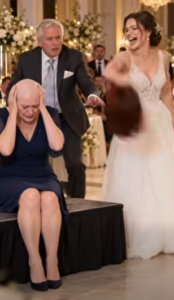
Saskia hugged her first. Then she grabbed the wig and pulled it down with a quick movement.
A murmur went through the hall. Somewhere a fork fell onto a plate.
Saskia lifted the wig like a trophy and laughed into the microphone.
“Finally everyone can see what is usually so carefully hidden here.”
A few guests reflexively joined in the laughter. That uncertain laughter that arises when people haven’t yet grasped whether they are witnessing a joke or an atrocity.
Then Saskia said: “Maybe she’ll stop always playing the grand lady now.”
Eva raised both hands to her head. Her fingers were trembling.
A woman at one of the front tables said loudly: “That’s disgusting.”
Saskia’s smile twitched, but she held the microphone tightly.
And Daniel?
My son looked at the ground.
“Daniel,” Eva said softly. “Please.”
He remained silent.
This silence affected me almost more than Saskia’s touch. When Daniel was sixteen, he had once stood by at school while others mocked a quiet boy. Eva had said to him then: “Not joining in isn’t enough. Sometimes silence is a choice in itself.”
I saw the same words reappear on her face.
I went onto the stage, took off my jacket, and draped it around Eva’s shoulders, high enough for her to cover her head. She smelled of her mild perfume and that clinical, metallic scent that had sometimes followed us home for months.
Saskia rolled her eyes.
“George, please. That was a joke. We’re at a wedding here.”
I looked at her.
“Exactly,” I said. “And that’s why I had hoped you would remember that evening differently.”
She smiled again, that small, confident smile I’d seen so often in recent months. Saskia thought we were pleasant, if somewhat boring, retirees. She knew I’d paid for a large part of the celebration. She didn’t know where the money came from.
She also didn’t know who actually owned the Kronenhof Hotel.
The wedding cost almost 170,000 euros. I covered most of it because Eva wanted Daniel to start his marriage debt-free.
Three weeks before the wedding, my lawyer, Dr. Miriam Henning, called me. A bank had submitted documents to her firm for review, in which Saskia’s father was already anticipating a company share that Daniel was to receive after the wedding: twenty percent of my hotel company. The transfer had been prepared, but not yet notarized.
“You have to decide if you really still want this,” Dr. Henning had said.
Since then, I carried a sealed, cream-colored envelope containing the crucial documents with me. I had convinced myself that I wouldn’t need it.
On stage, Saskia placed the wig on the music stand as if nothing had happened.
Then she saw my hand slide into the inside pocket of my jacket.
I pulled out the envelope.
At the table right next to the stage, Saskia’s father, Ralf Brenner, stood up so abruptly that his chair scraped backward. His gaze fell upon the embossed logo of the law firm in the corner of the envelope.
Within a second, all the color disappeared from his face.
He didn’t look at me, but at his daughter.
“Saskia,” he said hoarsely. “Don’t say another word.”
The sentence changed the space.
Until then, some guests had still hoped it could all be laughed off as a failed wedding joke. Now, Saskia’s head turned to Ralf’s, and Ralf’s to mine. The waitstaff remained discreetly standing to the side. Even the band had stopped adjusting their instruments.
Saskia laughed too loudly.
“Dad, what’s wrong with you?”
Ralf did not reply.
I didn’t take the microphone. I didn’t want to stage a public execution. I just wanted to get my wife off that stage.
“Eva,” I said, “we’re going downstairs now.”
She nodded, but before we took the first step, Daniel finally reached out his hand.
“Mom, wait.”
Eva looked at him. Not angrily. That would have been almost easier. She just looked at him, very tiredly.
“What for, Daniel?”
He opened his mouth, closed it again, and looked at Saskia.
She shook her head almost imperceptibly.
Then I understood something I hadn’t wanted to understand before: Daniel’s silence hadn’t just arisen that evening. It was rehearsed.
We left the stage. An older lady, whom I knew as a former colleague of Eva’s, lifted the wig from the music stand and brought it to us. She held it with both hands, almost carefully, as if it were something fragile.
“Eva,” she said, “you don’t have to be ashamed of anything.”
Eva pressed her lips together. “I know.”
But her eyes said something else.
In the small parlor next to the ballroom, I helped her put her wig back on. Her hands were too unsteady, so I adjusted the edge against her forehead as best I could. After thirty-seven years of marriage, I had changed her bandages, sorted her pills, and held a bowl for her at night when she was nauseous. But I had never seen her so quiet.
“I want to go home,” she said.
“Then we’ll go.”
“And Daniel?”
This question hurt because, despite everything, she thought of him first.
Before I could answer, there was a knock. Ralf Brenner came in. Without a jacket. His tie was crooked. Daniel was standing behind him.
Saskia wasn’t there.
Ralf looked at the envelope in my hand.
“Georg, before you do anything, we should have a reasonable conversation.”
“Sensible,” I repeated.
He swallowed.
Daniel looked back and forth between us, confused. “What’s in the envelope?”
I looked at my son.
“Something that others apparently know more about than you do.”
Ralf raised his hands in a placating gesture. “That’s not how it is.”
I opened the envelope.
Inside were no mysterious share certificates or spectacular contracts I could tear up on a wedding stage. That’s not how companies work in Germany. There were copies of a lawyer’s letter, a draft for the planned notarized transfer of twenty percent of my shares, and my already signed instruction to Dr. Henning to halt this process until further notice. It also contained correspondence with a Frankfurt bank.
Daniel took the first page.
The longer he read, the paler he became.
“What is Brenner Eventtechnik GmbH meant by this?”
Ralf exhaled audibly.
I said nothing.
Daniel continued reading.
Then he raised his head. “You listed my stake as security?”
“Not as security,” Ralf said quickly. “As an economic perspective. That’s something else.”
“A stake that I don’t even have yet.”
“You should get them.”
“From Dad.”
“After the wedding.”
“And how did you know that?”
For the first time that evening, Ralf had no answer ready.
Eva sat on a small sofa and watched him. Her face was pale, but her voice was calm.
“From Saskia?”
Ralf looked towards the door.
That was enough.
Daniel sat down in the chair opposite him. “Saskia told you about this?”
Ralf rubbed his forehead. “She said Georg had practically agreed to it. We had financing for the expansion. The bank wanted to see how our family would be positioned in the future.”
“Our family?” I asked.
He realized too late what he had said.
At that moment the door opened. Saskia came in. Two of her friends remained standing outside in the hallway when they noticed the atmosphere.
“What’s the meaning of this?” she asked. “The guests are waiting.”
Daniel held out the documents to her.
“Did you tell your father that I’m getting shares in Dad’s company?”
Saskia looked first at the paper, then at me.
“That wasn’t a secret.”
“For me, yes.”
She blinked.
Daniel repeated: “For me, yes, Saskia.”
She snorted. “Oh, please. Your father has been talking for months about how you should take on responsibility someday.”
That was partly true. I had wanted to bring Daniel into the hotel group. He had been working in controlling at a logistics company for several years and had a knack for numbers. Eva and I had hoped that he would one day take over part of the family business. But I had only discussed a concrete quota of twenty percent with Dr. Henning and my wife.
“How did you know about the twenty percent?” I asked.
Saskia crossed her arms.
“Daniel saw documents at your home.”
Daniel stared at her in disbelief. “No.”
“Then your mother will have to do it.”
Eva sat up.
“I never discussed business shares with you.”
“Someone must have told me.”
“Or you were looking,” said Daniel.
Quiet.
Saskia’s gaze wandered back to him.
“Don’t make a fool of yourself.”
And suddenly I remembered a Sunday in spring. Saskia had been visiting us at our terraced house in Bad Vilbel. Eva had gone to bed feeling nauseous. Daniel and I had driven to the petrol station for twenty minutes to get ice cubes and ginger. When we returned, the door to my study was open. Saskia had said she’d only been looking for a charging cable.
At the time I didn’t think anything of it.
Daniel was apparently thinking about that same afternoon.
“The study,” he said quietly.
Saskia rolled her eyes. “Oh my God.”
“You were at Dad’s desk.”
“I was looking for a charging cable.”
“In his document folder?”
Now it was Ralf who was looking at his daughter.
„Saskia?“
She turned to him. “But you wanted the financing!”
Nobody said anything.
It wasn’t a confession in the legal sense. But it was enough for the people in that room.
Ralf sat down slowly.
“You told me Daniel knew.”
“He would have gotten it anyway!”
Daniel stood up.
His face had changed. Not dramatically. More as if someone had drawn a line that hadn’t been there before.
“And that’s why your father was allowed to count on something that belonged to my father?”
Saskia laughed briefly and bitterly. “Don’t all act like money is suddenly sacred. Georg paid for this wedding, this hotel obviously belongs to him, and you all have more than enough.”
Eva looked at her for a long time.
“So that’s what you were talking about.”
Saskia turned around. “No. My point is that for months you’ve treated me as if I should be grateful to even be allowed into this family.”
Eva frowned. “When did I do that?”
“You and your manner. Always correct. Always calm. Always that polite smile.”
“Is that your proof?” asked Daniel.
“You know exactly what she’s like.”
Daniel looked at his mother.
I could see how desperately he was searching for an excuse that would allow him to remain both husband and son without having to make a decision.
Eva took that opportunity away from him.
“Daniel,” she said, “you don’t have to choose between two women today. You have to decide what kind of person you want to be.”
He lowered his gaze.
Then he said: “I should have said something on stage.”
Eva did not answer immediately.
“Yes,” she finally said. “You would have.”
Saskia stared at him. “You can’t be serious.”
“But.”
“Because of a wig?”
Daniel closed his eyes.
“No. Because of my mother.”
Voices could be heard outside in the hallway. Apparently, word had already gotten around that something was wrong. A cousin knocked and asked if the party was continuing.
I opened the door only a crack.
“The celebration is over,” I said.
“Georg!” Saskia’s voice became shrill.
I turned to her.
“The hall belongs to my company. The event is paid for. Food and drinks will of course be billed. But my wife will not stay another minute in a room where her humiliation is being sold as entertainment.”
“You can’t just throw out three hundred people!”
“I’m not throwing anyone out. I’m ending a party I’m funding.”
Ralf stood up. “This is only going to get worse.”
“No,” Eva said quietly. “It was worse on stage.”
That was the moment when the mood finally changed.
Not because I had money. Not because I owned the hotel. But because Eva, the smallest and weakest in the room, was suddenly the only person who spoke without theatrics.
Daniel took his jacket from the chair.
“I’ll drive you home.”
Saskia grabbed his arm. “You’re staying here.”
He looked at her hand.
“No.”
She let go.
We went through a side passage to the underground parking garage. The hotel manager, Mr. Baumann, came to meet us. He had known me for twelve years and asked no questions. He arranged a car and made sure that Eva didn’t have to go through the lobby.
Daniel sat in the front. Eva and I sat in the back.
For almost the entire journey to Bad Vilbel, nobody said anything.
Just before we reached our house, Daniel whispered: “Mom, I’m sorry.”
Eva looked out the window.
“I believe you when you say you’re sorry.”
“But?”
“Apologizing is the beginning, not the end.”
The next morning, Dr. Henning called at 8:30 a.m. I confirmed my instructions: The planned transfer of the shares would not be pursued. There was nothing to reverse, as nothing had yet been legally transferred. At the same time, the bank was to be informed in writing that neither Daniel nor Ralf Brenner held any shares in my company and that no one was authorized to present a future gift as a secured asset.
Dr. Henning asked only one question.
“Are you sure?”
I looked at Eva, who was sitting at the kitchen table, wearing a soft grey cardigan, her wig next to her on a stand.
“Yes.”
Ralf called in the morning. Then again. I answered the third time.
“Georg, the bank is freezing our loan process.”
“Then you need to talk to the bank.”
“You know what this means for us.”
“No, Ralf. I know what it meant for my wife to be humiliated in front of three hundred people. You yourselves built your financing on assumptions that weren’t yours.”
He fell silent.
“Saskia made a mistake.”
“More than one.”
“Do you want to ruin her marriage?”
“Neither you nor I can do that. Daniel and Saskia are responsible for it themselves.”
I hung up.
Later, we learned from Daniel that the bank hadn’t completely canceled the financing. They demanded new collateral and corrected the documents. Ralf’s company had to postpone its planned expansion. This wasn’t revenge on my part. It was simply the consequence of a non-existent stake no longer being presented as future capital.
Saskia, in turn, initially told her family that I had taken millions from her “because of a joke.” This version lasted about two days.
Then the woman from the front table who had shouted “That’s disgusting!” spoke up. She hadn’t filmed the scene, but she had spoken with several guests. A bridesmaid confirmed that Saskia had already said that afternoon that she wanted to “bring Eva down from her high horse.” Another friend admitted that Saskia had explicitly planned the wig as a punchline.
Suddenly it was no longer a spontaneous joke.
It was intentional.
Daniel came to us alone three days later.
He looked as if he hadn’t slept.
“Saskia is with her parents,” he said.
Eva put out coffee, even though she herself only drank tea.
Daniel sat down and stared at his hands.
“I always thought peace meant that no one raised their voice.”
I said nothing.
“With Saskia, it was often easier to let things slide. If she teased Mom, I told her not to take it so seriously. If Mom was hurt, I said Saskia didn’t mean it that way. I thought that would keep everyone together.”
Eva shook his hand.
“You always asked the quieter one to endure more.”
He nodded.
“Yes.”
Then my son cried.
Not loud. No big scene. He simply sat at our kitchen table and cried while Eva slid a tissue towards him.
She didn’t forgive him at that moment. That was important to me. Love isn’t an eraser.
But she stood him up.
In the following weeks, Daniel began counseling. He and Saskia initially lived separately. At that time, no one knew whether their marriage would last. Eva insisted that we not interfere.
“He has to decide for himself this time,” she said.
My decision regarding the company also remained unchanged. Not as a punishment for Daniel, but because I understood that a gift of this magnitude requires trust. Daniel was able to rebuild that trust. But it was no longer automatically tied to a wedding anniversary.
Two months later, after Eva’s last major chemotherapy treatment, we sat on our small balcony. It was a cool evening. From the street we could hear bicycles, a bus at the stop, and somewhere dishes from an open kitchen.
Eva was not wearing a wig.
For the first time in months, she sat outside without covering her head.
I asked her if she was cold.
She smiled.
“A little bit.”
I put a blanket around her shoulders.
After a while she said, “Do you know what the worst thing about that evening was?”
I thought she would call Saskia’s hand. The laughter. The looks.
But she said: “That Daniel looked the other way.”
I nodded.
“And do you know what the most important thing was after that?”
“That he looked?”
She took my hand.
“That he finally understood that silence is also a decision.”
On the table next to us lay the auburn-colored wig in a simple cloth bag. Eva had only worn it twice since the wedding.
Not because Saskia had taken them from her.
But because Eva had decided that no one else could decide what she had to hide.