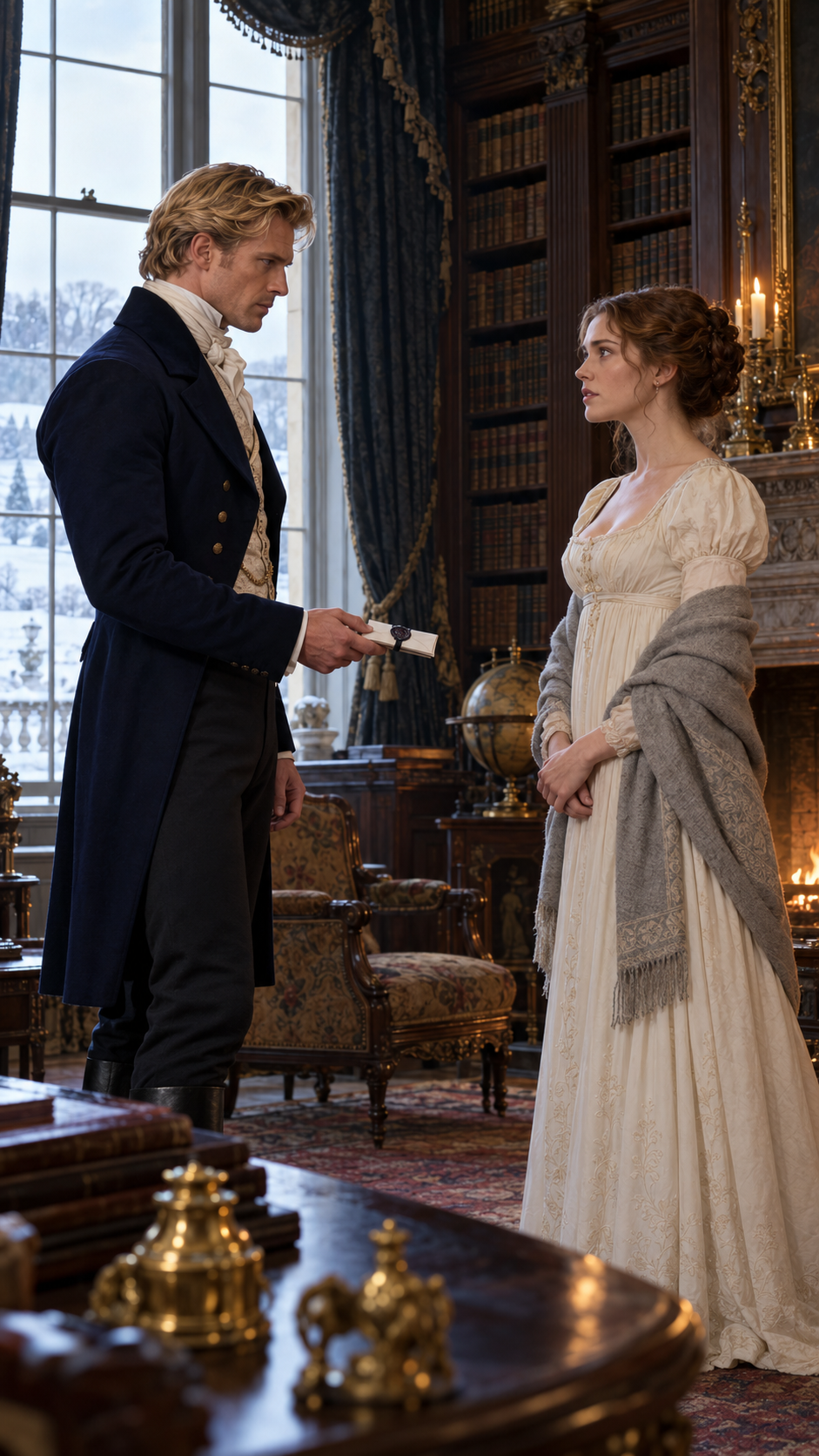
PART 2 — THE THINGS NO ONE HAD SEEN
The Duke did not ask Tabitha to sit.
He stood by the fireplace, one hand resting on the mantel, while she held her diary open in both hands. The pages trembled—not from fear, she told herself, but because the library was cold.
“Desmond cannot see the blackboard,” she said. “He can see clearly only when he is close to it.”
Everard looked at her without answering. His face had gone very still.
Tabitha turned to the page where she had written the measurements. “I tested him with letters, pictures, and objects. At a distance, he cannot make them out. At four feet, he reads them easily. A man in Ludlow may be able to help him. Mrs. Gillom says there is a lens maker who makes house calls.”
“How long have you known?” he asked.
“Since yesterday.”
“And you are certain?”
“Yes.”
The Duke looked toward the windows. The winter light had thinned to a grey wash across the room. For a moment, Tabitha thought he had decided she was mistaken. Then the hand resting on the mantel tightened.
“When Desmond was four,” he said, “he used to stand at the far end of the gallery when I returned from riding. He never ran to greet me. I thought he was shy.”
He paused. A log shifted in the fire.
“I thought many things.”
Tabitha heard the self-reproach in his voice. She also heard how carefully he was trying to hide it.
“Your Grace, he is not beyond help.”
“I did not ask whether he was.”
“No,” she replied quietly. “But you needed to hear it.”
His eyes returned to hers. For the first time since she had arrived at Wallingham, she saw no trace of contempt in them. There was only shock, and beneath it a grief so long held in check that it had become part of his face.
“Send for the lens maker,” he said. “Whatever it costs. From now on, you need not ask my permission to arrange anything concerning my son’s sight.”
Tabitha closed her diary. “Thank you, Your Grace.”
“Do not thank me.” He turned away again. “I should have known.”
She left the library with the words following her down the corridor.
I should have known.
That evening, a message went to Ludlow. A few days later, the lens maker arrived with his case of tools and several pairs of spectacles. Desmond endured the fitting with solemn suspicion. When the first pair was placed on his small nose, he stared at the room as if it had been remade while he was not looking.
“Can you see the clock?” Tabitha asked.
Desmond turned toward the mantel. His mouth opened.
“The hands,” he whispered. “I can see the hands.”
Rosanna stood beside him, watching his face. “Can you see me?”
He turned to his sister. “I can see the ribbon in your hair.”
Rosanna touched it at once, then laughed. This time the sound lasted longer.
The Duke stood in the doorway, one hand on the frame. He did not enter. But he did not retreat, either.
Desmond spotted him.
“Father?”
The Duke’s expression changed so quickly that Tabitha almost missed it. He took one step into the schoolroom.
“Can you see me, Desmond?”
The boy nodded. He looked at the Duke’s waistcoat, then at the buttons. “I can see the little gold buttons.”
For several seconds, no one moved. Then Desmond crossed the room and reached for his father’s hand. Everard bent toward him. The boy’s fingers closed around two of his, and the Duke let him hold on.
Tabitha looked down at her diary. She did not write what happened. Some things felt too precious to turn into a record while they were still unfolding.
But the change in the house did not come all at once.
The Duke began to appear in the schoolroom, though at first he stayed only a few minutes. He would listen while Rosanna read or watch Desmond puzzle through his letters. Sometimes he asked a question. More often, he stood quietly by the door, as if he were trying to learn the rules of a room he had avoided for years.
Tabitha remained polite with him. She did not mistake his efforts for a sudden transformation, and she did not pretend that a pair of spectacles could repair everything. Desmond had spent years believing himself a failure. Rosanna had learned to hide her loneliness behind sharp remarks. Everard, for all his authority, seemed to have forgotten how to speak with his own children.
So Tabitha taught them all, though not always from the same book.
She showed Desmond letters at a distance he could manage, and she taught him that asking for help was not the same as surrendering. She listened when Rosanna complained about the previous governesses, and she did not tell the girl that she should have been kinder to them. A child could only understand what she had been given the chance to understand.
And she waited for the Duke to speak.
He did not.
Days became weeks. The envelope remained in Tabitha’s desk drawer, sealed and untouched. Its instruction—Use before Easter—had become more unsettling than its money. She could not decide whether it was protection, dismissal, or an apology the Duke could not bring himself to offer.
Mr. Henderson, too, watched her from a distance. Whenever she met his eye, he looked away.
By the middle of February, the children had begun to trust her. Desmond no longer kicked the table when a lesson frustrated him. Rosanna had started to leave books on Tabitha’s desk with passages marked in pencil. The Duke, however, remained difficult to read. Some mornings he seemed grateful. On others, he closed himself off so completely that Tabitha wondered whether she had imagined the warmth she had seen when Desmond first recognized his face.
The rules about never being alone with him continued. All requests passed through the butler. Their conversations took place with the library doors open and a footman in the hall.
Tabitha had assumed the Duke feared scandal. She had also assumed he believed she might be one of the women who came to Wallingham hoping to catch a title.
That belief hurt more than she cared to admit.
She was not searching for a husband. She had come to work. She wanted the children to be taught properly, and she wanted the dignity of being judged by what she did rather than by what others imagined she might want.
Yet the Duke’s guardedness was not the only mystery at Wallingham. The past governesses had left traces everywhere. Miss Coombs’s name appeared in the children’s lesson books. Miss Thorley’s neat hand remained in a music notebook. The servants remembered both women with an uneasy fondness, but no one spoke of what had happened in detail.
One afternoon, while looking for a clean exercise book, Tabitha found a household account volume in a cabinet near the schoolroom. She had not intended to pry. The book lay open, its pages filled with lists of expenses and wages. As she turned through it, two entries caught her attention.
Miss Coombs, governess, dismissed. Quarterly wages £10. By his lordship’s order, £50.
In the margin, in the same neat hand, was another note:
Lord Culvermoor and his retinue, from 3rd to 8th April. Four additional maids from the village.
A year later, the pattern repeated.
Miss Thorley, governess, dismissed. Quarterly wages £10. By his lordship’s order, £50.
In the margin:
Lord Culvermoor and his retinue, from 25th to 31st March. Four additional maids from the village.
Tabitha read both entries again. Easter. A visit from Lord Culvermoor. A governess dismissed the following day. Fifty pounds.
The sealed packet in her drawer seemed suddenly heavier.
When Mrs. Gillom returned to the room, Tabitha kept her voice casual.
“Who is Lord Culvermoor?”
The housekeeper noticed the open page. Her mouth tightened.
“His Grace the Earl of Culvermoor,” she said. “The late Duchess’s father. He visits the children every Easter.”
“And the extra maids?”
“His lordship brings his own party. A man of his station likes familiar comforts.”
Mrs. Gillom took the account book from Tabitha and closed it.
“He is expected on April sixteenth,” she added. “As usual.”
That night, Tabitha wrote the dates into her diary. She lined them up as neatly as she could: the two dismissals, the two Easter visits, the two accusations, the two payments. Then she added her own date—the twelfth of January—and the envelope waiting in her drawer.
The facts seemed to form a pattern, but she could not yet see what the pattern meant.
She thought of Miss Coombs, accused of stealing the late Duchess’s brooch. She thought of Miss Thorley, branded with a shameful accusation that could follow her from one household to another. She thought of Henderson’s warning, and of the Duke’s insistence that she leave before Easter.
What did Lord Culvermoor want from the children? Why did every governess leave after he visited? And why had the Duke given her fifty pounds in advance, before there was any accusation against her?
Tabitha wrote until her fingers cramped. When she finally put away the diary, the house was quiet. The sealed packet remained untouched in the drawer.
She told herself her theory was incomplete.
She also told herself she would not be dismissed without knowing why.
PART 3 — THE PRICE OF AN EASTER
As Easter approached, the house began to change in small, unmistakable ways.
Mrs. Gillom ordered the carpets beaten and the silver polished. New linen arrived for the guest rooms. The servants who had been quiet all winter grew tense as Lord Culvermoor’s visit drew near.
Tabitha noticed that the Duke became more withdrawn. He stopped coming to the schoolroom. When she passed his study, the door was locked. When she sent a request through the butler, the reply came back that His Grace was occupied.
She tried not to let the growing distance unsettle her. She tried to believe that she had misread his earlier kindness.
The account book remained in her thoughts.
Her suspicions hardened, though not into certainty. The previous governesses might have done something wrong. The dates might be coincidence. Lord Culvermoor might have no part in their dismissals. But the same pattern had occurred twice, and the Duke had paid each woman a large sum after her reputation was damaged.
The £50 in Tabitha’s drawer could mean almost anything. It could be hush money. It could be a bribe. Or it could be a warning meant to send her away before Lord Culvermoor arrived.
On April second, she decided that she could not wait for the Duke to call for her.
At three minutes past three, she went to his study and knocked. No servant stood in the hall. She heard the Duke say, “Come in.”
Everard sat at his desk with papers spread before him. He stood so quickly that his chair scraped backward.
“Miss Whittaker, you should not be here.”
“I know your rule, Your Grace.”
“Then why have you disregarded it?”
“Because I have something to tell you, and I would like you to hear it before you send me away.”
He stared at her. She shut the door behind herself, but stayed near it, holding her diary against her chest.
“There are seventeen days until Easter,” she said.
He looked at the diary. “What does that have to do with this?”
“I found the household accounts. Miss Coombs was dismissed just after Lord Culvermoor’s visit in 1833. Miss Thorley was dismissed just after his visit in 1834. Both were accused of disgraceful things. Both were paid £50 by your order.”
He did not interrupt.
“Lord Culvermoor is expected here on April sixteenth,” she continued. “I was paid in January, three months before my dismissal was due. The envelope says I must use the money before Easter.”
The Duke’s hands rested on the desk. She saw them tremble once, then grow still.
“Miss Whittaker—”
“I think you hire a governess each winter and dismiss her before Lord Culvermoor can hear what she has seen in this house. I think you let him believe the worst of her. Then you pay her enough to go away and keep quiet.”
His face had gone pale.
“I think he uses the governesses’ disgrace to argue that you are unfit to raise your children. And I think you are afraid that if he sees the children as they are, he will take them from you.”
“Is that what you think?” he asked.
“It is what the facts appear to say.”
“You have gathered facts and made them into a story.”
“Then correct me.”
He looked down at the papers on his desk.
“Miss Coombs was accused of stealing a brooch,” Tabitha said. “Miss Thorley was accused of improper conduct. Was either accusation true?”
The Duke did not answer.
“Was the brooch found?”
His silence stretched.
“Your Grace,” she said, more softly, “I have laid out what I know. If I am wrong, tell me where.”
“There is no error in your facts,” he said.
“Then my conclusion is correct?”
“I did not say that.”
“Why did you pay me in January?”
His eyes lifted to hers. For one unguarded instant, she saw something there that looked like the confession she had been demanding. Then it disappeared behind the same hard stillness he wore before everyone.
“You have seventeen days,” he said. “That is all you need to know.”
It was not enough.
Tabitha left with more questions than before.
In her diary she wrote down every word she could remember. She also wrote the facts beside her theory, hoping the act of recording them would show her the gap she had missed.
The dates were accurate. The payments were real. The accusations had happened. The Earl’s visits had come immediately before the dismissals.
But as she studied the dates, something disturbed her. Lord Culvermoor had been at Wallingham when the women were accused. Miss Coombs had been dismissed on April ninth; the Earl had left the day before. Miss Thorley had been dismissed on April first; he had left the day before that as well.
If the Duke had paid the women to keep them silent, why had the money come after their names were already ruined?
And why had Tabitha’s payment come before anything had happened?
The difference mattered.
She searched her diary for everything she had written about the Duke. He had locked the study door when she passed. He had forbidden private meetings. He had insisted that their conversations take place with the door open and a footman nearby. She had thought those rules meant he suspected her.
But if the Duke were trying to protect himself from her, he would not need to keep such strict distance. He had the power to dismiss her whenever he wished. He could have allowed the household to believe whatever it liked.
Instead, he had arranged that no one could accuse her of being alone with him.
The memory of the packet returned: Use before Easter.
If a man wanted silence after an injustice, he might pay someone afterward. If he wanted to keep a woman from being harmed, he might pay her early enough to leave before trouble began.
Tabitha stared at the page until the words blurred.
She had been wrong before. She might be wrong now.
At dawn, she found Henderson in the room where the servants brushed and repaired the Duke’s coats. He was polishing the sleeve of a dark frock coat. When he saw her, he set down the brush.
“Tell me the other half of the truth, Mr. Henderson.”
He studied her face. “What do you mean?”
“You warned me that the Duke had ruined the other governesses. You told me about the accusations and the payments. You told me enough to make me believe he meant to ruin me as well.”
“I told you what I knew.”
“No. You told me what you thought might make me leave.”
Henderson lowered his eyes.
“You were trying to protect me,” Tabitha said. “But from what?”
For a long time, he did not answer. Then he went to the door and closed it—not because they needed secrecy, Tabitha realized, but because he did not want anyone else to hear.
“Lord Culvermoor loved his daughter,” he said. “He has never recovered from her death.”
“He believes the Duke is a poor father?”
“He believes His Grace was not there when his daughter needed him. And that belief has never softened.”
Tabitha’s throat tightened. “Was the Duke away when she died?”
Henderson’s face drew taut.
“Her Grace asked him not to go to London that spring. There was a vote in the House of Lords. His Grace thought he had to attend it. He told her he would be gone five days.” The valet’s voice grew quieter. “He returned after four. Her Grace had died on the morning he left.”
“Did he know she was ill?”
“She had taken poorly. He did not understand how serious it was until he returned. He has never forgiven himself.”
Tabitha pictured the Duke at the window, staring at a winter landscape that offered no comfort. She thought of the gallery and the boy at the far end, unable to see the man who stood there. She thought of the Duke watching his son and believing the child did not wish to come near him.
“And Lord Culvermoor has tried to take the children?”
“Every Easter, he brings a document asking His Grace to give up the right to raise them. He says the children would be better at Culvermoor. He has a solicitor who advises him that the Chancery Court may listen if he can prove the children are neglected.”
“Are they?”
“No,” Henderson said. Then, after a pause: “Not in the way the Earl believes.”
The housekeeper’s footsteps sounded in the corridor. Henderson waited until they passed.
“Each year Lord Culvermoor comes looking for evidence. His people see what they expect to see. A brooch goes missing. The chaplain sees a governess near the dressing room. Someone reports that a young woman entered the Duke’s study. The Earl’s party makes a record of every small thing.”
“And the accusations?”
“The brooch was found behind a wall panel in May. It had fallen there. By then Miss Coombs had been gone for weeks. No one saw any use in telling the Earl. As for Miss Thorley, I never believed a word of it.”
“Why did you tell me the Duke had ruined them?”
“I was trying to make you leave before the same thing happened to you.” He looked ashamed. “I saw two good women leave this house under a cloud. I could not watch a third.”
“And the Duke’s payments?”
“He could not restore their names. He could only give them enough to begin again somewhere else. He has never spoken of it.”
Tabitha kept her eyes on him. “Why did you not tell me all this?”
“Because the Earl’s party is coming. Because I have served His Grace since he was a boy, and I have watched him blame himself for things no one could have prevented. Because if I had told you the truth, I thought you would stay—and staying could bring you harm.” Henderson swallowed. “I chose the wrong way to protect you.”
“You did.”
He accepted the rebuke without looking away.
That evening, Tabitha went to the Duke’s study again. This time she did not knock. She opened the door and entered.
Everard looked up from his papers. He did not rise.
“I know about Lord Culvermoor,” she said. “I know he comes here each Easter to look for evidence that you are an unfit father. I know about the brooch, and I know that it was found behind a panel. I know you gave the other women money after they had been dismissed, because you could not repair the harm done to them. And I know you gave me my money early so I could leave before the Earl’s visit.”
The Duke said nothing.
“There is one thing I still do not know.”
“What is that?”
“Why you thought leaving was the only way to protect me.”
His jaw moved as though he had tried to answer and stopped himself.
“My wife asked me not to go to London,” he said at last.
Tabitha did not move.
“There was a vote coming up. I believed it mattered. She told me she was unwell and asked me to stay. I said I would return in five days.” His eyes fixed on a point beyond Tabitha’s shoulder. “I came back after four. She had died that morning.”
The room seemed to contract around them.
“I have never said it aloud,” he continued. “Not to Henderson. Not to anyone.”
“Why tell me now?”
“Because you asked what I kept silent about.”
She was quiet for a moment. “You cannot undo what happened.”
“No.”
“But you can stop punishing yourself through your children.”
His face tightened. “You think I have not tried?”
“I think you have been too afraid to get close to them. And too certain that your presence will hurt them.”
“I did not see that Desmond could not read.”
“You know that now.”
“I watched him stand at the end of the gallery for three years. I thought he did not want to come to me.”
“He wanted to. He simply could not see you clearly.”
The Duke looked away.
“Your son ran twenty-five metres to reach you the day he got his spectacles,” Tabitha said. “He saw you, and he ran as fast as he could.”
Everard shut his eyes. His hand closed over the edge of the desk.
For a moment Tabitha thought he would send her away. Instead, he pushed his chair back and sat down heavily, as if the strength had left his legs.
She moved nearer. “You have not lost the chance to be his father.”
“I do not know how to begin.”
“Begin by staying in the room.”
He looked at her then, and all the careful distance between them seemed suddenly fragile.
“I am not a warm man,” he said.
“No,” Tabitha replied. “You are not.”
Something almost like a smile crossed his face and faded.
“I did not notice my son was struggling. I thought he was difficult. I thought Rosanna needed nothing from me. I let their mother’s death become a reason to keep everyone at a distance.”
“You cannot change the past.”
“I can change what I do now.”
“Yes.”
He looked at her hand where it rested beside the papers. After a pause, he reached for it.
Tabitha let him take it.
His palm was warm, his fingers tense. He held her hand as if he were afraid that the moment would vanish if he loosened his grip.
“I should have trusted you,” he said.
“You should have spoken to me.”
“I have never known how to speak without making matters worse.”
“Then you will have to learn.”
He lowered his head, not quite touching her hand.
“Will you help me?”
Tabitha thought of the fifty pounds in her drawer. She thought of the rules, the locked doors, the warnings that had made her believe he despised her. She thought of the two governesses whose names still lay beneath suspicion.
“I will help you with your children,” she said. “But you must stop making decisions for me without telling me why.”
“I understand.”
“And I will not be hidden away whenever Lord Culvermoor comes.”
His expression sharpened. “That is exactly what I want to prevent.”
“You cannot protect me by keeping me ignorant.”
“I know.”
“Do you?”
He held her hand more firmly. “I will try to show you that I do.”
They sat in the lamplight with the open door between them and the corridor beyond. Neither of them spoke for a while.
Then the Duke raised her hand and kissed her knuckles.
It was a small gesture, almost formal. But when he looked up, his eyes were no longer guarded.
Tabitha felt the beginning of something she could not yet name.
PART 4 — THE EASTER VISIT
Lord Culvermoor arrived on April sixteenth.
He was a large, grey-haired man of seventy, with a deep voice and tired eyes. His solicitor, Mr. Atterton, came with him, as did his chaplain and several servants. Lord Culvermoor brought his own pillows, as Mrs. Gillom had predicted, and asked for his rooms to be prepared exactly as they had been the previous year.
Tabitha watched him greet Rosanna and Desmond. His affection for them was plain. He kissed Rosanna’s forehead and asked Desmond whether he had been reading. When the boy hesitated, the Earl’s gaze shifted toward the Duke.
“Still struggling?” he asked.
“Desmond has spectacles now,” Tabitha replied before the Duke could answer. “He can read very well.”
The Earl studied her. “And you are the new governess.”
“Miss Tabitha Whittaker.”
“I have heard your name.”
“Then I hope you have heard it correctly, my lord.”
Rosanna glanced quickly at Tabitha. The Duke’s eyes shifted to her, but he did not intervene.
Lord Culvermoor’s expression remained courteous, though his gaze was sharp. “You have been at Wallingham for some months?”
“Since January.”
“And do you find the children well cared for?”
Tabitha considered the question. She could have answered politely. Instead, she chose the truth.
“They are better cared for now than when I arrived. Desmond’s difficulty was mistaken for stubbornness. Rosanna had grown used to being left alone with her worries. Both needed more attention than they were receiving.”
The Earl’s face changed. The Duke went still beside her.
“I see,” Lord Culvermoor said.
Mr. Atterton watched Tabitha closely. His manner was mild, but his eyes moved from her to the Duke, then back again.
The next two days passed under a veil of civility. The household followed the usual Easter routine. Lord Culvermoor spoke with the children. His solicitor asked questions about their lessons and health. His chaplain attended the family at prayers. The Duke remained composed, but Tabitha could see the strain in the way he held his shoulders.
The rumours began before Easter Sunday.
A young maid from the village wrote regularly to her mother, who worked as a cook at Culvermoor. In her latest letter, she mentioned that the new governess had been seen leaving the Duke’s study late at night.
The letter reached Lord Culvermoor’s party on the evening of April eighteenth.
Tabitha had, in fact, gone to the Duke’s study that night. She had gone to confront him with the account book and her suspicions. No one had seen what was said. No one had seen the moment she had reached for his hand, or the way he had held it. They had only seen her leave.
On Easter Sunday, after church, the household gathered in the drawing room. The vicar, Mr. Fairhurst, and the neighbouring couple, Sir Quentin and Lady Prestovich, were among those present.
The children sat near the window. Lord Culvermoor stood by the fireplace with a document in his hand. Mr. Atterton waited beside him.
“I will not make a scene in front of our guests,” the Earl said to the Duke. “But I have a duty to protect my daughter’s children.”
The Duke’s face was unreadable.
“Three governesses in three years,” the Earl continued. “One accused of theft, another of shameful conduct, and now this young woman seen leaving your study in the middle of the night.”
Tabitha felt every eye turn toward her.
“The boy is seven years old and only recently learned to read,” the Earl went on. “I have asked for the truth, and I have not been given a convincing answer. I will not leave the children in a house where I have reason to believe they are neglected.”
He placed the document on the table.
“I ask you to sign the guardianship papers and allow me to take them to Culvermoor.”
A hush fell over the room.
The Duke looked at the paper. His hand moved toward the pen beside it.
Tabitha knew what he was about to do. She had seen that defeat in him before: the belief that the children would be better off without him.
“My lord,” she said, rising from her chair, “before anyone signs, allow me to speak.”
Lord Culvermoor turned. “This does not concern you, madam.”
“It concerns me more than anyone here. The woman you are speaking about is me.”
The Duke’s hand stopped above the pen.
“I was in His Grace’s study on the night mentioned,” Tabitha continued. “That is true. I went there because I had found the household accounts and believed the Duke had allowed two governesses to be disgraced in order to hide his own failures as a father. I accused him of it.”
A murmur passed through the room.
“He did not defend himself,” she said. “Not because every part of my accusation was true, but because he believed so many of the cruel things about himself that he could not answer me.”
Lord Culvermoor’s face had lost some of its certainty.
Tabitha opened her diary.
“I keep a record of the children’s lessons and of the things I observe. I wrote down what happened when Desmond was asked to read from the board. I noted that he could not identify letters from across the room, but read them clearly when he came closer. He was not lazy or disobedient. He was short-sighted.”
Desmond looked down at his spectacles. Then he lifted his chin.
Tabitha turned to him. “Would you read to your grandfather?”
The boy stood. His small hands trembled as he crossed to the vicar, who had a prayer book on his knee. Desmond took it and opened to the Easter service.
He began to read.
At first his voice was quiet. Then he grew steadier. He read the lines clearly, without stumbling.
Lady Prestovich lifted her handkerchief to her eyes. Rosanna moved nearer to her brother and rested one hand lightly on his shoulder.
Lord Culvermoor watched the boy. The Duke watched his children.
When Desmond reached the end of the passage, he looked up.
“Was that well, Grandfather?”
The Earl did not answer at once.
“Yes,” he said finally. “Very well.”
Tabitha closed her diary.
“As for the brooch,” she continued, “it was found behind a panel in the blue dressing room in May of 1833. Mrs. Gillom recorded it in the household book. Miss Coombs was already gone by then. And the Duke paid those women fifty pounds after their reputations had been damaged because he could not repair the injustice done to them.”
She looked at the sealed packet in her mind’s eye, though it was still in her room upstairs.
“He paid me the same amount in January, before Lord Culvermoor’s visit and before anything had happened. He was trying to give me the chance to leave before I was caught in another accusation. He made sure never to meet me alone because he wanted no one to be able to say I had behaved improperly with him.”
The Earl’s face had grown troubled. “Why did he not tell me this?”
“Because he believed you would not listen.”
“Is that what you believe?” the Earl asked.
Tabitha met his gaze. “I believe you came here wanting to protect your grandchildren. I believe His Grace wants the same thing. You have both tried to love them from opposite ends of a very long gallery.”
The words settled over the room.
For a moment, no one moved.
Then Rosanna stepped forward. She took her grandfather’s hand.
“Grandpa,” she said, “Desmond can see the buttons on Daddy’s waistcoat now. He told me so himself.”
Lord Culvermoor looked down at her, then at Desmond. The boy still held the prayer book. After a moment, the Earl turned toward the Duke.
“You were not there when my daughter died,” he said.
The Duke did not look away. “No.”
“I have believed for four years that you did not care enough to stay.”
“I cared,” Everard said. His voice was quiet. “I made the wrong choice. I have regretted it every day since.”
Lord Culvermoor’s fingers tightened around the document.
“I cannot decide what kind of husband you were to my daughter,” he said. “But I can see what kind of father you are becoming.”
The Duke’s eyes flickered.
The Earl looked toward the children again. “I will not take them from you today.”
He picked up the document, folded it once, and walked to the fireplace. He held the paper above the flames.
Mr. Atterton said nothing.
Lord Culvermoor released the document. It fell into the fire and began to curl at the edges.
“Read that prayer again, boy,” the Earl said, turning to Desmond. “I did not hear the ending.”
Desmond smiled and opened the book.
The tension in the room did not vanish, but it changed. Lord Culvermoor sat beside the children. The Duke stood behind them, no longer apart from the gathering. The vicar spoke quietly with Sir Quentin. Lady Prestovich watched Tabitha with kindness.
Tabitha remained where she was, her diary clasped in her hands.
She had not saved the Duke by herself. She had not erased the years of grief or corrected every wrong. But the children were still at Wallingham, and for the first time since their mother’s death, the family had begun to speak openly in the same room.
That evening, the Duke found Tabitha in the schoolroom.
She stood near the alphabet board in the fading light. The letters looked different now: not a test that Desmond had failed, but a record of what the household had failed to understand.
Everard stopped in the doorway.
He did not call for a footman. He did not remain safely on the other side of the room.
“Easter has come,” Tabitha said.
“I know.”
“You told me I had to leave.”
“I did.”
“And now?”
He crossed the room and stopped before her.
“Stay,” he said. “Not as my governess.”
Tabitha searched his face. “What are you asking?”
“I am asking you to stay as my wife.”
For a moment she could not speak.
He took both her hands, carefully, as though giving her time to pull away.
“I have had very little practice in being loved,” he said. “I have less practice in asking for it. But I would like to learn, if you would agree to teach me.”
Tabitha’s eyes warmed. “I write everything down in my diary.”
“So you have warned me.”
“I will record every promise.”
“Then record this one,” he said. “I will not ask you to bear the weight of my fears without telling you what they are.”
She looked down at their joined hands. “And I will not promise to agree with you merely because you are a Duke.”
“I would be disappointed if you did.”
A small smile touched her lips.
“You will have to learn to speak plainly,” she said.
“I will try.”
“You will have to learn to come into the schoolroom without standing in the doorway.”
“I will do that.”
“And you will have to let Rosanna disagree with you.”
“That may be the most difficult lesson.”
Tabitha laughed softly. “Then we will begin there.”
Everard leaned toward her, then paused, giving her the choice. She rose on her toes and met him halfway.
Their first kiss was gentle and uncertain. It carried no grand promise that life would become easy. It carried something better: the promise that they would face it honestly.
THE END — A HOUSE THAT LEARNED TO SEE
They were married in June in the small church at the edge of the park.
The wedding was quiet. Tabitha wore ivory silk and a wreath of small white flowers. Everard wore a dark blue tailcoat and a pale waistcoat. Rosanna stood beside Tabitha, trying to look composed and failing. Desmond, in new spectacles, carried the prayer book he had read to his grandfather on Easter Sunday.
Lord Culvermoor walked with Desmond after the ceremony. He had not become a different man in a few weeks, and neither had the Duke. But they had begun to speak to one another without the old accusation between them. The Earl visited Wallingham more often, and his visits became less like inspections and more like family calls.
Henderson lived long enough to dance at the wedding. He danced only once, with Mrs. Gillom, and complained afterward that the musicians had played too quickly. Tabitha never reproached him for telling her only half the truth. She understood why he had done it, even if she would never have chosen the same way.
The children remained at Wallingham. Rosanna grew into a young woman who could speak sharply without using sharpness as a shield. Desmond learned to read, then to write, then to choose the books he liked best. His spectacles changed as he grew, but the first pair stayed in the Duke’s desk.
Years later, when Desmond was preparing to leave for Oxford, Tabitha searched for sealing wax in Everard’s study. In the bottom drawer she found two things beneath a stack of old papers.
The first was the sealed packet addressed to her: Miss Whittaker, £50, January 12, 1835.
She had never opened it. Neither had Everard.
The second was a small pair of steel-framed spectacles, their curved arms worn smooth from use. Desmond had outgrown them at nine. Everard had kept them ever since.
Tabitha sat at the desk for a long time with both objects in her hands.
The packet had once seemed like a price: money offered to make her disappear. Later, she had understood it as a warning and an imperfect attempt at protection. Now it seemed to her like the first clumsy evidence that Everard had wanted to spare her the harm others had suffered.
She placed the spectacles beside the envelope.
When Everard came in, he saw what she had found.
“I thought I had put those away,” he said.
“You did.”
He stood behind her chair. “I could not bring myself to throw them out.”
“They helped Desmond see.”
“They reminded me how long I had failed to understand.”
Tabitha turned in her seat. “They can remind you of both things.”
He rested his hands on her shoulders. In the years since their wedding, he had learned to enter a room without stopping at the threshold. He had learned that love was not proven by never making a mistake. It was proven by returning, listening, and trying again.
“Do you still write everything down?” he asked.
“Of course.”
“What have you written about me today?”
“That you still leave sealing wax in the wrong drawer.”
He smiled. “A serious charge.”
“An accurate one.”
He bent and kissed her hair.
Downstairs, Rosanna was asking Desmond whether he had packed enough shirts for Oxford. Desmond insisted he had. Lord Culvermoor had come for dinner and was arguing with Mrs. Gillom about whether his room still needed his own pillows. The house was full of familiar voices, none of them afraid of being heard.
For four years, Wallingham had been a house of closed doors and unspoken grief. Then a governess arrived with a diary, a child received a pair of spectacles, and the people who had mistaken one another began, little by little, to see.
Tabitha slipped the old envelope back into the drawer.
She left the spectacles on the desk where Everard could find them.
And when she joined her family downstairs, no one stood alone at the far end of the gallery.

