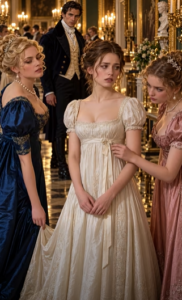
 “Your Grace, there is no need to involve yourself. My stepdaughter has embarrassed us quite enough.”
Lady Priscilla Fairborn spoke with the practiced composure of a woman who believed that a sufficiently elegant voice could make any accusation disappear.
But Benedict Annesley, Duke of Weatherborne, did not look at her.
He was looking at Rosalind.
The young woman stood beneath the golden chandeliers, both hands clutching the torn ivory silk against her body. Her face had gone terribly pale. A narrow red scratch marked her shoulder, and the ribbon that had once belonged to her mother lay somewhere among the polished floorboards.
Around her, London’s most distinguished families watched in silence.
Not one person had offered to help.
Benedict removed the dark cloak from his shoulders.
“Miss Fairborn,” he said quietly, “may I?”
Rosalind stared at him.
For one confused moment, she could not understand the question.
People had commanded her all evening. Lady Priscilla had ordered her to remain invisible. Sybil had mocked her poverty. Levvenia had ignored her pleas. And now, when her dignity seemed to be slipping through her trembling fingers, the most powerful man in the room was asking permission to assist her.
“Yes, Your Grace,” she whispered.
Benedict stepped closer and carefully settled the cloak around her shoulders.
He did not touch her skin. He did not attempt to arrange her as though she were incapable of helping herself.
He merely offered protection and allowed her to gather the heavy fabric around her ruined gown.
The warmth nearly undid her.
“Thank you,” she managed.
Benedict inclined his head.
Behind him, Lady Priscilla recovered from her surprise.
“How extraordinarily generous, Your Grace. Rosalind, come along. We shall use the servants’ passage and trouble no one further.”
“No.”
The word was not loud.
It was nevertheless heard throughout the gallery.
Lady Priscilla blinked.
“I beg your pardon?”
Benedict turned toward her.
“Miss Fairborn will not be removed through a servants’ passage as though she has committed an offense.”
“Surely Your Grace understands the requirements of propriety.”
“I understand them perfectly.”
His expression grew colder.
“And I understand the difference between an accident and cruelty.”
Sybil’s hand tightened around her fan.
Levvenia looked toward the floor.
Neither movement escaped Benedict’s notice.
He had seen Sybil’s slipper trapping the hem of Rosalind’s gown. He had seen Levvenia’s fingers pull the ribbon. The violence had been small enough to conceal beneath elegant gestures, but the result had been unmistakable.
His anger was not theatrical. It was the controlled anger of a man who had spent his life learning that power was most effective when exercised without shouting.
“No lady beneath my roof,” he continued, “will be made into entertainment.”
The silence deepened.
Rosalind felt every eye upon her, but for the first time that evening, those eyes no longer seemed to have the final word.
Benedict extended his arm.
“Miss Fairborn, will you allow me to escort you to the blue sitting room?”
She hesitated.
Accepting his arm would create gossip. Refusing it would leave her standing before the very people who had enjoyed her humiliation.
Her father had once told her that courage rarely arrived without fear.
She thought of him now.
Then she placed her gloved hand upon the Duke’s sleeve.
“Yes, Your Grace.”
They walked through the center of the gallery.
Not through the side passage.
Not behind the curtains.
Through the assembled company, as though Rosalind were a guest deserving every courtesy the house could offer.
Lady March, the elderly woman whose glove Rosalind had repaired earlier that evening, inclined her head as they passed.
The simple gesture brought tears dangerously close to Rosalind’s eyes.
Benedict paused beside Sybil and Levvenia.
“Miss Sybil. Miss Levvenia.”
Both sisters curtsied.
“I trust,” he said, his eyes moving briefly toward their slippers, “that you will take greater care where you place your feet.”
Sybil flushed scarlet.
Levvenia’s fan trembled.
Then Benedict continued walking.
Once beyond the gallery, Rosalind finally managed to speak.
“Your Grace, I fear your kindness will only make matters worse.”
“Worse for whom?”
“For my family. For your reputation. For everyone forced to discuss what happened.”
“And what of you?”
She looked down.
“I am accustomed to being discussed.”
“That was not my question.”
His tone softened.
“What happened to you tonight was deliberate.”
Rosalind’s head rose.
“You saw?”
“Enough.”
Her breath caught.
“You cannot prove it.”
“Not yet.”
Two words.
And somehow they frightened her more than any declaration of vengeance could have done.
At the blue sitting room, Mrs. Hensley, the housekeeper, was waiting with a maid and a clean change of clothing.
The Dowager Duchess arrived moments later, followed by Lady March.
Benedict gave his instructions calmly.
“The gown is to be preserved. Nothing is to be repaired until Mrs. Hensley has examined it. Mr. Vale will ensure that no one disturbs the gallery before the servants have finished their duties.”
Rosalind turned sharply.
“The gown?”
“Ruined things sometimes tell the truth more clearly than perfect ones.”
She looked at him for a long moment.
There was something unsettling about a gentleman who noticed what others worked so hard to conceal.
“Your Grace, I never wanted to cause a scandal.”
“You did not cause one, Miss Fairborn.”
He paused.
“Someone caused it for you.”
Lady March approached and offered Rosalind her arm.
“Come, child. There is nothing improper about allowing decent people to behave decently.”
Rosalind almost smiled.
As she entered the sitting room, Benedict remained outside with his mother.
The Dowager Duchess studied her son.
“You understand what London will say.”
“Yes.”
“They will assume your attention means something.”
“Perhaps it does.”
His mother’s eyes narrowed.
“Benedict.”
He looked toward the closed sitting room door.
“I have spent the evening surrounded by women instructed to appear perfect. The only woman who interested me was the one repairing other people’s difficulties.”
“And now?”
“Now I wish to know why her own family appears determined to destroy her.”
The Dowager Duchess closed her fan.
“Then be very certain of your facts before you act.”
Benedict nodded.
He had every intention of doing so.
What he did not yet understand was that the torn gown would prove to be only the beginning.
By morning, someone would have manufactured a second scandal.
And this time, the evidence would appear to be written in Rosalind’s own hand.
The gossip sheet arrived before breakfast.
Lady Priscilla placed it beside her cup of chocolate and allowed it to remain unopened until Rosalind entered the dining room.
Sybil sat in pale blue morning silk, her expression carefully subdued.
Levvenia looked as though she had hardly slept.
Rosalind took her usual seat at the far end of the table.
She had spent most of the night awake, remembering the sound of tearing silk and the terrible moment when strangers began whispering her name.
Her mother’s gown remained at Weatherborne House.
She could still feel the weight of Benedict’s cloak around her shoulders.
Lady Priscilla unfolded the newspaper.
“How quickly London becomes interested in a young lady who ought never to have attracted attention.”
Rosalind remained silent.
Her stepmother read aloud a carefully worded account of the previous evening. It described a young woman of reduced circumstances, an unfortunate wardrobe mishap, and a duke whose extraordinary generosity had encouraged speculation.
The final sentence suggested that compassion and calculation were sometimes difficult to distinguish.
Sybil sighed.
“How dreadful. People may believe Rosalind planned the entire thing.”
Rosalind looked at her.
“Did you?”
Sybil’s eyes widened.
“I beg your pardon?”
“Do you believe I planned to have my dress torn before an entire room?”
Lady Priscilla laid down the paper.
“That tone is unnecessary.”
“So was what happened to me.”
The room grew still.
Rosalind had never spoken so plainly at breakfast.
Her stepmother’s face hardened.
“Your sisters had excellent prospects last night. Everything we arranged was jeopardized because you insisted upon making yourself conspicuous.”
“I was standing beside Lady March.”
“You were standing where the Duke could see you.”
“Is that a crime?”
“Rosalind!”
The sharpness of the command brought back years of obedience.
For a moment, she almost lowered her eyes.
Instead, she remembered Benedict asking whether she was overcome.
She remembered answering that she was embarrassed, but not defeated.
“I did not tear my own gown,” she said.
“No one has suggested that you did.”
“Then perhaps we should stop pretending that the fabric simply decided to betray me.”
Sybil set down her knife.
“Must you accuse us?”
“I have not named anyone.”
“That is hardly necessary when you look at us so accusingly.”
Rosalind saw Levvenia’s fingers tighten around her teacup.
Something in the younger woman’s face unsettled her.
Fear.
Not merely the fear of having caused a scandal.
The fear of something that had not yet been discovered.
A footman entered carrying a folded letter.
“For Lady Priscilla. Delivered by hand.”
Lady Priscilla broke the seal.
As she read, her expression changed.
“Well,” she murmured, “this is most unfortunate.”
Sybil leaned forward.
“What is it, Mama?”
“A letter allegedly written by Rosalind to the Duke.”
Rosalind’s stomach tightened.
“I wrote no such letter.”
Lady Priscilla began reading.
The message suggested that Rosalind had deliberately positioned herself in the gallery so that the Duke would notice her. It described desperation, family neglect, and the hope that an encounter might improve her fortunes.
The wording was sufficiently intimate to invite scandal.
Worse, the handwriting resembled hers.
Rosalind stood.
“May I see it?”
Lady Priscilla held the page beyond her reach.
“There is no need.”
“There is every need. It bears my name.”
“It bears your handwriting.”
“It is not mine.”
Sybil gave a small, wounded laugh.
“Rosalind, surely you do not expect us to believe that someone would forge a letter merely to embarrass you.”
Rosalind stared at her.
The question was so carefully chosen that it sounded rehearsed.
Before she could answer, footsteps approached.
Mr. Vale, the Duke’s steward, entered carrying an engraved card.
“His Grace the Duke of Weatherborne requests the honor of calling upon Lady Priscilla and Miss Rosalind Fairborn at noon.”
Lady Priscilla went very still.
“The Duke himself?”
“With the Dowager Duchess, my lady.”
Mr. Vale bowed.
“He wishes to discuss last evening.”
No one spoke until the steward had departed.
Then Sybil whispered, “He cannot intend to pursue this.”
Rosalind turned toward her.
“Why should that trouble you?”
Sybil looked away.
At noon, Benedict arrived with his mother.
Lady Priscilla had transformed the drawing room into a scene of injured respectability. Sybil and Levvenia sat together on a sofa, dressed beautifully enough to suggest that no disturbance had ever entered their lives.
Rosalind stood near the window.
Benedict bowed to the ladies and accepted the forged letter.
He read it once.
Then again.
“Miss Fairborn,” he said, “did you write this?”
“No, Your Grace.”
“Can you prove that?”
“Not yet.”
Something almost resembling a smile touched his mouth.
“An honest answer.”
Lady Priscilla interjected.
“Surely the handwriting speaks for itself.”
“Handwriting can imitate,” Benedict replied. “Habits are more difficult.”
He turned the page toward the light.
“The writer has made an unusual spelling error and attempted to correct it. I have seen Miss Fairborn’s handwriting. She does not make this error.”
Levvenia’s face lost color.
Sybil spoke quickly.
“A clever person might make an error deliberately.”
“Indeed,” Benedict answered. “Which is why I have not accused anyone.”
He placed the letter upon the table.
“But neither will I accept it as evidence against Miss Fairborn.”
The Dowager Duchess regarded Rosalind thoughtfully.
“What do you want, child?”
For a moment, Rosalind did not know how to answer.
She could ask the Duke to silence the gossip. She could beg him to protect her from Lady Priscilla. She could allow his authority to settle the matter.
But she remembered how easily her life had always been decided by other people.
“I want the truth,” she said.
“Not pity.”
Benedict looked at her with unmistakable respect.
“Then truth shall be our concern.”
Before departing, he informed Lady Priscilla that the damaged gown would be examined in Rosalind’s presence.
Lady Priscilla objected immediately.
“Surely such an examination is unnecessary. The girl was wearing old silk.”
“Old silk can tear,” Benedict replied. “It does not ordinarily prepare itself to tear.”
Lady Priscilla said nothing more.
Outside, Mr. Vale approached the Duke with a folded cloth.
Inside lay a short length of thread and a message from Mrs. Hensley.
The housekeeper had noticed something unusual about the fastening of Rosalind’s gown.
One edge of the ivory ribbon was ragged, where it had been torn.
The other was clean.
As though someone had cut it before the disaster.
Benedict examined the thread carefully.
For the first time, his suspicions were supported by something more substantial than a fleeting movement in a crowded gallery.
He looked back toward the Fairborn house.
Someone had prepared Rosalind’s humiliation.
And someone had been determined to make certain the damage could not be dismissed as an ordinary accident.
What Benedict did not yet know was how much further the deception extended.