 PART 1
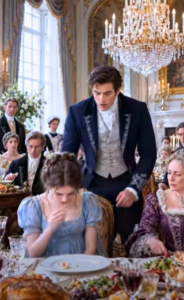
Saraphene Oldwick sat in the middle of it with an empty plate in front of her.
Not because she had already eaten. Because no one had served her. No one ever did.
She smoothed the crease of her borrowed gown — the same gray silk she’d worn to three dinners this season, let out twice at the seams and still too short at the wrist — and kept her eyes low. She had learned that trick the way you learn to walk on a floor that creaks. Carefully. Silently. Without ever letting anyone hear the sound of you moving through the world.
Across the table, her stepmother, Uleria, laughed too loudly at something Lord Ashworth had said. Her stepsisters, Caredwin and Isulf, leaned into each other like a single wall of silk and indifference. And in the space where Saraphene existed, the air felt thinner than the candle flame nearest her hand.
She pressed two fingers quietly against her ribs, beneath the table, where no one could see.
Four days.
Four days since she had eaten a real meal, and her body had started keeping its own accounting — a faint tremor in her hands she was working very hard to hide, thoughts that moved a half-second slower at the edges than they should.
She had learned, somewhere between the age of seven and the age of twelve, that hunger was quieter than grief. Grief made you loud. It made your throat close and your eyes betray you at the worst possible moment. Hunger simply made you smaller. Meal by meal. Until you took up exactly the amount of space Uleria Oldwick had always wanted from her — which was none at all.
Her father had married Uleria when Saraphene was seven. A widow from the northern counties, two daughters of her own, a smile that never quite reached her eyes. Saraphene remembered standing at the top of the staircase in Oldwick House, watching the woman climb out of the carriage below, and feeling something she couldn’t name then but understood perfectly now — the stillness of a person who has already looked at you and done the arithmetic. Decided you are a problem to be managed, not a child to be loved.
Her father hadn’t noticed. He never noticed anything. He died three years later of a fever that took him in two weeks, and by the time the black dresses were ordered, everything — the house, the income, the Oldwick name — flowed entirely through Uleria’s hands. Saraphene had been left a trust. Sealed until her twenty-first birthday. Now only weeks away.
Eleven years is a very long time to live in a house where you are tolerated the way one tolerates a drafty window.
The hunger had started small. A missed tray here. A portion quietly halved there. A cook who had received new instructions about “household economies.” Saraphene had understood, even at twelve, that it was deliberate. She simply hadn’t understood what to do about it. So she had done what she always did.
She adjusted.
She learned which nights the kitchen door stuck instead of locked. She learned the bread left cooling on the shelf after supper was never counted. She learned that if she moved through the house like a ghost — soft, careful, without complaint — she could survive without anyone ever having to admit what was being done to her.
That, more than anything, was what Uleria had always counted on. That Saraphene would be too proud to beg. Too uncertain to accuse. Too isolated to be believed.
Tonight had felt, at first, like every other dinner of the season — long table, too many candles, conversation moving in tight predictable circles. Saraphene had sat down, arranged her hands in her lap, and looked at her empty plate, thinking, as she often did, about the bread on the cooling shelf. Whether there’d be any left by the time they got home. Whether she could eat it before Uleria noticed she was still awake.
Then the room changed.
A hush moved through the guests the way cold air moves under a door. Chairs scraped. Spines straightened. And when Saraphene finally lifted her eyes, she saw him standing in the doorway.
Caspian Montre. Duke of Draven.
He stood like a man who had forgotten — or simply never learned — how to be unremarkable. His gaze swept the room with the disinterest of someone used to power, until it stopped.
On her.
On her empty plate.
His expression didn’t change. But something behind his eyes did.
Saraphene looked away first. She was very good at looking away. But the moment sat strangely in her chest for the rest of the meal — small and unresolved, like a word you cannot quite remember the meaning of but cannot stop turning over.
When the third course arrived and her plate remained bare, she managed it the way she always did — a word to the footman, a small gesture, nothing anyone could point to and name. She did not look across the table to see if he was still watching.
She looked at her hands instead. They had stopped trembling.
She wasn’t sure if that was strength, or simply the stillness that comes when a body finally stops expecting anything at all.
What she did not know — could not have known — was that across the room, a man who had seen a great many things in his life had just seen something he would not be able to put down again.
She was almost to the carriage, the cold night air smelling of woodsmoke and wet stone, when she heard his voice behind her. Quiet. Certain. The kind of quiet that comes from someone who has decided, finally, to say the thing they’ve been holding.
“You did not eat tonight.”
Saraphene stopped walking. And for the first time in eleven years, she did not know what version of herself to turn around and show him.
PART 2
She turned around slowly.
Caspian Montre stood a few feet away on the steps of Lady Pemberton’s house, his coat dark against the light spilling from the open door behind him. He wasn’t blocking her path. He wasn’t crowding her. He simply stood there, hands loose at his sides, his eyes on her face with a quality of attention that made her usual defenses feel suddenly, uselessly thin.
“I was not hungry,” she said. Her voice came out level. Years of practice had made sure of that.
He said nothing for a moment. Just looked at her the way he had looked at her across the table — careful, unhurried, the kind of look that didn’t slide over surfaces but pressed gently against them.
“You were not served,” he said. Not a question.
The air went out of the evening. Not dramatically — the way heat leaves a room when the fire dies, gradually and then all at once, until you’re simply standing in the cold wondering how you didn’t notice sooner.
“Your grace,” she said, reaching for the title the way you reach for something to hold onto when the ground tilts. “I appreciate your concern, but I assure you—”
“I watched the footman bypass your place three times,” he said. “On instruction. The instruction came from the woman sitting two seats to your left.” He paused. “I would like to know how long that has been happening.”
The carriage was fifteen feet away. Uleria hadn’t come out yet. Saraphene could hear laughter still spilling from the house behind her — people not yet ready for the evening to end. She had perhaps two minutes before her stepmother emerged and found her standing here, talking to the Duke of Draven. And whatever arithmetic Uleria did in her head about that would have consequences Saraphene would feel for weeks.
“You are mistaken,” she said.
“I am not,” he said, without heat, without emphasis. Simply as a fact.
And that was what undid her, slightly. Not the words. The certainty behind them. She had spent so long in a house where the truth was always negotiable that someone stating a true thing as though it were allowed felt strange and destabilizing in a way she hadn’t prepared for.
“It is a domestic matter,” she said. “It is nothing that concerns anyone outside the family.”
Something crossed his face. Not pity — she would have shut down entirely for pity. Closer to recognition. A brief, particular tightening around the eyes, as though she’d said something that landed somewhere specific inside him.
“Perhaps not,” he said. “But I find I am concerned regardless.”
Behind her, the front door opened, and Saraphene heard Uleria’s laugh spill out into the night — the one she always heard first, the one she’d learned to track across rooms and gardens the way a body learns to track the sound of something that has historically meant danger. She turned her face away from him, reflexively. A small movement. But she felt him notice it. Felt him catalogue it alongside everything else.
Uleria descended the steps with Caredwin on one arm, and when she saw Saraphene standing near the carriage, she smiled — the particular smile that looked, from any distance, like warmth.
“There you are, darling,” she said. “I wondered where you’d gone.”
Then her gaze moved past Saraphene to the man standing behind her, and the smile changed. Not visibly. Not in any way you could describe to someone who hadn’t seen both versions.
But Saraphene had seen both versions a thousand times. And she felt the shift in her chest like a drop in temperature.
“Your grace,” Uleria said, her voice sliding into the register she reserved for people who mattered. “What a lovely surprise. I did not know you and my stepdaughter were acquainted.”
“We were just being introduced,” Caspian said, easy and smooth, giving nothing away.
“How delightful,” Uleria said, turning to Saraphene with a fond, proprietary warmth she performed for audiences. “Saraphene is such a quiet creature. We do worry she doesn’t make enough of herself in company.”
Saraphene said nothing. Nothing was usually safest.
“On the contrary,” Caspian said pleasantly. “I found her quite direct.”
A pause. Small. Barely perceptible. Uleria’s smile did not move — but something behind it recalculated.
“How charming,” she said. Then, to Saraphene, with a lightness that had iron at its center: “Come, darling. It’s late.”
Saraphene moved. She was almost at the carriage door when she heard him speak again — this time to Uleria, with a cordiality so polished it could cut glass.
“Lady Oldwick. I believe we share a mutual acquaintance in Lord Fenwick. He’s hosting a gathering at Fenwick Park on Friday. I understand your family has been invited.”
“We have,” Uleria said carefully.
“I’ll be attending as well,” Caspian said. “I look forward to furthering my acquaintance with your family.”
He did not look at Saraphene when he said it.
He did not need to.
PART 3
She sat in the carriage with her hands folded in her lap and Uleria’s silence filling the space between them like water filling a held breath, and she thought about the way he had said the word family — the slight, almost imperceptible weight he’d placed on it, as though it were something he intended to examine very closely in the very near future.
Caredwin fell asleep against the window before they’d cleared the first mile. Isulf sat opposite and did not sleep, did not speak, and at one point looked at Saraphene with that particular expression — not malice, not indifference, something less comfortable than either — and then looked away again at the dark fields.
Uleria said nothing until they were through the gate at Oldwick House.
Then, quietly, without turning her head: “You will not speak to him again.”
Not a request. The syntax of a directive dressed as a sentence.
Saraphene looked at the darkness outside the window. “Of course,” she said.
It was the first lie she had told out loud in years. She had told many quiet lies — the lie of the empty plate accepted without complaint, the lie of the smile that said nothing was wrong, the lie of a body that presented itself as fine when it was, in fact, slowly being taken apart. But this lie had a shape. A direction. A small future bending away from Uleria’s architecture toward something Saraphene didn’t have a name for until that night.
She pressed her fingers against her ribs in the dark and thought about a man who had watched a footman bypass her plate three times and had not looked away. Thought about Friday.
She did not know, sitting in that carriage, that the small quiet decision she had just made — to not obey — was the first crack in a structure that had held her down for eleven years. She did not know that Caspian Montre had, that same evening, sent a note to his solicitor asking for everything that could be found about the Oldwick household finances and the terms of a certain young woman’s father’s estate.
She only knew that for the first time in longer than she could honestly remember, she had something to stay awake for that was not hunger.
The days between Tuesday and Friday had always been, in Saraphene’s experience, unremarkable. This week was different, though she couldn’t have explained it to anyone. Nothing had changed visibly. She rose at the same hour, moved through the same house with the same careful management of space and sound. She ate what was available — on Wednesday, a heel of bread and a bowl of broth left on the kitchen table in a way that could have been accident or could have been the cook’s quiet, unacknowledged conscience. She’d long since stopped trying to determine which.
But something inside her had shifted orientation. She examined the feeling carefully, the way you examine something unfamiliar before deciding whether to pick it up. It was not hope exactly. It was closer to alertness — the heightened attention that comes when something in your environment has changed in a way that matters, and your body knows it before your mind catches up.
On Thursday morning, Uleria came to her room. This was unusual. Uleria did not come to Saraphene’s room in the east wing, with its cold windows and its floorboards that announced every step. Proximity required effort. Distance was simpler.
“I wanted to speak with you about tomorrow evening,” Uleria said, moving to the window, putting the light behind her face. “I’ve been thinking it might be better if you stayed home. You’ve seemed tired lately. I worry about you.”
Saraphene looked at her stepmother’s silhouette and felt the familiar cold clarity Uleria always eventually produced in her. Not anger — anger was too expensive. Something more precise. A kind of seeing.
“I am not tired,” she said.
“Nevertheless,” Uleria said. “Large gatherings are taxing, and I would not want you to embarrass yourself by seeming unwell.”
There it was. Not you cannot go. Rather: you might embarrass yourself. A gift of concern shaped exactly like a lock.
“I would not want that either,” Saraphene said carefully. “I will rest well tonight so that I am at my best for tomorrow.”
The silence between them had texture. Uleria was very good at silence — she used it the way some people use pressure, evenly, persistently, until the thing she was pressing on either yielded or cracked. Saraphene did neither. She stood with her hands loose at her sides and her face arranged in the expression she’d perfected over years of exactly these encounters — agreeable, mild, faintly opaque. The expression that gave Uleria nothing to grip.
After a moment, Uleria smiled. “Of course,” she said. “Rest well.”
She left. Saraphene waited until the footsteps receded down the corridor before she sat on the edge of the bed and pressed her palms flat against her thighs and breathed.
She was going to Fenwick Park.
She had decided that in the same moment she understood it was a decision that could not be unmade — because the alternative, staying small, staying exactly where Uleria needed her, was one she had agreed to for eleven years and was no longer willing to agree to. Though she could not yet fully explain why.
Except that something had changed on the steps of Lady Pemberton’s house. And the change had not reversed itself.
What she needed now was information — the thing Uleria had always understood and used against her. And that meant she needed access. Access to the library. Access to the drawer she’d noticed two years ago and never touched, because touching it had felt, at the time, like a risk with no sufficient return.
The calculus had changed.

