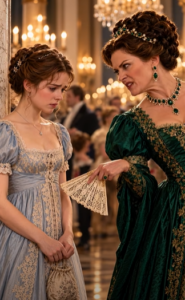
 “I know who took my letters, Agnes. And that person is standing in this room.”
Robert Langley’s voice was so quiet that Agnes almost wondered whether she had heard him correctly.
Around them, the orchestra continued its graceful waltz. Crystal chandeliers shimmered above the polished floor, and London’s finest families watched the Duke of Langley dance with a young woman whose gown had been considered an embarrassment only minutes earlier.
But Agnes had forgotten the music.
“Who?” she whispered.
Robert’s gaze moved toward Lady Fenwick.
The older woman stood beside her daughter, her emerald silk gown glittering beneath the candlelight. Her ivory fan lay on the floor where she had dropped it.
She was staring directly at Robert.
And for the first time that evening, there was no trace of amusement in her expression.
“Robert,” Agnes said, her voice trembling, “what does Lady Fenwick have to do with us?”
“That,” he answered, “is what I intend to discover before the evening ends.”
Agnes looked at him in confusion.
“But you said you knew.”
“I know where the letters were found. I know who had access to them. And I know someone has lied to both of us for ten years. I will not accuse anyone publicly until I understand the whole of it.”
There was something in his expression Agnes remembered from childhood.
When Robbie had been determined to do something, nothing could easily turn him aside.
But the boy she had known had never possessed the power to ruin another person’s reputation with a single accusation.
The man standing before her did.
“Please,” she said. “Do not make a spectacle because of me.”
Robert’s eyes returned to hers.
“A spectacle?”
“Everyone is already talking.”
“Let them.”
“You don’t understand what it is to be laughed at by people who can make your life difficult.”
His face changed.
For a moment, he seemed deeply ashamed.
“You’re right,” he said. “I do not.”
The admission surprised her.
Robert continued, “But I understand what it is to lose someone because another person decided you had no right to keep them.”
The music ended.
Robert bowed, then offered Agnes his arm.
Instead of returning her to the pillar where she had been standing, he escorted her toward the windows.
The elderly woman seated there rose to greet them.
“Agnes Bell,” she said warmly. “You have your mother’s eyes.”
Agnes stopped.
The Dowager Duchess of Langley was dressed in midnight-blue silk, with diamonds at her throat and silver hair arranged beneath a delicate ornament.
Yet something about her smile was familiar.
“You knew my mother?”
“I knew her when you were a little girl. She was one of the few people who could persuade my grandson to behave himself.”
Robert gave a faint smile.
“Grandmama.”
“And I recall,” the Dowager continued, “that you were the only child who could persuade him to read a book instead of climbing something he had been forbidden to climb.”
Despite everything, Agnes almost laughed.
“Your Grace,” she said, curtsying, “thank you for inviting me.”
Charlotte Langley took both her hands.
“You should have been invited into our lives long ago.”
Agnes felt an unexpected sting behind her eyes.
The old woman looked at Robert.
“Have you told her?”
“Only that I wrote.”
“Then she deserves to see what I found.”
Charlotte reached into a small velvet bag resting upon her chair.
She withdrew a folded paper, yellowed with age.
Agnes recognized the handwriting before she saw the signature.
Robbie’s handwriting.
The same uneven letters he had once used to write silly stories beneath the oak tree.
Charlotte opened it carefully.
“My dear Agnes,” Robert read softly, “I have been at school for six weeks, and everyone here is terribly dull. No one understands why apples taste better when stolen from one’s own orchard.”
Agnes gave a broken little laugh.
“I remember that.”
His voice grew quieter.
“I hope you have not forgotten our promise. I mean to keep it, even if I must wait until we are both very old.”
Tears blurred the words.
Beneath the message was the signature.
Your devoted friend, Robbie.
Agnes pressed her fingers to her lips.
“I never saw this.”
“I know,” Charlotte answered.
“Where did you find it?”
“In a writing desk that belonged to Robert’s late mother.”
Robert’s expression tightened.
The Dowager continued carefully.
“The desk had been kept closed since her death. Last week, when its contents were being examined, we discovered a concealed compartment.”
“Inside,” Robert said, “were several of my letters to you.”
Agnes looked from him to his grandmother.
“But why would your mother have kept them?”
“That is the question,” Charlotte replied.
A familiar voice interrupted them.
“Your Grace.”
Lady Fenwick approached.
Her face had recovered some of its color, but her smile appeared painfully fixed.
“How delightful to see you enjoying the evening. Miss Bell seems to have made quite an impression.”
Charlotte’s expression cooled.
“She has always made an excellent impression upon me.”
Lady Fenwick’s gaze fell upon the yellowed letter in Robert’s hand.
Her smile vanished.
“An old letter?” she asked.
Robert folded the paper.
“Something that has been missing for many years.”
Lady Fenwick’s fingers tightened around her gloves.
“How very curious.”
“Indeed.”
For a moment, nobody spoke.
Then Robert said, “I understand you were closely acquainted with my mother.”
Lady Fenwick blinked.
“Naturally. The late Duchess and I were friends for many years.”
“And you visited Langley House frequently?”
“Of course.”
“Even during the years I was away at school?”
“Yes, but I hardly see—”
“Did you ever assist my mother with her correspondence?”
The question landed with devastating precision.
Lady Fenwick’s complexion changed.
“Robert,” Charlotte said quietly, “perhaps this conversation should take place somewhere private.”
Lady Fenwick seized upon the suggestion.
“I quite agree. Such questions are hardly suitable for a ballroom.”
Robert studied her for another moment.
“Then perhaps we may speak tomorrow.”
“Tomorrow?”
“At Langley House. Eleven o’clock.”
She opened her mouth, then closed it.
“Certainly, Your Grace.”
As she turned to leave, Agnes noticed something.
Lady Fenwick was no longer looking at her with contempt.
She was looking at her with fear.
And that frightened Agnes far more.
The carriage journey home was cold and silent.
Agnes sat beside her father, who had come to collect her from the ball.
The Reverend Samuel Bell was a gentle man with thinning hair and tired eyes. His coat was carefully brushed, though its cuffs had been mended several times.
He had spent the evening waiting at the modest lodging where they were staying during their brief visit to London.
“Well, my dear?” he asked. “Was the ball everything you hoped?”
Agnes looked at him.
How could she explain?
How could she describe being humiliated before strangers, recognizing the boy she had once loved, and discovering that ten years of silence might have been manufactured by someone else?
“Father,” she said at last, “did you ever receive letters for me from Robert Langley?”
The Reverend turned sharply.
“Robert?”
“Yes.”
He was quiet for several seconds.
Then he answered, “Not after he went away to school.”
Agnes’s heart sank.
“Are you certain?”
“Quite certain. You asked me often enough.”
She looked down.
He sighed.
“You were terribly disappointed when he stopped writing.”
“I believed he had forgotten me.”
Her father reached for her hand.
“I know.”
“But he didn’t.”
The Reverend Bell stared.
“What do you mean?”
Agnes swallowed.
“He wrote to me, Father. For years. And someone kept his letters.”
The old man’s expression filled with sorrow.
“Good heavens.”
She turned toward the dark carriage window.
“I don’t know whether to be happy or angry.”
“Perhaps,” her father said gently, “you are entitled to be both.”
Agnes leaned against the seat.
Then she remembered something else.
“Father, did I ever send him a letter?”
“One, certainly. You spent three evenings writing it.”
“I remember. I asked if he had learned to make friends at school.”
Her father nodded.
“You cried when no answer came.”
Agnes closed her eyes.
Somewhere, perhaps, Robert had spent ten years believing she had abandoned him.
And she had spent those same years believing he had abandoned her.
But neither had known the truth.
Outside, London passed in darkness.
And Agnes wondered whether a friendship broken by ten years of silence could ever become whole again.
At eleven o’clock the following morning, Lady Fenwick arrived at Langley House.
She entered the drawing room with the stiff dignity of a woman determined not to appear afraid.
Robert stood beside the fireplace.
His grandmother sat near the window.
On a small mahogany table lay seven letters tied with faded blue ribbon.
Lady Fenwick noticed them immediately.
“Robert,” she began, “I must confess that yesterday’s conversation left me rather puzzled.”
“Then perhaps today will clarify matters.”
He indicated a chair.
She declined it.
“I have another engagement shortly.”
“This need not take long.”
Charlotte looked up.
“Sit down, Margaret.”
The use of her Christian name seemed to unsettle Lady Fenwick more than anything else.
She obeyed.
Robert picked up the letters.
“These were discovered in my mother’s desk.”
“So I understand.”
“They were written by me when I was at school.”
Lady Fenwick said nothing.
“Every one was addressed to Miss Agnes Bell.”
“How unfortunate they were mislaid.”
“Mislaid?”
“Letters are sometimes misplaced, Your Grace. Particularly in a large household.”
Robert placed the bundle on the table.
“Seven letters do not ordinarily become misplaced in the same locked compartment.”
Her lips tightened.
“I cannot possibly explain the habits of a woman who has been dead for several years.”
“No,” Charlotte said. “But you may be able to explain your own.”
Lady Fenwick turned toward her.
“I beg your pardon?”
Charlotte spoke slowly.
“My daughter-in-law relied upon you during her final years. You helped arrange her correspondence, advised her on social matters, and were frequently present when Robert was away.”
“I was being a loyal friend.”
“Perhaps you were.”
Robert took another paper from the desk.
It was a letter written in his mother’s hand.
“I found this among her papers.”
Lady Fenwick stared at it.
Robert read aloud.
“Robert remains stubbornly attached to the vicar’s daughter. Margaret assures me the attachment will pass if correspondence is discouraged. She believes the girl has expectations that will only cause unhappiness.”
Silence filled the room.
Lady Fenwick lifted her chin.
“Your mother was concerned for your future.”
“She was concerned because someone persuaded her that Agnes wanted to marry me for money.”
“That would hardly have been an unreasonable fear.”
Robert’s expression hardened.
“Agnes was twelve.”
Lady Fenwick looked away.
“A child’s ambitions can be encouraged by foolish parents.”
“My parents never encouraged anything of the sort,” Robert said.
“And you cannot know what the Bell family may have hoped.”
Charlotte’s voice was suddenly sharp.
“I knew Mrs. Bell, Margaret. She was a woman of exceptional character. You will not insult her in this house.”
Lady Fenwick fell silent.
Robert continued.
“My mother believed that keeping the letters would protect me. But the letters were not addressed to her.”
“She was your mother. She had every right to guide you.”
“Guide me, perhaps. Deceive me, no.”
Lady Fenwick rose.
“I will not remain here to be accused of dishonesty.”
Robert did not raise his voice.
“Did you advise my mother to intercept those letters?”
She stared at him.
“Robert—”
“Yes or no?”
A long silence followed.
Finally, she answered, “I advised her to prevent an unsuitable attachment from developing.”
Robert looked down.
The confirmation seemed to hurt him more than he had expected.
“And did you ever tell me that Agnes had refused to correspond with me?”
Lady Fenwick’s eyes narrowed.
“You were a young boy. You needed to concentrate on your education.”
“Did you tell me?”
She turned toward the window.
“Your mother wished you to forget the girl.”
Robert stood very still.
It was not a direct answer.
But it was enough to understand how much had been done in the name of his supposed welfare.
Charlotte closed her eyes.
“Margaret, I had hoped there was some explanation less cruel than this.”
Lady Fenwick faced her.
“Cruel? I protected an ancient family from a disastrous marriage.”
“There was no marriage,” Robert said. “There were two children who wanted to remain friends.”
“You would never have remained merely friends.”
The words hung in the air.
Lady Fenwick seemed to realize she had said too much.
Robert studied her.
“Was that what frightened you?”
“What frightened me was watching your mother suffer over your refusal to understand your position.”
“Or perhaps,” Charlotte said, “you feared that Robert would choose someone other than the young lady you hoped he would marry.”
Lady Fenwick flushed.
“My daughter’s prospects are not relevant.”
“Then leave Caroline out of this,” Robert replied. “She has done nothing wrong.”
For the first time, Lady Fenwick appeared uncertain.
Robert gathered the letters.
“I will not repeat this conversation publicly.”
She looked relieved.
“But I expect you to leave Miss Bell in peace.”
“Of course.”
“And I expect you to cease speaking of her family as though honest poverty were a disgrace.”
Lady Fenwick’s mouth tightened.
“Very well.”
Robert moved toward the door.
“There is one further matter.”
She paused.
“Miss Bell wrote to me when I was at school. I never received her letter.”
Lady Fenwick looked at him sharply.
“How would I know anything about that?”
“I have not said you would.”
An uncomfortable silence followed.
He opened the door.
“Good day, Lady Fenwick.”
She left without another word.
Once she had gone, Robert returned to the drawing room.
Charlotte remained by the window.
For a long time, neither spoke.
Finally, Robert said, “Mother knew.”
“Yes.”
“She kept my letters.”
“Yes.”
He sat down.
For years he had remembered his mother as a woman who had loved him fiercely, though sometimes too anxiously.
Now he had discovered that her love had included a decision that had cost him ten years with Agnes.
“I don’t know what to do with that,” he admitted.
Charlotte looked at him with compassion.
“Your mother feared many things after your father died. She feared losing you. She feared people taking advantage of you. And Margaret knew precisely how to strengthen those fears.”
“That doesn’t excuse her.”
“No.”
“Nor does being dead make the decision less wrong.”
Charlotte nodded.
“You may love your mother and still acknowledge that she made a terrible mistake.”
Robert stared at the letters.
“I believed Agnes did not care.”
“And she believed the same of you.”
He gave a bitter laugh.
“How absurd.”
“How tragic,” Charlotte corrected.
Robert untied the ribbon.
There were seven letters, all written between his thirteenth and fifteenth birthdays.
He remembered writing many more.
Some had probably been discarded.
Others might remain undiscovered.
He had no way of knowing.
But seven had survived.
Seven small pieces of evidence that a boy had not forgotten the girl beneath the oak tree.
“Grandmama,” he said suddenly, “why did you invite Agnes without telling me?”
Charlotte smiled sadly.
“Because I had watched you become a man who refused every suitable young woman presented to him, yet never seemed quite happy.”
“That hardly explains it.”
“I wanted to know whether the girl you remembered still existed.”
“And?”
“She does.”
Robert looked toward the fire.
Charlotte continued, “But you must be careful, my dear.”
“Of what?”
“Of thinking that finding Agnes again gives you the right to claim her.”
He turned.
His grandmother’s expression was gentle but serious.
“She is not twelve anymore. Neither are you. She has lived ten years without you, endured losses you know nothing about, and grown into a woman who may have very different hopes.”
Robert lowered his eyes.
“I know.”
“Then do not make another decision about her life without asking what she wants.”
He looked at the letters.
“I only want the chance to know her again.”
Charlotte smiled.
“Then begin there.”
That afternoon, Agnes received a small parcel.
There was no expensive gift inside.
Only seven letters tied with faded blue ribbon.
And a note.
Agnes,
These belong to you.
I am sorry you had to wait ten years to receive them.
I would like to call upon you tomorrow, if you will permit it.
Robert.
Agnes sat beside the narrow window of their rented London lodging and carefully untied the ribbon.
She read the first letter.
Then the second.
By the fourth, tears were falling onto the paper.
The boy she remembered was there in every line.
He complained about examinations, described a horse he disliked, asked whether the old oak tree had survived the winter, and confessed that he had never found another person who understood why a good story mattered more than a grand dinner.
In the seventh letter, written when he was fifteen, he had added something different.
I suppose you have forgotten me by now.
Perhaps that is sensible.
But I cannot seem to manage it.
Agnes pressed the letter against her heart.
For ten years, she had believed his silence meant indifference.
Now she understood that he had once suffered the same loneliness.
But there was something the letters could not answer.
Did Robert still care for the woman she had become?
Or had he merely returned to claim a beautiful memory?

