 Jasper Thorne breathed in only a fraction of an inch. Any deeper, and the whalebone of her stays pressed against the purple flesh of her lower ribs, and the pain rose in a dull, throbbing wave.
“Stand up straight, for God’s sake,” her stepbrother George hissed against her ear, his hand pressed to her back like a brother’s protection, his knuckles digging into her spine. “Lord Hastings is looking this way.”
Then Lord Hastings was before her, holding out a gloved hand, and George’s fingers closed around her bare arm, pressing precisely into the bruises he had given her the night before. Jasper placed her hand in Hastings’ hand because there was no other choice.
And across the ballroom, a tall man with flint-grey eyes set down his brandy on a passing footman’s tray without looking, and began to walk toward her.
PART 1
I. The Price of a Quadrille
You think a Regency ballroom is a fairy tale? Silk gowns, waltzes, stolen glances. It is not. It is an auction block. Behind the chandeliers and the string quartets, it is a place of desperate bargains and silent survival, and for some women the corset is not the tightest thing restricting their breath. The tightest thing is whatever they are hiding underneath it.
The ballroom of the Duke of Devincure’s London house was a sweltering cage of gilt and mirrors. Hundreds of beeswax candles burned in the great crystal chandeliers, dripping wax onto the polished floorboards and heating the room to an unbearable temperature. The air was thick with expensive perfume and the sweat of bodies packed too tightly together, and beneath it all lay the metallic tang of fear.
Her fear.
Jasper breathed in only a fraction of an inch. The whalebone of her stays pressed against the mottled purple and yellow flesh along her lower left ribs, and each shallow breath sent a dull, throbbing wave outward until it reached her shoulder. She exhaled slowly, letting the air seep past her teeth in a thin, controlled stream.
“Stand up straight, for God’s sake.”
The voice was low, and it hissed against her ear, carrying the sour stench of stale port and cloves. Her stepbrother George. His hand rested on the small of her back, and to any casual observer it looked like a protective, brotherly gesture. In reality his knuckles dug sharply into her spine, grinding the bone against the bruise.
“I am standing straight,” Jasper murmured.
She kept her eyes fixed on the dizzying spin of the dancers in the centre of the room. She did not look at her brother’s face. She had learned long ago that his face told her nothing she needed to know, and everything she feared.
“You look like a whipped dog,” George muttered. “Smile. Lord Hastings is looking this way. If you ruin this for me tonight, Jasper, I swear to you, what happened on the stairs yesterday will be a gentle preamble.”
She remembered the stairs. The heavy oak banister. The sudden, violent shove, when she had told him there was no money left to pay his gaming debts. The sickening crack as her side struck the wood, and the way she had lain at the bottom of the flight, listening to him count out loud, the way one counts coins, because the number of her bruises was a sum he had decided to be pleased with.
She forced the corners of her mouth upward. It felt grotesque.
George finally pulled his hand away, turning to greet a passing acquaintance with a booming, artificial laugh. Jasper seized the moment of freedom to edge backwards. She found the cool plaster of a Corinthian pillar and leaned her shoulder against it, and her legs felt hollow beneath her. The silk of her periwinkle gown, two seasons old and hastily altered to hide a frayed hem, seemed impossibly heavy.
She needed twenty minutes. Twenty minutes of standing, and then she could claim a headache, and then she could hide in the carriage until it was over.
She closed her eyes for a single moment. The orchestra was playing a frantic, screeching reel, and it battered against her skull like hail on a tin roof.
“Miss Thorne.”
Her eyes snapped open.
Lord Hastings stood before her. He was a man in his late fifties, his waistline expanding against a tightly buttoned canary-yellow waistcoat. His eyes were small, wet, and roaming, and they had settled on her collarbone with the patient interest of a man reading a bill of sale.
“My lord,” Jasper said, and dipped into a shallow curtsy.
The movement pinched her ribs. A sharp spike of agony shot up to her shoulder, and she swallowed hard, tasting bile.
“You are looking exceptionally pale tonight,” Hastings observed, in a tone devoid of any actual concern. He held out a thickly gloved hand. “Perhaps a turn about the floor will put some colour in your cheeks. The reel is just beginning.”
She looked at his hand, and it looked like a trap.
George materialised from the crowd, and his fingers clamped down on her bare upper arm. His grip was a vice.
“My sister would be delighted, Lord Hastings,” he said smoothly. “Wouldn’t you, Jasper?” His thumb pressed precisely into the tender, bruised flesh where he had gripped her the night before.
“Delighted,” she whispered.
She placed her hand in Hastings’ hand. He yanked her forward toward the set. Jasper stumbled, catching herself just before she tripped on the hem of a passing dowager’s gown.
The floor was slick with wax, and the heat in the centre of the room was ten degrees hotter than at the walls. The music flared, and the dance began.
A country reel is a geometric equation of human bodies advancing, retreating, turning, and spinning. On any other evening Jasper would have disliked it. Tonight it was torture. Hastings’ hands were heavy and damp through his gloves, and he pulled her into each turn with far more force than necessary, jarring her shoulder every time.
Breathe in. Step. Breathe out. Turn.
Every time her left foot struck the floor, the shock wave travelled up her leg and slammed into her fractured rib. She tried to compensate, putting more weight on her right side, but the frantic pace of the music made it impossible to favour the injury. A large woman in fuchsia satin bumped into her from behind, and Jasper gasped. The sound was swallowed by the chatter and the screech of the violins.
“Keep the time, girl!” Hastings barked, yanking her back into the line.
The room began to tilt.
The edges of Jasper’s vision blurred, a grey vignette creeping in from the corners. The chandeliers smeared into long, jagged streaks of yellow light, and the music sounded as though it were being played underwater.
I am going to be sick.
She could not be sick. If she caused a scene, George would never forgive her. And that was not a metaphor. She knew the look in her brother’s eyes when rage blinded him. If she humiliated him in front of the ton, he would beat her until she could not stand at all, and he would do it somewhere no one could see.
“Hands across,” Hastings ordered, thrusting out his arm.
Jasper reached for him. Her fingers brushed his sleeve, but she missed his hand. A cold sweat broke out across her forehead, and the air vanished from her lungs. It felt as though an iron band were tightening around her chest, crushing the breath from her one inch at a time.
Just make it to the edge. Just step away.
She broke the line. She turned her back on Hastings, deaf to his indignant squawk, and pushed blindly through a gap between two dancing couples.
“Watch yourself,” a man snapped.
“My apologies,” she tried to say, but no sound came. Her lips were numb. She needed a door, an alcove, a window, any place where the air was not moving in suffocating perfumed waves. She saw the heavy crimson velvet of a drapery pooling near a set of French doors. One of the doors stood open a crack, and the black night air seeped through the gap.
It looked like salvation.
She dragged her feet toward it. Ten yards. Five yards. The pain in her side suddenly sharpened into something clear and terrible. It was no longer a dull throb. It was a hot knife twisting between her ribs.
Her knee buckled. She caught herself on a small marble side table, and a silver candelabra rattled ominously.
Three more yards.
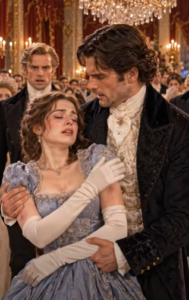
She took another step, and her right ankle gave way completely. The grey vignette rushed inward and swallowed the light. The noise of the ballroom muted into a high, ringing silence, and she felt herself falling. There was no time to brace, no time to throw out her hands. She was simply going down, surrendering to the impact of the unforgiving parquet.
She squeezed her eyes shut, bracing for the crash, for the scandal, for George’s wrath.
But the floor never came.
II. The Man by the French Doors
Matthew Ryan, Duke of Westmore, loathed London.
He hated the pretence. He hated the painted faces and the hollow conversations about nothing. Most of all, he hated the way people looked at him, as though he were a ledger made of flesh: a walking estate to be divided and conquered by whichever ambitious mother pushed her daughter hardest.
He stood near the French doors, nursing a glass of watered-down brandy and calculating how many minutes he must remain before his departure would no longer be considered a direct insult to his hostess. He watched the crowd with cold detachment. He saw the subtle cruelties: the dowagers whispering behind their fans, shredding reputations; the young bucks eyeing women like horses at Tattersall’s.
Then he saw her.
She had broken away from the dancing set, her face chalk-white, moving with the jerky, unnatural gait of a wounded animal. Matthew’s eyes narrowed. He had spent four years in the Peninsula before inheriting the title, and he knew what pain looked like. Real pain, not a tight corset or a pinched toe.
The girl in the faded periwinkle gown held her left arm pressed tight against her ribs, and her breathing was shallow and erratic.
She bumped a table. The candelabra shook. Matthew stepped forward, setting his brandy on a passing footman’s tray without looking. She took another step, and her eyes rolled back. She dropped like a stone.
Matthew moved.
He did not shout. He did not cause a panic. He closed the distance with the speed of absolute necessity, and slid his arms beneath hers before her knees struck the parquet. He caught her solid and drew her back against his chest. She was remarkably light. Too light. Her head lolled against his shoulder, and her skin was ice cold, dotted with a sheen of terrified sweat.
“Easy,” he murmured, though she was entirely unconscious.
He did not freeze. He did not call for smelling salts or draw a crowd. The last thing a vulnerable woman needed in this shark tank was an audience.
With one fluid motion he lifted her into his arms and adjusted his grip, bringing his left hand round to support her back. The moment his palm pressed against her left side, even through the layers of silk and stays, he felt something give. She groaned in her unconsciousness, a terrible, pathetic sound, and flinched violently away from his hand, curling inward like a dying spider.
Matthew’s jaw tightened. The muscles in his neck jumped. He did not move his hand, but he eased the pressure entirely, supporting her weight beneath her knees and shoulders instead.
He turned on his heel.
Beside him, heavy crimson drapes concealed a small, unused antechamber leading to the gardens. He kicked the door open with a booted foot, slipped inside, and kicked it shut behind him. The noise of the ballroom was instantly muffled to a dull, rhythmic thumping through the wall.
The antechamber was dark, lit only by a sliver of moonlight bleeding through the window. Matthew crossed the small space and laid her gently on a velvet chaise. He stepped back to give her air, and watched her chest rise and fall. The breathing was uneven and jagged.
He knelt beside the chaise, and up close the damage was plain. It was not merely a swoon. There was a faint, fading yellow bruise along her jawline, expertly disguised beneath a heavy application of rice powder. The fabric of her right sleeve had ridden up when he carried her, revealing four distinct dark purple ovals pressed into the pale skin of her upper arm.
Finger marks.
Matthew’s breath hissed through his teeth. He had seen enough brutality in men on the battlefield to recognise its aftermath in women.
She stirred. A small, ragged gasp escaped her lips, and her eyelids fluttered open, confused and frantic. She tried to sit up, a reflexive movement of pure panic.
“Don’t move,” Matthew said. His voice was low and gravelly, but deliberately stripped of any command. “It was a request.”
She froze.
Her eyes snapped to him, wide and wild in the dim light. She looked at his face, at his broad shoulders blocking the door, and the terror radiating from her was almost palpable. She pulled her knees up and shrank back into the corner of the chaise, pressing her left arm defensively across her ribs.
“I apologise,” she stammered, the words rushing out in a breathless stream. “I am sorry I tripped. I will go back. Please, do not tell my brother.”
Matthew did not move toward her. He stayed kneeling on the floor, keeping himself lower than she was, his hands visible and empty.
“I have no intention of telling anyone anything,” he said slowly. “And you did not trip. You collapsed.”
She stared at him, her chest heaving painfully. “I am fine. I must return to the floor.”
“Will George?” Matthew asked, his tone flat. “Will your brother?”
She tried to push herself up, her face twisting in agony, and a sharp cry escaped as the pressure on her ribs intensified. She fell back against the cushions, panting.
“You have a broken rib,” Matthew said. It was not a question. “Possibly two. Your brother did that.”
“No.”
The lie was instinctive, fast, and desperate. “I fell down the stairs. I am clumsy.”
“And did the stairs also grab you by the arm?” Matthew asked, glancing pointedly at her exposed bicep.
Jasper looked down and realised her sleeve had ridden up. She scrambled to pull the fabric down, hiding the finger marks.
The shame that washed over her face was worse than the pain. She looked away and stared at the dark wallpaper, waiting for the lecture, the disgust, or the threat of exposure.
Instead, Matthew stood. He crossed to a side table where a heavy crystal pitcher of water sat untouched, poured a glass, and carried it back to her.
Jasper hesitated, eyeing him warily. Then she reached out with a trembling hand and took the glass. Their fingers brushed. His were warm and rough with calluses. They were not the soft hands of a gentleman who spent his nights shuffling cards.
“Drink it slowly,” Matthew instructed, stepping back to give her space again. “You are in shock.”
She took a tiny sip. The cool water felt like a miracle against her dry throat.
“Who are you?” she whispered, finally looking at him properly.
He was tall, and built with the dense, hard muscle of a labourer rather than a lord. His dark hair was slightly too long, and his eyes were the colour of flint. There was no pity in his expression. Pity was something she loathed, because pity meant they thought you weak. In his eyes there was only a cold, calculating anger, and it was not directed at her.
“My name is Matthew Ryan,” he said.
Jasper choked on the water.
The Duke of Westmore. The most notoriously reclusive, cynical, and ruthlessly practical man in the peerage. He was infamous for eviscerating fools with a single sentence in the House of Lords, and for ignoring the ton entirely.
“Your grace,” she breathed, struggling to rise.
“Sit down,” he snapped.
The sharpness in his voice made her flinch violently, throwing up her hands to shield her face. Matthew stopped dead. The anger drained from his eyes at once, replaced by a profound regret. He swore softly under his breath.
“I am sorry,” he said, and the absolute sincerity in his voice shocked her more than anything else that night. “I should not have raised my voice. You are safe here, Miss Thorne.”
Slowly, she lowered her arms.
“Jasper Thorne,” she said, almost to herself.
“Miss Thorne.” Matthew pulled a small wooden chair from against the wall, sat down facing her, and rested his forearms on his knees. He looked at her not as a scandal waiting to happen, but as a tactical problem requiring immediate solution.
“Here is what is going to happen,” he said. “You are going to sit there and breathe. I am going to stand outside that door so that no one enters. When you are ready, I will have my carriage brought round to the side entrance, and I will take you wherever you wish to go.”
Jasper stared at him, her heart hammering against her injured ribs. “You cannot. George is my guardian. If I leave without him, if he finds out I left with a duke, he will kill me.”
Matthew’s expression did not change, but the temperature in the room seemed to fall by ten degrees.
“If your brother lays another hand on you, Miss Thorne,” he said, very calmly, “I will ensure he never uses his hands again. Now drink your water.”
She held the glass, her fingers shaking so badly that the water rippled. She could not process it. Men of his station did not care about women like her. They cared about dowries, bloodlines, and avoiding scandal. To be found alone in an antechamber with an unmarried woman was social suicide for her and an extreme inconvenience for him.
Yet he sat there, guarding the door with his broad back, watching the shadows instead of her, granting her the one thing she had not possessed in years.
Dignity.
“Why are you doing this?” she asked at last, when the silence had stretched too taut.
Matthew glanced over his shoulder. The flint in his eyes had softened. “Because the floor out there is incredibly hard, Miss Thorne. And you look as though you have taken enough blows for one lifetime.”
Jasper felt a hot prickle behind her eyes. She had not cried when George threw her into the banister. She had not cried when he bruised her arm. But this simple, blunt observation from a stranger, the plain validation that she was in fact hurting, shattered something deep inside her chest.
She pressed the heel of her hand against her eyes, fighting the tears back. Crying was dangerous. Crying made you blind to your surroundings.
Matthew saw it. He did not offer a handkerchief, and he did not offer platitudes. He merely turned his head back toward the door, giving her the privacy to pull herself together.
“We will wait ten minutes,” he said quietly to the doorframe. “Then I am going out to find this George. You will stay here.”
“No.” Terror seized her throat again. “You do not understand. He is heavily in debt. If he thinks I have alienated a duke, or worse, if he thinks he can extort you because we are alone—”
“Let him try,” Matthew replied, and a dark, humorous smile touched the corner of his mouth. “I have dealt with extortionists, Miss Thorne. I have dealt with cowards who strike women. They all break the same way. Now rest. You will need your strength.”
Jasper sank back into the velvet cushions. The pain in her side was a constant, burning fire. But for the first time in her life, the fear had stopped suffocating her. She looked at the Duke’s broad shoulders, a solid wall between her and the monsters beyond the door. She closed her eyes, and for the first time that night took a full, deep breath.
It hurt. She did not care. She was still breathing.
Matthew stepped back into the ballroom, and the heat struck him like a physical blow. He did not scan the crowd at random. He searched with predatory focus.
Men who lived on grit and desperation had a particular posture. They hovered near the edges of wealthy circles, their laughter a fraction too loud, their eyes constantly darting toward the card rooms. He spotted George Thorne in less than two minutes. George stood near a group of older peers, a forced, oily smile plastered across his face. He was sweating heavily, his collar wilting.
Matthew approached quietly, blending into the crowd until he stood directly behind the man.
“Mr. Thorne.”
George spun round, irritation flaring until he recognised the Duke of Westmore. His posture dissolved at once into a pathetic bow. “Your grace. A profound honour. I was not aware you were in attendance this evening.”
“We need to speak privately.”
Matthew did not wait for an answer. He turned and walked toward the gentlemen’s smoking room, a sanctuary strictly off limits to women. He knew George would follow. Men like George always followed titles.
The smoking room was mostly empty, save for a few elderly lords asleep in deep leather wing chairs. The air was thick with cigar smoke. Matthew walked to the farthest corner, beside a cold hearth, and turned.
George scurried up, dabbing his forehead with a linen handkerchief. “How may I be of service, your grace?”
“If this concerns the hounds my late father bred, I assure you I have no quarrel with you,” Matthew said. The words were flat and devoid of emotion. “It concerns your sister.”
George froze, the handkerchief suspended an inch from his face. His eyes darted left and right. “I beg your pardon. Has Jasper offended you? I assure you she is clumsy and often unwell, but she means no disrespect.”
“She is currently in an antechamber, nursing two broken ribs and a bruised jaw,” Matthew said, his voice dropping an octave, carrying the distinct rough edge of a man who had commanded soldiers in the mud of Spain. “Injuries she sustained from you.”
George’s face flushed a deep, ugly crimson. The obsequious mask slipped, revealing the feral panic beneath.
“Now see here. That is a vicious slander. It is a family matter. The girl is hysterical. If she has been telling tales—”
Matthew closed the distance between them. He did not raise his hands. He merely invaded George’s personal space, using his height and the immovable breadth of his shoulders to trap the smaller man against the marble mantelpiece.
“I do not listen to tales,” Matthew said softly. “I look at evidence. I saw the bruises on her arm where you dragged her. Do not insult my intelligence by lying, Thorne.”
“She is my ward,” George spat, a cornered rat showing its teeth. “You have no right to interfere. I am her legal guardian. And if you have compromised her by being alone with her, you will answer to me, Westmore. Duke or not, I shall have satisfaction.”
Matthew let out a low, dry laugh that raised the hairs on the back of George’s neck.
“Satisfaction? You want to call me out? You barely know which end of a pistol to hold. I would put a ball through your kneecap before the second count.” He paused. “But we are not going to duel, George. We are going to trade.”
George swallowed hard. “Trade?”
“You owe four thousand pounds to the moneylenders at Whites,” Matthew stated. It was an educated guess, based on the desperation in George’s eyes, but he knew the exact cost of the life George was trying to fake. “You owe another two thousand to a money-lender in Cheapside who is running out of patience with your excuses. You brought your sister here tonight to sell her to Hastings, to clear your markers.”
George’s silence was a deafening confirmation.
“Here is the new arrangement,” Matthew said, stepping back an inch to let George breathe. “Miss Thorne is leaving with me. She will not return to your house. You will tell anyone who asks that she has gone to the country for her health, to reside with a distant aunt. You will sign over her guardianship to my solicitors tomorrow morning.”
“You are mad. You cannot simply steal a woman—”
“I will have my man of business purchase your debts by noon tomorrow,” Matthew continued smoothly. “All of them. They will be transferred to my ledger.”
George’s eyes widened, and greed warred violently with his pride. “You would clear my debts?”
“I will own your debts,” Matthew corrected, his tone turning to ice. “And as long as you stay away from Jasper, as long as you never speak her name, never send her a letter, and never come within fifty yards of her person, I will never call those debts in. But if you cross me, George, if you ever try to touch her again, I will ruin you. I will take your house, your horses, and the very clothes on your back, and then I will send you to the Fleet to rot until you die.”
He stared down at the sweating, trembling man.
“Do we have a bargain?”
George looked at the floor. He looked at the heavy gold signet ring on Matthew’s hand. He swallowed his pride, because pride was an expensive luxury he could no longer afford.
“We have a bargain,” he muttered.
“Good.” Matthew turned on his heel. “My solicitors will expect you at ten o’clock. Do not be late.”
When Matthew returned to the antechamber, Jasper had not moved. She sat rigid on the edge of the velvet chaise, her arms wrapped protectively round her torso. The terror in her eyes spiked when the latch clicked, and only settled marginally when she saw that it was him.
“It is done,” he said.
He picked up her discarded shawl from the floor and draped it over a chair.
“What did he say?” Her voice was a fragile whisper. “Is he coming for me?”
“He is not coming for you. Not tonight. Not ever.”
Matthew walked to the side door leading to the gardens and cracked it open, checking the perimeter. The gravel path was empty. A dense London fog was rolling in, thick and mercifully obscuring.
“My carriage is waiting at the end of the lane.”
Jasper stared at his back. “I do not understand. You bought him off?”
“I reasoned with him,” Matthew corrected dryly. “Using a currency he understands.”
He turned back to her. She looked impossibly small. The cynical, hardened core of his chest, the part that had survived the war and the cutthroat politics of the House of Lords, ached with a sudden, unfamiliar sharpness.
“Can you walk?”
“Yes.” Jasper forced herself to stand. The colour drained from her face instantly, but she locked her knees and held her ground. “Where are we going?”
“To my townhouse in Mayfair.” Seeing the immediate, terrified realisation of the scandal that would follow flash across her eyes, he raised a hand. “My aunt, Lady Agatha, resides with me. She is deaf in one ear, entirely uncompromising, and commands a small army of maids. You will be perfectly chaperoned. You are safe.”
He offered his arm. Not his hand, but his forearm, steady and solid as a tree branch.
Jasper looked at it. Trusting a man was a tactical error she had sworn never to make again. But the alternative was returning to the ballroom, to the stairs, to George.
She placed her trembling fingers on the dark wool of his sleeve.
They moved slowly through the gardens. The damp night air bit through her thin silk, and each shiver sent a fresh spasm through her ribs. Matthew did not rush her. He matched her halting pace and blocked the wind with his body wherever he could.
The carriage was a heavy, unadorned black coach waiting in the shadows. The tiger leapt down to open the door, keeping his eyes respectfully fixed on the pavement. Matthew helped her up the steps. It was a clumsy, painful process, and when at last she sank into the plush leather squabs, she let out a long, ragged breath.
The carriage lurched into motion. The rhythmic clatter of hooves on cobblestones filled the silence.
Matthew sat on the opposite bench. He did not sit beside her. He stayed in the shadows, giving her the whole of the forward-facing seat.
“There is a lap robe beneath you,” he said quietly. “Put it round your shoulders.”
Jasper found the heavy wool and pulled it over herself. It smelled faintly of leather, rain, and sandalwood, and it was warm.
“I have no money, your grace,” she said suddenly, staring at her clasped hands. “George spent whatever my father left. I cannot repay you for this.”
“I am a duke, Miss Thorne. I own half of Devon. I do not require your money.”
“Then what do you require?”
She looked up, her eyes cutting through the darkness to find his face. It was not a naive question. It was the question of a survivor. Men did not do favours for battered, penniless women without expecting a return on their investment.
Matthew met her gaze and did not flinch from the raw accusation in it.
“I require you to heal,” he said simply. “I require you to let my physician look at those ribs tomorrow. I require you to sleep without keeping one eye on the door.”
Jasper searched his face for the lie, the hidden condition, the trapdoor. There was nothing there, only the calm, steady presence of a man who had seen a broken thing and decided that it should not stay broken.
A heavy, overwhelming exhaustion crushed her. The adrenaline that had kept her standing, that had carried her through the last two days, evaporated all at once. Her chin dropped to her chest. She curled onto her right side, drew her knees up beneath the wool blanket, and surrendered to the dark.
Matthew watched her sleep. The carriage struck a rut, and she moaned, her brow furrowing in pain. He reached out, caught the edge of the blanket that had slipped, and tucked it gently back around her shoulder.