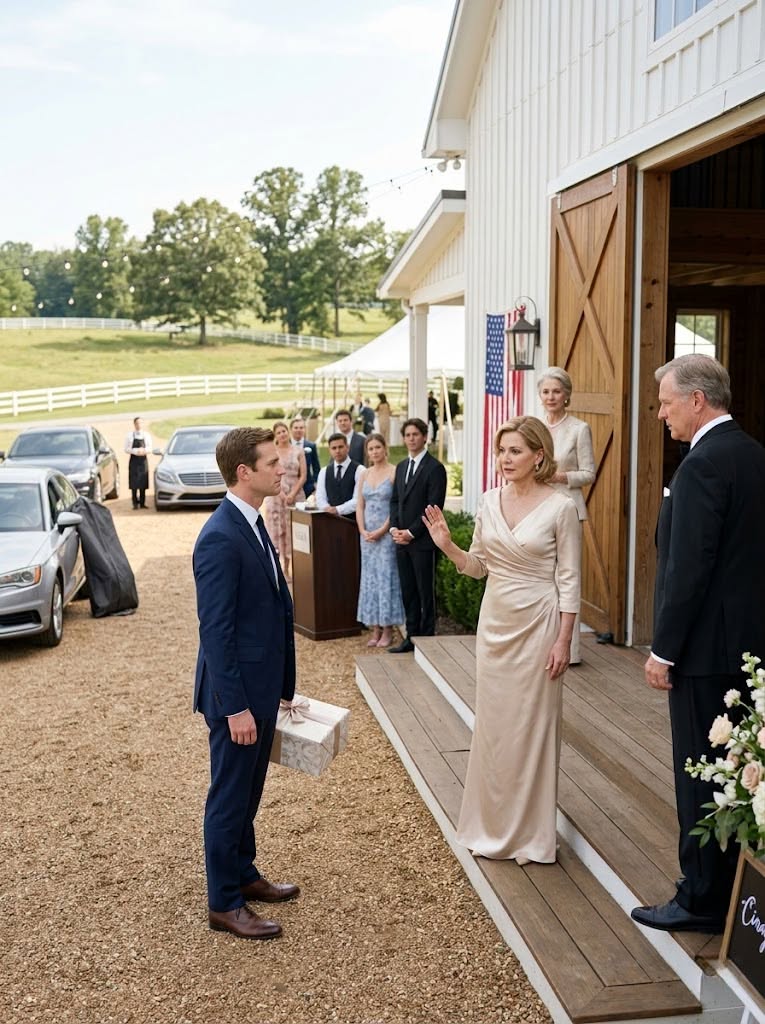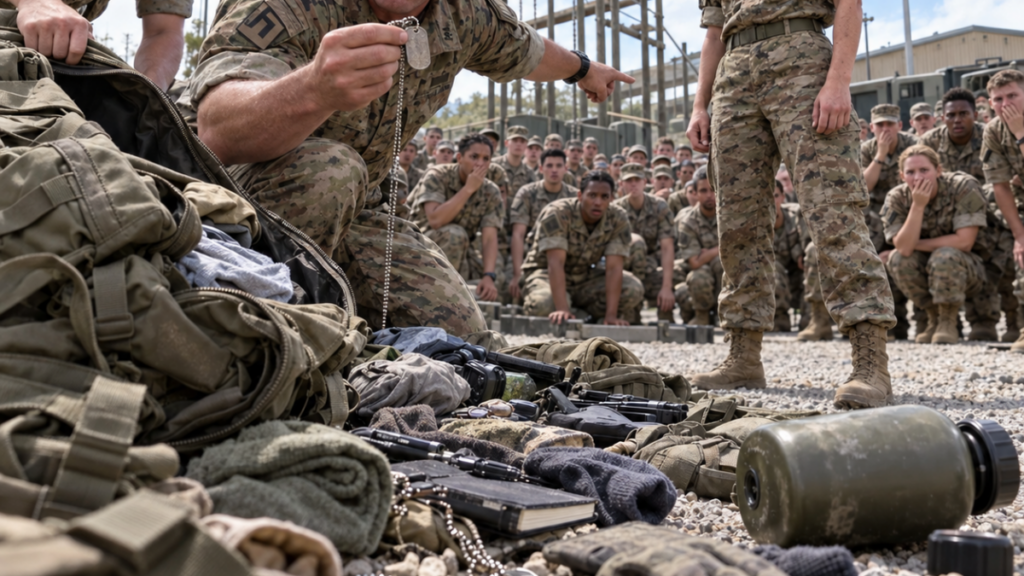
“Quitters ride the truck,” Staff Sergeant Cole Mercer said as he dumped my ruck onto the wet gravel in front of nearly sixty soldiers. Socks, rain gear, water, and fifteen years of secrets scattered under the white range lights while his squad laughed. Then a pair of identification tags slid from a hidden pocket. The Master Sergeant running the march picked them up, read the name, and went completely still. Twelve miles later, Mercer would be the one inside that truck—and I would finally understand why I had carried those tags for so long.
### Part 1
The first thing I remember is the wet gravel pressing through the knees of my uniform. It was 4:40 on a Friday morning at Fort Campbell, Kentucky, and two portable light towers flooded the start point with the kind of white glare that made everyone look exhausted before we had taken a single step. Beyond their reach were pine trees, diesel fumes, insects beating themselves against the lamps, and twelve miles of road leading toward a finish line we could not see. Five days of testing had reduced 138 candidates to fifty-nine, and the twelve-mile foot march was the last event standing between us and the Expert Field Medical Badge.
Three hours. Thirty-five pounds minimum in the ruck. Helmet, weapon, water, and everything else on the packing list. Cross before the clock reached three hours and the week became something you would remember every time you looked at the badge on your uniform; cross a second late and none of the previous five days mattered. My ruck had weighed thirty-six pounds, four ounces, and I was tightening the shoulder straps when Staff Sergeant Cole Mercer walked toward me with three soldiers from his company behind him.
Mercer was thirty-one, broad through the shoulders, and loud in a way that made quieter people feel as if they were somehow failing to participate. He had called me “Retread” since Monday because I had left the Army years earlier and returned, and by Wednesday he had discovered another story about me. According to somebody from somebody else’s old unit, Staff Sergeant Mara Vance had attempted this same badge years ago, reached mile nine, climbed into the recovery truck, and quit. Mercer liked that version because it fit neatly into the kind of lesson he enjoyed teaching younger soldiers.
He grabbed the top handle of my ruck and pulled it backward before I understood what he was doing.
My arms caught in the straps. “What the hell?”
He ignored me, unzipped the main compartment, and turned the whole pack upside down.
My poncho hit first. Then the liner, water pouches, a rolled uniform top, socks sealed in plastic, wet-weather gear, hygiene kit, first-aid supplies, and every carefully packed ounce spilled across the gravel. A few soldiers laughed before they even knew why, because laughter spreads quickly when somebody confident gives everyone permission.
“Quitters ride the truck,” Mercer announced. “Might as well save the Army some fuel and put Vance in it now.”
Specialist Erin Salazar covered her mouth while laughing. Private First Class Noah Keller did not bother hiding his. Sergeant Marcus Bell stared at the ground for a second, then joined them when Mercer looked his way.
Fifty-nine headlamps turned toward me.
I knelt.
I wish I could tell you I did it because I was calm, disciplined, and too strong to react, but that would make me sound better than I was. I knelt because eighteen years of habits, including the years I had spent outside the Army, had trained me to deal with the problem immediately in front of me. My things were on the ground, the clock was getting closer to starting, and anger would not repack a ruck.
Then something metallic struck the gravel beside my left hand.
A chain.
Two identification tags.
They had been inside a zippered compartment in the top flap, a compartment I had checked around two that morning. One tag landed faceup beneath the lights.
Mercer nudged it with his boot.
“Whose are these?” he asked. “Another souvenir?”
A shadow moved between us and one of the light towers.
Master Sergeant Owen Hale, the NCO in charge of the entire foot-march lane, bent without saying anything and picked up the tags.
I had spent five days avoiding being close enough for him to study my face. I had recognized him Monday morning across the in-processing area, not because he looked the same after fifteen years, but because he still stood the same way—weight slightly forward, hands loose, like he expected someone to need him without warning. At forty-four his hair was gray at the temples and his posture carried the small bends accumulated by people who have spent half their lives under body armor.
He turned on his headlamp.
The beam fell across the metal.
I watched him read the first line.
Then the second.
He read the last name again.
Liam Rourke.
Hale’s face changed so completely that for a second I thought the lights had flickered. The color left him from his forehead downward, and his hand tightened around the chain.
Mercer was still smiling.
“She’s been carrying somebody else’s tags around?” he said. “That’s a new one.”
Hale stood.
“Put everything back.”
Mercer’s smile weakened. “Master Sergeant?”
“Every item.”
“I didn’t—”
“You took it out.”
Hale’s voice never rose.
“You put it back. By hand. Now.”
The generators hummed behind us. Nobody laughed.
Mercer looked from Hale to me, trying to understand what rule had suddenly changed. Then he got down on one knee in the wet gravel and began putting my gear back inside the ruck.
He packed it badly.
Socks at the bottom. Poncho too high. Water uneven. The load would pull left for the entire march, and I knew that before he had finished.
I let him do it.
Hale held the tags toward me.
His fingers were trembling.
I looked at them, then at him.
“Keep them until the finish, Master Sergeant.”
He stared at me.
“Where did you get these?”
“Not here.”
“Mara.”
It was the first time all week anyone there had used my first name.
“Not now.”
Mercer zipped my pack and stood, his face red with humiliation. Hale slipped the tags into his chest pocket and buttoned it.
A grader lifted the whistle.
I slid my arms into the straps, feeling immediately how badly the weight sat against my back.
The whistle blew.
Fifty-nine candidates stepped into the darkness.
Behind us, the recovery truck started its engine.
Its headlights washed across the gravel, and I did not have to turn around to know exactly what it looked like.
Fourteen years earlier, on this same road, I had watched the world through those headlights from inside that truck.
And for the first time since then, someone beside me knew the story everyone had been telling about why.
They just did not know the truth.
### Part 2
Mile one lies to everybody. Your body is warm, your shoulders have not started complaining, the road feels flatter than it really is, and the dark keeps you from seeing how far you still have to go. I settled into a pace a little under fourteen minutes per mile and did the arithmetic I had rehearsed for months: fifteen minutes per mile gave me exactly three hours, which meant it gave me nothing; fourteen built a minute of protection each mile, something I might desperately need later.
Mercer and his three soldiers moved quickly ahead of me, four headlamps bouncing in a compact group. He wanted distance between us because whatever had happened at the start point had embarrassed him, and men like Mercer often treated speed as the answer to humiliation. I watched them pull away without chasing. My left hip contained three titanium screws, and after fourteen years I knew the difference between discipline and ego.
The screws had been there since I was twenty-two.
That was the detail the story about me always left out.
By the second mile, the candidates had separated into small groups. Boots no longer made one large rolling rhythm, only scattered patterns moving along the road, and somewhere behind me the recovery truck crawled at the pace of the slowest soldier. I did not look back, although I could hear it whenever the engine climbed.
Mercer’s rumor had reached me Wednesday while we waited beside an evacuation lane. Salazar had asked, smiling too politely, whether it was true I had “ridden the truck” the last time I attempted the badge. Mercer had been sitting behind her with his elbows on his knees, pretending not to listen.
“Yes,” I had said.
Her expression brightened. “So you quit?”
“I rode the truck.”
“Isn’t that the same thing?”
“No.”
Mercer laughed. “Sounds pretty similar.”
I checked my water and walked away because explaining yourself to somebody committed to misunderstanding you is a bad use of oxygen.
The story had survived longer than many military careers. A female medic had crushed the academic portion, breezed through the medical lanes, reached the final march, and quit around mile nine because the road got hard. Apparently an old grader named Mitch Keene had repeated it for years, and eventually the woman became less a person than a cautionary tale.
Some people were good in classrooms.
Some looked impressive until things hurt.
Some quit.
The story required no X-ray, no surgical report, no reason.
At mile two I was nearly two minutes ahead of schedule.
The road began climbing gradually after that, and I could see Mercer’s group about two hundred yards ahead. A pickup approached slowly from behind and drew beside me.
Master Sergeant Hale sat in the passenger seat.
The window was down.
He did not speak.
Neither did I.
The tags made a faint rectangular shape beneath his chest pocket.
He stayed beside me for perhaps a hundred yards, then the truck accelerated toward the next checkpoint. I watched the red taillights disappear between the pines and felt something I had spent fifteen years arranging my life not to feel.
Recognition.
Not of him.
Of myself.
I had known Hale immediately Monday morning. Fifteen years earlier, before age, scars, promotions, and time had changed both of us, he had been Staff Sergeant Owen Hale, infantry squad leader, twenty-nine years old, lean, impatient with stupidity, patient with frightened soldiers. I had been Specialist Mara Vance, twenty-one, a combat medic attached to his platoon in Afghanistan.
He called me Doc.
Nobody had called me that in years.
I had not allowed anybody to.
The sky was turning from black to charcoal when I reached mile three.
Forty-three minutes.
Still ahead.
I listened to my breathing and tried to stay inside the present, but memory works badly under fatigue. The road beneath my boots became another road, then a mountain trail, then a narrow switchback above a river thousands of miles away.
Kunar Province.
2011.
I had arrived at the combat outpost in April after the infantry platoon lost its medic to an injury. For most of that deployment I was the only woman living there, sleeping behind a poncho liner hung as a curtain in one corner of the aid station. Nobody had much energy to make a problem of it; the mountains, patrol schedule, and constant feeling of being watched provided enough problems.
Hale checked everybody’s water before patrols.
Mine included.
“I’m the medic,” I complained once. “Hydration is literally part of my job.”
“Then you won’t mind a second opinion, Doc.”
That was Hale.
Exact.
Annoying.
Usually right.
Liam Rourke was one of his soldiers.
Twenty years old, from a small Ohio town called Weston Creek, with red hair that turned almost copper under the Afghan sun and a laugh that rose at the end as though everything he said might secretly be a question. His mother, Diane, mailed handwritten letters almost every week, and Liam read pieces aloud during supper because he believed humiliating himself first prevented anyone else from doing it effectively.
One night he waved a page at me.
“My mom wants to know if you’re feeding me.”
“I am not your mother, Rourke.”
“She thinks because you’re the only woman here, you must control food.”
“I control gauze.”
“She says thank you for keeping me alive.”
“I haven’t had to yet.”
He folded the letter carefully.
“I’m telling her you promised.”
“I promised nothing.”
“You did now.”
I can still see his face when he said it.
That grin.
Those stupid sunburned ears.
The confidence of a twenty-year-old who believed the people around him had enough skill to negotiate with death.
Months later, at mile three on a Kentucky training road, I could hear his voice as clearly as if he were walking beside me.
You promised, Doc.
The recovery truck rumbled somewhere behind us.
Ahead, Hale’s pickup waited near the next checkpoint.
The tags were still in his pocket.
And I understood something I had not admitted even to myself.
I had not brought them onto that road by accident.
### Part 3
September 14, 2011 began clear enough to see individual rocks on the opposite slope. Nineteen of us left the outpost before sunrise, moving toward a village we checked regularly, and by seven-ten we were exposed on switchbacks cut into the mountainside. The first burst of gunfire came from across the valley, then another from higher ground, followed by explosions against the rock behind us that threw stone fragments through the air.
Hale was hit in the opening minute.
I reached him while he was still trying to give orders, furious that his leg was not cooperating. I stopped the bleeding, treated another wound along his side, and kept forcing him flat while he tried to raise himself on one elbow.
“Stay down.”
“Doc, I need—”
“You need to stay down.”
The first evacuation aircraft managed to land on a narrow rock shelf above us and took Hale and another casualty under fire. As it lifted away, we heard over the radio that no aircraft would attempt that landing zone again. The shelf was too exposed.
Liam was hit eleven minutes later.
He had moved toward a gap in the line when he dropped without making a sound.
That frightened me before I even reached him.
Liam always made noise.
I cut away enough gear to find the wound and knew almost immediately that the bleeding was coming from a place where my hands could do very little. I packed what I could, applied pressure, and lied to him with the confidence that medics are sometimes forced to manufacture for other people.
“How bad?” he asked.
“You’re going to be fine.”
“That’s not a number.”
“You’re still annoying me. That’s a good sign.”
The fight continued long enough for time to stop behaving normally. When it finally ended, the nearest safe place for an aircraft was a stretch of riverbank nearly four miles below us, past switchbacks, terraces, a village trail, and a steep descent toward the water. We had multiple wounded and too few people available to carry.
Private Aaron Pike and I took Liam’s litter.
Aaron was nineteen and strong enough to make physical work look easy, but mountain terrain does not care how strong you are. We slipped once on a terrace, the litter striking the ground hard enough for Liam to cry out, and Aaron apologized until Liam told him to shut up.
Every quarter mile I checked Liam again.
His pulse grew thinner.
His skin changed.
His voice did not.
He talked about home, his mother, an old pickup truck he planned to buy, and a girl who worked at a pizza shop who had never displayed the slightest interest in him. Somewhere above the river, Aaron’s hands began cramping so badly he could not hold the litter handles.
We took Liam off.
I got beneath him.
He weighed almost thirty pounds more than I did even after we removed unnecessary equipment.
I carried him across my shoulders.
There was nothing cinematic about it. My boots slipped. My back cramped. His weight crushed the air out of me on every steep section, and Aaron had to keep a hand against Liam’s back so he would not slide.
We traded whenever Aaron’s hands recovered.
Then I took Liam again.
Half a mile from the river, Liam said something that stopped feeling like conversation.
“Doc.”
“I’m here.”
“Don’t let them give my mom the speech.”
“What speech?”
“You know.”
“Nobody is giving your mother anything.”
“The officers at the door.”
“Liam.”
“The uniform. The hat. The speech.”
“You’re going home.”
“Promise.”
“You’re going home.”
“You already promised.”
I wanted to hit him for saying it.
“I heard you,” he whispered.
We reached the riverbank shortly before ten.
The aircraft was already coming.
Rotor wash hit us with river water, sand, and tiny stones. I removed the remaining equipment that might interfere with treatment, and when the chain around Liam’s neck caught against my trauma shears, I pulled his identification tags free and closed my fist around them without thinking.
The flight medic took him.
His lips moved as they lifted the litter.
I never heard what he said.
Liam died before the medical team could save him.
Two days later, I found the tags inside a pocket of my aid bag.
I sat on my cot holding them.
The correct thing to do was obvious. Take them to the first sergeant. Explain that I had accidentally removed them. They would become part of Liam’s personal effects and go home to his mother.
I stood once.
Then I sat again.
I have spent fifteen years searching for a noble explanation and never found one.
The closest I can give you is this: if I still had those tags, then some part of Liam was still on that riverbank with me instead of inside a shipping case moving through a system of paperwork toward Ohio. It was grief with a childish logic, and grief does not stop being childish merely because the person experiencing it is a soldier.
I told myself I would turn them in tomorrow.
Then Hale, recovering in Germany, wrote letters to the families of soldiers his squad had lost.
Someone told him Liam’s tags had disappeared during the battle.
Hale wrote that to Diane Rourke.
The first sergeant mentioned it during formation.
The tags had been lost in combat.
My stomach dropped.
Suddenly returning them meant admitting I had kept them after discovering the mistake. It meant correcting a wounded squad leader’s letter to a grieving mother. It meant questions, statements, maybe an investigation, and my twenty-one-year-old mind turned fear into delay.
One day became a week.
A week became deployment.
Then home.
The tags followed me.
I attempted the Expert Field Medical Badge the next spring.
I was twenty-two and arrogant enough to believe a twelve-mile Kentucky road could not hurt me after I had carried Liam down an Afghan mountain.
At mile seven my left hip began aching.
At eight the pain sharpened.
At nine, on a small downhill, my leg stopped supporting me.
I hit the gravel.
I tried to stand.
The pain erased the world for several seconds.
The recovery truck stopped behind me.
A grader named Sergeant First Class Mitch Keene stepped out.
“Walk or ride, Sergeant.”
“Give me a minute.”
“You don’t have one.”
I tried again.
My leg collapsed.
A young driver helped me into the truck.
At the finish area Keene told someone, loudly enough for me to hear, “Knew she’d quit.”
The X-ray that afternoon showed what had actually happened.
My femoral neck was fractured.
A surgeon placed three screws into my hip the following week.
He told me the damage had probably started months earlier.
Maybe on a mountain.
Maybe beneath the weight of a dying soldier.
The Army eventually medically separated me.
I went home with paperwork, scars, and Liam’s tags.
I placed them inside an old coffee can with a yellow plastic lid.
They stayed on a closet shelf for eleven years.
But stories move more freely than medical records.
Mine became simpler every time somebody repeated it.
Mara Vance reached mile nine.
Mara Vance got tired.
Mara Vance climbed into the truck.
Mara Vance quit.
### Part 4
For eleven years I built a life around motion. I became a paramedic in Nashville and worked nights because nights left less empty space for memory, and because emergencies rewarded the part of me that functioned best when something was already going wrong. Car crashes, kitchen-floor heart attacks, industrial accidents, frightened families, young soldiers from Fort Campbell who had learned just enough battlefield medicine to help themselves before we arrived—I treated the problem, cleaned the equipment, restocked, and went to the next call.
The yellow coffee can moved with me through three apartments.
About twice a year I took it down.
I rarely opened it.
Sometimes I simply held the can, feeling the chain shift inside, then returned it to the shelf.
In 2018 I searched Diane Rourke’s name online. I found a Gold Star family page with a photograph of her sitting on a porch, a folded flag across her lap, Liam’s red hair now appearing as streaks of gray in hers. I closed the page.
I reopened it forty or fifty times over the next several years.
I never contacted her.
There was no version of the opening sentence that made me look like the person I wanted to believe I was.
Dear Mrs. Rourke, your son’s identification tags were not lost.
Dear Mrs. Rourke, I found them fifteen years ago.
Dear Mrs. Rourke, I kept them because returning them meant admitting I had already kept them too long.
People called me a quitter because of the truck, and I let them.
That word hurt less.
Quitter described what someone thought my body had done on one bad morning.
The truth about Liam described a choice.
In late 2023 I responded to a multi-car crash north of Nashville. One victim was a young soldier returning to Fort Campbell, trapped behind a collapsed dashboard with an injury to his arm. Before I reached him, he had already controlled the bleeding himself.
“Who taught you that?” I asked while we worked.
“My medic, ma’am.”
My medic.
The phrase followed me home.
Three months later I walked into an Army recruiting office carrying a medical folder thick enough to stop a door.
The recruiter read my history twice.
“Prior service.”
“Yes.”
“Medical separation.”
“Yes.”
“Three screws.”
“Still there.”
He looked at me over the folder.
“Why come back?”
I had prepared an answer about experience, training younger medics, service, leadership, unfinished professional goals.
Instead I said, “I left something unfinished.”
He nodded.
The waiver process lasted months.
There were orthopedic evaluations, strength testing, physical therapy assessments, and a doctor who seemed personally offended by the amount of weight I wanted permission to carry. Eventually the Army let me return.
I came back as a sergeant.
By the time I attempted the badge again, I was thirty-six and a staff sergeant leading a treatment platoon.
The coffee can came to Fort Campbell.
On my second night in the barracks, I opened it and removed Liam’s tags for the first time in years.
I put them inside my ruck.
I told myself they were a reminder.
That was not completely true.
They were a debt.
At mile five of the current march, dawn had turned the pine trees from black to green. Sweat was collecting beneath my helmet, the humidity already thick despite the hour, but my hip remained quiet.
I passed the five-mile marker a little over two minutes ahead.
At mile six there was a water point in a clearing.
Mercer’s group was there.
He was drinking while Salazar refilled a canteen. Keller said something when he saw me, but Mercer did not laugh this time.
Master Sergeant Hale’s pickup was parked beyond the tables.
He stepped onto the road.
I kept walking.
“Mara.”
I slowed.
He fell beside me.
After twenty yards he stopped.
I stopped too, irritated because clocks do not care about emotional history.
Hale removed Liam’s tags from his pocket.
“His mother has a box near her front door,” he said.
The world around us seemed to narrow.
“I know.”
“I’ve been to her house twice.”
I looked at him.
He continued. “His watch is in it. Letters. A pocketknife. That little Bible he carried and never opened.”
“I remember.”
“Everything except these.”
“I know.”
“I told her they were lost.”
“I know.”
For the first time since sunrise, Hale looked straight at me.
“Doc.”
The word opened something behind my ribs.
Nobody had called me that since Afghanistan.
“I’ll tell you everything.”
“When?”
I checked my watch.
“After the finish.”
His expression almost became a smile, although there was nothing funny in it.
“You’re putting the clock ahead of me?”
“Yes, Master Sergeant.”
“Fair enough.”
Behind us the recovery truck had arrived, idling twenty yards away.
The driver leaned out.
“Master Sergeant, we holding?”
Hale looked at me, then at the truck.
“Take it to the back.”
The driver frowned. “She is the back.”
“Not anymore.”
“Master Sergeant?”
“Go find the last candidate.”
The truck rolled around us.
Hale removed his patrol cap, folded it, and put it inside a cargo pocket.
Then he started walking beside me.
Back at the water point, Mercer’s entire group was staring.
I heard Keller ask, “Why is Master Sergeant Hale walking with her?”
Mercer answered sharply.
“Move.”
They hurried away.
The road turned along a low ridge.
Hale walked on my left side.
My bad side.
Neither of us spoke for almost a mile.
Then, without looking at me, he asked, “Who told Mercer you quit?”
“Mitch Keene told people for years.”
Hale exhaled through his nose.
“He always did like a clean story.”
“Clean stories are easier to repeat.”
Hale nodded once.
At mile eight I was three minutes behind pace.
Stopping with Hale had cost time.
Loose sand cost more.
Then my hip became warm.
Not painful.
Just awake.
I knew that sensation.
Fourteen years earlier, I had ignored it.
Ahead of me stood the white marker for mile nine.
Behind me, somewhere out of sight, the truck followed somebody else.
For years I had wondered what would happen if I ever reached that number again.
Now there was only one way to find out.
I kept walking.
### Part 5
The nine-mile marker was nothing impressive. White wood, black number, grass around the bottom. I had turned it into something enormous in my mind for fourteen years, but when I finally passed it again, the world did not change. My left leg remained beneath me.
I exhaled so hard Hale heard it.
He glanced over.
I said, “This is where it happened.”
He did not ask what.
He remembered.
We walked another fifty yards.
Then I told him the truth.
Not elegantly.
Not with fifteen years of emotional preparation polished into some perfect confession.
“The chain caught in my shears at the river. I found the tags in my aid bag two days later. I was going to turn them in. Then your letter came from Germany. They told us you’d written Diane that the tags were lost. I panicked.”
Hale’s eyes remained on the road.
“I put them in a can when I got home. I kept them eleven years.”
Nothing.
“When I came back into the Army, I put them in my ruck.”
Still nothing.
“I should have told somebody.”
“Yes.”
“I should have told Diane.”
“Yes.”
“I let your letter stay wrong because I was afraid of what correcting it would say about me.”
He walked perhaps twenty more steps.
Then he said, “You let me be the liar.”
I had imagined anger from him.
Anger would have been easier.
His voice was tired.
“No,” I said. “You were wrong because I made sure you didn’t have the truth. I was the liar.”
He rubbed a hand over his face.
“I stood in her front hall looking at that box, Mara.”
“I know.”
“Twice.”
“I know.”
“I told her we never found them.”
“I’m sorry.”
“Sorry doesn’t bring fifteen years back.”
“No.”
That was important.
I did not ask him to tell me it was all right.
It was not.
The road continued beneath our boots.
Finally I said, “After I cross the finish, I’m giving them back.”
He looked over.
“To Diane?”
“In person.”
“Ohio is five hours.”
“I’ve carried them fifteen years. I can drive five hours.”
Hale nodded.
“I’ll drive.”
“You don’t have to.”
“I know.”
The decision did something strange to me.
My hip still hurt.
The clock had not become kinder.
But the weight inside my chest shifted.
For fifteen years I had treated Liam’s tags as if carrying them were proof that I had not abandoned him. Walking that morning beside Hale, I finally understood that returning them would not mean leaving Liam behind.
It would mean letting him arrive home.
At nine and a half miles we passed a young candidate sitting on his ruck, rubbing his calf.
“You injured?” I asked.
“Cramp.”
“Drink and walk.”
He nodded but did not stand.
“Don’t sit too long,” I told him. “The truck makes sitting look better every minute.”
He laughed weakly and rose.
At mile ten the road curved.
I saw a pair of boots sticking from the grass.
A ruck lay beside them.
A helmet rested upside down near the ditch.
Mercer.
He was flat on his back.
Even from twenty yards away I knew something was wrong.
His skin had a gray-pink tone and, despite the humid Kentucky heat, looked dry.
I dropped my ruck.
Hale immediately lifted his radio.
I knelt beside Mercer.
His eyes opened when I called his name.
“Tanner.”
“I’m good.”
“What day is it?”
“I’m good.”
“What day?”
He stared at me.
“Tuesday.”
It was Friday.
The clock in my head split into two clocks.
One belonged to the badge.
The other belonged to Mercer.
Only one mattered now.
Hale radioed lane control while I opened Mercer’s uniform enough to begin cooling him and checked his responsiveness. His pulse was racing.
“Get off me,” he muttered.
“You’re overheated.”
“I can finish.”
“No.”
“I’m not getting on that truck.”
There it was.
Not medical judgment.
Pride.
The recovery truck appeared around the curve.
The lane medic jumped out with cooling supplies before it had completely stopped.
We worked together, bringing Mercer’s temperature down while Hale coordinated evacuation. Slowly the confusion left his face.
Then his eyes focused on mine.
Recognition followed.
“You,” he whispered.
“Me.”
He tried to sit.
I pushed him gently back.
“I’m not riding the truck.”
His voice cracked.
I understood that he was no longer talking about the march.
He was talking about everything he had said all week.
Everybody in his world had been divided into people who finished under their own power and people who rode.
Strong and weak.
Winners and quitters.
I looked toward the truck.
“Everybody rides sometime, Tanner.”
He shut his eyes.
“Today it’s you.”
We loaded him.
The lane medic climbed in beside him.
As the truck started moving, Mercer opened his eyes again and looked at my abandoned ruck lying beside the road.
Then he looked at me.
No apology.
Not then.
He did not have one available yet.
The truck disappeared toward the range tower.
My hands shook from the cold water used for cooling.
“Time?” I asked.
Hale checked.
“Two thirty-seven.”
My stomach dropped.
More than five minutes had vanished.
Two miles remained.
I had less than twenty-three minutes.
“That’s ugly,” Hale said.
“Very.”
“You can stop.”
I looked at him.
He raised both hands.
“Medical advice, not a character judgment.”
“My hip still works.”
“For now.”
I picked up my ruck.
Mercer’s bad packing dragged it left.
I tightened the straps.
“No time to fix it.”
Then I started running.
Not real running.
The short, ugly shuffle soldiers use when a heavy pack makes normal running impossible.
Hale ran beside me on the leg I had treated fifteen years earlier.
Neither of us mentioned the ridiculousness of two people with damaged hips trying to outrun a clock.
At mile eleven I passed three candidates.
One called, “Go, Sergeant!”
Hale checked his watch.
“Eleven fifty left.”
My hip stopped whispering.
Pain arrived.
Every impact sent it deep into the joint.
Stop, my body said.
I thought about Liam across my shoulders.
One hundred sixty pounds.
A goat trail.
Four miles.
Thirty-five pounds on a Kentucky road suddenly seemed very small.
I kept moving.
Then the range tower appeared through the trees.
The final straightaway opened ahead.
The finish clock was visible.
So were the people waiting beside it.
Mercer’s three soldiers had already finished.
Salazar.
Keller.
Bell.
They stood shoulder to shoulder near the chute.
Not laughing.
Not talking.
Just watching me come.
### Part 6
I learned later what had happened after Mercer left his soldiers around mile nine and a half. He had started weaving, but when Bell asked if he was all right, Mercer ordered them to continue. They argued until he shouted that they were not throwing away their badge times because of him. The three soldiers had obeyed, partly because he outranked them and partly because he had spent all week teaching them that the clock was the final judge of character.
They finished nearly twenty minutes before I reached the tower.
Then the lane radio came alive.
Heat casualty.
Mile ten.
Candidate providing immediate aid.
When somebody asked which candidate, Hale had used my name.
Minutes later the recovery truck arrived with their squad leader inside under cooling sheets.
The same woman Mercer had mocked at the start had stopped her own clock to keep him from becoming a much worse story.
They knew that before I ever came into sight.
The digital clock read 2:56:41 when I entered the final straightaway.
I needed approximately seventy seconds to cover the remaining distance.
My hip felt like someone had pushed a heated iron rod through the joint.
Hale was still beside me.
“You’ve got it.”
“Don’t talk.”
“That bad?”
“Talking costs oxygen.”
He laughed once.
The clock reached 2:57.
The finish chute widened in front of me.
Salazar’s mouth was slightly open.
Keller held a bottle of water but seemed to have forgotten it.
Bell stood with both arms hanging at his sides.
I remembered each of them laughing under the light towers.
I felt no triumph.
That surprised me.
For days I had imagined how good proving them wrong might feel, but by mile twelve there was no energy left for revenge. Mercer was headed to a hospital, Liam’s mother had spent fifteen years without something that belonged to her, and I had finally admitted why.
The clock showed 2:58:11.
I crossed at 2:58:24.
One minute and thirty-six seconds remained.
A grader called my roster number and marked the sheet.
I stopped moving.
That was the dangerous moment.
My lungs could not decide whether to breathe quickly or deeply, my ears rang, and the ruck climbed halfway toward my neck when I bent forward with both hands on my knees.
Someone touched my shoulder.
Lieutenant Colonel Rebecca Sloane, president of the test board.
“You good, Staff Sergeant?”
“Ask me tomorrow, ma’am.”
Her mouth twitched.
“Fair answer.”
Hale came through the chute behind me, breathing hard.
He walked straight toward Mercer’s three soldiers.
Other finishers and cadre were close enough to hear.
He removed Liam’s identification tags.
The chain swung from his fingers.
“Specialist Liam Rourke,” Hale said.
The three soldiers looked confused.
“He was in my squad in Afghanistan.”
Nobody moved.
“September 2011, he was wounded on a ridge nearly four miles from the nearest landing zone.”
Hale looked toward me.
“She carried him down.”
Salazar blinked.
Hale continued.
“Most of the last stretch on her back.”
Keller lowered his water bottle.
“She was on the truck,” Salazar said quietly.
Hale looked at her.
“Yes.”
Her cheeks turned red.
“Fourteen years ago. With a fractured hip.”
Silence.
“Today,” Hale said, “she put somebody else on that truck because he needed it.”
No speech.
No humiliation.
No attempt to turn Mercer into the new target.
Just facts.
Facts had been missing from my story for a long time.
Hale walked over.
I straightened slowly.
He placed Liam’s tags into my palm.
Then he closed my fingers around them.
“Finish it, Doc.”
I showered, ate, and spent an hour with an ice pack against my hip before driving to the hospital that afternoon.
Mercer was sitting upright in bed.
Color had returned to his face.
An IV line ran into one hand.
When I entered, he tried to stand automatically.
A nurse told him to stay seated.
He obeyed.
For several seconds neither of us spoke.
Finally he said, “Keene told me.”
I pulled the visitor chair closer.
“Mitch Keene?”
“At my first unit. He came around every EFMB cycle even after he retired. Told the story about the female medic who quit at nine.”
“I figured.”
“I’ve repeated it.”
“How many times?”
He stared at the blanket.
“Probably twenty.”
“That’s efficient.”
He looked up, uncertain whether I was joking.
I was not completely sure either.
“I dumped your ruck in front of everybody.”
“Yes.”
“Then you stopped your march for me.”
“You were sick.”
“I could’ve cost you your badge.”
“You almost cost yourself more than a badge.”
He swallowed.
“I left my people thinking that finishing mattered more than taking care of somebody.”
“You taught what somebody taught you.”
“That doesn’t excuse it.”
“No.”
He seemed surprised that I agreed.
I was finished making forgiveness cheap.
“I’m sorry,” he said.
I studied him.
Not because I wanted him to suffer.
Because I needed to know whether he understood what he was apologizing for.
“I don’t need you to feel guilty forever, Tanner. I need you to stop teaching bad lessons because they sound tough.”
He nodded.
“I didn’t finish.”
“No.”
“There’s a spring test.”
“Yes.”
He hesitated.
“Would you train us?”
That surprised me more than the apology.
“You?”
“All four of us.”
“Ask again when you’re discharged.”
The next morning thirty candidates stood for the badge ceremony.
When Lieutenant Colonel Sloane reached me, she pinned the badge carefully and said under her breath, “Master Sergeant Hale told me why you were late at mile ten.”
“Yes, ma’am.”
“He also told me why you weren’t.”
I understood.
“Welcome back, Staff Sergeant Vance.”
At the rear of the bleachers stood Mercer, hospital wristband still around his arm.
When my name was announced, he stood.
Salazar stood next.
Then Keller.
Then Bell.
Nobody clapped wildly.
Nobody made a scene.
They simply stood.
That felt better.
After the ceremony my company commander handed me my ruck.
“You may want to repack this.”
“I definitely do.”
She opened the top and frowned.
“Who puts socks under a poncho?”
I looked across the field at Mercer.
“He does.”
For the first time all week, laughing at him did not feel necessary.
I had somewhere more important to go.
Hale was waiting beside his truck.
Five hours north, an Ohio mother had spent fifteen years believing her son’s tags disappeared on a mountain.
The chain was inside my pocket.
This time I was not carrying it back to my room.
### Part 7
We drove to Ohio on Sunday morning. Hale chose country music until the station dissolved into static north of Cincinnati, then switched the radio off, and for almost an hour the truck contained nothing but road noise and the occasional click of a turn signal. I had imagined this drive hundreds of times without realizing it.
In those imaginary versions, I always knew what I would say.
Reality was different.
The tags felt impossibly heavy inside my pocket.
Diane Rourke lived in a white house on a quiet street lined with maple trees beginning to turn orange. Hale had called before we left Kentucky, so she was sitting on the porch when we arrived.
Her hair was completely gray.
She still had Liam’s eyes.
I stepped out.
For a moment I could not move.
Hale remained by the truck.
“Go,” he said.
I walked up the steps.
“Mrs. Rourke?”
She stood.
“Mara.”
Hearing my name from her made my throat close.
I reached into my pocket.
There was no graceful transition.
No speech capable of carrying fifteen years.
I held out the tags.
Her eyes dropped.
She stopped breathing for a second.
Her hand rose, then stopped halfway.
“Are those—”
“Yes.”
She took them.
The chain pooled into her palm.
She rubbed one cracked rubber edge between her thumb and finger.
I began talking before fear could stop me.
I told her about the riverbank.
The chain catching in my shears.
Finding the tags in my aid bag.
Hale’s letter.
The formation where I learned she had been told the tags were lost.
The panic.
The delay.
The coffee can.
Eleven years on a shelf.
Returning to the Army.
The ruck.
Fifteen years.
I did not shorten the ugly parts.
When I finished, my hands were empty.
I had forgotten what empty hands felt like.
“I’m sorry,” I said. “I kept something that belonged to you.”
Diane looked down at the metal.
I waited.
Anger would have been fair.
Telling me to leave would have been fair.
Instead she said, “Liam wrote about you.”
I could not answer.
“Every letter from July onward had something about Doc. Doc said drink water. Doc says I’m too skinny. Doc threatened to throw my cigarettes off the mountain.”
“He did not have cigarettes.”
“He lied to his mother.”
Despite everything, I almost smiled.
Diane closed her fingers around the tags.
“He said you were the one person there who never lied to him.”
The sentence hit harder than anger would have.
“I did lie.”
“To me.”
“Yes.”
“Because you kept him.”
“I kept him from you.”
She shook her head.
“You kept him.”
“Mrs. Rourke—”
“I was here.”
She tapped the porch beneath her shoe.
“You were there.”
Her voice remained steady.
“My son died on a mountain eight thousand miles away. I couldn’t carry him. I couldn’t hold his hand. I couldn’t tell him anything. Somebody had to carry part of him afterward.”
“That doesn’t make what I did right.”
“No.”
She met my eyes.
“It doesn’t.”
I needed that answer.
Not absolution.
Truth.
“You should have brought them home.”
“Yes.”
“You should have written.”
“Yes.”
“You let fear make a decision for fifteen years.”
“Yes, ma’am.”
Her expression softened without becoming sentimental.
“But you came.”
“Eventually.”
“Eventually matters when the alternative is never.”
Behind me, Hale shifted near the bottom step.
Diane looked past me.
“Owen.”
He removed his cap.
“Ma’am.”
“Get up here.”
He climbed slowly.
His old injury made one step awkward.
He stopped beside me.
“I wrote you they were lost,” he said. “I believed it, but I should have asked more questions.”
“You were in a hospital in Germany.”
“I was still her squad leader.”
“You had metal being removed from your leg.”
“I should have—”
“Owen.”
He stopped.
“You wrote to me when half the people around you were telling you to focus on yourself.”
She touched the tags.
“You told me what you believed was true. Mara knew the truth and took fifteen years to tell me. Those are different mistakes.”
Hale nodded.
“I’m sorry anyway.”
“So is she.”
Diane looked at both of us.
“I’m not interested in making either of you suffer enough to satisfy some imaginary account book. Liam is still gone either way.”
There it was again.
Not forgiveness packaged into a beautiful sentence.
Reality.
She opened the front door.
“You’re staying for dinner.”
Hale looked at me.
I almost laughed.
Liam had inherited his favorite conversational trick honestly.
His mother still made people agree by pretending the decision had already been made.
Inside the front hall sat a wooden box.
Hale had described it accurately.
A watch.
Letters tied together with faded ribbon.
A pocketknife.
A small Bible with a bent cover.
Several photographs.
Diane placed the tags on the table.
Then she reconsidered.
Beside the front door was an ordinary nail.
“Liam used to hang his truck keys there,” she said.
She looped the chain over it.
The tags settled against the wall.
A tiny sound.
Metal touching painted plaster.
I stared at them.
For fifteen years I had believed releasing that chain meant abandoning the person connected to it.
Watching it hang beside his mother’s door, I finally understood how wrong I had been.
I had not released Liam.
I had delivered him.
That night, Hale and I drove back toward Kentucky.
He kept both hands on the wheel.
After nearly an hour he said, “You okay?”
“No.”
“Good.”
I looked at him.
He shrugged.
“Would’ve been weird if you were.”
I laughed.
A small laugh.
A tired one.
The first honest sound I had made all weekend.
The yellow coffee can was waiting on my shelf when I returned to Fort Campbell.
For the first time since 2013, it was empty.
### Part 8
Mercer came to my company area three weeks later with Salazar, Keller, and Bell behind him. He had recovered, passed his follow-up medical evaluation, and looked deeply uncomfortable standing outside my office without the protective volume he usually carried around himself. He stopped at parade rest.
“Staff Sergeant Vance.”
“Mercer.”
He glanced at his soldiers.
“We want to take you up on the training.”
“You asked when you were in the hospital.”
“I’m asking while standing.”
“Improvement.”
Salazar nearly smiled.
I looked at all four.
“Thursdays. Zero four. Range road.”
Mercer blinked.
“That early?”
“You wanted expert help.”
His mouth tightened.
“Yes, Staff Sergeant.”
The first Thursday morning was cold enough for our breath to show.
I made them unpack their rucks before we started.
Mercer watched carefully as I explained weight distribution, hydration, pacing, foot care, and how to tell the difference between discomfort and warning signs worth respecting.
Then I held up a pair of socks.
“Where do these go?”
Keller immediately looked at Mercer.
Everyone laughed.
Mercer did too.
That mattered.
We trained throughout the fall.
Sometimes Hale joined us.
Sometimes other medics from my company came along.
The strangest part was watching Mercer change slowly enough that I trusted it.
He stopped treating every slower soldier as weak.
He began circling back for whoever fell behind.
Once, when Keller developed a problem six miles into a training march, Mercer stopped the entire group without consulting his watch.
Keller protested.
“We can still make pace.”
Mercer shook his head.
“Pace isn’t going anywhere.”
He looked toward me.
I said nothing.
He had learned it.
In the spring, all four attempted the badge again.
Salazar passed.
Bell passed.
Keller missed a medical-lane task and was eliminated before the march.
He was furious for about twenty minutes, then volunteered to help at a water station.
Mercer reached the final foot march.
He did not break any records.
He did something better.
At mile eight another candidate from a different unit began falling behind.
Mercer stayed with him.
The two crossed together with six minutes remaining.
When Mercer reached the finish, I was standing near Hale.
He bent forward with his hands on his knees.
After catching his breath, he looked up.
“No truck.”
I smiled.
“No truck.”
Then his expression changed.
“But if I needed it?”
“You’d ride.”
He nodded.
“Yeah.”
That was the whole lesson.
Not that trucks were shameful.
Not that pain must always be overcome.
Not that good soldiers never stop.
The Army fills young people with stories about endurance because endurance matters, but sometimes those stories become dangerous when nobody teaches where endurance ends and responsibility begins.
The recovery truck had never been my enemy.
The fracture was real.
The surgeon was real.
The mistake was letting other people’s version of one mile define the next fourteen years of my life.
Hale eventually filed a correction through the unit’s historical records explaining what had happened to Liam’s tags. It required several signatures, awkward questions, and more paperwork than seemed reasonable for two pieces of metal.
When it was finished he sent me one text.
“Fifteen years late. Still worth correcting.”
I saved it.
Diane and I did not become some artificially perfect second family.
Life is rarely that neat.
We wrote occasionally.
She mailed me a photograph from her porch one Christmas.
The tags were visible beside the door, hanging from Liam’s old key nail.
On the back she wrote only, “Still home.”
That was enough.
The coffee can remained on my shelf.
I considered throwing it away.
I did not.
Instead I placed my Expert Field Medical Badge inside and left the yellow lid slightly open.
Sometimes soldiers from my platoon came into my office and noticed it.
Most never asked.
One private did.
“What’s in the can, Sergeant?”
“A thing I finished late.”
He looked confused.
“That’s it?”
“That’s enough.”
Years ago, I believed unfinished things followed you because they wanted punishment.
I know better now.
Some unfinished things follow because they are waiting for a decision.
A conversation.
A doorbell.
A truth.
An apology that does not demand immediate forgiveness.
A road you were afraid to walk again.
I still think about the start point sometimes.
Mercer turning my ruck upside down.
Socks hitting wet gravel.
People laughing.
Liam’s tags sliding into the white light.
For years I might have called that moment humiliating.
Now I think it was fortunate.
If Mercer had not dumped my ruck, Hale might never have seen those tags.
If Hale had never seen them, I might have passed the march, earned the badge, returned to my quarters, and put Liam back inside the yellow coffee can.
I might have continued carrying him for another year.
Or ten.
The worst thing Mercer did to me that week accidentally opened the door I had refused to open myself.
That does not erase what he did.
Understanding an outcome does not require forgiving the action that caused it.
I never told Mercer I was grateful he humiliated me.
I was not.
I simply stopped needing his humiliation to mean anything about me.
There is a difference.
A year after my badge test, our company completed a long training march on the same range road.
The recovery truck followed at the rear.
Near mile nine I heard it behind us.
For an instant my body remembered fourteen years earlier—the gravel, the impossible pain, Mitch Keene’s voice saying he knew I would quit.
Then I looked around.
My soldiers were walking.
Mercer was near the back helping a younger medic adjust a loose strap.
Hale was no longer part of the exercise, but I could almost hear him asking whether everyone had enough water.
My hip ached.
Not dangerously.
Just enough to remind me that bones remember too.
We passed the nine-mile marker.
I did not look away this time.
A few miles later, the truck driver rolled alongside us and called through the open window.
“Anybody want a ride?”
Mercer looked at me.
For half a second the old joke hung between us.
Then he said, “We’re good.”
I shook my head.
“Wrong answer.”
He frowned.
I pointed toward the soldiers around us.
“Check everybody first.”
Mercer turned.
“You all good?”
A chorus of complaints answered him.
“My feet hate you.”
“My shoulders are dead.”
“I need pancakes.”
Mercer laughed.
“Anybody actually hurt?”
Nobody was.
He looked back at me.
“Everybody’s good, Sergeant.”
“Now you can say it.”
He faced the truck.
“We’re good.”
The driver accelerated.
Its engine faded ahead of us.
I watched it disappear around the bend without feeling anything chase after it.
Once, people saw me inside that truck and decided they knew the whole story.
They did not see the fractured bone.
They did not see the mountain.
They did not see Liam across my shoulders.
They did not see the tags inside my fist.
And for too long, I thought the answer was to prove them wrong by carrying everything farther.
I was wrong about that too.
You are allowed to finish the road.
But not every weight deserves to cross the line with you.
Some things belong in your ruck.
Some belong in a yellow coffee can.
And some things, no matter how long you carried them or why, belong on an ordinary nail beside somebody else’s front door.
The hardest mile of my life was never mile nine.
It was the distance between holding on and opening my hand.
THE END!