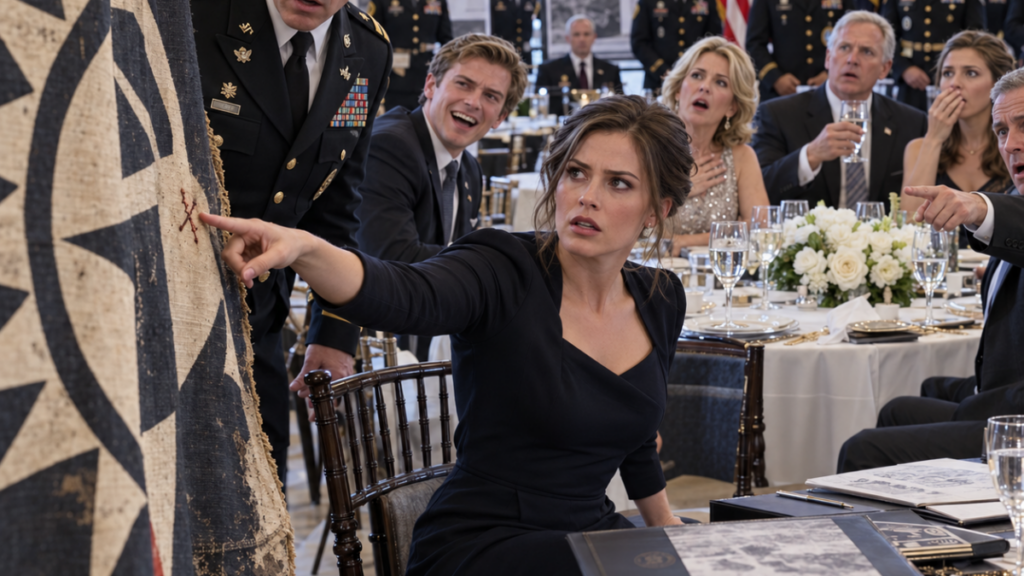
My Family Laughed When I Recognized The Enemy Flag. “How Could You Possibly Know That?” The Intelligence Officer Demanded. My Family Was Still Laughing. I Pointed To One Small Mark On The Flag. “Because That Isn’t Their Battle Symbol.” He Froze. “Then What Is It?” I Looked At Him. “It’s The Mark They Used To Identify Who They Were Hunting.” The Target Of That Secret Operation Was Me.
For six years, my family treated me like the disappointing sister who spent her life entering numbers into spreadsheets. Then my brother-in-law brought a scorched black-and-crimson banner to dinner and waved it in my face while everyone laughed at my warning. One guest stopped laughing. He was a senior military intelligence officer, and when he noticed the gold stitching I had recognized, he asked me one question that turned our family dinner into a federal investigation: “How do you know what that means?”
### Part 1
By the time Gavin Cross tapped his fork against a wineglass and announced that he had “something extraordinary” to show everyone, I had already spent most of the evening doing what my family preferred me to do: staying useful and staying quiet. I had refilled the ice bucket twice, carried a tray of grilled vegetables from the kitchen because my sister Emily didn’t want to wrinkle her dress, and listened to my father explain to three people why Gavin was supposedly about to land the biggest consulting contract of his career. Nobody had asked how my week had been, which was fine with me.
The dinner was taking place behind Gavin and Emily’s oversized colonial house in northern Virginia, on a stone patio designed to look casual despite costing more than my annual rent. String lights glowed above the pergola, citronella candles burned beside crystal glasses, and the swimming pool filter produced a steady mechanical hum behind the hedge. Everything smelled like grilled rosemary, expensive wine, and the sharp chlorine drifting from the water.
I was thirty-four, unmarried, and employed—according to my family—as a records analyst for a regional shipping company. I drove an eight-year-old silver hatchback with a dent near the rear bumper, rented a small apartment twenty minutes away, and wore a navy blouse I had bought on sale because Emily had specifically texted me, Please don’t come looking like you just left the office.
Six years earlier, my family had stopped asking why I never talked about work.
They had created their own explanation instead.
Nora was boring.
Nora lacked ambition.
Nora had wasted her thirties.
That version made them comfortable, so I let them keep it.
My mother, Patricia, worried aloud that I was “letting life pass me by.” My father, Warren, occasionally forwarded job openings he thought might help me “finally move up.” Emily had become particularly fond of comparing my life with hers, usually without realizing she was doing it. She had Gavin, the house, the pool, the catered dinners, and enough photographs from charity events to make her social media look like a luxury hotel brochure.
Gavin was worse because he mistook proximity to important people for importance of his own.
He worked in business development for a private aerospace and defense supplier, which meant he attended conferences, shook hands with former officials, memorized acronyms, and came home convinced he understood national security. He collected military memorabilia with the enthusiasm of a man who had never been close enough to danger to smell burned electrical wiring inside a damaged vehicle.
His office contained framed maps, decommissioned equipment, antique-looking knives, challenge coins he had purchased rather than earned, and photographs of himself standing beside retired generals at fundraising events.
That night, he had a new prize.
“Everybody, gather around,” Gavin said.
My father grinned immediately.
Emily touched her husband’s shoulder as though he were about to unveil a museum acquisition.
Across the patio, one of the neighbors had brought a guest named Daniel Rourke. I had noticed him when I arrived because he carried himself differently from everyone else there. Mid-fifties, gray at the temples, conservative jacket despite the heat, mineral water instead of alcohol, eyes that seemed to notice entrances before faces.
Gavin had introduced him casually.
“Colonel Rourke works somewhere mysterious enough that he refuses to tell me anything useful.”
Rourke had smiled politely.
“Most of my work is paperwork.”
That answer had almost made me laugh.
Instead, I had taken my seat.
Now Gavin disappeared through the French doors and returned carrying a dark leather satchel.
“I have a contact who handles foreign surplus,” he said. “Customs seizures, estate collections, private channels. Things museums don’t get.”
“You mean things you buy from strangers online?” I asked.
Emily sighed.
“Please don’t start.”
“I asked a question.”
Gavin grinned at me.
“You wouldn’t appreciate it, Nora.”
There it was.
That familiar little cut.
Not cruel enough to challenge without looking sensitive, but sharp enough to remind me where he believed I belonged.
He placed the satchel on the teak table and opened the brass clasps.
The smell reached me before I saw what was inside.
Old smoke.
Dust.
Oil.
And something metallic embedded deep in coarse fabric.
Every muscle in my back tightened.
Gavin pulled out a folded bundle of dark cloth.
My fork stopped halfway to my plate.
“Where did you get that?” I asked.
He ignored me.
“Ladies and gentlemen.”
He shook the fabric open.
The banner snapped once in the warm evening air.
Black.
Not true black anymore, but charcoal darkened by soot and age.
A jagged crimson border surrounded an emblem formed by two inverted blades inside a broken circle. The design itself would have meant nothing to most people.
The stitching did.
Along the inner edge ran irregular gold thread, worked by hand into groups so subtle they appeared decorative.
Three short intervals.
One long.
Two crossed sections near the lower seam.
My heart slammed once against my ribs.
Then everything inside me became strangely quiet.
The pool pump disappeared.
The voices disappeared.
For half a second I was somewhere else entirely, staring at fabric nailed to a mud wall while a radio whispered in my ear and someone beside me breathed far too quickly.
I put my fork down.
“Fold it.”
Gavin blinked.
“What?”
“Fold that banner and put it back in the bag.”
The table became still for perhaps two seconds.
Then Gavin laughed.
My father joined him.
Emily stared at me with open irritation.
“Oh, Nora,” my mother said. “What now?”
I pushed my chair back.
The legs scraped hard across the stone.
Gavin lifted the banner higher.
“Careful. Apparently we’ve offended the curator.”
“I’m serious.”
“So am I. Do you know what I paid for this?”
“I don’t care.”
Emily leaned back in her chair.
“You spend your days moving numbers between spreadsheets. Can you please not pretend you’re suddenly an expert because Gavin owns something military?”
“It isn’t military.”
Gavin’s grin widened.
“Here we go.”
“It isn’t a standard battlefield flag either.”
My father chuckled.
“Nora, sweetheart, maybe sit down.”
I stepped closer instead.
There were details I could see now that confirmed what my body had already known. A reinforced corner shaped for hand-carrying rather than hanging. A narrow hidden seam. Uneven gold stitching that followed a numerical pattern instead of decoration.
Something cold moved through my stomach.
“Gavin, who sold it to you?”
“A collector.”
“What collector?”
“Why?”
“Because you need to stop touching it.”
He raised his eyebrows.
“And what exactly do you think is going to happen?”
I pointed toward the lower edge.
“There’s an encoded sequence in that seam.”
Emily actually laughed.
“You cannot be serious.”
My mother covered a smile behind her wineglass.
Gavin swung the cloth toward me.
“Tell us, Professor. What does my scary antique say?”
I saw movement beyond him.
Colonel Rourke had set down his glass.
His expression had changed.
Not surprise.
Recognition.
He crossed the patio without hurrying, but everyone unconsciously moved out of his way.
“That will be enough,” he said.
Gavin lowered the banner slightly.
“Colonel?”
Rourke did not answer him.
He examined the cloth from three feet away, then came closer and studied the gold stitching.
When he looked at me, there was nothing friendly left in his face.
“How could you possibly know there’s a code in that seam?”
My family stopped laughing.
I stared at him across Gavin’s ridiculous trophy, and for the first time in six years, I realized the life I had buried had just found me again.
### Part 2
Nobody moved for several seconds. A moth struck one of the patio bulbs above us, making a faint tapping sound that seemed absurdly loud in the silence, while Gavin looked from Rourke to me as if we had both decided to participate in some elaborate joke at his expense. I could feel Emily studying my face, waiting for the nervous smile she expected whenever family teasing went too far.
It never came.
Rourke pointed toward the lower left corner of the banner.
“Don’t touch it,” he told Gavin.
Gavin laughed uncertainly.
“Come on, Colonel. It’s cloth.”
“Then leaving it alone shouldn’t be difficult.”
The tone changed the room.
My father slowly lowered his drink.
Gavin obeyed, although irritation flashed across his face.
Rourke looked back at me.
“You recognized the stitching immediately.”
“Yes.”
“How?”
I could have lied.
For six years, lying by omission had been the foundation of my civilian life.
I told people I worked in logistics because technically I did.
I said I had traveled overseas for contracts because technically I had.
I said an old vehicle accident had caused the scars along my ribs because explaining anything more would have required answers I was not permitted to give.
But the banner changed the equation.
“Look underneath the crimson border,” I said. “There should be a second layer of synthetic reinforcement.”
Rourke’s eyes narrowed.
“How thick?”
“Approximately five millimeters.”
“Color?”
“Originally gray. Heat usually turns it brown.”
Gavin looked annoyed again.
“You two could be making this up.”
Rourke ignored him.
“What does the gold represent?”
My throat tightened.
“I need to know where he got it first.”
“That wasn’t my question.”
“And I’m not answering that question until I know whether this is authentic.”
Emily crossed her arms.
“This is ridiculous. Nora, you’re embarrassing yourself.”
Rourke turned his head for the first time.
“No, she isn’t.”
Emily’s mouth remained slightly open.
Rourke faced me again.
“May I examine the seam?”
“Yes, but use something between your hand and the fabric.”
That answer made him study me even more carefully.
He removed a pair of thin gloves from his jacket pocket, pulled them on, and lifted one corner without disturbing the rest. Gavin started to object, but Rourke leaned toward the lower seam and found what I had described.
His jaw tightened.
“There’s reinforcement.”
I said nothing.
“And discoloration.”
Gavin’s face changed.
My mother whispered, “What does that mean?”
Nobody answered.
Rourke traced the gold pattern without touching it directly.
“There are breaks in the thread.”
“Those aren’t breaks.”
“What are they?”
“Separators.”
His eyes came back to mine.
“Between what?”
I glanced toward Gavin.
“Where did you buy it?”
Gavin threw up his hands.
“A private forum. Is everyone happy now?”
“What forum?”
“I don’t remember.”
“You paid money to someone you don’t remember?”
“Three thousand dollars.”
My father nearly coughed into his wine.
Emily stared at Gavin.
“You told me eight hundred.”
“That isn’t important.”
“It feels pretty important.”
Rourke stepped closer.
“Who arranged the transaction?”
“A guy I know.”
“Name.”
“Why are you interrogating me?”
“Because your sister-in-law recognized a coding method that was never publicly documented, and because I recognize part of it too.”
The color drained from Gavin’s face.
My father looked at me.
“Nora?”
I wished he had sounded concerned.
Instead, he sounded suspicious.
As though discovering there might be more to my life offended him personally.
“What coding method?” he asked.
I sat down again because my legs had begun to ache with an old warning sensation I had not felt in months.
Rourke noticed.
His eyes dropped briefly toward the way I shifted weight from my left side.
Then he looked at a faint scar near my wrist.
I saw the moment another question occurred to him.
“What year?” he asked.
I understood exactly what he meant.
“Don’t.”
“What year did you see one?”
“Colonel.”
“What year?”
Gavin gave a nervous laugh.
“Oh, this is perfect. She watches documentaries for one weekend and now everybody thinks she’s some kind of spy.”
I turned toward him.
“2018.”
Rourke became completely still.
The old version of me instantly regretted saying it.
My mother frowned.
“You were working in Richmond in 2018.”
“Yes.”
“You lived in Richmond.”
“I had an apartment there.”
Emily shook her head.
“See? This is what I mean. You’re letting him confuse you.”
Rourke’s gaze never left me.
“Eastern sector?”
I did not answer.
“Northern corridor?”
Silence.
“Mountain region?”
My fingers tightened against the edge of the table.
He saw it.
His expression changed from suspicion to something much more complicated.
“God,” he whispered.
Gavin glanced between us.
“What?”
Rourke stood straighter.
“Nothing yet.”
My mother looked frightened now.
“Nora, what is he talking about?”
“I don’t know what he thinks he knows.”
“That isn’t an answer.”
“It’s the only one I can give you.”
Emily made an exasperated sound.
“You have spent years complaining that nobody takes you seriously—”
“I have never complained about that.”
“Well, maybe not out loud.”
“That’s convenient.”
She pushed her chair back.
“You come here acting superior because you don’t care about the things we care about, and now suddenly a colonel walks in and you’re speaking in codes?”
I almost laughed.
Not because anything was funny.
Because I had spent six years being criticized for being too ordinary, and Emily had somehow transformed the possibility that I was not ordinary into another character flaw.
Rourke interrupted us.
“Mrs. Cross, your sister recognized restricted methodology.”
Emily froze.
“Restricted?”
“Yes.”
Gavin swallowed.
“So maybe she saw it online.”
“No.”
“How can you know that?”
“Because I was part of the review team that helped classify material associated with this network.”
That silenced everyone again.
Rourke turned toward me.
“There were fewer than forty people outside the operational units who had access to those reports.”
I said nothing.
“And fewer than twelve would recognize that stitching without a reference file.”
My father’s face had gone pale.
“Nora?”
I looked at the banner.
The gold thread seemed brighter under the patio lights than I remembered it ever being in daylight.
“The emblem belonged to a transnational militant-financing network we called Sable Sun,” I said carefully. “They used symbols differently from conventional groups.”
Gavin seized on the explanation.
“So it is a battle flag.”
“No.”
“What is it?”
I took a slow breath.
“Some symbols identified safe houses. Some marked couriers. Some were used to communicate debts or alliances.”
“And this one?”
“That one was carried by small teams.”
Rourke’s voice became quieter.
“What kind of teams?”
I hated that he already knew.
I hated that everyone else was listening.
“Teams assigned to find someone.”
My mother’s chair creaked as she shifted.
“Find who?”
I looked at the gold stitching again.
My pulse had begun beating heavily behind my eyes.
Rourke leaned closer.
“What does this specific sequence mean?”
For years, I had imagined what would happen if my cover story ever collapsed in front of my family. I had pictured disbelief, anger, accusations, perhaps even tears.
I had never imagined it would happen beside a swimming pool while grilled salmon cooled on expensive plates.
“The stitching isn’t a unit designation,” I finally said.
Rourke waited.
“It identifies a person.”
His face hardened.
“Which person?”
Gavin whispered something I could not hear.
I looked directly at Rourke.
Then I gave him the first fragment of an answer.
“The person that team was hunting survived.”
The colonel’s expression told me he understood exactly why I had chosen those words.
My family did not.
Not yet.
### Part 3
Rourke asked Gavin for his phone.
Gavin refused.
It took less than thirty seconds for the refusal to collapse.
Rourke did not threaten him or raise his voice; he simply explained that if the banner was what we suspected, its origin might involve stolen government evidence, and voluntarily preserving the purchase record would look considerably better than forcing investigators to reconstruct it later. Gavin unlocked the phone so fast he mistyped his passcode twice.
Emily stood beside him with both hands pressed against her stomach.
“You said this was legal.”
“It was supposed to be.”
“That is not the same sentence.”
My father turned to me.
“Nora, what person?”
I looked toward Rourke.
He was scrolling through Gavin’s transaction history.
“Not yet.”
My father’s eyebrows rose.
“What do you mean, not yet? This is our family.”
“That has never entitled you to classified information.”
The words came out colder than I intended.
He flinched anyway.
A few years earlier, I would have softened them immediately.
I did not now.
Rourke found the transaction.
He read silently for several moments.
“When did you purchase it?”
“Three weeks ago.”
“Seller?”
“A user named EasternVault.”
“Real name?”
“I don’t know.”
“Payment?”
“Digital escrow.”
“Shipping?”
“Private courier.”
Rourke looked up sharply.
“You had a foreign-origin object delivered by private courier to your home?”
Gavin bristled.
“You make it sound criminal.”
“I haven’t decided what it sounds like yet.”
He handed the phone back but instructed Gavin not to delete anything.
Then he stepped away from the table and made a call.
I could hear only his side.
“Rourke. Priority verification.”
Pause.
“Archive window 2017 through 2019. Sable Sun textile identifiers.”
Another pause.
“Specifically bounty sequence, black-crimson field, inverted twin-blade crest.”
He glanced at me.
“And check stolen evidence inventories within the last twelve months.”
The waiting was worse than the questions.
Nobody knew what to say, so all the little sounds of the backyard returned: insects, the pool pump, a dog barking two houses away. Somewhere inside the kitchen, an ice maker dumped a tray with a sudden crash, and my mother jerked so hard that Chardonnay spilled across the table.
Emily stared at me.
“How do you know Colonel Rourke?”
“I don’t.”
“He obviously knows something about you.”
“He recognizes information.”
“That isn’t what I asked.”
“It’s the answer.”
She shook her head.
“You always do this.”
“Do what?”
“Talk around everything.”
I almost reminded her that for years she had barely asked me anything worth answering.
Instead, I said, “There were reasons.”
My mother’s voice trembled.
“Were you in danger?”
I met her eyes.
There were some lies that had been required.
Others had simply become convenient.
“Yes.”
Her face collapsed slightly.
“When?”
“For a long time.”
“And you never told us?”
“I couldn’t.”
My father walked away from the table and rubbed both hands over his face.
“This is insane.”
Gavin muttered, “Finally, somebody says it.”
My father turned on him.
“Not you.”
It was the first time that night anyone in my family had directed anger away from me.
Rourke’s phone buzzed.
He answered immediately.
“Yes.”
His expression tightened.
“Repeat that.”
He listened.
Then his eyes found mine.
“What was the call sign?”
Something inside me went cold.
He listened again.
“Understood.”
The phone lowered slowly.
Nobody spoke.
Rourke removed his glasses, folded them, and slipped them into his jacket.
“The banner matches an item cataloged after a joint operation in 2018.”
Gavin gripped the back of a chair.
“So it’s authentic.”
Rourke ignored the absurd note of pride in his voice.
“It was held in a secure evidence facility overseas until approximately seven months ago, when an audit discovered several pieces missing.”
Emily whispered, “Missing?”
“Stolen.”
Gavin looked sick.
“I didn’t steal anything.”
“I did not say you did.”
“Then why are you looking at me like that?”
“Because stolen classified-linked material somehow reached a suburban backyard through a collector network, and you paid three thousand dollars for it without asking basic questions.”
Gavin opened his mouth.
Nothing useful came out.
My mother looked at Rourke.
“What about the stitching?”
He did not immediately answer.
Instead, he approached me.
“Nora.”
I had not told him my first name.
He had heard my family use it, of course, but the deliberate way he said it made the moment feel formal.
“Was your surname always Hale?”
“No.”
Emily stared at me.
“What?”
My father whispered, “Nora.”
I ignored both of them.
Rourke asked, “Previous surname?”
“I’m not discussing personnel history on an unsecured patio.”
That was the answer that confirmed everything for him.
He inhaled slowly.
“When did you separate?”
“Six years ago.”
“Medical?”
“Administrative transition.”
His gaze dropped toward my left hip.
“Following an engagement?”
“Yes.”
The phone in his hand vibrated again.
This time he looked at the screen instead of answering.
Whatever he read removed the last trace of uncertainty from his face.
He stepped back from me.
Straightened.
And brought his feet together.
The movement was small.
My family probably would not have understood it if his hand had not risen immediately afterward in a crisp salute.
Emily gasped.
My father sat down.
I closed my eyes for half a second.
I had spent six years making sure this exact moment never happened.
“Captain Hale,” Rourke said.
My mother made a broken sound behind me.
Rourke continued.
“I was briefed on Operation Glass Harbor after I transferred into strategic intelligence. Your detachment’s extraction was used as a case study for years.”
“Colonel.”
“My apologies.”
“Please lower your hand.”
He did.
Gavin stared at me as if my face had physically changed.
“Captain?”
I hated the word in his mouth.
Emily’s voice was almost inaudible.
“You were in the military?”
“Yes.”
“You told us you worked logistics.”
“I did.”
“You said you processed freight records.”
“Sometimes.”
My father looked bewildered.
“What were you actually doing?”
Rourke answered before I could.
“Whatever she is permitted to tell you.”
I appreciated that.
I also knew the secrecy was already over in every way that mattered.
I looked at my parents, my sister, and the brother-in-law who had spent years turning my silence into entertainment.
“I served in a specialized reconnaissance and intelligence unit,” I said. “My work involved identifying financial routes, couriers, safe locations, and people connected to organizations operating across several borders.”
Emily stared at me.
“You were a spy?”
“No.”
It was the simplest answer and almost true.
Gavin suddenly laughed.
Not because he found anything funny.
Because denial was the only place left for him to hide.
“This is unbelievable. You? You got upset when your tire blew out on I-95.”
I looked at him.
“Yes.”
“You called roadside assistance.”
“My transmission was damaged.”
“But you were scared.”
“I was angry.”
“You were crying.”
“My leg had locked up from an old nerve injury and I couldn’t stand.”
His mouth closed.
The patio became painfully quiet.
My mother lowered her eyes.
She had mocked me for that incident too.
Rourke looked toward the banner.
“There is one question still unanswered.”
I knew which one.
He approached the cloth again.
“The archive identifies this as a personal bounty marker recovered after an engagement. The encoded target file is compartmented.”
My father whispered, “Target?”
Rourke looked at me.
“You said the person survived.”
“Yes.”
“Were you part of the team assigned to protect that person?”
“No.”
His expression tightened.
“Then how did you recognize the sequence immediately?”
There was no graceful way around it anymore.
I walked to the table and touched one finger to the air above the first break in the gold thread.
“That group represents a date.”
I moved to the next.
“That one represents an operational identifier.”
Then the final section.
“And that one represented the target’s call sign.”
Rourke did not blink.
“What was the call sign?”
My mouth felt dry.
“Wraith.”
He stared at me.
Behind him, the color disappeared from Emily’s face.
I looked at my family and finally finished the sentence I had avoided for six years.
“Seven years ago, Sable Sun made that banner because the person they were hunting was me.”
### Part 4
My mother sat down as if someone had removed the strength from her legs.
Emily whispered my name.
My father said nothing at all.
Gavin looked at the banner, then at me, and I watched the realization spread across his face that he had spent an evening shaking an object connected to an attempt on my life inches from my head.
For once, even he had no joke.
I stepped away from the table.
The air smelled different now.
Same charcoal from the grill, same flowers climbing Emily’s fence, same chlorine from the pool, but my body had returned to an old state of alertness where every scent separated into information.
Exit gate.
Kitchen door.
Fence height.
Sight line from the neighboring roof.
Parked vehicles.
I hated how natural it felt.
Rourke noticed.
“You think the purchase was intentional.”
“I think we don’t know.”
“Explain.”
“Sable Sun used objects as communication before they used digital channels. Old identifiers surfaced in marketplaces occasionally because collectors thought they were war relics.”
“You think somebody watches the sales.”
“I would.”
Rourke’s eyes sharpened.
“If the banner was stolen intentionally—”
“Then the buyer matters.”
Gavin backed away from us.
“Wait. What does that mean?”
I turned toward him.
“How much information did the seller receive?”
“Just payment.”
“Shipping address?”
His expression answered before he did.
“Yes.”
“Phone number?”
“Yes.”
“Email?”
“Well, obviously.”
“Did you communicate directly?”
“A few messages.”
“Did you mention who would see the banner?”
He hesitated.
My stomach tightened.
“Gavin.”
“I may have said I was showing it at a dinner.”
Emily swore under her breath.
“To whom?”
“Clients. Friends. Family.”
“Did you name anyone?”
“No.”
“Did you post about tonight online?”
Silence.
Emily’s eyes widened.
“Gavin.”
He reached for his phone.
Rourke stopped him.
“Don’t.”
“I only posted the table setup.”
“When?”
“This afternoon.”
“Public account?”
Gavin looked embarrassed.
“My business profile.”
Rourke cursed quietly.
He stepped away and placed another call.
This one was shorter.
“Possible exposure. Residential location. Need digital containment and two counterintelligence units.”
My mother stood abruptly.
“Exposure to what?”
Rourke looked toward me.
I answered.
“Possibly nothing.”
“That doesn’t sound like nothing.”
“It may simply be stolen property passing through collectors.”
“And the alternative?”
I did not want to tell her.
She saw that.
“Nora.”
“The alternative is somebody wanted to know who bought it.”
Emily’s hands began shaking.
“Why?”
“To see where it went.”
“And then?”
“To see who recognized it.”
Nobody spoke.
Gavin looked toward the dark windows of the houses beyond the fence.
“You think somebody is watching us?”
“I think panicking before we have evidence would be useless.”
“That wasn’t my question.”
“No. I don’t know if anybody is watching.”
He grabbed his hair with both hands.
“Oh my God.”
My father finally found his voice.
“What happened seven years ago?”
I looked at him.
His face had lost every trace of judgment.
For a strange moment, I saw him the way I had seen him when I was ten and broke my wrist falling from a tree—frightened because he could not fix something.
“We disrupted a financial pipeline tied to weapons procurement,” I said. “People lost money. Important people.”
“You?”
“My team.”
“And they blamed you?”
“They identified me.”
“How?”
“We never proved it.”
Rourke glanced toward me.
“You suspect an internal leak.”
“I always did.”
That surprised him.
“Was that documented?”
“No evidence.”
“So you never pursued it?”
“I was busy surviving.”
My mother covered her mouth.
I continued because stopping would make everything worse.
“After the operation, several small teams crossed through different regions using bounty markers like that one. They weren’t armies. They were trackers. A symbol told each team whom they were looking for and how payment would be verified.”
Emily looked at the banner.
“What would they do when they found you?”
I held her gaze.
“You already know.”
She looked away.
My father’s voice cracked.
“Were you hurt?”
“Yes.”
“How badly?”
“Badly enough that I stopped doing that work.”
My mother began crying.
Quietly.
Not theatrically.
I had rarely seen her cry without expecting someone to comfort her.
This time nobody did.
Within thirty minutes, two dark SUVs arrived outside the house.
No sirens.
No lights.
Four people in plain clothes entered through the side gate, and the dinner transformed into a controlled scene.
Phones were collected temporarily.
The banner went inside a rigid evidence container.
Photographs were taken of the satchel, the table, and Gavin’s purchase records.
A woman named Agent Lena Park questioned Gavin in the dining room while another investigator copied information from his devices.
Through the glass doors, I watched my brother-in-law become smaller by the minute.
Emily stood beside me.
“Is he going to prison?”
“I don’t know.”
“You understand this stuff.”
“I understand operations. I am not his lawyer.”
“He didn’t know.”
“That matters.”
She nodded rapidly.
“So you can tell them that.”
“I already did.”
Her relief lasted only a second.
Then she looked at me.
“You aren’t going to protect him.”
It was not really a question.
“No.”
“But he’s family.”
There it was.
That word again.
The word people in my family used whenever they wanted obligation without accountability.
“Family doesn’t mean I interfere with a federal investigation.”
Emily’s face hardened.
“You could at least try.”
“Try what?”
“Help him.”
“He bought stolen restricted material from an anonymous broker because he wanted strangers to think he was impressive.”
“He didn’t know it was stolen.”
“And I told the investigators exactly that.”
She lowered her voice.
“You know what I mean.”
“Yes.”
I did.
She wanted me to use whatever secret influence she had just discovered I possessed.
Six hours earlier, she believed I was a failure.
Now she wanted access to the imaginary power attached to my past.
Something inside me finally became very tired.
“No, Emily.”
She stared at me.
“What?”
“I won’t make a call. I won’t ask Colonel Rourke for special treatment. I won’t tell anyone Gavin deserves protection because he married my sister.”
Her eyes filled with angry tears.
“We didn’t know who you were.”
The sentence landed harder than anything she had said that evening.
I looked directly at her.
“That is exactly the problem.”
She frowned.
“What?”
“You think knowing who I was should have changed how you treated me.”
Emily opened her mouth.
I kept going.
“You think the medals would have made me worthy of basic respect. The clearance. The rank. Whatever story you’re building in your head right now.”
“That isn’t fair.”
“It’s completely fair.”
“We thought you had given up on yourself.”
“And that gave you permission to humiliate me?”
“I never humiliated you.”
I almost smiled.
“Last Christmas, you seated me at the folding table with teenagers because Gavin’s business partners were ‘more interesting company.’”
Her cheeks flushed.
“That wasn’t—”
“At Mom’s birthday you joked that I could organize the receipts because spreadsheets were the only thing I was good at.”
“I was kidding.”
“You always are afterward.”
She began crying harder.
I felt nothing.
That frightened me more than anger would have.
Agent Park appeared in the doorway.
“Ms. Hale?”
“Yes?”
“We found something in Mr. Cross’s messages.”
Rourke joined her.
The look on his face told me this was no longer only about stolen evidence.
Park held up a printed screenshot.
“The seller contacted Gavin again forty-six minutes ago.”
I took the page.
There was one line.
Hope your guest enjoyed seeing an old memory.
For a moment, I could hear my heartbeat.
Then I noticed something beneath the message that everyone else had missed.
A tiny attachment icon.
I looked at Park.
“Open the file.”
### Part 5
The attachment contained a photograph.
It had been taken from outside Gavin and Emily’s property less than two hours earlier.
The image showed the patio through a gap in the hedge, blurred slightly by distance but clear enough to identify the dinner table, the banner, and every person standing around it.
Including me.
Nobody spoke after Agent Park enlarged it on her tablet.
My mother grabbed the back of a chair.
Emily started crying again.
Gavin, brought in from the dining room by another investigator, stared at the screen and whispered, “I didn’t know.”
Rourke turned to his agents.
“Lock down the street.”
The next ten minutes moved quickly.
Curtains closed.
Exterior lights went off.
Neighbors were quietly contacted.
A camera team checked doorbells and traffic feeds.
No one rushed dramatically through the yard with weapons raised, but I understood the efficiency underneath the calm.
I had lived inside that rhythm once.
Park looked at me.
“Can you identify anything in the message style?”
“No.”
“The attachment metadata has been stripped.”
“Expected.”
“The account is already gone.”
“Also expected.”
Gavin sat at the dining table with both elbows on his knees.
His expensive watch looked ridiculous now.
“Why me?”
I turned toward him.
“Because you were easy.”
He looked wounded.
“What does that mean?”
“You advertise what you buy. You post your collections. You brag about your contacts.”
“I network.”
“You broadcast.”
Rourke gave me a brief glance that said he agreed.
Gavin looked down.
“So they picked me because I’m stupid.”
I could have said yes.
Instead, I said, “Because you were predictable.”
That hurt him more.
For years, Gavin had built his identity around believing he was the most sophisticated person in any room.
The possibility that someone had studied him and found him simple enough to manipulate seemed to break something.
Emily sat across from him.
“Why didn’t you tell me it cost three thousand?”
He looked at her.
“Seriously?”
“Yes, seriously.”
“We’re doing this now?”
“You lied to me about bringing stolen evidence into our house.”
“I didn’t know it was stolen!”
“You knew I would be angry about the money.”
He stared at her.
Even in the middle of a federal security incident, their marriage found time to reveal its ordinary fractures.
I walked away.
Rourke followed me to the hallway.
“You all right?”
“Yes.”
“That answer usually means no.”
“It means I’m functional.”
He accepted that.
“Do you think Sable Sun remnants are still operational?”
“Not in the way they were.”
“But somebody knew the marker.”
“Yes.”
“And somebody knew you might recognize it.”
“Yes.”
“Which narrows the field.”
I looked at him.
“You’re thinking former network personnel.”
“Or someone with access to the archives.”
“That second group worries me more.”
He nodded.
I had thought about the leak for seven years.
During the original operation, my detachment had compromised a financing network by intercepting courier chains and identifying safe accounts used to move money through legitimate businesses. We had expected retaliation, but retaliation should have been broad.
Instead, it had been personal.
Within weeks, teams knew my operational identifier.
They knew routes.
They knew habits.
Once, they knew the address of a supposedly secure transit apartment less than twelve hours after I arrived.
Someone had been feeding them information.
The official investigation found nothing conclusive.
Then came the ambush that ended my field career.
I woke in a military hospital with nerve damage in one leg, two cracked vertebrae, and a doctor explaining that recovery would be measured in years, not months.
Afterward, disappearing felt reasonable.
Necessary, even.
The Department built a quiet civilian transition around a logistics position with a company that contracted heavily with government agencies. My work was real but intentionally unremarkable.
I loved it.
That was something my family never understood.
Ordinary life was not punishment.
Ordinary life had been the reward.
Coffee from the same shop every morning.
A broken elevator in my apartment building.
Complaining about traffic.
Buying groceries without checking reflections in windows.
The things Emily considered evidence that I had settled were exactly the things I had once believed I might never have.
Rourke interrupted my thoughts.
“There’s another issue.”
“What?”
“Your family.”
I almost laughed.
“That category is large.”
“They know now.”
“Yes.”
“Your history.”
“Part of it.”
“Enough to complicate your privacy.”
I looked through the doorway.
My mother sat alone at the kitchen island.
My father stood behind her.
Emily and Gavin were still arguing in whispers.
“They won’t tell anyone tonight.”
“You sound confident.”
“I’m not.”
Rourke studied me.
“Do you want us to brief them formally?”
“No.”
“Why?”
“Because they’d interpret it as importance.”
He frowned.
I explained.
“If you put them in a room and tell them they are custodians of sensitive information, my father will finally believe I accomplished something worthwhile. My mother will turn secrecy into martyrdom. Emily will make it part of her identity that her sister was some mysterious captain.”
“That sounds cynical.”
“It’s experience.”
Rourke looked almost amused.
“What do you want, then?”
“I want them told not to discuss an active investigation.”
“That I can do.”
“And nothing else.”
He nodded.
Agent Park entered the hallway.
“We pulled three camera angles.”
“Vehicle?” Rourke asked.
“Possibly.”
She showed us a frame from a neighbor’s security camera.
A dark sedan had parked halfway down the street at 6:14 p.m.
The plate was unreadable.
At 8:03, a person wearing a cap walked along the sidewalk, paused near the Cross property for less than twenty seconds, and continued out of frame.
Nothing distinctive.
Except the way he held his left arm.
My stomach tightened.
“Go back.”
Park rewound.
“Again.”
She replayed it.
I leaned closer.
Rourke watched my face.
“You recognize him?”
“No.”
“That wasn’t convincing.”
“I recognize the posture.”
Park paused the video.
The man’s left hand stayed close to his body instead of swinging naturally.
Rourke asked, “Injury?”
“Habit.”
“What kind?”
I looked at the frozen image.
“People who carry concealed radios under loose clothing sometimes protect one side without realizing it.”
Park glanced at Rourke.
“That’s thin.”
“I know.”
She moved to close the image.
“Wait.”
Something else had registered.
A small detail.
Shoes.
The man wore ordinary running shoes, but the laces were tied using a double loop with the excess tucked inward.
I had seen that exact habit hundreds of times.
Not from Sable Sun.
From us.
My skin turned cold.
“Colonel.”
Rourke looked at me.
“I don’t think the person outside tonight came from the network.”
“Then who?”
I pointed to the screen.
“I think he was trained by people on my side.”
### Part 6
That changed the investigation.
Until that moment, the working assumption had been simple: an old hostile network had stolen a relic, watched the collector chain, and used Gavin’s vanity to locate me. Now the possibility of an insider pushed the problem backward through seven years of buried questions.
Rourke had every outside agent replaced with personnel he knew personally.
He did not explain that decision to my family.
I appreciated the discretion.
At 11:20 p.m., my parents were escorted home.
Emily refused to leave Gavin.
I stayed because Park needed me to review archived personnel photographs from the period surrounding Operation Glass Harbor.
The irony was almost funny.
My family had spent years treating my silence as proof that nothing interesting had ever happened to me.
Now I sat at my sister’s kitchen table scrolling through faces I had worked desperately to forget.
Analysts.
Liaisons.
Contractors.
Transport coordinators.
Communications staff.
Some I remembered fondly.
Some barely at all.
One photograph stopped me.
Martin Vale.
Civilian communications specialist.
Older than me by maybe eight years at the time.
Quiet.
Efficient.
He had maintained relay equipment at two forward staging locations used by our detachment.
Rourke saw my expression.
“What?”
I enlarged the picture.
“Vale had a shoulder injury.”
“What kind?”
“Old surgery. Left side.”
Park searched another database.
“Separated from government contracting in 2020.”
“Why?”
She read.
“Performance dispute. Later investigated for procurement irregularities. No charges.”
Rourke leaned over her shoulder.
“Current address?”
“Maryland.”
“Recent employment?”
“Private communications security.”
I studied the photograph.
The man outside Gavin’s house had been too far away for facial recognition.
But height was close.
Build was possible.
“Why would he care about me after seven years?” I asked.
Park looked at me.
“Maybe he cared seven years ago.”
That possibility made the room seem colder.
I remembered Vale at a staging facility overseas, handing me a replacement radio before a nighttime movement.
He had smiled.
“Try not to break this one.”
I had told him, “Try giving me one that works.”
Ordinary interaction.
Nothing memorable.
That was what frightened me.
Real betrayals rarely announced themselves with dramatic speeches.
They looked like someone doing their job.
At midnight, investigators located Vale’s current phone.
It was turned off.
His vehicle registration matched the general description of the sedan caught on the neighborhood camera.
By 1:00 a.m., an agent confirmed the car was not at his home.
Rourke made another call.
Emily appeared in the doorway.
“Can I talk to Nora?”
Rourke looked at me.
I nodded.
We moved to the living room.
The party decorations still hung over everything.
Unused dessert plates waited on a sideboard.
A bowl of lemons sat beneath a framed wedding photograph of Emily and Gavin.
Normal objects.
Ruined evening.
Emily sat on the sofa.
“I’m sorry.”
I remained standing.
“For what?”
“All of it.”
“That covers a lot.”
She flinched.
“I deserve that.”
I said nothing.
She rubbed her hands together.
“I keep replaying things I said to you.”
“That sounds unpleasant.”
“Nora.”
“What do you want me to say?”
“I don’t know.”
“Then maybe don’t ask me to make your apology easier.”
She stared at the carpet.
“I thought you judged me.”
I had not expected that.
“For what?”
“For caring about the house. Gavin’s career. Parties. All of it.”
“I didn’t.”
“You were always so quiet.”
“That wasn’t judgment.”
“It felt like it.”
“So you punished me for what you imagined I thought?”
Tears filled her eyes.
“When you say it like that—”
“How else should I say it?”
She wiped her face.
“I wanted you to envy me.”
The honesty stopped me.
Emily looked embarrassed.
“I know how awful that sounds.”
“Why?”
“Because you never seemed impressed.”
I sat in the chair opposite her.
“Emily, I watched a man bleed to death while asking me to tell his wife he was coming home. I spent three days once sleeping in the same clothes because we could not risk leaving a building. When I came back, I wanted a grocery store and a quiet apartment.”
She stared at me.
“I didn’t know.”
“You keep saying that.”
“I know.”
“My life didn’t need to be extraordinary for you to respect it.”
She nodded.
“I understand now.”
“No. You understand because you found out it was extraordinary.”
That silenced her.
I did not enjoy hurting her.
But truth sometimes hurt because somebody had spent years building comfort on top of a lie.
Her phone, sealed in an evidence bag on the coffee table, lit up.
We both looked at it.
An incoming call.
Unknown number.
Agent Park appeared immediately.
“Don’t touch it.”
She photographed the screen.
The call stopped.
Then a text arrived.
Emily stared.
Park read it without opening the message fully.
“What does it say?” I asked.
She looked at me.
“It says, ‘Ask your sister who left her behind at Ghazni.’”
My stomach dropped.
Emily looked terrified.
“What does that mean?”
I did not answer.
Rourke entered behind Park.
He had heard.
His expression changed.
“Nora?”
For years I had remembered the ambush in fragments.
Dust.
Metal.
Radio noise.
The smell of fuel.
My team splitting during extraction.
A vehicle moving before I reached it.
I had always been told the driver believed I was already aboard.
Three people had signed statements confirming confusion under fire.
One of them had been Martin Vale.
Not because he was on my team.
Because communications logs showed he had transmitted the final departure order.
I stood.
“He didn’t just leak my location.”
Rourke’s face hardened.
“What are you saying?”
“He controlled the relay channel that night.”
Park understood first.
“He gave the extraction order.”
“Yes.”
“And if he knew you weren’t in the vehicle—”
“He knew exactly what would happen when it left.”
The old question I had buried for years suddenly had an answer.
I had not been accidentally left behind.
Someone had made sure I was.
### Part 7
Martin Vale was arrested shortly before dawn at a motel forty miles away.
He had two phones, several encrypted storage devices, and financial records linking him to intermediaries who had moved money for Sable Sun years earlier. Investigators later explained that the scheme had started small: information sold for cash, routes passed through brokers, equipment diverted from storage, identities exposed one piece at a time.
My identity had simply been worth more than most.
Vale had never been ideologically loyal to anyone.
He had been loyal to money.
That bothered me more than hatred would have.
Hatred at least had a shape.
Greed could sit beside you drinking bad coffee and discussing radio batteries.
At 6:30 in the morning, Rourke found me sitting on the patio steps.
Dawn had turned the sky pale gray.
The banner was gone.
So were the agents who had processed most of the property.
Only a few vehicles remained outside.
“You should sleep,” he said.
“So should you.”
“I’m old. We survive on institutional disappointment.”
I laughed unexpectedly.
It hurt my ribs.
Rourke sat one step below me.
“They found evidence Vale had been watching collectors for months.”
“Looking for the banner?”
“Specifically that item.”
“Why?”
“We think he stole it through an intermediary.”
I stared at the wet stone beneath my shoes.
“To flush me out.”
“Yes.”
“He could have searched records.”
“Your transition identity was properly sealed.”
“So he needed behavior.”
Rourke nodded.
“He knew Wraith would recognize the marker.”
I looked toward the hedge where the photograph had been taken.
“And Gavin gave him a perfect stage.”
“Yes.”
“Is Gavin being charged?”
“That will be up to prosecutors.”
“For possession?”
“Possibly lesser violations related to the acquisition. But at this point, he appears to have been a reckless buyer rather than part of the theft.”
“That sounds accurate.”
Rourke studied me.
“You don’t want him destroyed.”
“No.”
“Despite everything?”
“I don’t confuse consequences with revenge.”
That was the difference my family had never understood about me.
They thought silence meant weakness because their version of strength required an audience.
I had spent enough time around real consequences to know they did not need applause.
Gavin came outside thirty minutes later.
His shirt was wrinkled.
His hair had collapsed.
Without the watch, jacket, and confident posture, he looked like an ordinary forty-year-old man who had not slept.
“Nora.”
I waited.
He sat several feet away.
“I owe you an apology.”
“Yes.”
He almost smiled.
“I guess I deserve that too.”
“You do.”
He looked toward the pool.
“I’ve been thinking about every stupid thing I ever said to you.”
“That could take a while.”
This time he actually laughed, though there was no humor in it.
“I wanted people to think I belonged in rooms with important people.”
“I know.”
“I thought collecting all that stuff made me look connected.”
“I know.”
“And you were actually…”
He stopped.
“Actually what?”
He shook his head.
“It doesn’t matter.”
That answer surprised me.
Maybe he had learned something after all.
He rubbed his palms against his knees.
“I’m sorry I treated you like you were less than me.”
I believed he meant it.
That did not erase anything.
“Thank you.”
His eyes lifted.
“Can we ever be okay?”
“I don’t know.”
He nodded.
It was the first answer all night he accepted without arguing.
My parents arrived later that morning despite being told they did not need to return.
Mom came through the gate carrying coffee as if beverages could somehow restore normality.
Dad looked twenty years older than he had at dinner.
“We wanted to see you,” Mom said.
“I’m fine.”
She hugged herself.
“I keep thinking about what you went through.”
I did not respond.
“We failed you.”
Dad looked at the ground.
“Yes,” I said.
Mom flinched.
“I expected you to say we didn’t.”
“I’m done making other people comfortable with things they did to me.”
Dad swallowed.
“That’s fair.”
He sat beside her.
“We thought we were helping when we pushed you.”
“You thought success looked like money and marriage.”
“We wanted you secure.”
“I was secure.”
“We didn’t know.”
There was the sentence again.
This time I interrupted.
“You knew enough.”
They looked at me.
“You knew I worked. I paid my bills. I never asked you for money. I never hurt anyone. I showed up when you needed help.”
Mom started crying.
“You’re right.”
“You didn’t need a classified résumé to know whether I deserved respect.”
Dad rubbed his eyes.
“I’m ashamed.”
I believed him too.
Belief was not forgiveness.
That distinction mattered.
“I’m not cutting you off,” I said. “But things are changing.”
Mom looked hopeful too quickly.
“We can fix—”
“No.”
Her expression fell.
“You can behave differently. Maybe eventually we build something different. But we are not fixing the old relationship because I don’t want it back.”
Neither of them spoke.
“I’m not going to pretend years of contempt disappeared because Colonel Rourke saluted me.”
Dad nodded slowly.
“I understand.”
“Good.”
Emily stood near the doorway listening.
She did not interrupt.
Over the next three months, the investigation widened.
Vale eventually agreed to cooperate.
Several brokers were arrested.
Evidence connected him to the original leak that had compromised my detachment.

