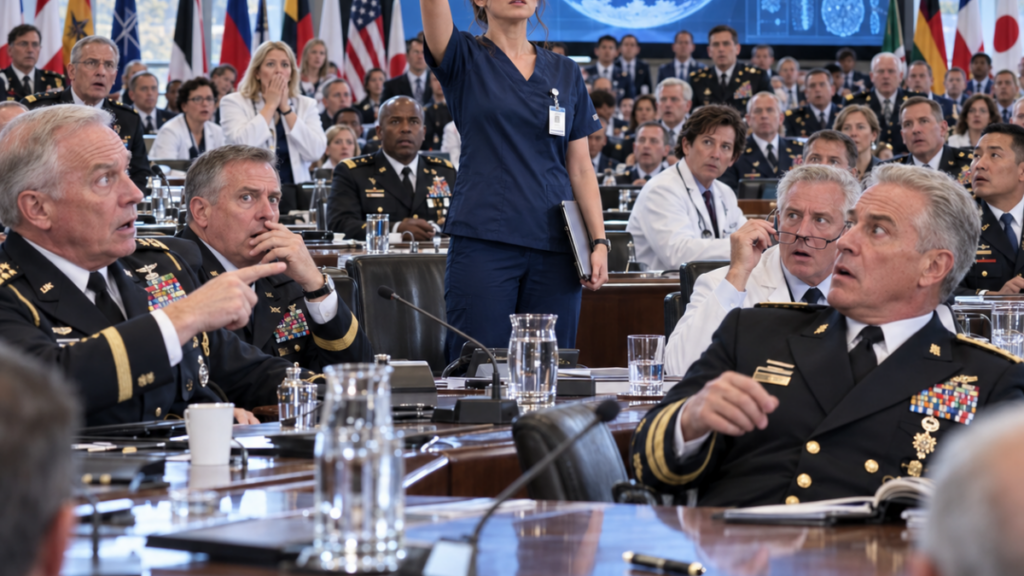
When I raised my hand at the International Defense Medicine Conference, an admiral laughed and told me the panel was for people who understood real battlefields. Within seconds, hundreds of officers, surgeons, and diplomats were laughing with him. They saw blue scrubs, a hospital badge, and an ordinary nurse who had wandered beyond her place. I almost sat down. Then I noticed one dangerous mistake on the screen, walked to the microphone, and said something I had spent 6 years trying never to say again.
### Part 1
“Maybe we should let the nurse finish making the beds before we rewrite military doctrine,” Vice Admiral Raymond Kessler said, pointing directly at me.
The laughter came faster than I expected. It started at the long panel table beneath the enormous American and NATO flags, rolled through the first rows of uniforms, and then spread across the conference hall until nearly 300 people were looking at me instead of the presentation screen. I kept my hand raised because lowering it would have felt like admitting he was right.
My name is Nora Whitaker, and that morning I was supposed to be invisible. I was 34, a trauma nurse at Chesapeake Regional Medical Center outside Washington, D.C., with brown-blond hair that never stayed inside its clip, an old black watch on my wrist, and a pale line of scar tissue running from my right elbow toward my palm. Most of my coworkers knew me as the woman who volunteered for bad shifts, remembered everybody’s coffee order, and never talked about herself.
I had not been invited to the International Defense Medicine Conference because anyone considered my opinion important. Dr. Marissa Cole, our hospital’s director of emergency services, developed a fever the night before and called me at 5:40 that morning while I was still standing barefoot in my kitchen. “I need you to cover my seat,” she said. “Take notes, bring back the handouts, and please don’t argue with anybody wearing stars.”
“I don’t argue,” I told her.
Marissa laughed. “Exactly why I’m sending you.”
By 8:00, I was inside the glass-and-steel conference center near Arlington, surrounded by polished shoes, decorated uniforms, tailored suits, translators wearing headsets, and doctors whose biographies filled half a page in the program. An event coordinator glanced at my blue scrubs and hospital badge, then pointed toward the back wall. “Clinical support personnel can stand behind the delegate seating.”
I looked at the empty chair assigned to our hospital, then at him. “I’m representing Chesapeake Regional.”
He gave me the pleasant smile people use when they believe they are correcting someone beneath them. “Yes, ma’am. Support representation is in the back.”
I almost told him I had been standing in the back of rooms for most of my adult life. Instead, I moved.
The morning session was called Future Readiness in Extended Casualty Care. The title alone tightened something inside my chest. I chose a spot beside a pillar, crossed my arms over the folder Marissa had given me, and promised myself I would listen, take notes, return to the hospital, and forget every uncomfortable memory the conference dragged loose.
For the first hour, that plan worked. Speakers discussed evacuation delays, field hospitals, supply chains, remote surgery, satellite consultation, and the difficulty of treating wounded personnel when aircraft could not fly. Nurses were mentioned 5 times, always as support personnel who carried out decisions made by someone else.
Then Admiral Kessler stood.
He was the director of a multinational medical-readiness initiative, a broad man with silver hair and the easy confidence of someone accustomed to rooms becoming quiet when he entered them. He told 300 people that modern battlefield medicine had solved almost every serious problem between the point of injury and surgical care. His staff advanced the slides while he walked across the stage.
I barely listened until one sentence appeared beneath a diagram.
My stomach dropped.
The wording was polished, official, and dangerously incomplete. It recommended a fixed timeline for a procedure that should never be treated as a simple countdown. Context mattered: circulation, shock, evacuation time, monitoring, patient condition, and whether bleeding could be controlled another way.
But the slide reduced all of that to one number.
My fingers closed around the edge of my folder.
I knew where that number had come from.
Six years earlier, in a ravine almost 7,000 miles away, I had watched what happened when someone treated medicine like a clock instead of a human being. I remembered rain striking stone, diesel fumes, freezing hands, men asking when the helicopter was coming, and a young corporal named Ethan Price staring at me as if I could bargain with death.
I looked down at my watch.
The second hand moved.
Every 15 minutes.
I had been checking that watch every 15 minutes for 6 years.
Admiral Kessler continued speaking. “This framework gives commanders confidence that once the immediate intervention is completed, the casualty remains stable until evacuation.”
My pulse thudded against my throat.
Stable.
.
It was one of the most dangerous words in medicine.
Nobody stays stable because a slide says they should.
I raised my hand.
At first, nobody noticed. Then a British brigadier glanced toward me, followed my arm upward, and nudged the officer beside him. More heads turned until Colonel Matthew Dyer, the session moderator, stopped Kessler and looked toward the back.
“Question?”
“Yes, sir,” I said.
The coordinator near the wall stared at me in horror.
Kessler shaded his eyes dramatically. “From the nursing section?”
A few people laughed.
“I believe the timeline on the current slide could be misunderstood in prolonged evacuation conditions.”
The laughter stopped for half a second.
Then Kessler smiled.
“Sweetheart, this panel is discussing operational medicine, not hospital scheduling.”
That was when the room exploded.
A colonel covered his mouth. Someone behind me whispered, “Oh, this should be good.” One civilian physician actually turned in his seat so he could watch me absorb the humiliation.
.
My face went hot.
I had endured artillery without crying. I had held pressure on wounds while people screamed inches from my face. Yet standing beneath those white conference lights with hundreds of strangers laughing at my scrubs made my hands shake.
I almost lowered my arm.
Then I saw the slide again.
I saw Ethan again.
I kept my hand raised.
Colonel Dyer leaned toward his microphone. “Admiral, perhaps let her ask the question.”
Kessler spread his hands. “Absolutely. We believe in education.”
More laughter.
He pointed toward the aisle microphone.
“Come on, nurse. Educate us.”
I walked forward.
My shoes sounded too loud on the polished floor. The closer I moved toward the stage, the more uniforms I passed, rows of ribbons and stars and insignia that once would have made me straighten automatically.
I stopped at the microphone.
“What is your name?” Colonel Dyer asked.
“Nora Whitaker.”
“Position?”
“Registered nurse. Trauma services.”
Kessler leaned back in his chair. “And your military background, Nurse Whitaker?”
A warning moved through me.
I looked directly at him.
“That isn’t relevant to whether the slide is correct.”
The room changed.
Not much.
Just enough.
A few smiles vanished.
Kessler’s eyes narrowed.
“Then by all means,” he said. “Tell us what’s wrong.”
I looked at the screen.
For 6 years I had tried not to speak about the worst 41 hours of my life.
Now the same mistake that had haunted those hours was glowing 30 feet above me.
I placed both hands on the microphone stand.
“The problem,” I said, “is that your slide assumes evacuation happens on time.”
### Part 2
For the first few seconds after I spoke, Admiral Kessler still looked amused. He crossed one ankle over his knee and gestured for me to continue like a professor inviting a student to embarrass herself. I knew that expression because I had seen versions of it in hospitals, committee meetings, and even family dinners whenever somebody heard the word nurse and mentally replaced it with assistant.
“The first minutes after a major injury are about immediate threats,” I said. “Severe bleeding, breathing problems, circulation, keeping someone alive long enough to reach advanced care. Your presentation handles that reasonably well.”
Kessler raised his eyebrows at “reasonably.”
I continued before he could interrupt. “But your model jumps from initial treatment to evacuation as if nothing important happens in between. Sometimes evacuation takes 30 minutes. Sometimes weather, terrain, enemy activity, damaged vehicles, or simple bad luck turn 30 minutes into 20 hours.”
A few officers stopped smiling.
“That is why we have field medics,” Kessler said.
“One medic cannot watch 10 or 12 deteriorating patients continuously while also managing communications, security, movement, supplies, and whatever else the team needs.”
“Which is why commanders prioritize.”
“Patients don’t deteriorate according to command priorities.”
A low sound moved through the audience.
Not laughter this time.
Interest.
Kessler leaned forward.
“You’re speaking in generalities.”
“Then let’s be specific.”
I turned slightly toward the screen. “You say the patient is stable after the first intervention. What happens when body temperature drops hour after hour? What happens when blood products change the patient’s chemistry? What happens when swelling changes circulation? What happens when a breathing problem returns after something shifts during transport? Who notices?”
Kessler opened his mouth.
I kept going.
“Who checks the same person repeatedly, not once, but dozens or hundreds of times? Who catches the small change before it becomes the emergency?”
A woman seated behind the NATO placard placed her pen on the table.
Her name card read Major General Elise Van Rooyen, Allied Medical Command.
She was watching me carefully.
I pointed toward the glowing number on Kessler’s slide.
“And that timeline is not universal.”
His smile finally disappeared.
“It is taken directly from the Joint Extended Care Guide.”
“I know.”
“You’ve read it?”
“Yes.”
“Interesting.”
The word came out sharp.
“You have access to restricted operational guidance?”
Colonel Dyer shifted beside him.
I could feel the room looking at me differently now. Ten minutes earlier, they had wondered whether a nurse understood the presentation; now they were wondering how a civilian hospital nurse had read documents most civilians would never see.
I should have stopped.
Instead I heard myself say, “The original guidance contains conditions and exceptions that your slide removed.”
Kessler turned to the screen.
“That’s not what my staff reported.”
“Then your staff summarized it badly.”
Somebody in the back whispered, “Jesus.”
Kessler’s face tightened.
Before he could answer, Major General Van Rooyen lifted her microphone.
“Nurse Whitaker, what page are you referring to?”
I told her.
The British officer beside her opened the digital document on his tablet.
Silence spread while he scrolled.
His thumb stopped.
He read.
Then he looked at Kessler.
“She’s correct.”
Three words.
That was all.
Yet I felt the entire room tilt.
Colonel Dyer pulled out his phone. Two doctors in the front row leaned toward each other. An Army surgeon who had laughed hardest earlier stopped smiling and opened his notebook.
Kessler looked at his staff.
One young lieutenant near the projection booth had gone pale.
“A formatting error,” Kessler said.
“No, sir.”
My voice surprised even me.
He slowly turned back.
“No?”
“It’s not formatting.”
I swallowed.
“It’s a way of thinking.”
The room became so quiet that I could hear the ventilation above us.
“You are designing care around the assumption that transportation will rescue the patient before the gaps in your plan matter. When transportation fails, those gaps become someone’s job whether doctrine assigns them or not.”
“And you believe nurses should fill them.”
“I believe nurses already do.”
There it was.
The reason I had stood.
Not the slide.
Not Kessler.
Six years earlier I had been a Navy hospital corpsman attached temporarily to a special operations support element during an exercise that became very real, very fast. I had left the service afterward, earned my nursing degree, and spent years trying to build an ordinary life.
But the ravine followed me.
I had written about it in secret.
Night after night, after my hospital shifts, I filled notebooks with everything we had done correctly and everything I wished we had known. Eventually those notes became a long clinical proposal about prolonged care, continuous reassessment, team responsibilities, nursing presence, and the dangerous empty hours between injury and evacuation.
The proposal was inside the folder pressed against my hip.
Forty-seven pages.
Nobody at Chesapeake Regional knew.
I had never submitted it.
I had convinced myself that staying silent was humility.
Really, it was fear.
Kessler tapped one finger on the table.
“How much operational medicine have you actually practiced, Nurse Whitaker?”
The question was different from the earlier insult.
Now he wanted an answer.
I stared at him.
“Enough.”
“That’s not a credential.”
“No.”
“Then what is?”
Major General Van Rooyen interrupted.
“Admiral, perhaps the more useful question is whether her argument is correct.”
Kessler looked irritated. “General, this woman walked into an international conference and challenged established doctrine.”
“Which appears to contain an error.”
A few heads turned toward Kessler.
His cheeks reddened.
Colonel Dyer cleared his throat. “Nurse Whitaker, you mentioned continuous observation. What specifically are you proposing?”
I looked down at the folder.
This was the exit.
I could give a polite answer, return to the wall, and leave with my life intact.
Instead, I opened it.
“I wrote something.”
Kessler gave a humorless smile.
“Of course you did.”
I removed the first page.
“Nursing teams for prolonged casualty care. Small, mobile, trained to remain with isolated patients when evacuation timelines collapse.”
The Army surgeon in the front row stopped writing.
“You wrote a doctrine proposal?” he asked.
“I wrote a clinical framework.”
“Based on what?”
“Case reviews.”
“Published?”
“Some.”
“How many?”
“Forty-one prolonged evacuation events from multiple countries, plus civilian disaster medicine and remote-care cases.”
That caught them.
Van Rooyen leaned forward.
“How long have you been working on it?”
“Nearly 3 years.”
Kessler laughed once.
It sounded forced.
“And you just happened to bring it today?”
“No. It was in my work bag because I revised it after night shift.”
Something about that answer affected the nurses scattered throughout the room. I saw it in their faces.
They knew exactly what it meant to finish a 12-hour shift, go home exhausted, and still care enough about a problem to sit at a kitchen table until sunrise trying to solve it.
Van Rooyen extended her hand.
“May I see it?”
I walked the pages forward.
As I approached the panel table, another memory rose so sharply that I almost stumbled.
Rain.
Stone.
A radio crackling.
My old team leader shouting my call sign.
Wren.
I had not heard that name in 6 years.
I placed the document in front of Van Rooyen.
She read the title.
Then the subtitle.
Her eyes changed.
She looked at me once.
Then back at the page.
“Where did you get this phrase?” she asked.
My stomach tightened.
“What phrase?”
She touched the paper.
“‘The empty hour.’”
I said nothing.
Van Rooyen slowly turned toward the British officer beside her.
He was staring at me too.
Kessler looked between us.
“What?”
The British officer spoke quietly.
“That phrase appeared in the earliest draft of the Graybridge Field Notes.”
My mouth went dry.
Nobody outside a handful of people should have known that name.
Kessler frowned.
“The Graybridge Field Notes became part of the Wren Guidelines.”
The word hit me harder than I expected.
Wren.
Around the room, officers began turning toward one another.
Admiral Kessler stared at me.
“What exactly did you say your name was?”
“Nora Whitaker.”
His eyes narrowed.
I should have stopped.
Instead I looked at the conference doors at the far end of the hall, wondering how quickly I could leave once the session ended.
Then those doors opened.
A Marine major general stepped inside.
He took 2 steps.
Saw me.
And stopped breathing.
### Part 3
Major General Daniel Mercer looked older than the last time I had seen him. There was more gray at his temples, another row of ribbons on his chest, and 2 silver stars on each shoulder where I remembered an oak leaf years ago. But I recognized his posture before I recognized his face: weight slightly forward, shoulders loose, eyes moving constantly even inside a secure conference hall.
He had taught me that posture.
I looked away.
Not because I disliked him.
Because if Daniel Mercer walked toward me, the life I had built since leaving the service was about to split open in front of 300 people.
At the panel table, nobody seemed to realize what had happened yet. Major General Van Rooyen was still reading my paper while Admiral Kessler questioned the British officer about the origins of the Wren Guidelines.
The guidelines had been developed after a disastrous mountain mission and eventually incorporated into allied extended-care training. The official version contained no author’s name, only a reference to “field observations gathered during Operation Hollow Ridge.”
The omission had been intentional.
Mine.
Six years earlier, when investigators debriefed us after Hollow Ridge, I refused every interview request except the formal medical review. I refused commendation ceremonies, refused a magazine profile, refused even the photograph someone wanted for a training center.
I wanted Ethan Price’s mother to get the attention.
Not me.
Daniel respected that.
He protected my identity so thoroughly that over time, “Wren” became less like a person and more like an anonymous source cited in military medical training.
Which was exactly what I wanted.
Until that morning.
Mercer began walking down the aisle.
At first only a few people noticed him. Then chairs shifted, heads turned, and recognition moved across the room because he was now deputy commander of Marine special operations, one of those men whose name appeared in newspapers whenever the Pentagon wanted to reassure the country that someone competent was handling something unpleasant.
Admiral Kessler straightened.
“General Mercer. Glad you could finally join us.”
Mercer did not answer.
His eyes never left me.
I gripped the edge of the table.
“Nora,” he said.
No rank.
No “Nurse Whitaker.”
Just Nora.
I had not heard my name in his voice since the day I left the Navy.
“Sir.”
That single word was enough.
Kessler noticed.
Van Rooyen noticed.
Everybody noticed.
Mercer stopped several feet away.
He studied my face, then my scrubs, then the scar on my arm.
“I heard someone talking about Hollow Ridge from the hallway,” he said.
My throat tightened.
“I wasn’t talking about Hollow Ridge.”
“No.”
His expression softened.
“You never do.”
Kessler looked irritated again.
“General, perhaps you can settle an issue. Nurse Whitaker is implying she has unusual familiarity with the origins of the Wren Guidelines.”
Mercer finally looked at him.
“She does.”
“How?”
Mercer’s gaze returned to me.
He understood what I was asking without words.
Do not.
Please.
For 6 years, he had honored that request.
Then he glanced toward Kessler’s slide.
Something in his face changed.
“What happened?”
Van Rooyen answered.
“Admiral Kessler dismissed her question about prolonged-care doctrine. Nurse Whitaker corrected an error and then presented a nursing framework that appears to overlap with unpublished language from the original Graybridge notes.”
Mercer stared at Kessler.
“You dismissed her?”
Kessler’s jaw tightened.
“I questioned her qualifications.”
Mercer laughed.
Not loudly.
That made it worse.
“Of course you did.”
A nervous ripple moved through the room.
Kessler crossed his arms.
“General, if you know this woman, perhaps you could explain why a civilian nurse has access to material linked to a classified operational review.”
Mercer looked at me again.
I lowered my eyes.
He waited.
I could have stopped him.
Instead I gave the smallest nod.
Mercer stepped toward the microphone.
“Six years ago, a reconnaissance element and support team were moving through the Sarin Pass during what was supposed to be a limited operation,” he said. “A coordinated attack hit the convoy before weather trapped the survivors inside a narrow ravine.”
The hall went still.
I stared at the polished floor.
“Air evacuation was impossible. Ground extraction was delayed. We had multiple casualties and very little equipment.”
He paused.
“Our senior medic was badly injured in the initial blast.”
A memory rose.
Chief Wallace trying to sit up while I pressed him back down.
“You run it now, Wren.”
I closed my eyes.
Mercer continued.
“The person who took over was a 27-year-old hospital corpsman attached for medical support.”
I heard someone inhale sharply.
“She had limited supplies, no surgeon, freezing rain, wounded men spread across rocks, and no reliable timeline for evacuation.”
My fingers curled.
Forty-one hours.
I had measured them in 15-minute intervals because looking any farther ahead would have broken me.
Check airway.
Check bleeding.
Check temperature.
Check mental status.
Move.
Repeat.
Again.
Again.
Again.
Ethan Price had been 22.
He told bad jokes whenever I checked him.
Around hour 30, he stopped joking.
Mercer’s voice became quieter.
“Eleven people made it out alive.”
Kessler looked toward me.
“What was the corpsman’s name?”
Mercer ignored him.
“When the review team asked how so many survived, she gave them 86 pages of notes. Times, observations, failures, decisions, environmental problems, equipment issues, and recommendations. She didn’t write it to impress anybody. She wrote it because one man died, and she believed we needed to understand why.”
The first row had gone motionless.
“Those notes became the basis of the extended-care framework people later nicknamed the Wren Guidelines.”
My chest hurt.
Kessler stared at my scar.
Then at my watch.
Something clicked.
“Her call sign?”
Mercer turned toward me.
“Wren.”
The room disappeared.
I heard nothing for several seconds.
Then came whispers.
Not loud.
A current of recognition.
People knew that name.
Some had trained from the guidelines.
Some had cited them.
Some had built programs around them.
And that morning some had laughed at the woman who wrote them.
Kessler’s expression emptied.
“You’re saying Nurse Whitaker is Wren.”
Mercer shook his head.
“No, Admiral.”
Kessler frowned.
Mercer’s voice sharpened.
“I’m saying Wren became Nurse Whitaker.”
For the first time that morning, someone laughed and I did not feel humiliated.
It was the British brigadier.
A soft, astonished laugh of understanding.
Then he stood.
His chair scraped the floor.
He looked directly at me.
“I used your field observations in Afghanistan,” he said. “We changed our overnight monitoring routines because of them.”
I didn’t know what to say.
Another officer stood.
Then a military doctor from Canada.
A surgeon from Germany.
Not everyone knew my name, but many knew the lessons.
I felt trapped.
This was exactly why I had remained anonymous.
Mercer saw the panic in my face.
“Sit down,” he told the room.
People obeyed.
He moved closer.
“You okay?”
“No.”
“Good.”
I almost smiled.
That was Daniel.
He had always considered honesty more useful than reassurance.
Kessler spoke.
“If she wrote the foundation of the guideline, why is she working in a civilian emergency department?”
Every emotion inside me sharpened.
Mercer looked at me.
This answer belonged to me.
I turned toward Kessler.
“Because I left.”
“Why?”
“Because I was tired of people turning the worst night of my life into a success story.”
Nobody moved.
“The mission became famous because 11 people survived. I remembered the one who didn’t.”
Mercer’s eyes lowered.
Kessler had nothing to say.
I looked toward my paper in front of General Van Rooyen.
“The Wren Guidelines were written from one event. What I’m presenting today is different. It’s about everything I learned afterward as a nurse.”
Van Rooyen nodded.
“Then finish presenting it.”
Kessler shifted.
“We have a schedule.”
She looked at him.
“So did your evacuation plan.”
The British brigadier coughed into his hand, hiding a smile.
Van Rooyen pointed toward the microphone.
“Nurse Whitaker, you have my remaining panel time.”
I stared at her.
Twenty minutes earlier, I had been standing against the back wall because someone thought my scrubs meant I did not belong in a chair.
Now a major general was surrendering her speaking time to me.
But the most frightening thing was not the attention.
It was the possibility that I finally had a chance to say what I had spent years writing alone.
I opened my folder.
“Then I want to talk about hour 20,” I said.
And every pen in the room came up.
### Part 4
Once the room stopped seeing me as entertainment, speaking became easier. I forgot the decorations on the uniforms, forgot the cameras near the side wall, and imagined I was back at my hospital teaching a new nurse why a patient who “looked fine” could still be the one who scared me most.
“The dangerous period isn’t always the dramatic one,” I said. “Often it’s the quiet stretch afterward.”
I described the cases I had reviewed without identifying units or operations. A wounded person treated correctly at the beginning could worsen hours later because of cold, blood loss, breathing complications, exhaustion, infection risk, pain, dehydration, medication effects, circulation changes, or simple human error.
“In most after-action reports,” I said, “the initial treatment is documented beautifully. Then you reach hour 6, hour 12, hour 20, and the record becomes thin.”
Van Rooyen nodded slowly.
“Because everyone is waiting for transport.”
“Exactly.”
I pointed toward the empty chair beside the NATO placard.
“Waiting is treated as dead time. It isn’t. Waiting is care.”
That sentence changed the room.
People wrote it down.
I could hear pens moving.
I explained that nursing offered something military systems often underestimated: continuity. Physicians diagnosed and operated. Field medics excelled at urgent stabilization. But nurses were trained to observe changes hour after hour, identify trends, notice when the small details stopped fitting together, and protect a patient across long periods of uncertainty.
“Nobody needs to become less important,” I said. “You simply need someone whose primary responsibility is to keep watching.”
Kessler had stopped interrupting.
He stared at the document in front of him.
I showed the panel a chart comparing prolonged evacuations. I had deliberately removed identifying details and focused on patterns: when responsibilities were unclear, subtle decline went unnoticed longer.
The British brigadier raised a hand.
“Your proposal recommends integrating nurses farther forward.”
“Only when operationally appropriate, with specific training and command support.”
“Not replacing medics.”
“Absolutely not.”
He nodded.
“Good.”
A colonel from the Army medical corps asked about staffing.
A civilian disaster physician asked about austere environments.
A Canadian officer challenged one of my assumptions about transport.
I answered.
Then another question came.
And another.
The atmosphere changed from confrontation into something I had not expected.
Work.
Actual work.
The people who had laughed at me began testing the idea instead of testing my right to speak.
That was all I had wanted.
Halfway through the discussion, a young Army captain raised her hand. She wore medical insignia and looked barely 30.
“Can I ask something less technical?”
“Sure.”
“Why didn’t you publish this?”
I looked down at my folder.
It was a fair question.
“I tried.”
The words surprised me.
I had never admitted that publicly.
Three years earlier, I sent an early version to a respected military medical journal under my civilian name. The response praised the analysis but questioned whether I had enough authority to propose operational doctrine.
One reviewer wrote, “The author appears to overstate nursing’s role in environments traditionally led by physicians and combat medical personnel.”
Another suggested I convert the paper into a bedside nursing article.
I closed the email and never submitted it again.
“Someone told me it wasn’t my lane,” I said.
The captain looked toward Kessler.
Half the room did too.
He noticed.
His expression tightened.
I continued.
“I believed them longer than I should have.”
A woman behind me said, “We’ve all done that.”
A few nurses laughed quietly.
Not at me.
With me.
I felt something inside my chest loosen.
Then Admiral Kessler finally spoke.
“I owe you an apology.”
The hall went still.
I was not ready for that.
He stood.
Without the microphone, without the presentation screen behind him, he looked older.
Less like an institution.
More like a man.
“This morning I saw your clothing before I heard your argument,” he said. “I made an assumption based on status, appearance, and profession.”
Nobody moved.
“I encouraged this room to laugh at you.”
His voice thinned for a moment.
“I was wrong.”
I waited.
He seemed to expect something.
Maybe forgiveness.
Maybe reassurance.
Maybe the polite response women are trained to give when powerful men finally acknowledge disrespect.
I gave him none of those.
“You were wrong before you knew my history,” I said.
His face changed.
I continued.
“If General Mercer had never walked through those doors, the slide would still have been wrong.”
A murmur passed through the room.
“I shouldn’t need a secret military story for you to take me seriously.”
Kessler lowered his eyes.
“No.”
“That’s the problem.”
He nodded.
“It is.”
I looked at the rows of people.
“If you only respect the nurse after discovering she used to wear a uniform, you still haven’t learned anything.”
The Army captain smiled.
Van Rooyen leaned back slowly.
Mercer closed his eyes for a second like a proud father who would deny being proud if accused.
Kessler remained standing.
“What would you have me do?”
It was the first truly useful question he had asked me.
“Fix the slide.”
A small laugh moved through the room.
“And?”
“Stop presenting nurses as background personnel in a system that depends on them.”
Another pause.
“And?”
I thought about the paper.
“Give the proposal an independent review. Not because of who I used to be. Because of the evidence.”
Kessler nodded.
“Done.”
I almost corrected him.
No one person should have been able to declare something done.
Before I could speak, General Van Rooyen raised a hand.
“Not done.”
Kessler looked at her.
“Begun.”
She picked up my paper.
“Allied Medical Command will convene a formal evaluation panel. Multidisciplinary. Nursing, surgery, emergency medicine, transport, field medicine, logistics, and operational leadership.”
She looked directly at me.
“And you will participate.”
I hesitated.
“As what?”
Van Rooyen smiled.
“As the person who wrote the proposal.”
The answer hit harder than any praise.
Not Wren.
Not former corpsman.
Not mystery hero.
The person who wrote the proposal.
Nora Whitaker.
I nodded.
“Yes, ma’am.”
Mercer leaned against the edge of a chair.
“Still hate conferences?”
“I hated this one about 40 minutes ago.”
He laughed.
Then my phone vibrated inside my pocket.
I ignored it.
It buzzed again.
And again.
Finally I looked.
Twenty-three messages.
Coworkers.
My sister.
Three numbers I didn’t recognize.
Someone had posted a short video from the conference online.
The caption read:
Nurse corrects admiral during defense summit. Wait until minute 2.
My stomach dropped.
The last thing I wanted was my past moving through the internet.
Then one message stopped me.
It came from an unfamiliar number with a North Carolina area code.
Nora, this is Caroline Price.
Ethan’s mother.
I haven’t contacted you because I thought you wanted privacy.
But I just saw you.
Please call me.
There is something about Ethan’s last letter you need to know.
### Part 5
I left the conference hall during the lunch break and locked myself inside a restroom stall like a teenager hiding from school. Outside, I could hear women discussing the morning session while paper towel dispensers hummed and doors opened and closed.
I stared at Caroline Price’s message until the screen dimmed.
For 6 years, Ethan had been the one part of Hollow Ridge I could not transform into doctrine.
Eleven survivors became lessons.
Ethan became guilt.
I had met his mother once at his memorial service.
Caroline was a small woman with silver-streaked hair and the calm eyes of someone holding herself together because everybody else had already fallen apart. She hugged me that day and said, “Thank you for staying with him.”
I spent years wondering whether she would have hugged me if she knew about the decision I made.
Near the end of the 41-hour hold, our supplies were nearly gone.
Two patients deteriorated at once.
One had a realistic chance if I committed our remaining resources to him.
Ethan’s condition was worse.
I made the call.
He understood before anyone explained it.
“Save Reyes,” he whispered.
I told him to shut up.
He smiled.
“That’s an order, Doc.”
He died before extraction.
Nobody blamed me.
That was almost worse.
I called Caroline.
She answered on the first ring.
“Nora?”
“Yes.”
Her breath caught.
For a moment neither of us spoke.
Then she said, “You look older.”
I laughed and cried at the same time.
“You too, probably.”
“Definitely.”
I pressed my forehead against the stall door.
“I’m sorry I never called.”
“Don’t.”
“I should have.”
“You were 27 years old carrying the weight of a decision a room full of older people was supposed to help you carry.”
I closed my eyes.
“You know about the decision?”
“Nora.”
Her voice softened.
“Ethan wrote about you before that mission.”
I opened my eyes.
“What?”
“He wrote letters.”
“To you?”
“Every few weeks.”
My throat tightened.
“He called you Wren?”
“He called you the short medic who bossed everybody around.”
Despite everything, I smiled.
“That sounds like him.”
Caroline laughed quietly.
“His last letter was mailed before the mission. It arrived after he died.”
The bathroom sounds disappeared.
“What did he say?”
She paused.
“He said the team had been training for situations where evacuation might take longer than expected. He wrote that you wouldn’t stop asking annoying questions about what happened after the first hour.”
My hand covered my mouth.
I remembered Ethan teasing me during training.
Whitaker thinks everyone’s going to get stranded on a mountain for a week.
Caroline continued.
“He wrote, ‘If anything ever goes bad out here, I want Wren making the decisions because she worries about things the rest of us forget.’”
My knees weakened.
I sat on the closed toilet lid.
“He said that?”
“Yes.”
Tears slipped down my face.
“He trusted you before Hollow Ridge, Nora.”
I could barely breathe.
Caroline’s voice became firmer.
“He didn’t die because you chose someone else. He died after you kept him alive far longer than anyone believed possible.”
“I couldn’t bring him home.”
“You brought his friends home.”
The sentence broke something open inside me.
For years, I had believed guilt was how I honored Ethan.
If I stopped hurting, perhaps I was abandoning him.
Caroline took that belief apart in less than 5 minutes.
“What did you want to tell me about the letter?” I asked.
“That.”
“That’s it?”
“Mostly.”
She laughed through tears.
“And that if you ever stood in front of people talking about how medicine should change, I was supposed to tell you Ethan would be furious if you made it about him.”
I laughed harder.
That sounded exactly like him.
“He’d say something rude.”
“Oh, absolutely.”
I wiped my face.
“Thank you.”
“No.”
Caroline inhaled.
“Thank you for finally standing up.”
When I returned to the conference hall, the lunch break had nearly ended. People glanced at me as I walked past, but the attention felt different now.
Some smiled.
Some nodded.
A young Navy nurse stopped me.
“I just wanted to say something.”
I braced myself.
She looked terrified.
“Last year I raised a concern during a planning meeting. A surgeon told me to stay in my lane.”
I felt anger rise.
“What happened?”
“I stayed in my lane.”
She looked embarrassed.
I shook my head.
“No. You survived the room.”
She looked at me.
“There’s a difference.”
The next session became less about my past and more about the future.
General Van Rooyen placed my proposal on the agenda.
Not someday.
That afternoon.
She invited nurses from 7 countries to join the discussion, including some who had originally been sitting along the walls.
The event coordinator who had moved me from the delegate seats appeared beside me holding a new badge.
“Ms. Whitaker?”
“Yes.”
“I’m sorry about this morning.”
He offered me the badge.
It read:
NORA WHITAKER
CLINICAL DELEGATE
I looked at it.
Then at him.
“Thank you.”
He flushed.
“I should have checked.”
“Yes.”
He nodded.
No excuses.
I appreciated that more than a speech.
Admiral Kessler returned after lunch without his morning swagger. During the first break, I caught him speaking quietly with 2 nurses near the stage.
He was listening.
Actually listening.
That mattered.
It did not erase what happened.
It did not require me to forgive him.
Change did not need to become reconciliation.
Sometimes accountability was enough.
Late that afternoon, the formal conference director announced the formation of an emergency working group to examine extended-care staffing and nursing integration.
Then General Van Rooyen did something I did not expect.
She offered me the lead clinical role.
I nearly said no.
“I work full-time.”
“We’ll arrange a temporary fellowship.”
“I don’t want to leave bedside nursing.”
“Then don’t.”
“I mean it.”
“So do I.”
She leaned closer.
“Perhaps the person designing a nursing system should continue being a nurse.”
I looked toward Mercer.
He shrugged.
“Don’t ask me. Last time I gave you career advice, you left the Navy.”
“You told me to choose the life I could live with.”
“Terrible advice.”
I smiled.
Then Van Rooyen placed a hand on my paper.
“We need someone who understands both worlds.”
I stared at the 47 pages.
For years, they had lived in my apartment beside unpaid bills and grocery lists.
Now generals were building a committee around them.
“I’ll do it for 6 months.”
Van Rooyen smiled.
“One year.”
“Six months.”
“Nine.”
“Six.”
She sighed.
“You negotiate like a field medic.”
“Nurse.”
“Right.”
We shook hands.
Across the hall, applause started unexpectedly.
I hated applause.
But this time I let it happen.
Then Mercer approached holding something in his palm.
An old challenge coin.
Scratched.
Darkened with age.
I recognized it instantly.
Hollow Ridge.
“Where did you get that?”
“Ethan gave it to me before the mission.”
My breath stopped.
Mercer closed my fingers around it.
“He told me if anything happened, give it to the person who got everybody home.”
I shook my head.
“No.”
“Nora.”
“No.”
He kept my hand closed.
“Caroline told me to stop protecting you from the truth.”
I stared at him.
“You talked to Caroline?”
“Every Memorial Day.”
Of course he had.
Mercer stepped back.
“For once in your life, Whitaker, carry something that isn’t guilt.”
I looked down at the coin.
On one side was the team insignia.
On the other, scratched by hand, were 3 words.
Keep watching, Wren.
### Part 6
The video from the conference had 8 million views by the time I arrived for my shift the next morning. I knew because my charge nurse, Leah Moreno, met me at the staff entrance holding her phone 3 inches from my face.
“You neglected to mention that you’re apparently a classified military legend.”
“I’m not classified.”
“Excellent. Then explain.”
“I have patients.”
“You have 9 million patients now.”
“Eight.”
Leah stared at me.
“You checked?”
“My sister texted me.”
She followed me toward the locker room.
For years, I had successfully kept my military past separate from my hospital life. Chesapeake Regional knew I was a veteran because it appeared in HR paperwork, but almost nobody knew details.
That separation ended in one morning.
At the nurses’ station, my coworkers applauded.
I considered turning around.
“Absolutely not,” I said.
They applauded louder.
Dr. Kevin Shaw, an emergency physician who had worked beside me for 4 years, leaned against a computer.
“So the quiet nurse who’s been correcting my orders at 3 a.m. also rewrote allied battlefield medicine.”
“I’ve never corrected your orders.”
Leah snorted.
“You correct his orders every night.”
“I politely ask questions.”
Kevin nodded.
“Terrifying questions.”
The jokes helped.
They made the strange attention feel smaller.
Normal.
Then my first patient arrived, an elderly man with shortness of breath and a frightened daughter.
Within minutes, I was back where I belonged.
Monitor.
Observe.
Reassess.
Notice.
Medicine did not care how many people had watched a video.
The body still whispered before it shouted.
During lunch, my hospital administrator asked me to come upstairs.
He was sitting with our public-relations director and 2 attorneys.
I disliked all 3 chairs immediately.
“We’ve received interview requests,” the PR director said.
“No.”
“Nora—”
“No.”
“National networks.”
“No.”
“Military publications.”
“No.”
“A documentary producer.”
“Absolutely not.”
The administrator rubbed his forehead.
“Could you at least let her finish?”
“Sure.”
The PR director looked tired.
“Everyone wants the story of the nurse who humiliated an admiral.”
“That isn’t the story.”
“I agree.”
She surprised me.
“The story is that a nurse identified a doctrinal problem because nursing expertise had been underestimated.”
I relaxed slightly.
“That’s closer.”
“We’d like to help frame it responsibly.”
I thought about the young Navy nurse at the conference.
About every woman who had been told to stay in her lane.
“One interview.”
The PR director smiled.
“Which outlet?”
“I don’t care.”
“What conditions?”
“No dramatic reenactments of Hollow Ridge. No identifying casualties without family permission. Half the segment must be about working nurses who have nothing to do with the military.”
She wrote everything down.
“And Admiral Kessler?”
“What about him?”
“Would you do a joint interview?”
“No.”
The answer came instantly.
The administrator looked surprised.
“He’s publicly apologized.”
“I know.”
“You don’t accept it?”
“I accept that he apologized.”
“That’s different?”
“Very.”
I folded my arms.
“I don’t hate him. I hope he changes. But I’m not turning disrespect into a friendship because audiences like redemption arcs.”
Nobody argued.
That afternoon Kessler called me directly.
“I heard you declined the joint interview.”
“Yes.”
“Fair.”
I had expected pressure.
There was none.
He continued.
“I wanted to tell you that I removed 3 slides from today’s closing session.”
“Which ones?”
“The nursing support slides.”
“Good.”
“I replaced them.”
“With what?”
He hesitated.
“Integrated clinical roles.”
I sat on the edge of an empty stretcher.
“Better.”
“I also asked 2 nurses to review the deck before I present again.”
“Much better.”
A pause.
“I don’t expect you to forgive me.”
I looked through the glass toward the nurses’ station.
“You keep saying forgive.”
“I suppose I do.”
“Maybe stop making yourself the center of what happened.”
Silence.
Then Kessler said, “That’s fair too.”
For the first time, I believed he might actually learn something.
The working group began 2 weeks later.
I attended meetings in scrubs whenever possible, partly because I went straight from the hospital and partly because I refused to let anyone mistake authority for clothing again.
The first meeting contained 14 people.
Generals.
Doctors.
Field medics.
Nurses.
Logistics experts.
One aviation officer who questioned everything.
I liked him immediately.
We argued for 5 hours.
It was glorious.
Nobody cared who had gone viral.
They cared whether the system would work.
We dismantled my proposal paragraph by paragraph.
Some sections survived.
Some did not.
A flight surgeon proved that one staffing assumption would fail in smaller units.
An Army medic showed me that one checklist was too complicated under field conditions.
A British nurse suggested a handoff system far better than mine.
Every correction made the plan stronger.
That was what expertise should look like.
Not one genius.
A room full of people willing to be wrong.
Three months later, the pilot program began.
Teams trained in simulated isolation environments where evacuation was deliberately delayed.
The scenarios were exhausting.
Participants rotated responsibilities, documented changes, practiced handoffs, managed limited resources, and learned how quickly a “stable” patient could become unstable when nobody owned the next hour.
At the end of the first pilot, a young medic approached me.
“I thought this nursing thing was stupid.”
I smiled.
“Good opening.”
He laughed.
“I didn’t get it. Then during the 18-hour scenario, I realized I hadn’t eaten, slept, checked the radio, or looked at the second patient in almost an hour.”
“And?”
“The nurse noticed the second patient’s breathing changed before I did.”
“That is the point.”
He nodded.
“I know now.”
That mattered more to me than the conference applause.
The program expanded.
Not everywhere.
Not immediately.
Some commanders resisted.
Budgets slowed things.
Organizations protected old habits.
But the idea existed now.
It could be argued about.
Tested.
Improved.
No longer hidden in my apartment.
Six months after the summit, Van Rooyen called me.
“We have results.”
I sat at my kitchen table, the same table where I wrote the first draft.
“Good or bad?”
“Both.”
“That’s usually reality.”
“Readmissions decreased in the pilot group. Documentation improved. Two scenarios identified serious deterioration earlier because responsibility for repeated assessment was explicit.”
I closed my eyes.
“Ethan.”
“What?”
“Nothing.”
Van Rooyen continued.
“Allied Command wants a permanent program.”
I looked around my small kitchen.
There was a mug beside the sink.
Laundry on a chair.
My old military box under the window.
An ordinary life.
Exactly what I had once wanted.
“We also want a director,” she said.
“No.”
“Nora.”
“No.”
“You haven’t heard the offer.”
“I know the offer.”
“It includes authority to design training across partner hospitals and operational units.”
“No.”
“Why?”
“Because directors stop seeing patients.”
“Not this one.”
I went silent.
Van Rooyen knew me too well.
“Two hospital shifts a month minimum,” I said.
“Four.”
I smiled.
“You’re learning.”
“Is that a yes?”
I looked at Ethan’s coin lying beside my notebook.
Keep watching, Wren.
“Yes.”
### Part 7
One year after the conference, I returned to the same hall where 300 people had laughed at me.
This time my name was printed on the program.
Dr. Marissa Cole held the invitation between 2 fingers in the hospital break room and grinned.
“Look at this.”
“Don’t.”
“Nora Whitaker, Director of the Allied Continuous Care Initiative.”
“Temporary director.”
“It doesn’t say temporary.”
“It should.”
Marissa placed the invitation on the counter.
“You know what my favorite part is?”
“I assume you’re going to tell me.”
“I told you not to argue with anyone wearing stars.”
“Terrible advice.”
“Worked out beautifully.”
The conference looked almost identical from outside.
Same glass walls.
Same bright October sunlight.
Same flags.
Same smell of coffee and expensive carpet.
But the seating was different.
Nurses were mixed throughout the delegate section.
Not because of me alone.
Policy had changed.
Every clinical discipline received designated representation.
The event coordinator who had sent me to the wall the year before recognized me immediately.
“Ms. Whitaker.”
“Hello, Aaron.”
He blinked.
“You remembered my name.”
“You remembered where I was supposed to stand.”
He winced.
I smiled so he knew I was teasing.
“How are you?”
“Better at checking badges.”
“Good.”
He handed me mine.
This year it read:
NORA WHITAKER
PROGRAM DIRECTOR / REGISTERED NURSE
I liked the second title more.
Admiral Kessler was at the front of the hall.
He had not chaired the planning committee that year.
That decision was his.
After the first conference he voluntarily stepped away from the role and recommended a rotating clinical chairmanship.
His career survived.
I was glad.
Accountability did not always need destruction.
Sometimes the harder outcome was letting someone live with the lesson and prove whether they meant the apology.
Kessler saw me.
He walked over.
“Nurse Whitaker.”
“Admiral.”
“No hidden papers this year?”
“Forty-two slides.”
He looked worried.
“Should I leave?”
“Probably.”
We both laughed.
Then he became serious.
“I wanted you to know we changed the leadership course.”
“How?”
“There’s now a module about expertise bias.”
I raised an eyebrow.
“That sounds painfully bureaucratic.”
“It is.”
“Good.”
He smiled.
“One of the case studies is unnamed.”
“Keep it that way.”
“I will.”
He did not ask for forgiveness.
That was how I knew the apology had matured.
General Mercer arrived 20 minutes late, naturally.
“You own a watch,” I told him.
“I command people who own watches.”
“That’s not how time works.”
“It has worked so far.”
He hugged me.
In public.
Years earlier that would have made me uncomfortable.
Now I hugged him back.
“Caroline coming?”
“Front row.”
My stomach tightened.
I had not seen Ethan’s mother in person since the memorial.
We spoke every few months after the conference, but phone calls were easier than faces.
Then I saw her.
Small.
Silver-haired.
Walking down the aisle carrying a worn envelope.
Everything inside me stopped.
She smiled.
“Nora.”
I crossed the space between us.
The hug lasted a long time.
“I’m sorry,” I whispered.
She pulled back.
“We agreed you were going to stop saying that.”
“I’m still practicing.”
“Practice faster.”
I laughed.
Then she handed me the envelope.
Ethan’s handwriting was on the front.
Mom.
My knees nearly gave out.
“Is that—”
“The letter.”
“I can’t take this.”
“It’s a copy.”
She smiled.
“I know my son. If I gave you the original, you’d put it in a fireproof box and never touch it again.”
She was right.
I opened it carefully.
The paper had been photocopied.
Near the bottom, one paragraph was underlined.
There’s this corpsman Whitaker who keeps asking what happens if nobody comes for us. Everybody gives her crap because she makes us repeat checks until we’re sick of hearing her voice. But if things ever go sideways, she’s the one I want awake. She notices everything.
I covered my mouth.
Caroline squeezed my arm.
“You weren’t invented by Hollow Ridge.”
I looked at her.
“What?”
“People tell your story as if that mission made you extraordinary.”
Her voice softened.
“Ethan already knew who you were.”
I read the lines again.
That was when I understood something I should have understood years earlier.
Hollow Ridge was not my identity.
It was not where courage began.
It was not where nursing began.
It was a terrible place where habits, training, fear, stubbornness, teamwork, and love collided.
The conference director called us toward the stage.
Caroline took the front-row seat beside Mercer.
I walked to the microphone.
One year earlier, my hands shook so badly I hid them against the stand.
This time I rested them openly on top.
“Last year,” I began, “I raised my hand in this room because I thought a slide was wrong.”
Laughter.
Warm laughter.
Kessler covered his face.
I smiled.
“I was correct.”
More laughter.
“Still is,” Kessler called.
The room laughed again.
Then I became serious.
“But that isn’t why I’m here.”
Behind me appeared an image of 4 people: a physician, a field medic, a nurse, and a logistics specialist.
“No profession gets to own the truth.”
I let the sentence settle.
“The reason our pilot program worked is that everybody involved gave up something.”
I pointed toward the physician.
“Doctors gave up the assumption that leadership always belonged to the highest credential.”
The medic.
“Medics gave up the assumption that needing help meant they had failed.”
The nurse.
“Nurses gave up the habit of waiting quietly until someone asked what we knew.”
The logistics specialist.
“And administrators discovered that apparently supplies do not teleport.”
The loudest laughter yet.
I presented the pilot results.
Fewer missed reassessments.
Clearer handoffs.
Better responsibility tracking.
Faster recognition of changing patient conditions.
No miracles.
Just systems.
At the end, I announced that the framework would expand to 11 allied training sites.
The applause began.
I raised a hand.
“One more thing.”
The screen changed.
A single sentence appeared.
THE EMPTY HOUR BELONGS TO EVERYONE.
“People keep calling this the Whitaker model.”
I shook my head.
“It isn’t.”
Van Rooyen watched from the panel.
“It was built from the work of medics, nurses, doctors, pilots, corpsmen, logisticians, patients, families, and people whose names most of you will never know.”
I looked at Caroline.
“And one young Marine who taught me that sometimes the person you cannot save can still help you save thousands of people you will never meet.”
Caroline lowered her head.
Mercer reached for her hand.
I took Ethan’s coin from my pocket.
“I carried guilt for 7 years because I confused remembering someone with punishing myself.”
The room went completely silent.
“I don’t do that anymore.”
Caroline looked up.
She was crying.
So was I.
“But I still remember.”
I placed the coin beside the microphone.
“That’s the difference.”
### Part 8
Three years after I raised my hand, nobody called the program experimental anymore.
The Continuous Care Initiative had training teams in military hospitals, disaster-response units, remote clinics, and several civilian trauma networks. Some countries adopted every part; others modified it heavily.
That was fine.
Good ideas were supposed to survive disagreement.
I split my time between program work and Chesapeake Regional.
Van Rooyen complained that 4 bedside shifts per month made scheduling impossible.
I told her that was why God invented calendars.
She told me not to bring theology into staffing.
My favorite shifts remained nights.
At 2:00 a.m., titles disappeared.
Patients did not care about conference programs.
Families did not care who had saluted whom.
They cared whether someone noticed.
One Tuesday morning, I was checking on a patient after surgery when a new nurse named Ava stood in the doorway.
“Nora?”
“Yes?”
“Can you look at room 417?”
“What happened?”
“Nothing exactly.”
I looked at her.
That answer always interested me.
“What feels wrong?”
She hesitated.
“He’s talking normally. His numbers are mostly okay. But he looks different than 20 minutes ago.”
I followed her.
The patient looked almost fine.
Almost.
Ava was right.
Something subtle had changed.
We called the physician.
Further evaluation showed a developing complication early enough to address before it became a crisis.
Later, Ava apologized.
“For what?”
“I thought I was overreacting.”
“You weren’t.”
“I didn’t have proof.”
“You had observation.”
She nodded.
“I almost didn’t say anything.”
I leaned against the nurses’ station.
“Want to know something embarrassing?”
“Always.”
“The most famous thing I’ve ever done started because I raised my hand while wondering whether I should keep my mouth shut.”
She smiled.
“I saw the video.”
“Of course you did.”
“My nursing school showed it.”
I groaned.
She laughed.
“They cut the part where the admiral called you sweetheart.”
“Good.”
“No.”
She grinned.
“That’s the best part.”
Around sunrise, I drove home.
My apartment was gone.
Not literally.
I had eventually bought a small townhouse with a narrow backyard and a kitchen big enough for 2 people to cook without arguing.
The second person was named Sam Bennett.
He was a pediatric physical therapist I met during a hospital committee meeting after he disagreed with me for 45 straight minutes.
I liked him immediately.
Not because he rescued me.
Not because I needed a replacement for anything military service had taken.
I liked him because he knew I was capable and therefore never confused loving me with protecting me from my own choices.
We moved slowly.
I insisted on that.
The life I built after Hollow Ridge belonged to me, and I was not giving it away simply because someone kind appeared at the right time.
Sam understood.
That was one reason he stayed.
When I walked inside that morning, he was making coffee.
“How many people did you save last night?”
“None.”
“Good shift?”
“Excellent.”
He handed me a mug.
I looked through the back window.
October light covered the fence.
For years, certain kinds of rain sent me back to Hollow Ridge.
Sometimes they still did.
Healing did not erase memory.
It changed my relationship to it.
Caroline visited every Memorial Day.
Mercer came when he could.
We did not toast Ethan with dramatic speeches.
We ate too much food and told stories he would have hated us telling.
The story about the stolen truck.
The tattoo disaster.
The time he accidentally mailed his mother a letter containing 3 pages meant for his girlfriend.
Caroline laughed until she cried.
That was how I finally learned to remember him as a person instead of a death.
Admiral Kessler retired 2 years after the conference.
At his final official event, he invited nurses from every major military medical command to sit in the front row.
He sent me an invitation.
I did not go.
I had a hospital shift.
He later mailed me a handwritten note.
Good reason to miss it.
That was the last time we spoke.
I never became his friend.
I never needed to.
He changed something.
I respected that.
He hurt me publicly.
I remembered that too.
Both could be true.
General Van Rooyen eventually became chair of the international medical board.
Mercer earned a third star and immediately became even more impossible to schedule.
Dr. Marissa Cole never stopped taking credit for sending me to the original conference.
“If I hadn’t gotten sick,” she reminded me at least once a month, “you’d still be hiding that paper in your apartment.”
“If you hadn’t gotten sick, I would have slept.”
“History demanded my sacrifice.”
“You had a fever of 100 degrees.”
“Heroism takes many forms.”
The program’s 5-year review took place, appropriately, in the same conference center where everything began.
I arrived early.
Not because I was nervous.
Because I had always arrived early.
At the entrance, a young coordinator checked my badge.
“Dr. Whitaker?”
“Nurse Whitaker.”
He looked confused.
My credentials now included an honorary doctorate, several fellowships, and more committee titles than any sane person should carry.
But I still corrected people.
“Nurse Whitaker,” he repeated.
“Thank you.”
Inside the hall, the flags were already arranged.
United States.
NATO.
United Kingdom.
Canada.
Germany.
Netherlands.
And many others.
I walked toward the seats.
There was a reserved place at the panel table with my name.
I looked at it.
Then I noticed a young nurse standing near the back wall holding a folder against her chest.
She looked uncertain.
Too uncertain.
I walked over.
“Are you attending the panel?”
She straightened.
“Yes, ma’am.”
“Why are you standing back here?”
She glanced toward the chairs.
“I wasn’t sure if those were for senior delegates.”
I remembered blue scrubs.
White lights.
Laughter.
“What’s your name?”
“Lieutenant Jasmine Lee.”
“What’s in the folder?”
Her eyes brightened.
“A proposal.”
I smiled.
“Good.”
I pointed toward the front.
“Sit beside me.”
Her face changed.
“Ma’am?”
“You’re here to contribute?”
“Yes.”
“Then contribute.”
We walked together toward the front.
Nobody stopped us.
When the session began, I spoke for 20 minutes about outcomes, failures, budget problems, unexpected lessons, and everything we still needed to improve.
Then the moderator opened questions.
Hands rose.
Generals.
Doctors.
Researchers.
Then Jasmine raised hers.
The moderator did not see her.
I did.
I remembered the exact weight of that moment 5 years earlier, how ridiculous and exposed I had felt with my arm in the air while powerful people decided whether I deserved a voice.
I leaned toward my microphone.
“The nurse in the second row.”
Jasmine froze.
Then she stood.
Her first sentence came out too softly.
“Could we reconsider the transportation assumptions in scenario 4?”
Somebody on the panel looked at the chart.
Another person frowned.
Jasmine explained.
She had noticed something.
Something the rest of us had missed.
I felt a smile form.
Not because she proved anyone stupid.
Because the system was working.
We listened.
We asked questions.
We changed the model.
Nobody laughed.
Afterward, Jasmine found me outside the hall.
“I thought that question was probably dumb.”
“It wasn’t.”
“How did you know?”
“I didn’t.”
She looked confused.
I adjusted the strap of my work bag.
“That’s why I let you ask.”
Outside, late-afternoon sunlight reflected off the glass buildings.
My phone buzzed.
A text from Sam.
Dinner at 7. Don’t accidentally redesign NATO again.
I smiled.
Another message appeared beneath it.
From Mercer.
Saw the livestream. Kid in second row was sharp.
I typed back.
She’s a nurse.
His answer came immediately.
Exactly.
I slipped the phone into my pocket.
For years, people told my story as the day a room full of powerful men discovered that the quiet woman in scrubs had once done extraordinary things.
But they misunderstood.
The extraordinary part was never Hollow Ridge.
It was not the secret call sign.
Not the classified notes.
Not the generals standing.
Not even the guidelines.
The important moment happened before anyone knew who I was.
A nurse saw something wrong.
She raised her hand.
They laughed.
And she spoke anyway.
That was the part worth remembering.
Because somewhere, in some hospital, conference room, aid station, classroom, office, or family, another person would eventually find herself standing at the edge of a room while more powerful people talked as if they knew everything.
She might have no medals.
No hidden past.
No general waiting to recognize her.
She might simply know something they did not.
I hoped she would raise her hand.
I hoped the room would listen before somebody famous explained why it should.
And if the room laughed first, I hoped she would speak anyway.
Because respect should never depend on discovering that the person in front of you once had another title.
A nurse was enough.
It had always been enough.
THE END!
Disclaimer: Our stories are inspired by real-life events but are carefully rewritten for entertainment. Any resemblance to actual people or situations is purely coincidental.
Disclaimer: This story is fictional and created for entertainment purposes only. Any names, characters, places, or events are fictitious or used fictitiously. No real person or organization is intended to be portrayed.

