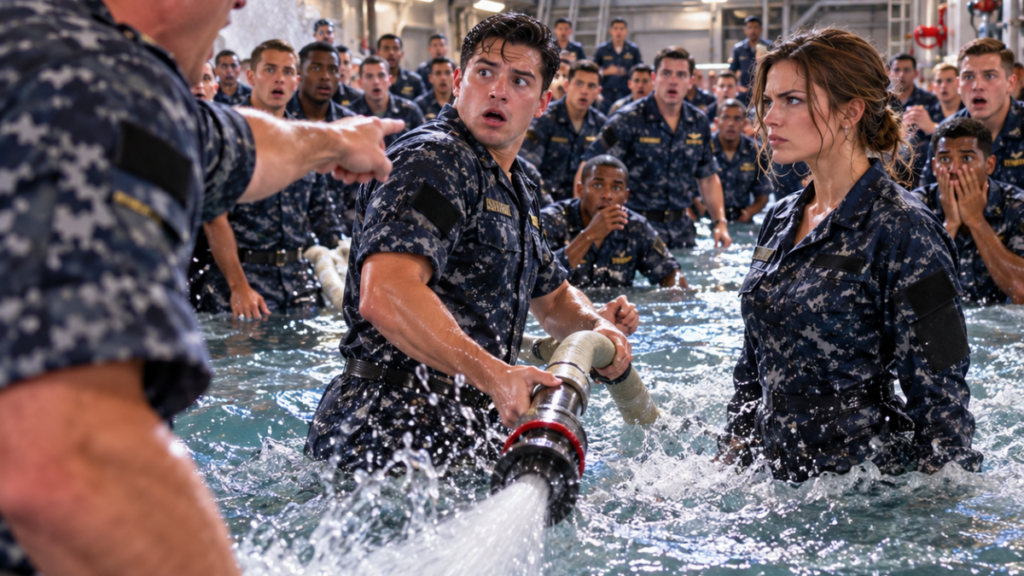
Flooding Trainer. Forty-Degree Water At Our Waists. Thirty Sailors Watching. The Chief Pulled The Hose Out Of My Hands. “Step Back, Ma’am. Let Me Show You How It’s Actually Done.” He Handed It To His Best Sailor. “Reyes. Show Her.” Reyes Turned, Saw My Face, And The Hose Slid Out Of His Hands. The Chief Laughed. “What’s Wrong With You? Petty Officer, I Said Show Her.”
The chief yanked the charged hose out of my hands in front of thirty sailors and said, “Step back, ma’am. Let me show you how it’s actually done.” Then he handed it to his best damage-control instructor and ordered him to demonstrate. The petty officer turned toward me, saw my face, and went completely white. The hose slipped from his hands and began thrashing through freezing water. What nobody in that flooded steel room knew was that he had seen my face once before—eleven years earlier, at the top of a ladder on a sinking ship.
### Part 1
The wet trainer was a ship that never went anywhere. It sat inside a warehouse at a naval training center in Norfolk, Virginia, a haze-gray steel compartment surrounded by scaffolding, pipes, a control booth, and a floor drain large enough to swallow a toolbox. When the instructors pushed the right buttons, seawater-cold water blasted through ruptured fittings, climbed past your knees, then your waist, and turned every lesson you had memorized from a manual into something physical. I signed in at 0630 on a Thursday morning in February 2026 with thirty sailors from my destroyer’s repair parties behind me, all of us dressed in blue coveralls, boots, hard hats, and float coats.
My name was Lieutenant Commander Evelyn Carter, and at forty-one I was the chief engineer of the USS Hamilton, a guided-missile destroyer tied up across the base. I had been aboard for five months, long enough for most of my sailors to know me as the woman who signed maintenance packages, argued over parts, reviewed casualty procedures, and appeared in engineering spaces at inconvenient hours with a notebook. Damage Controlman Second Class Priya Shah caught me at the gear rack and stared when I started pulling on a float coat. “Ma’am, you know department heads usually watch from the control booth, right?” she asked, and when I told her I would be on the patching team, she studied my face as if deciding whether I was joking.
I had heard versions of that question for years. Officers watched; sailors worked. Officers approved damage-control bills; enlisted sailors crawled into smoke, freezing water, and machinery spaces where the deck plates burned through your boots. The funny thing was that I had spent fourteen years on the enlisted side before earning a commission, but very few people aboard Hamilton had ever read far enough into my record to notice more than the gold oak leaf on my collar. I did not correct their assumptions because most assumptions eventually corrected themselves when the lights went out.
The civilian running the control booth was an older man with a gray ponytail and a mug that read WORLD’S OKAYEST GRANDPA. He asked whether it was my first time in a wet trainer, and I told him no. “Chief Rourke runs a hard class,” he said while looking down through the window at the empty compartment. “Best damage-control instructor on the base, probably. Doesn’t much like officers getting into his water, though.” I asked whether officers slowed people down, and after considering the question seriously, he said, “Usually.”
My commanding officer, Commander Laura Bennett, had asked me the previous afternoon whether I truly intended to climb into the trainer with the repair parties. “You have about three hundred things waiting for your signature,” she had said from behind her desk. I told her I would sign them wet, and she gave me the particular look captains give when they have already read enough of your record to know arguing will not help. She was one of the few people aboard who knew that before I became Lieutenant Commander Carter, I had been Chief Damage Controlman Carter, and before that I had spent years carrying hoses, swinging hammers, crawling through smoke, and learning exactly how quickly the ocean could take a steel compartment.
Chief Mason Rourke walked into the safety brief at 0700 carrying a clipboard and wearing the expression of a man who considered unnecessary words another form of wasted motion. He was broad through the shoulders, gray at the temples, and looked as if twenty-four years around fire hoses had permanently taught his body to lean into pressure. He explained the temperature, escape routes, safety signals, flooding limits, and the rule that mattered most: nobody drowned in his trainer. Then he noticed the insignia on my collar, smiled politely, and said, “Ma’am, there’s a spot next to the watertight door where you can stand. Good view. Officers usually like it for the pictures.”
A few sailors laughed, though none of mine did. I told him I would be working with the patching team, and his smile tightened for less than a second before he said, “Suit yourself.” At the far end of the room, a first-class petty officer was inspecting nozzles, hoses, shoring timbers, and patch kits with quick, practiced hands. He was compact, maybe thirty, with a pale scar disappearing beneath his collar and a name tape that read MORENO.
I knew the name was common, so I told myself it meant nothing. I lowered my face shield, tightened the cracked chin strap on my borrowed hard hat, and followed my sailors into the trainer. Petty Officer Adrian Moreno passed me carrying a sledgehammer, glanced toward me through the bad warehouse lighting, then looked away without changing expression. I did the same, but for reasons I could not explain yet, my hands had already gone cold before anyone turned on the water.
### Part 2
I grew up in Bath, Maine, where ships seemed less like machines than weather. My father spent thirty-one years in the shipyard building destroyers, and when I was young he used to tell me that every warship was simply a steel box filled with people trying to keep the ocean outside. “Everything else is decoration,” he would say, usually while eating dinner with grease still trapped in the lines of his hands. When I enlisted in 2003 and asked to become a damage controlman, the recruiter asked whether I understood what the job involved, and I told him my father built the box and I wanted to help keep the ocean out.
My first ship was an aging frigate out of Mayport, and I reported aboard at nineteen with more determination than body weight. During my first general-quarters drill, a first-class petty officer named Rick Dalton handed the men hoses, axes, breathing gear, and shoring equipment, then gave me a battle lantern. “Women in damage control hold the light,” he said without hostility, almost kindly, as if he were explaining where coffee was stored. I held the lantern steady, watched every movement, memorized every valve, and spent my nights drawing the fire-main system deck by deck until I could move through the ship in darkness.
Six months later, during a smoke-filled drill, a hose team became disoriented in a passageway. I was behind them with my lantern when the nozzleman turned toward the wrong ladder. “Left,” I said. “Next hatch left, then down.” Dalton looked back through his mask, stared at me for a long second, then followed my direction, and after the drill he never mentioned it.
At the next general quarters he handed me a hose instead of a lantern. That was how most changes happened in the Navy I knew—not through speeches, not because someone suddenly admitted an old assumption had been stupid, but because one day they stopped putting you where they thought you belonged and started putting you where your hands had proven useful. Nobody ever apologized for giving me the flashlight. Eventually I carried both.
Back in Norfolk, the first evolution involved a split overhead fitting. The booth operator pushed a switch, and a flat sheet of freezing water exploded across the compartment with enough noise to erase conversation. Priya had the patch kit while two younger sailors, Marcus Reed and Jonah Kim, braced beside us, but the movements came back to me without thought: gasket, band, wedge, hammer, tighten. Ninety seconds later the violent sheet had become a spray, the spray a drip, and then nothing.
“Time,” Chief Rourke called, looking at his stopwatch before examining the repair. “Nice work, Shah. Good hands.” Priya opened her mouth because everyone on the patching team knew whose hands had placed the gasket and set the wedge, but I touched her elbow before she could speak. She looked at me sharply, then closed her mouth, and I pretended the mistake did not bother me as much as it did.
The next evolution was shoring a simulated damaged hatch. I lifted a timber from the stack, but Rourke intercepted me before I could settle it onto my shoulder. “Ma’am, I need experienced hands on this one,” he said loudly enough for everyone nearby to hear. “Why don’t you let Kim take that?” He removed the timber from me with careful firmness, not disrespectful enough to challenge directly, just certain enough to tell me exactly what he believed about my place in his trainer.
I stepped against the bulkhead and watched my sailors build the frame. Rourke taught them well, correcting measurements without humiliating anyone and spotting a weak wedge before it became dangerous, which somehow made his blindness toward me more frustrating. He was not incompetent, cruel, or lazy. He was exactly the kind of man who could be right about almost everything and still miss the person standing directly in front of him.
Moreno passed me with the sledgehammer again and gave me another quick look. My face shield was fogged and half lowered, so whatever thought crossed his mind disappeared before I could read it. Then Rourke called a twenty-minute warming break before the main flooding evolution, and thirty sailors crowded into a cinder-block room smelling of wet canvas, burnt coffee, rubber gear, and the metallic cold that clung to everyone’s clothes. Rourke stood at the front with a paper cup and told them he wanted to explain why he took flooding drills so seriously.
“Eleven years ago,” he began, “a destroyer was struck by a merchant vessel during a night transit. Hull opened below the waterline. Berthing compartment flooded fast. Forty racks, two sailors trapped.” My hand stopped halfway to my coffee because I knew the rest of the story before he spoke another word. He described a chief who had gone down a ladder into black water with two minutes before the hatch had to be shut, returned carrying one unconscious fireman, then tried to go back for the second.
Around me, young sailors listened with the solemn fascination people have when tragedy has become training material. Rourke said the chief had survived only because an officer at the top of the ladder grabbed the back of the chief’s collar and pulled her out before the hatch closed. “I never found out who that chief was,” he said. “But somewhere out there is a sailor alive because somebody went down while everybody else was coming up.”
Across the warming room, Adrian Moreno stood perfectly still beside the coffee pot. He was no longer listening like a man hearing a familiar training story. He was listening like someone waiting for a door that had been closed for eleven years to open, and for the first time that morning I stopped wondering whether I recognized his name. I began wondering whether he remembered my face.
### Part 3
The day before the collision had been painfully ordinary. I had been aboard that destroyer for only three weeks, newly selected as leading chief for the damage-control division and still learning which sailors needed close supervision and which ones could be trusted with a compartment before breakfast. We ran a flooding drill in a berthing space two decks below the main deck, no real water involved, just scenario cards, hoses, simulated casualties, and people moving through procedures they had performed dozens of times. Fireman Adrian Moreno was an engineman striker who occasionally augmented the repair locker, and he was terrible at damage control.
He tangled his hose around a ladder, talked while he should have been listening, and made two sailors laugh while the first class running the drill was trying to explain a boundary failure. Petty Officer Harris finally stopped the evolution, pointed at Moreno, and said, “If this were real, you’d be dead.” Moreno grinned and answered, “If this were real, Chief Carter would come get me.” He hooked his thumb over his shoulder without realizing I was standing in the passageway behind him, and the whole hose team laughed.
There was another fireman named Ethan Miller who was the opposite of Moreno. Ethan was twenty, quiet, pale, methodical, and did everything exactly as trained. He worked crossword puzzles in pen during meals and got enough answers wrong that Moreno constantly tried to correct him, though Ethan almost never accepted the suggestions. I remember seeing the puzzle book tucked beside his rack during an inspection, next to a picture of him with his mother at what looked like a county fair.
At 0210 the next night, I woke on the deck because the ship had been struck hard enough to throw me from my rack. There was a grinding vibration through the hull, then the alarm, then the unmistakable change in the ship’s motion that told every experienced sailor something heavy had happened below the waterline. A merchant vessel had hit our starboard side while we were transiting a narrow channel, opening a section of hull below the surface. I ran toward the casualty before I knew where it was because sometimes your body understands an emergency faster than your mind.
The damage was in the same berthing compartment we had drilled in the day before. Thirty-eight sailors had escaped, but two were missing, and the water was rising too quickly for the repair parties to control. At the top of the ladder stood Ensign Thomas Mercer, our young damage-control assistant, wearing a sound-powered headset and the expression of someone doing arithmetic where every answer hurt. “Chief, we’re setting the boundary,” he told me. “We have to close this hatch.”
That was the rule. If a compartment flooded faster than you could fight it, you isolated it before the ocean took the rest of the ship. I told him two sailors were still below, and he looked from me to the hatch to his watch before saying, “You have two minutes.” I grabbed a battle lantern, put it between my teeth, and went down.
The water at the bottom of the ladder was already at my chest. Emergency lighting had failed, mattresses and seabags drifted through the darkness, and somewhere forward the ocean came through torn steel with a sound like a waterfall inside a tunnel. I knew the compartment because I knew every space on that ship, every rack row, locker, ladder, and bulkhead, and I moved through black water using the lantern beam and memory. That was when my boot struck another boot.
The first sailor was sitting against a locker with his head tilted backward, his mouth barely above the surface. He was unconscious, nineteen years old, and even through wet hair and darkness I recognized Adrian Moreno, the fireman who had joked the previous afternoon that the chief would come get him. Ten feet farther forward, under a collapsed rack frame, I could see a sleeve and one pale hand. Ethan Miller was pinned beneath twisted metal with water rising around him.
I had less than a minute remaining. I have spent eleven years wishing I could say I stood there and made some deliberate decision, weighed distances, calculated survival chances, or chose according to training. I did not. Adrian was within reach, Ethan was trapped under steel, and the water was climbing toward my chin.
I hooked my arms beneath Adrian’s shoulders and dragged him backward. Wet coveralls made him feel twice his size, and the lantern kept striking my teeth as I fought my way toward the ladder with his head against my shoulder. I remember grabbing the first rung, somebody above reaching for his collar, and Adrian coughing once when we reached the top. His eyes opened for perhaps one second, and from less than a foot away he looked directly into my face.
Then the corpsman took him from me. I turned around before anyone could stop me and went back down the ladder because Ethan Miller was still there. By then the water had climbed so high that when my boots reached the deck, it touched my chin, and after one step forward it went over my head.
I tried to move toward where I had last seen Ethan’s hand, but something caught the back of my collar. Ensign Mercer had flattened himself on the deck above and reached one arm through the hatch. “Chief,” he shouted. “Time.” He pulled while I fought him for perhaps half a second, and then together with another sailor he dragged me through the opening.
The hatch closed. We shored it from the outside while the steel groaned under thousands of gallons of trapped water, and the ship survived. Ethan Miller did not, and for eleven years I had lived with one sentence I could never make sound any different no matter how many times I repeated it in my head: I could reach one.
### Part 4
When the warming break ended, I returned to the trainer before everyone else. For four minutes I stood alone in the gray compartment staring at the ladder, knowing perfectly well that it was bolted to a warehouse structure in Virginia and not welded into a damaged destroyer halfway across the world. Trauma does not care about engineering drawings, and my hands had tightened before the water even started. Priya came through the hatch behind me, studied my posture, and quietly asked, “Ma’am, you okay?”
I told her I was fine, and because she was a good sailor she knew better than to believe me but also knew when not to push. The rest of the repair party entered stamping boots and making jokes, thirty bodies filling the space until the ladder became ordinary again. Chief Rourke climbed to the catwalk with his clipboard, Adrian Moreno took his safety position near the forward bulkhead, and the control booth activated the flooding sequence. Three pipes ruptured at once.
Water hammered down from overhead, blasted from the port bulkhead, and surged from a low fitting near the deck. Within minutes it reached our waists, forty-degree water pulling heat from our bodies while voices echoed against steel. I had the hose, Priya had the patch kit, and I opened the nozzle toward the largest overhead break to knock the pressure aside long enough for her to work. My face shield had fogged completely, so I pushed it up and turned my face into the spray.
That was when Chief Rourke climbed down from the catwalk. He crossed the space, grabbed the charged hose directly behind the nozzle, and removed it from my hands before I understood what he was doing. Water kicked sideways across the compartment as he gained control. “Step back, ma’am,” he said loudly enough for all thirty sailors to hear. “Let me show you how it’s actually done.”
Nobody moved. Priya froze with the patch gasket in her hands, Marcus held a shoring timber halfway to his shoulder, and the room seemed to narrow around the fact that a chief petty officer had just removed a hose from his department head because he believed she did not know how to use it. Rourke did not take the nozzle himself. Instead he turned toward Adrian and held it out.
“Moreno,” he ordered. “Show her.”
Adrian stepped forward automatically. He took the hose with the effortless familiarity of a man who had spent years controlling pressure, adjusted his grip, and turned toward me. My face shield was still raised.
I watched recognition happen.
The color disappeared from his face so quickly I thought for an instant he might be having a medical problem. His fingers opened. The charged hose fell into the waist-deep water.
A loose fire hose does not simply lie there. The nozzle snapped sideways with violent force, spraying the overhead and whipping across the surface while sailors ducked away. Adrian did not react at all. He stood with his hands open at his sides, staring at me as if the room had vanished around us.
Rourke gave a short laugh of surprise. “What’s wrong with you?” he demanded. Adrian did not answer, so Rourke’s voice sharpened. “Petty Officer, I said show her.”
Adrian continued staring at my face.
I saw the nineteen-year-old in him then. Not the decorated first-class instructor, not Rourke’s best sailor, not the man whose hands could control a flooding evolution almost without thought. I saw a young fireman opening his eyes at the top of a ladder, water in his lungs, a strange chief eight inches from his face. I realized he had remembered me for eleven years from one second of consciousness.
The hose kicked again. Nobody else seemed able to move, so I pushed through the water, caught the line behind the nozzle, walked my hands forward against the pressure, and closed the bail. The hose went still.
Rourke climbed fully into the water, his face red with the anger of a competent instructor whose classroom had suddenly stopped obeying logic. “Everybody out,” he barked. “Evolution stopped. Booth, secure water.” Then he looked directly at me and lowered his voice only slightly. “Ma’am, with respect, I don’t know what this is, but I run a safe trainer. I don’t need a department head coming in here and turning an evolution into a circus.”
The incoming water stopped, but the compartment remained flooded to nearly four feet. Thirty sailors stood watching us. I knew the easy response because I had used it most of my career: tell him he was right, hand him his classroom back, leave quietly, let everyone pretend nothing had happened.
Then I looked at Adrian. His face had gone past shock into something heavier, and I understood that if I walked away he would have to stand in that flooded compartment alone with eleven years suddenly alive in front of him. I had already left him alone once.
“Chief,” I said to Rourke, “the water is still in the space. Finish your evolution.”
He stared at me.
I held the hose past him toward Adrian. “Petty Officer Moreno,” I said. “Show them.”
Adrian looked at the nozzle, then at me. For one long second I thought he would refuse, but finally his hands closed around the hose. He nodded once, and in that small movement I saw the frightened nineteen-year-old disappear beneath the sailor he had spent eleven years becoming.
### Part 5
Chief Rourke returned to the catwalk without another word. “Booth,” he said into his radio. “Restart the evolution. Same scenario.” The pipes erupted again, and Adrian Moreno moved.
I had watched thousands of sailors perform damage control over the years, including some excellent ones, but Adrian attacked that flooded compartment with a precision that made the entire repair party seem to accelerate around him. He knocked down the overhead break in three controlled sweeps, gave Priya enough protection to seat the gasket, redirected Marcus and Jonah toward the damaged hatch, and called instructions without shouting. He never once looked toward me while the water was rising.
The gauge stopped at three feet eight inches. Then the level began dropping. Seven minutes and fifty seconds after the evolution restarted, the booth operator announced the time over the speaker with audible surprise.
Adrian closed the nozzle and placed the hose carefully across a shoring timber. He stood in thigh-deep water, turned toward the thirty soaked sailors around him, and said, “I need everyone to hear something.” His voice was steady, but his jaw trembled.
“You heard Chief Rourke’s story in the warming room this morning,” he began. “Destroyer collision. Night transit. Flooded berthing compartment. A chief went down a ladder with two minutes before they closed the hatch.” Above us, Rourke stopped writing on his clipboard.
Adrian swallowed. “I was the fireman she carried up.”
Someone behind me whispered, “No way.”
“I was nineteen,” Adrian continued. “I was unconscious for most of it. At the top of the ladder I woke up for maybe one second, and I saw somebody’s face. That’s all I remembered.” He looked directly at me then. “I have been looking for that face for eleven years.”
The room became so quiet I could hear water draining through the grated deck. Adrian explained that after recovering, he had changed ratings and become a damage controlman because he felt he owed someone a hose. He had asked people from the ship, searched old records, contacted former crew members, and eventually told Chief Rourke enough of the story that Rourke began repeating it to every wet-trainer class. “Every group that comes through here, I look at the faces,” Adrian said. “Every chief. Every officer. Every sailor.”
He laughed once, but no humor came with it. “The day before the collision, the first class running our drill told me I’d be dead if the casualty were real. I joked that if it were real, the chief would come get me.” His eyes stayed on mine. “I didn’t even know her. She had been on the ship three weeks.”
I wanted to disappear into the water. I wanted to tell him the story had been exaggerated, that memory was unreliable, that survival belonged to a hundred people rather than one person. Most of all, I wanted to avoid what always followed Adrian’s survival in my own mind: Ethan Miller under the rack frame.
Instead I said, “Yes. It was me.”
Priya made a small sound beside me.
Through the booth window, the gray-haired civilian operator stood from his chair. Next to him, Senior Chief Denise Holloway, the leading chief for the training facility, reached across the panel and activated the drains herself. Water began spiraling around our legs.
Chief Rourke slowly removed his hard hat. He held it in both hands while looking down at me from the catwalk, and I could see him replaying the entire morning—the joke about the photo spot, the patch he had credited to Priya, the timber he had taken off my shoulder, the hose he had pulled from my hands. His expression changed by degrees until embarrassment gave way to something more uncomfortable: understanding.
Marcus Reed began clapping. One person, slowly.
I lifted my hand. “Don’t.”
He stopped.
“Not for me,” I said. I pointed toward Adrian. “He’s the one who just fought the space.”
Adrian shook his head, and for the first time that morning he smiled. His eyes were wet, but underneath the emotion was the same grin I remembered from the young fireman who could make an entire repair locker laugh at the wrong time. “Chief,” he said.
I had not been called that way in years.
“You came and got me.”
The sentence reached backward through eleven years and landed on the day before the collision. If this were real, the chief would come get me. I had heard him say it as a joke when he did not know I was listening.
I could not answer. I only nodded.
The last water drained away with a long metallic sigh. Thirty sailors remained standing around us even though the evolution had ended, and I realized with sudden discomfort that many of them were looking at me differently. I did not want them to see a legend because legends make dangerous instructors; legends encourage people to believe emergencies are solved by extraordinary individuals instead of teams, procedures, training, and luck.
Chief Rourke seemed to understand some of that. He climbed down, replaced his hard hat, and ordered everyone into the warming room. His voice had changed, not softer exactly, but stripped of the casual certainty he had carried all morning.
I stayed behind to secure my gear. Adrian waited near the ladder, watching me with an expression I could not interpret. I knew eventually he would ask about the second sailor.
That frightened me more than the flooding had.
### Part 6
Chief Rourke found me at the gear rack while I was struggling to open the frozen clip on my float coat. He stood beside me long enough that the silence became its own conversation. Finally he said, “Ma’am, I’m going to report myself to Senior Chief Holloway.”
I asked him what for, though we both knew. “For the way I treated you in front of your sailors,” he said. “Taking equipment out of your hands, assuming you didn’t know the work, the whole morning.” I finally forced the clip open and hung the coat on its hook.
“No,” I told him. “You’re going to keep teaching.”
He frowned. I explained that I had spent enough time in training environments to recognize someone who could keep sailors alive, and Rourke was one of the best instructors I had watched. “You just need to look at who is actually in the water with you,” I said. “Not the collar. Not the job title. Not whether someone fits whatever picture you have in your head. Look at the hands.”
Rourke turned his hard hat slowly between his palms. He admitted he had spent years watching officers come through the wet trainer only for photographs or qualification checkboxes, so eventually he began assuming all of them were the same. “Most bad habits have reasons,” I told him. “That doesn’t make them good habits.”
Then I asked him for one thing.
“When you tell the collision story again, there were two firemen in that compartment.” Saying the next name aloud felt like lifting something rusted. “The other one was Ethan Miller. Twenty years old. From Ohio. He did crossword puzzles in pen and got half the answers wrong.”
Rourke’s face changed.
“He was trapped beneath a rack frame,” I continued. “I reached Adrian first. I went back for Ethan, but the water was over my head and Mercer pulled me out before the hatch closed.” My throat tightened, but I made myself finish. “When you tell the story, say Ethan’s name. Don’t make him the unnamed sailor who didn’t come out.”
Rourke looked at me for a long time. “Yes, ma’am,” he said. “I’ll tell it right.”
The warming-room door was open when I passed. My sailors were wrapped in towels with coffee cups between their hands, talking loudly until they saw me, at which point every conversation stopped. Priya stood first, then Marcus, then the rest, thirty dripping people rising one after another.
“Sit down,” I told them. “Drink your coffee before Chief Rourke makes you do this again.”
They laughed nervously and sat, but Priya followed me into the hallway. She pulled the door closed behind her and said, “Ma’am, this morning when I asked whether you’d done this before, you told me once or twice.”
“I may have understated.”
She did not smile. “You let him give me credit for your patch.”
“It was your patch.”
“You placed the gasket.”
“You held the light.”
Priya stared at me with the offended expression of a sailor who suspected she was being given a lesson she had not asked for. I told her about my first ship, when men had handed me a flashlight because they believed that was the only job I could perform. “It took me years to understand that holding the light steady matters too,” I said. “Next time you swing the hammer, I’ll hold it.”
Her eyes filled, and she looked irritated about that as well. “Yes, ma’am,” she said before returning to the warming room.
Senior Chief Holloway met me near the exit. She was in her late forties, silver threaded through dark hair, and she had been a damage controlman almost as long as I had. She did not salute, apologize for Rourke, or make a speech.
She simply held out her hand and said, “DCC Carter.”
Not lieutenant commander. Not ma’am.
Chief Damage Controlman Carter.
I shook her hand. “Senior Chief.”
It was enough.
Adrian waited outside on the loading dock holding two cups of terrible trainer coffee. The wind off the river was gray and sharp, and when he handed one to me I suddenly remembered another cup of coffee eleven years earlier, another officer standing beside me after sunrise while a damaged destroyer limped toward port. We stood without speaking until Adrian finally asked why I had never come to see him after the collision.
“I did,” I said.
He turned.
“I went to the hospital in Bahrain. You were asleep. I stood in the doorway for a few minutes, and then I left.”
“Why?”
Because I was afraid of the first question you would ask, I thought.
Out loud I said, “Because if I woke you, you would ask where Ethan was.”
Adrian stared down into his coffee. “Would you have told me?”
“I would have had to tell you that I could reach one.”
He looked up. “Is that how you think of it? Like you chose?”
“I reached you. Ethan was trapped farther in.”
“That isn’t choosing.”
“It feels like choosing when you’re the one who came back.”
We stood in silence while a tug sounded somewhere beyond the buildings. Finally Adrian said, “I think about Ethan every day. He was my rackmate.”
“I know.”
He looked surprised.
“I have his crossword book.”
For the second time that day, Adrian Moreno looked at me as if the world had unexpectedly rearranged itself.
### Part 7
The crossword book had spent eleven years in the bottom drawer of my desk. It was swollen from seawater, warped so badly that several pages had fused together, and the ink had bled into blue-gray clouds around Ethan’s uneven block letters. I had found it nine days after the collision when the ship reached dry dock and the flooded compartment was finally pumped out. Nobody asked me for it, so I kept it because returning it would have required explaining things I had not yet learned how to explain.
There was another thing in that drawer: a letter from Ethan’s mother, Margaret Miller. Two months after the casualty, she had written that someone from the crew had told her I went down into the compartment searching for her son. She thanked me and said she did not need details, only wanted to know someone had tried.
I wrote responses nine times. Every version contained the same unbearable sentence: I could reach one. Every time I reached those words, I folded the letter, put it away, and told myself silence was kinder.
The night after the wet trainer, I sat alone in my stateroom aboard Hamilton with the crossword book on my knees. Shore power hummed through the bulkheads, and somewhere down the passageway someone was playing music quietly enough that I could only hear the bass. For eleven years I had believed carrying that memory privately was a form of strength.
Adrian’s face in the trainer had shown me something different. Being remembered by the sailor I saved meant remembering the sailor I could not bring out. They were not separate stories, no matter how carefully I had tried to store them in different parts of myself.
Around midnight I took out paper.
Dear Mrs. Miller,
Then I wrote the sentence.
I could reach one.
I did not soften it. I explained where Ethan had been, where Adrian had been, how quickly the water rose, how I had returned after carrying Adrian to the ladder, and how Ensign Mercer had physically pulled me out when time expired. I told her Ethan had performed every step correctly during the drill the day before, that he loved crossword puzzles, and that he had kept the finished ones because he wanted to show them to her.
I told her I still had his book.
Then I apologized for taking eleven years to write.
Three weeks later I returned to the wet trainer with Hamilton’s second repair party. Beside the ladder was a new placard identifying the final scenario as THE MILLER EVOLUTION. Underneath were Ethan’s name, the date of the collision, and three facts: two casualties, one ladder, two minutes.
Chief Rourke ran the evolution himself. Two training mannequins were placed inside a dark flooded compartment, one near the ladder and another farther away beneath a fallen rack frame. A two-minute clock was mounted where everyone could see it.
Rourke never told the class there was a correct answer.
There wasn’t one.
The point was to make sailors understand what procedural language like “set the boundary” looked like when human beings existed on both sides of the hatch. Some teams removed the closer casualty and returned for the second. Others tried immediately to free the trapped mannequin and nearly lost both. Afterward Rourke forced them to explain every choice without pretending the ocean cared about intentions.
In the warming room he told the collision story again.
This time he said Ethan Miller’s name.
He said Adrian Moreno’s name too.
He did not say mine because I had asked him not to.
When Rourke reached the part about the chief going down the ladder, his eyes briefly found mine across the room. I nodded once, and he continued without identifying me. The story belonged to the lesson now, not to my rank.
After class he walked me toward the exit. “Got another officer coming through next week,” he said. “Brand-new ensign. Supply Corps.”
I waited.
“I’m going to let her hold the hose.”
“Good.”
“I’m going to watch her hands.”
“Better.”
Adrian requested orders to Hamilton without telling me. I discovered it when the detailer called my office and asked whether I objected to receiving a first-class damage controlman with eleven years of experience, instructor qualifications, and a recommendation from Chief Rourke that took nearly half a page. I told him I had no objection.
Adrian reported aboard in April as leading petty officer for one of our repair lockers. Priya became his assistant and spent her first week looking equally delighted and terrified, which I considered healthy. Commander Bennett called me into her cabin shortly afterward with my old service record open on her desk.
“Why didn’t you tell me?” she asked.
“You read my record.”
“I read that you were the leading damage-control chief during the collision. I read your achievement medal.” She tapped the folder. “I did not read that you personally went into the compartment.”
“There wasn’t much about it in the final report.”
Bennett leaned back. “Mercer’s original statement should still exist in the investigation file.”
“I never looked.”
“I’m going to.”
Captains do not always ask permission when they phrase something like a statement. I let her.
Several weeks later Navy Personnel Command informed me that my award from the collision was under review. I put the letter in the same drawer where Ethan’s crossword book had lived.
Whatever came from the review was paperwork.
The water had already happened.
### Part 8
Margaret Miller answered my letter in May. Her handwriting was small, straight, and careful, and the envelope sat unopened on my desk for almost an hour because after waiting eleven years I suddenly became afraid to know what she thought. Finally I opened it.
She wrote that she had always suspected Ethan had been trapped because the officer who came to her house after the casualty could not look her in the eye when explaining the recovery. She said knowing someone had seen her son, recognized him, and tried to return for him was all she had ever wanted. Then she told me she did not want the crossword book back.
“Keep it,” she wrote. “Ethan would probably be happy somebody in the Navy is still trying to solve his terrible puzzles.”
At the bottom she included a clue.
Seven letters. Keeps the ocean out.
I spent two days trying to solve it before Adrian finally found me staring at the paper during lunch. I covered it with my hand when he leaned over, but he saw enough to start laughing.
“Ma’am, are you cheating on Miller’s crossword?”
“I’m conducting research.”
“What’s the clue?”
“None of your business.”
He kept laughing until Priya came over, read the clue upside down, and suggested “bulkhead,” which had eight letters. Adrian proposed “sea wall,” then proudly counted the letters wrong twice.
That made me laugh harder than anything had in months.
In June Hamilton sailed from Norfolk for deployment. On our third day underway, Commander Bennett called general quarters for an unannounced flooding drill in a berthing compartment two decks below. I went to the repair locker because chief engineers are supposed to observe, evaluate, and avoid getting in the way unless needed.
Adrian was distributing equipment when I arrived. Hoses went to the hose team, shoring timbers to another group, patch kits to Priya’s people. Then he looked up at me and smiled.
“Ma’am,” he said, holding out a battle lantern, “somebody’s got to hold the flashlight.”
The entire repair locker laughed.
I took it.
Then I reached past him and took a hose too.
His grin widened.
General quarters continued around us, alarms ringing, ventilation shifting, boots pounding against steel decks. We moved toward the casualty space with the hose team while Priya called out assignments behind us. Eleven years earlier, a nineteen-year-old fireman who could barely manage a hose had joked that if a casualty became real, his chief would come get him.
Now that same sailor was leading a repair locker.
The Navy eventually upgraded my old award. Commander Bennett insisted I attend the presentation, Senior Chief Holloway sent me a message containing only the words ABOUT TIME, and Chief Rourke appeared without telling me he was coming. Adrian stood in the back beside Priya.
I accepted the medal because refusing it would have turned someone else’s effort into another argument. Afterward I put the case in my desk next to Margaret Miller’s letter.
The medal did not make the ladder easier to remember.
Recognition rarely repairs the thing people imagine it will. It can correct a record, restore a name, or tell younger sailors that certain work mattered, but it cannot change which compartment flooded or who came up the ladder. The only thing that changed me was finally saying Ethan’s name where other people could hear it.
Chief Rourke continued teaching the Miller Evolution. Every class ended with exhausted sailors standing in cold water while a clock counted down from two minutes. He told them there was no heroic answer hidden in the scenario, only decisions made with incomplete information while time disappeared.
He also stopped pulling officers off hoses.
Months later he emailed Adrian a picture of a young female ensign working a patch team during a flooding evolution. There was no caption except one sentence.
Watched her hands.
Adrian printed it and taped it inside the repair locker.
By the end of deployment, Priya had become one of the strongest repair-locker leaders on the ship. During a drill off the coast of Japan, I watched her place a new fireman behind a hose team with a battle lantern. The sailor looked disappointed.
Priya told him, “Hold it steady. You’ll need both hands eventually.”
I almost laughed.
That was how lessons survived in the Navy. Somebody taught you badly, somebody else taught you better, and eventually you got the chance to decide which version you passed forward. My father had once told me a ship was nothing more than a steel box full of people trying to keep the ocean out.
He was wrong about one thing.
The people were not inside the box.
The people were the box.
Steel could split. Pumps could fail. Reports could lose names between drafts, and medals could arrive years late with the wrong story attached. What kept a ship alive was somebody reaching for the hose, somebody holding the flashlight, somebody grabbing a collar at the top of a ladder, and somebody going back even when there was no guarantee they would return.
For eleven years I believed strength meant carrying Ethan Miller quietly. I thought if I put the memory into a drawer and kept working, that proved I had survived it. Adrian taught me otherwise without trying.
Strength was telling Margaret what happened.
Strength was asking Rourke to say Ethan’s name.
Strength was letting Adrian remember the person who carried him without allowing that memory to erase the person we lost.
Near the end of deployment, I went down to the repair locker during another drill. Adrian was checking nozzle patterns while Priya inspected patch kits, and a group of new sailors stood around them trying to look less nervous than they were. Nobody stopped working when I entered.
That made me happier than a room standing at attention ever could.
Adrian noticed me eventually and tossed over a battle lantern.
I caught it.
“You holding the light today, ma’am?”
“For now.”
He pointed toward a charged hose on the deck.
“Think you still remember what to do with one of those?”
I looked at him.
Priya covered a smile.
“You planning to show me?”
Adrian immediately raised both hands. “Absolutely not.”
Everyone laughed.
The alarm sounded. We moved.
And when the lights went out, I held the flashlight steady until someone needed my hands somewhere else.
Because that was the lesson I had spent most of my life learning: you do not have to convince everyone in the room that you know how to hold the hose. You do not need to win every argument, correct every insult, or announce everything you survived.
Sometimes the people standing in the water with you already know.
Sometimes they need eleven years to recognize your face.
And sometimes the hardest person to convince is yourself—that reaching one person does not mean you abandoned the other, that surviving a choice does not mean you made it without pain, and that silence is not the same thing as strength.
I still keep Ethan Miller’s crossword book.
I still get the answers wrong.
Adrian still corrects me, and I still ignore at least half his suggestions because I think Ethan would appreciate that.
Somewhere in Norfolk, at the end of every wet-trainer class, Chief Mason Rourke pushes a button and a steel compartment begins filling with freezing water. Young sailors fight leaks, carry casualties, argue with a clock, and discover how quickly neat classroom rules become complicated when water reaches their chest.
Then Rourke opens the drains.
The water leaves with a long rattling sigh.
Before the class goes home, he tells them about Adrian Moreno.
Then he tells them about Ethan Miller.
He says both names.
And that is enough.
THE END!

