 PART 1: The Laugh That Silenced Two Hundred Guests
My son’s bride shoved my sixty-eight-year-old wife into the mud in front of nearly two hundred wedding guests, and when my wife cried out in pain, the bride laughed.
But the moment that destroyed something inside me was not the shove.
It was watching my son walk past his fallen mother, wrap an arm around his new wife, and whisper something that made her laugh even harder.
My name is Thomas Whitmore, and until that afternoon at Briarwood Estate outside Charleston, South Carolina, I believed there were certain things my family would never have to question.
I believed my son loved his mother.
I believed kindness would eventually be recognized.
And I believed that helping pay for a beautiful wedding was one of the last great gifts a father could give his only child.
By the time the afternoon ended, I would understand how terribly wrong I had been about at least two of those things.
The wedding had been planned for almost a year.
My wife, Margaret, had thrown herself into every detail with the enthusiasm of a woman who had waited decades to see her son marry.
She was sixty-eight, with silver hair she wore neatly pinned above her neck and gentle blue eyes that had somehow remained warm through every disappointment life had handed us.
Arthritis had made walking difficult, especially across uneven ground, but she refused to let her cane become the most important thing people noticed about her.
She preferred to be remembered for her homemade peach cobbler, her terrible jokes, and the way she could make a stranger feel welcome within five minutes.
Daniel was our only son.
He was forty-one, successful in his career, and old enough that I had stopped worrying about whether he knew how to make his own decisions.
Or so I thought.
When he introduced us to Vanessa Caldwell, he seemed happier than I had seen him in years.
Vanessa was beautiful in the deliberate, polished way of someone who never entered a room without knowing how she wanted to appear.
She had chestnut-brown hair, expensive taste, and a smile that changed depending on who was standing in front of her.
Around Daniel, she was affectionate and charming.
Around her friends, she was witty and confident.
Around Margaret, she sometimes became someone I barely recognized.
The first time I noticed it, we were discussing wedding flowers over dinner.
Margaret suggested using garden roses because they reminded her of the flowers her own mother had carried on her wedding day.
Vanessa smiled across the table.
“That sounds sweet, Margaret, but we’re trying to make the wedding look elegant rather than homemade.”
Daniel laughed awkwardly.
Margaret lowered her eyes toward her plate.
I remember reaching beneath the table and squeezing her hand.
Later, when I asked whether Vanessa had hurt her feelings, Margaret dismissed the incident.
“She’s just particular about what she wants, Thomas.”
I wanted to believe her.
There were other moments.
Vanessa complained that Margaret’s handwriting looked old-fashioned when she offered to address the invitations.
She rejected a family photograph Daniel wanted displayed near the guest book because the colors did not match the wedding decorations.
She even suggested Margaret should avoid wearing anything too bright because photographs looked better when the parents blended into the background.
Each time, Margaret found an excuse.
“She’s nervous.”
“She’s under pressure.”
“It’s her special day.”
I began to realize my wife was doing something she had done throughout our marriage.
She was absorbing someone else’s cruelty because she believed keeping the family together mattered more than defending herself.
But there was one incident I could never quite forget.
Three weeks before the ceremony, Margaret gave Vanessa a pearl bracelet that had belonged to her mother.
It came in a faded blue velvet box, with a tiny handwritten note tucked beneath the lining.
Margaret had kept that bracelet for forty years.
Her mother wore it when she married Margaret’s father, and Margaret had always dreamed of passing it down to the woman who married our son.
When Vanessa opened the box, Margaret’s hands trembled with anticipation.
“I thought you might wear it on the wedding day.”
Vanessa studied the pearls.
“Oh, wow, that’s very vintage.”
The word itself was harmless.
The expression accompanying it was not.
Still, Vanessa thanked her, and Margaret smiled for the rest of the evening.
A few days later, my wife overheard Vanessa talking to one of her bridesmaids.
Apparently, Vanessa had described the bracelet as something that belonged in an antique shop rather than beside her designer wedding dress.
Margaret did not tell me immediately.
When she finally did, she made me promise not to mention it.
“I didn’t give it to her because I expected compliments.”
I looked at her.
“Then why did you give it to her?”
“Because she’s going to be part of our family.”
That was Margaret.
She kept making room for people who seemed determined to make her feel unwelcome.
Meanwhile, the wedding budget continued growing.
The original plan was a relatively modest celebration with about eighty guests.
Then Vanessa discovered Briarwood Estate, an elegant property outside Charleston with manicured gardens, a lakeside ceremony lawn, and a beautiful reception area beneath towering oak trees.
Eighty guests became nearly two hundred.
A simple dinner became an elaborate catered reception.
The small band Daniel had wanted became a professional ensemble with additional musicians for the evening.
Every time the costs increased, Daniel called us.
“Dad, Vanessa’s heart is really set on this.”
Or he would say something that worked even better on Margaret.
“Mom, you know how much this means to her.”
My wife and I were financially comfortable after decades of careful saving, but we were not people who spent money casually.
I had spent thirty-seven years running a small construction business.
Margaret had worked as a school librarian before retiring.
We understood the difference between what people needed and what they wanted.
Yet this was our son’s wedding.
So we agreed to help with the venue, catering, flowers, photographer, and music.
The invoices arrived under our names because we were the ones arranging payment.
Vanessa never asked whether we were comfortable spending so much.
She simply thanked us whenever a bill was settled and moved immediately to the next expensive detail.
By the wedding week, I had begun to feel that our generosity was being treated less like a gift and more like an obligation.
But Margaret was happy.
She would sit at our kitchen table carefully reviewing schedules and guest arrangements, smiling whenever she imagined Daniel standing beneath the wedding arch.
“I just want him to have a wonderful day.”
So I swallowed my concerns.
I told myself that after the ceremony, the pressure would disappear.
The arguments about flowers and seating arrangements would become harmless memories.
Daniel and Vanessa would begin their marriage, and Margaret and I would return to our peaceful routines.
I was wrong.
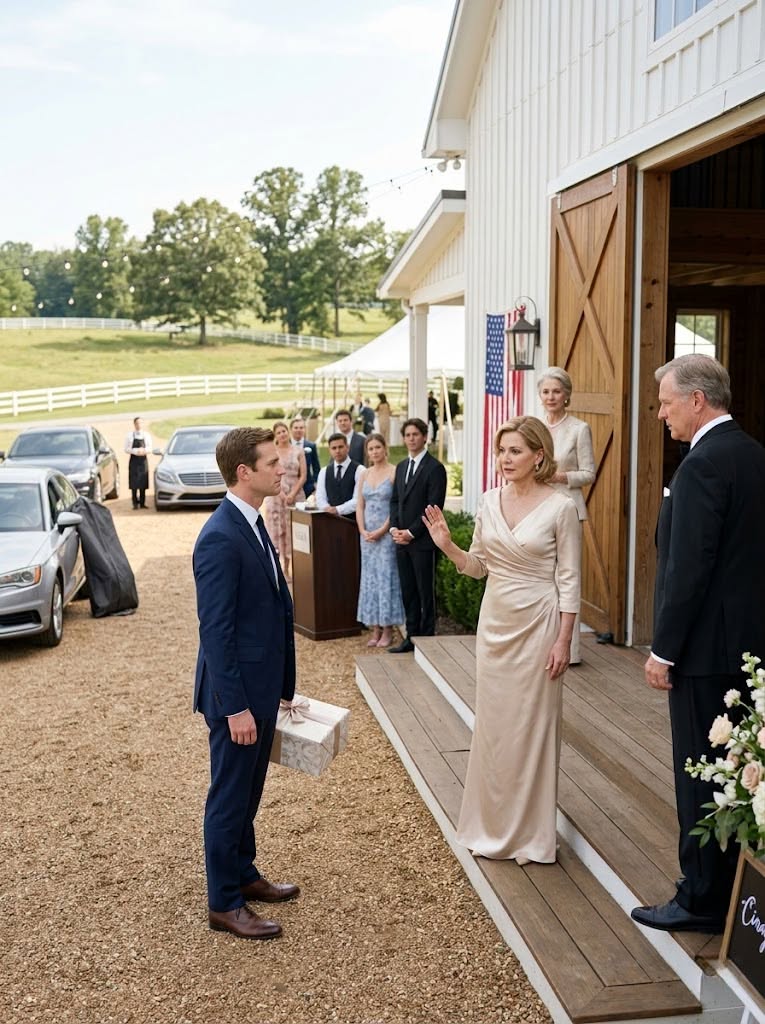
The wedding afternoon arrived beneath a clear Carolina sky.
Briarwood Estate looked beautiful.
White roses framed the lakeside ceremony space.
Delicate lights hung between oak branches.
Long tables stood beneath flowing ivory canopies, and the lake reflected the late-afternoon sunlight like polished glass.
Margaret wore a pale blue dress with delicate embroidery around the sleeves.
She had spent weeks choosing it.
When she stepped out of our bedroom that morning, I told her she looked just as beautiful as she had on our own wedding day.
She laughed.
“You’re forgetting how young I was back then.”
“Not the important parts.”
She kissed my cheek.
I remember that moment more clearly now than anything else about the morning.
Because several hours later, I would see that same beautiful dress covered in mud.
The ceremony itself went smoothly.
Daniel looked handsome in his dark suit.
Vanessa walked down the aisle in an extravagant white gown with a long embroidered train.
Guests rose.
The musicians played.
Margaret held my hand tightly as our son exchanged vows.
When Daniel promised to honor and protect his wife, Margaret wiped tears from her eyes.
I did too.
Whatever concerns I had carried into the ceremony, I tried to set them aside.
For a little while, I allowed myself to believe we were witnessing the beginning of something wonderful.
The reception began with champagne and photographs.
Guests wandered across the lawn while servers circulated with silver trays.
Vanessa moved from group to group, accepting compliments and posing for pictures.
Margaret stayed close to the edge of the reception area because the ground was slightly uneven.
She had been standing near an arrangement of white flowers when Vanessa approached her.
I was perhaps twenty feet away.
At first, nothing seemed unusual.
Vanessa was smiling.
Margaret turned toward her.
Then I noticed something change in my wife’s expression.
Her smile disappeared.
She looked confused.
I saw her say something, but the music swallowed her words.
Vanessa stepped closer.
Margaret shifted her cane.
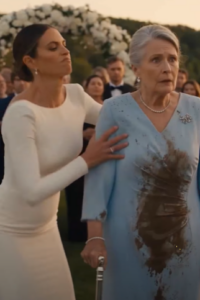
Then, without warning, Vanessa placed both hands against my wife’s shoulders.
And pushed.
Margaret stumbled backward.
Her cane slipped from her fingers.
She tried to regain her balance, but her foot caught the soft edge of the lawn.
She fell sideways into a patch of wet brown mud near the lake.
Her cry cut through the music.
For one awful second, I could not move.
Then her cane struck the ground with a sharp clatter.
The nearby guests fell silent.
I saw my wife’s face twist in pain.
Mud covered one side of her pale blue dress.
Her hands pressed helplessly against the ground.
And Vanessa laughed.
It was not the startled laughter of someone who had made a terrible mistake.
She stood looking down at Margaret with a smile that seemed almost triumphant.
“Oh, Margaret, you really should watch where you’re going.”
A bridesmaid standing nearby raised a hand to her mouth.
Someone whispered Vanessa’s name.
But Vanessa continued smiling.
I started toward my wife.
Daniel was closer.
He had been standing only a few yards away, talking to a wedding guest.
I expected him to run to his mother.
Instead, he walked toward Vanessa.
He placed an arm around her waist.
He leaned down and whispered in her ear.
I could not hear what he said.
But Vanessa turned toward him.
And laughed again.
That second laugh made my stomach turn.
I reached Margaret and knelt beside her.
“Are you hurt?”
She tried to smile.
“I’m all right.”
But her voice shook.
I helped her move carefully into a sitting position before attempting to get her upright.
Her left hand was trembling.
When she put weight on her right leg, she winced.
“Don’t rush.”
She looked past me toward the guests.
“Thomas, everyone’s staring.”
I wanted to tell her that she had nothing to be ashamed of.
Instead, I picked up her cane, helped her stand, and removed my jacket.
I wrapped it around her shoulders to cover the mud.
Her face had gone pale.
“Please don’t make a scene.”
I looked toward Vanessa.
She was adjusting her wedding dress as though nothing had happened.
Daniel stood beside her.
He was not laughing now.
His face had become strangely tense.
But he still had not approached his mother.
That silence told me almost as much as the shove.
For months, I had helped pay for a wedding that was supposed to celebrate love.
Now I was watching two people behave as though humiliating an elderly woman was entertainment.
I looked at Richard Caldwell, Vanessa’s father.
He stood nearby holding a champagne glass.
His expression was uncomfortable, but he said nothing.
The guests had begun whispering.
A server quietly retrieved Margaret’s fallen cane.
One of Vanessa’s bridesmaids looked ready to cry.
Yet nobody seemed willing to confront the bride.
I realized they were all waiting for the moment to pass.
They expected Margaret to swallow her humiliation.
They expected me to remain quiet.
They expected the music to start again and the wedding photographs to continue as though nothing had happened.
Margaret touched my arm.
“Thomas, please.”
I covered her hand with mine.
“I’m not going to shout.”
She studied my face.
“Then what are you going to do?”
I glanced toward the bandstand.
“I’m going to stop pretending.”
The bandleader looked surprised when I approached.
“Mr. Whitmore, is everything all right?”
“No.”
I held out my hand.
“May I have the microphone?”
He hesitated.
Then he handed it to me.
The musicians stopped playing one by one.
A strange silence spread across the reception.
I turned toward the guests.
Nearly two hundred faces looked back at me.
Vanessa’s smile disappeared.
Richard lowered his glass.
Margaret stood beside the lawn with my jacket around her shoulders.
And Daniel began walking toward the bandstand.
I raised the microphone.
“Ladies and gentlemen, before the first dance, I believe everyone deserves to understand why this wedding will no longer be paid for by the Whitmore family.”
The reaction was immediate.
Whispers rose from every table.
Vanessa stared at me in disbelief.
Richard took a step forward.
But Daniel moved faster.
“Dad, stop.”
There was something in his voice that made me lower the microphone.
I expected anger.
I expected another excuse for his bride.
Instead, I saw fear.
Daniel was staring directly at Vanessa.
And then he said six words that changed the meaning of everything I had witnessed.
“Dad, you didn’t hear what I said.”
I tightened my grip on the microphone.
“Then tell me.”
Daniel swallowed.
His eyes moved toward his mother, still trembling beside the lawn.
Then he looked at Vanessa.
And in front of nearly two hundred people, my son said something I never expected to hear.
“I told her I saw everything.”
PART 2: The Words My Son Whispered
For a moment, I could only stare at Daniel.
He had reached the bandstand with an expression I had never seen on his face before.
Not anger.
Not embarrassment.
Something closer to the look he wore as a little boy when he knew he had allowed something terrible to happen and could not figure out how to undo it.
“You saw her push your mother?”
Daniel nodded.
“Yes.”
“Then why did you walk toward Vanessa?”
The question escaped me before I remembered the microphone was still in my hand.
Several guests moved closer.
Vanessa’s face hardened.
“Daniel, don’t do this.”
He turned toward her.
“I asked you what you were doing.”
Vanessa gave a short laugh.
“You’re making it sound like I attacked her.”
Daniel’s voice shook.
“You pushed her.”
The silence that followed was heavier than anything I had experienced in years.
Vanessa looked around as though searching for someone willing to support her version of events.
Her bridesmaids avoided her eyes.
Richard Caldwell stepped forward.
“Perhaps everyone should calm down and handle this privately.”
I looked at him.
“Your daughter just shoved my wife into the mud.”
Richard adjusted his cuff.
“Thomas, I understand you’re upset.”
“No, Richard, I don’t think you do.”
Behind him, Margaret took a careful step toward a nearby chair.
I immediately passed the microphone back to the bandleader and went to her.
A woman from the catering staff offered assistance.
Together we helped Margaret sit beneath one of the canopies.
Her right ankle was beginning to swell.
When I asked whether she could move it, she nodded, but the pain in her expression frightened me.
“Someone needs to check that ankle.”
Margaret gripped my hand.
“Please don’t leave Daniel alone out there.”
I looked back toward the bandstand.
Daniel stood several feet from Vanessa.
For the first time that afternoon, he was no longer touching her.
I asked the catering supervisor to bring ice and help us arrange medical attention.
Then I returned to the lawn.
Vanessa met me before I reached the microphone.
“Are you seriously threatening to ruin my wedding because Margaret lost her balance?”
I stared at her.
“You put both hands on her shoulders.”
“She was blocking the photographer.”
That answer startled me.
“What?”
Vanessa gestured toward the lake.
“We were trying to get pictures, and she wouldn’t move out of the way.”
I looked toward the photographer, who had stopped working.
He was holding his camera against his chest.
“Was Margaret blocking your photograph?”
He hesitated.
Then he answered quietly.
“No, sir.”
Vanessa turned sharply.
“That’s not what happened.”
The photographer looked uncomfortable.
“I was setting up a different shot when I saw Mrs. Whitmore fall.”
“Did you see Vanessa push her?”
He lowered his gaze.
“I saw her hands on Mrs. Whitmore’s shoulders.”
A murmur traveled through the guests.
Vanessa’s cheeks flushed.
Richard stepped between us.
“Thomas, we’re not going to turn this wedding into a courtroom.”
I looked directly at him.
“Then stop asking everyone to pretend they didn’t see what happened.”
Daniel stepped closer.
“Dad, please listen.”
I turned toward my son.
He took a breath.
“When I walked up to Vanessa, I asked whether she had pushed Mom on purpose.”
I felt my jaw tighten.
“And?”
Daniel looked toward his bride.
“She told me Mom was being dramatic.”
Vanessa interrupted.
“Because she was.”
Daniel’s voice rose.
“She was on the ground, Vanessa.”
Several guests flinched at the sudden force in his words.
For a moment, I saw the boy I had raised.
The boy who used to run into the house whenever his mother called.
The boy who once cried because he accidentally broke her favorite coffee mug.
But then Daniel said something that made my hope falter.
“I didn’t know what to do.”
I stared at him.
“Your mother was lying in the mud.”
“I know.”
“And you didn’t know what to do?”
His face crumpled.
Vanessa crossed her arms.
“This is ridiculous.”
The words came out so casually that I almost laughed.
Not because anything was funny.
Because I could no longer understand how someone could stand beside the pain she had caused and remain so completely certain that she was the victim.
Richard took Daniel aside.
I could hear only fragments.
“Think carefully.”
“Marriage.”
“Public embarrassment.”
“Your future.”
Daniel pulled away.
“My mother is hurt.”
Richard’s expression changed.
He was no longer merely uncomfortable.
He looked irritated.
Meanwhile, my phone vibrated.
It was a message from the venue coordinator.
She had heard my announcement and wanted to know whether I was requesting changes to the remaining reception services.
I read it twice.
The beautiful tables were already arranged.
The guests had eaten appetizers.
The ceremony had taken place.
But the expensive dinner service, additional entertainment, and several other scheduled services were still ahead.
I knew we could not simply erase contracts or refuse payment for work already performed.
I also knew I did not have to approve every additional expense Vanessa might demand.
I typed a short reply.
“Please suspend any optional additions and meet me before proceeding with further changes.”
Then I slipped the phone into my pocket.
Vanessa noticed.
“What are you doing?”
I looked at her.
“Taking responsibility for what I’m paying for.”
Her expression hardened.
“You can’t humiliate me in front of all these people.”
I glanced toward Margaret.
“Do you hear yourself?”
For the first time, Daniel stepped between us.
“Vanessa, apologize to my mother.”
She stared at him.
“Excuse me?”
“Apologize.”
Her eyes narrowed.
“You’re choosing them over me?”
Daniel took a breath.
“I’m asking you to take responsibility.”
Vanessa slowly shook her head.
Then she reached for the bracelet on her wrist.
The pearls gleamed beneath the afternoon sunlight.
Margaret’s mother’s bracelet.
Vanessa unclasped it and held it between two fingers.
“If everyone is going to be so sentimental about this family, maybe you should take your precious little heirloom back.”
My heart sank.
She extended her hand toward Daniel.
But instead of placing the bracelet in his palm, she let it fall.
The pearls struck the stone walkway.
The clasp snapped against the edge.
And when Margaret heard the sound, she lifted her head.
Vanessa looked straight at her.
“There, Margaret, now you have something else to cry about.”