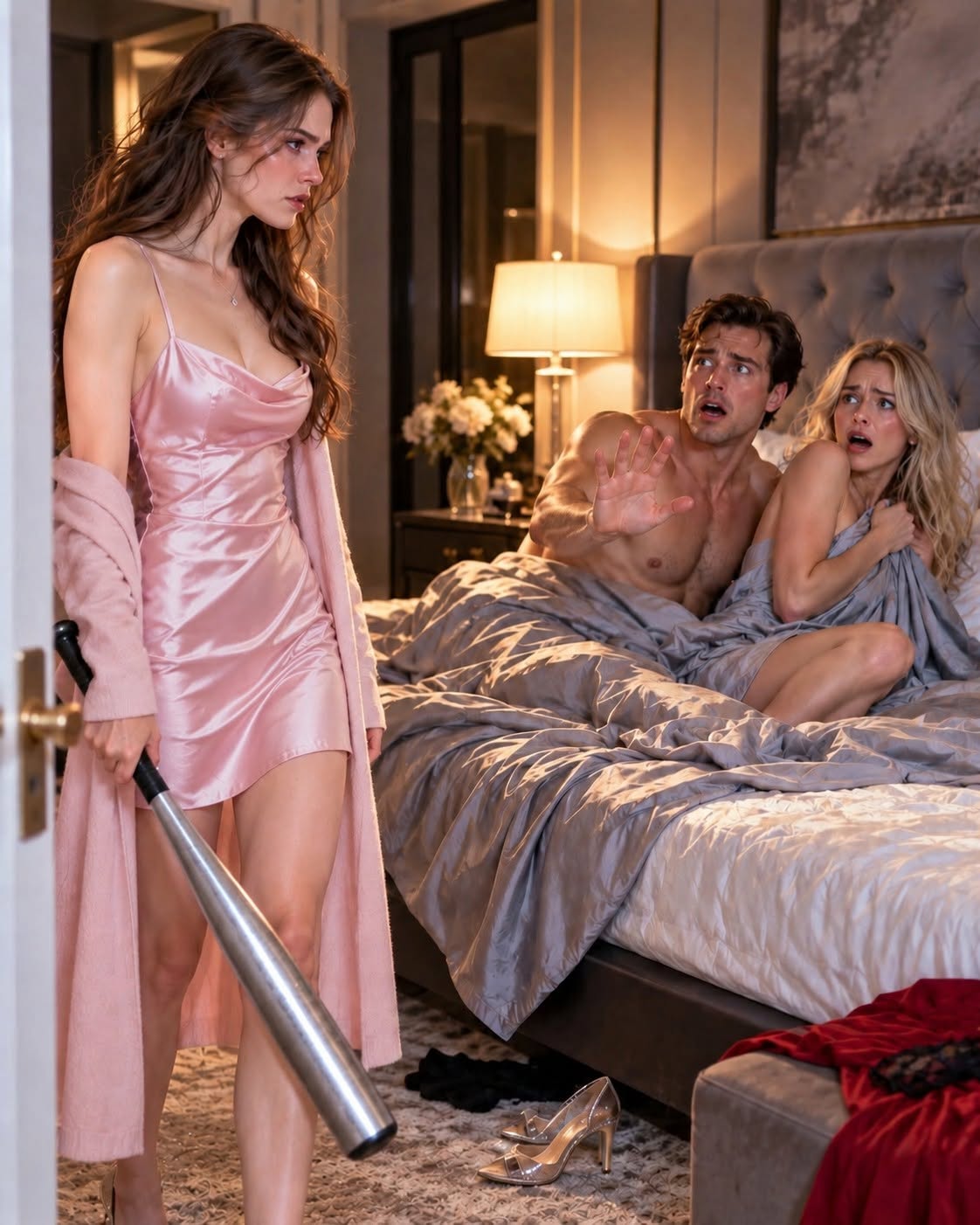
I simply walked into the hallway, picked up the baseball bat beside the shoe cabinet, and came back so calm that even now, three years later, I still remember the terror on their faces.
My name is Evelyn Lane.
And that night cost me three years of my life.
When the prison gates finally opened, it was March.
Spring wind touched my face as I stepped outside carrying everything I owned in one state-issued plastic bag.
Across the road stood a man holding an enormous bouquet of sunflowers.
He was tall, maybe forty, wearing a dark wool coat over a charcoal suit. His hair was almost black, but silver had begun appearing near his temples.
I had never seen him before.
At least, I thought I hadn’t.
His eyes were red.
“Evelyn,” he said hoarsely.
“I’ve waited a long time.”
He held the flowers toward me.
“Come home with me.”
I stared at him.
“Who are you?”
His expression changed.
And before he could answer, I noticed the black SUV parked behind him.
Two men stood beside it.
Not chauffeurs.
Not friends.
Security.
The stranger looked like a man accustomed to being obeyed.
But he wasn’t looking at me like someone giving an order.
He looked terrified that I might walk away.
And somehow that frightened me more.
But to understand why those words nearly broke me, you have to go back to December 17, 2021.
It was my third wedding anniversary with Michael Lane.
That morning, a major client paid my company early, allowing me to cancel an afternoon meeting.
Michael had spent six months casually mentioning a Rolex he liked, so I drove to a luxury store in downtown Boston and bought it for him.
The saleswoman noticed my wedding ring.
“Anniversary gift?”
I smiled.
“Three years today.”
On the drive home, I actually considered buying flowers too.
I was happy.
That is the part I remember most bitterly.
I unlocked our apartment quietly because I wanted to surprise him.
The lights were off, and at first I assumed Michael wasn’t home.
Then I heard something from our bedroom.
My body knew before my mind accepted it.
I walked down the hallway anyway.
The door was partly open.
Michael was there.
And beneath him was Rachel Hayes.
My best friend since childhood.
The woman who had been my maid of honor.
The woman whose father’s hospital bills I had helped pay without hesitation.
Rachel saw me first.
“Evelyn?”
She scrambled for the sheets.
Michael sat up, irritated more than ashamed.
“Didn’t you say you had a meeting this afternoon?”
That sentence destroyed something inside me.
He wasn’t shocked that I had discovered his betrayal.
He was angry that I had come home early enough to interrupt it.
Suddenly everything became silent.
I turned around and walked away.
Beside the shoe cabinet stood an aluminum baseball bat left over from a company event the year before.
I picked it up.
Behind me, I heard Michael whisper urgently:
“Get dressed. She’s lost it.”
When I returned, Rachel was struggling into her dress.
Her face went white.
“Evelyn, please. We’re sisters. Just let me explain.”
Sisters.
I remembered sharing lunches with her in elementary school.
Lending her money when her business failed.
Holding her while she cried at my wedding and promised I would always be the most important friend in her life.
I stopped directly in front of her.
Then I raised the bat.
“Evelyn, don’t—”
What happened next lasted only minutes, but it changed all three of our lives forever.
I swung.
Not at Rachel.
At the nightstand.
The lamp shattered.
Michael screamed my name.
I swung again.
The television cracked.
A framed wedding photograph fell from the wall.
Rachel rushed toward the hallway.
Michael grabbed my arm.
“Enough!”
I jerked away.
He grabbed me again.
Harder.
The bat moved.
He stumbled backward.
Rachel screamed.
After that, everything blurred.
Fear.
Rage.
Twenty-six years of friendship collapsing in seconds.
Three years of marriage turning into a joke.
Michael shouting.
Rachel crying.
Glass breaking.
By the time I lowered the bat, Michael was screaming my name, Rachel was on the floor, and I knew there was no version of my future that ended with me simply walking away.
So I picked up my phone myself.
I called 911.
I gave them my address.
And when the operator asked what had happened, I looked directly at the two people who had destroyed my marriage and said, with a voice so calm it frightened even me:
“I’ll be waiting for the police.”
I did wait.
I placed the bat on the floor.
I sat at the dining table.
I didn’t run.
I didn’t call an attorney.
That was my first mistake.
Michael did.
By the time police arrived, he was bleeding from a wound near his temple.
Rachel had an injured wrist from falling.
I had bruises forming around my upper arm.
But Michael spoke first.
“She attacked us.”
Rachel stood behind him.
Crying.
“She just snapped.”
I looked at her.
Something in my face must have frightened her because she stopped crying for half a second.
“You’re going to do this too?”
Rachel looked away.
The police officer turned toward me.
“Ma’am?”
“I came home and found them together.”
Michael interrupted.
“That doesn’t justify what she did.”
He was right.
That was the worst part.
Betrayal did not make violence disappear.
Pain did not erase consequences.
I had lost control.
I had to live with that.
But what I didn’t know that night was that Michael and Rachel had already been planning for the possibility that I might discover them.
I learned that much later.
At the time, I only knew I was handcuffed in my own kitchen while the anniversary gift I had bought Michael remained inside my purse.
I spent the night in custody.
The following morning, my attorney arrived.
His name was Peter Caldwell.
Michael had recommended him to me years earlier for business contracts.
That should have been my first warning.
Peter sat across from me.
“Michael’s injuries are significant.”
“Is he going to be okay?”
Peter hesitated.
“Yes.”
I closed my eyes.
“And Rachel?”
“Minor injuries.”
I breathed.
Peter studied me.
“The district attorney is considering aggravated assault.”
My stomach dropped.
“But I called the police.”
“That helps.”
“I stayed.”
“That helps.”
“They were—”
“I know what you found.”
He leaned forward.
“But infidelity isn’t a legal defense.”
“I know.”
“Michael says you threatened to kill him.”
“I never said that.”
“Rachel confirms it.”
I stared.
“She is lying.”
“Can you prove that?”
No.
I couldn’t.
The trial lasted six days.
Michael testified.
Rachel testified.
They described me as increasingly unstable.
Possessive.
Jealous.
Controlling.
Michael claimed our marriage had been failing for months.
That was news to me.
Rachel said I had suspected the affair and threatened her two weeks earlier.
A complete lie.
Peter barely challenged it.
I kept asking him why.
“Why aren’t you showing the messages?”
“What messages?”
“The ones between Michael and me.”
Texts from that morning.
Happy anniversary, beautiful.
Dinner tonight?
Can’t wait. Love you.
Peter said they were irrelevant.
The prosecution showed photographs of Michael’s injuries.
Rachel cried beautifully.
Then came the testimony that destroyed me.
Michael told the jury:
“I thought she was going to kill us.”
I looked at the man I had married.
He never looked back.
I was convicted.
The sentence was five years.
I served three.
Good behavior.
Mandatory counseling.
Work assignments.
Every day counted.
My mother, Helen Mercer, visited when she could.
She never asked why I did it.
She only said:
“You come home to me.”
My father had died when I was twenty-two.
Mom was all I had left.
Or so I believed.
Rachel never visited.
Michael filed for divorce six weeks after sentencing.
He took our apartment.
Most of our savings disappeared into legal fees.
My company collapsed without me.
Clients left.
Employees scattered.
My name became searchable online beside words I had never imagined would describe me.
ASSAULT.
DOMESTIC VIOLENCE.
PRISON SENTENCE.
The woman who entered prison was thirty-four.
She owned a consulting company.
Had a husband.
A home.
A retirement account.
A best friend she’d known since childhood.
The woman leaving prison at thirty-seven owned two pairs of jeans, three shirts, $1,842 in a release account, and a cardboard box of letters from her mother.
But prison did something else.
It forced me to look at the worst moment of my life without excuses.
I had been betrayed.
Yes.
I had been devastated.
Yes.
Michael and Rachel had lied.
Yes.
But I had still picked up the bat.
Healing began when I stopped saying they made me do it.
They hadn’t.
What they had done was theirs.
What I had done was mine.
That distinction saved me.
Which brought me back to the man with the sunflowers.
“Who are you?” I asked again.
He lowered the bouquet.
“Gabriel Moretti.”
The name meant nothing.
He noticed.
“Your mother never told you?”
“My mother?”
His face tightened.
“Evelyn…”
“Why would my mother tell me about you?”
Before he answered, another car pulled into the prison parking area.
An old blue Honda.
I recognized it.
“Mom.”
I moved toward it.
Then stopped.
The woman who stepped out wasn’t my mother.
It was my aunt Susan.
My stomach dropped.
“Where is she?”
Susan started crying.
“No.”
I dropped my plastic bag.
“No.”
Gabriel moved toward me.
I stepped back.
“Don’t touch me.”
He stopped instantly.
Susan reached me.
“Evelyn.”
“Where is Mom?”
“She died in January.”
The world went silent.
“What?”
“She had another stroke.”
“No.”
“She didn’t want you told.”
“No.”
“She said you only had eight weeks left.”
Susan’s voice broke.
“She didn’t want you spending them trapped in grief where you couldn’t say goodbye.”
I couldn’t breathe.
“My mother is dead?”
Susan nodded.
I sat down on the pavement.
Not gracefully.
My knees simply stopped working.
Three years.
I had survived three years by imagining one thing.
My mother waiting.
Her kitchen.
Her terrible coffee.
Her arms around me.
Gone.
“Where was she buried?”
Susan cried harder.
“She wasn’t.”
I looked up.
“What?”
“Her ashes are at home.”
“Whose home?”
Susan looked toward Gabriel.
My blood turned cold.
“No.”
Gabriel’s eyes filled.
“Evelyn.”
“Why does he have my mother’s ashes?”
Susan whispered:
“Because Helen spent the last eleven months living with him.”
I stared.
“Who is he?”
Neither answered.
“Who is he?”
Gabriel looked at me.
“I’m the man your mother called when she discovered Michael lied at your trial.”
Everything inside me stopped.
“What lie?”
Gabriel’s jaw tightened.
“The one that put you in prison three years longer than you should have been there.”
I stood.
“What are you talking about?”
He reached into his coat.
Slowly.
Then handed me a photograph.
Michael.
Rachel.
Peter Caldwell—my attorney.
The photograph had been taken two days before my trial began.
They were sitting together inside a private restaurant.
Michael’s hand rested on Rachel’s back.
Peter sat across from them.
On the table between them was an envelope.
I looked at Gabriel.
“What is this?”
“Evidence.”
“Of what?”
“That your attorney wasn’t working for you.”
My hand began shaking.
Gabriel continued.
“Michael paid him.”
I stared.
“To lose your case.”
“No.”
“Yes.”
“No.”
“And that isn’t the worst part.”
I couldn’t breathe.
“What could possibly be worse?”
Gabriel looked toward the sunflowers.
Then back at me.
“Your mother found out why Michael needed you in prison.”
I waited.
“He wasn’t trying to escape a bad marriage.”
Not that day.
I went with Aunt Susan.
She drove me to my mother’s small house in Somerville.
Nothing had changed.
That made it worse.
Her coat hung beside the door.
Reading glasses rested on the kitchen table.
A grocery list remained attached to the refrigerator with a magnet I had given her when I was twelve.
Milk.
Bread.
Tea.
Apples.
I stood in the kitchen and cried until there was nothing graceful left in me.
Susan didn’t interrupt.
When I finally stopped, she brought me a wooden box.
“Your mother wanted you to have this.”
Inside were letters.
Dozens.
Some addressed to me.
Others to attorneys.
One envelope had Gabriel’s name.
“Who is he?” I asked.
Susan sat across from me.
“Your mother called him a friend.”
“That isn’t an answer.”
“She met him after your conviction.”
“How?”
“She was investigating Michael.”
I almost laughed.
“My mother?”
“You know Helen.”
I did.
She had been a high-school librarian for thirty-two years.
People mistook quiet for harmless.
Mom encouraged that mistake.
Susan continued.
“She never believed Michael’s testimony.”
“So she hired Gabriel?”
“No.”
“She found him.”
“How?”
“Following money.”
That sounded even less like my mother.
Then Susan told me something I had never known.
Before becoming a librarian, Helen Mercer had spent six years working as a records analyst for the Massachusetts Attorney General’s Office.
Mom knew how to find documents.
She simply hadn’t used those skills professionally in decades.
After my conviction, she started.
She found irregular transfers from my company, Lane Strategic Consulting.
Michael had been my husband but not an owner.
Before my arrest, he had no authority to control the company.
After my conviction, however, someone produced an emergency power-of-attorney document bearing my signature.
It granted Michael authority.
“I never signed one.”
“I know.”
“He forged it?”
“Your mother believed so.”
I felt sick.
Using that document, Michael transferred contracts and client relationships from Lane Strategic Consulting into a new company.
Lane-Hayes Advisory Group.
Hayes.
Rachel.
My husband and best friend hadn’t simply started a relationship after I went to prison.
They had built a business from what I lost.
“How much?”
Susan looked down.
“How much did they take?”
“Your mother estimated eleven million dollars in contracts and assets over three years.”
I laughed.
I couldn’t help it.
Eleven million.
I had entered prison worried about whether my employees would survive.
Michael had been monetizing my absence.
“And Peter?”
“Your attorney had gambling debts.”
Of course.
Michael paid him through a consulting company.
Peter suppressed text messages.
Failed to call witnesses.
Never challenged Rachel’s false claim that I had threatened her before the incident.
He had not caused my actions.
But he had made sure the jury saw the worst possible version of them.
I looked at the photograph again.
“Why?”
“Because a shorter sentence would have been inconvenient.”
My stomach twisted.
“How short?”
“With competent representation, your mother found two attorneys who believed you might have received probation or significantly reduced incarceration based on your immediate surrender, lack of criminal history, documented provocation, and other evidence.”
I closed my eyes.
I still would have faced consequences.
I should have.
But three years?
Maybe not.
“What did Mom do?”
“She contacted Gabriel.”
“Why him?”
Susan hesitated.
“Because one of the companies receiving money from Michael belonged to a man Gabriel had been investigating.”
“For what?”
Susan looked uncomfortable.
“You need to ask him.”
I remembered the SUV.
The security.
The way Gabriel stood.
“What exactly does Gabriel Moretti do?”
Susan gave me a look.
“You really haven’t heard the name?”
“No.”
“Maybe prison protected you from gossip.”
“Susan.”
She sighed.
“The Morettis have owned shipping companies, construction firms, nightclubs, and private security businesses around Boston for decades.”
“And?”
“And there are stories.”
“What stories?”
“The kind people lower their voices to tell.”
I stared.
“Organized crime?”
“I don’t know.”
“You absolutely know.”
“I know Gabriel has never been convicted of anything serious.”
“That is an extremely specific defense.”
Susan sighed.
“Your mother trusted him.”
“Mom also trusted Michael.”
Susan flinched.
I immediately regretted it.
“Sorry.”
“No. You’re right.”
That night, I slept in my mother’s bed.
Or tried.
At 3:17 a.m., I opened the first letter she had written me but never mailed.
My Evelyn,
If you’re reading this, then I ran out of time.
I stopped.
Started again.
I need you to understand something before anger takes over.
You were wrong that night.
I cried.
Of course Mom would begin there.
What Michael and Rachel did was cruel, but cruelty does not excuse what happened afterward. You know this already. I watched you learn it. I am proud of you for learning it.
But accountability works both ways.
You answered for what you did.
They must answer for what they did too.
I read until sunrise.
Mom had documented everything.
Dates.
Bank transfers.
Property records.
Witnesses.
She had discovered Rachel and Michael’s affair began fourteen months before I caught them.
They had discussed my company.
My finances.
My schedule.
And six weeks before my anniversary, Michael increased a life-insurance policy on me.
That stopped me.
I read the line again.
Life insurance.
Three million dollars.
Beneficiary:
Michael Lane.
Why?
My phone rang.
Unknown number.
I nearly ignored it.
Then answered.
“Hello?”
“Evelyn.”
Rachel.
I stopped breathing.
Three years.
Her voice sounded almost unchanged.
“I’m glad you’re out.”
I said nothing.
“Evelyn?”
“What do you want?”
A pause.
“To talk.”
“No.”
“Please.”
“No.”
“There are things you don’t understand.”
I laughed.
“You slept with my husband in my bed.”
“I understand that part perfectly.”
“Michael isn’t who you think.”
“He stopped being who I thought three years ago.”
“Please.”
Something in her voice sounded wrong.
Fear.
“Where is Michael?”
Silence.
“Rachel?”
“He knows you’re out.”
“So?”
“He knows Helen found things.”
My hand tightened around the phone.
“You don’t get to say my mother’s name.”
Rachel started crying.
“I know.”
“Do you?”
“I deserve that.”
“Yes.”
Then she whispered:
“Evelyn, Michael is dangerous.”
I laughed bitterly.
“Interesting timing.”
“I mean it.”
“You testified that I was dangerous.”
“I lied.”
The room became still.
“What?”
“I lied at your trial.”
I sat down.
“Say it again.”
“I lied.”
“About what?”
“The threat.”
I closed my eyes.
“You said I threatened you two weeks before I caught you.”
“You didn’t.”
“Why?”
“Michael told me to.”
“Why?”
“He said if you went away, we’d have time.”
“Time for what?”
Rachel sobbed.
“The company.”
My hands became cold.
“And you agreed?”
“Yes.”
Twenty-six years.
Lunch boxes.
Sleepovers.
College.
Breakups.
Her father’s hospital bills.
My wedding.
“Yes?”
Her crying became louder.
“I was jealous of you.”
That hurt more than I expected.
“You had everything.”
“No, Rachel.”
“I thought you did.”
“You had the career.”
“The marriage.”
“Your mother adored you.”
“You walked into rooms and people listened.”
“I was always the friend who needed help.”
“So you took my husband?”
“At first I thought he loved me.”
“And later?”
Silence.
“Later I realized he loved what I could help him take from you.”
I almost hung up.
Then Rachel said:
“There is something else.”
“What?”
“The night you found us wasn’t supposed to happen like that.”
My body went cold.
“What does that mean?”
“Michael knew you were coming home.”
“No.”
“He told me your meeting had been canceled.”
I stopped breathing.
“He knew?”
“Yes.”
“Then why were you in our bedroom?”
Rachel cried harder.
“Because he wanted you to find us.”
I stood.
“What?”
“He said you would get angry.”
“He knew about the bat.”
“He knew you kept it by the door.”
“No.”
“He said you had a temper.”
“I didn’t.”
“I know.”
“Then why?”
“Because he needed something.”
“What?”
“A scene.”
The word landed like ice.
“He needed you to react.”
My mind raced backward.
Michael sitting up.
Didn’t you say you had a meeting?
Not surprise.
Performance.
“Rachel.”
“Yes?”
“Did Michael want me to hurt you?”
Silence.
That was the answer.
I nearly dropped the phone.
“Rachel.”
“He said you’d probably smash things.”
“That police would come.”
“That he could use it in the divorce.”
“He never said you’d actually…”
She stopped.
“What?”
“Go to prison.”
I sat down again.
“Where are you?”
“Don’t ask.”
“Are you with him?”
“No.”
“Where?”
“I left.”
“When?”
“Last week.”
“Why?”
Rachel whispered:
“Because I found the file.”
“What file?”
“Your life-insurance policy.”
I closed my eyes.
“I know about it.”
“No.”
Her voice sharpened.
“Not that one.”
My heart stopped.
“What are you talking about?”
“There is another policy.”
“How much?”
“Ten million.”
I couldn’t speak.
“And Michael changed the beneficiary.”
“To who?”
“Lane-Hayes Advisory.”
The company built from mine.
Rachel continued.
“It activates under a key-person provision if you die within five years of the company’s restructuring.”
“But I don’t work there.”
“He used the forged power of attorney to classify you as founding intellectual property holder.”
I felt sick.
“Rachel.”
“Yes?”
“Why are you telling me this?”
She began crying again.
“Because three days ago Michael asked me whether prison releases are always announced publicly.”
A chill moved through me.
“And yesterday…”
She paused.
“…I found a gun in his car.”
The call disconnected.
I stared at the phone.
Then someone knocked.
Three slow knocks.
I walked toward the door.
Looked through the peephole.
Gabriel Moretti stood outside.
Alone this time.
I opened the door halfway.
“Did you know?”
“Know what?”
“That Michael wanted me to catch them.”
Gabriel’s expression told me he did.
I opened the door.
“You knew.”
“Your mother suspected it.”
“Why didn’t anyone tell me?”
“You were incarcerated.”
“Phones exist.”
“Helen didn’t want you reacting before she had proof.”
I laughed bitterly.
“Everyone loves deciding what I can handle.”
Gabriel absorbed that.
“You’re right.”
That stopped me.
No defense.
No explanation.
Just:
“You’re right.”
I looked at him.
“Why did Mom trust you?”
His eyes changed.
“Because I owed your father my life.”
I froze.
“My father?”
Gabriel nodded.
“Twenty years ago, your father saved me.”
“From what?”
“A bullet.”
My mother had never mentioned any of this.
Gabriel continued.
“Your father knew what my family was.”
“And he helped you anyway?”
“He was a trauma surgeon.”
I remembered.
Dad had worked emergency medicine before dying in what Mom always described as a highway accident.
“He didn’t care who I was.”
“He saved me because I was on his table.”
Gabriel looked down.
“Years later, when he died, I promised Helen that if she ever needed anything, she could call me.”
“And she waited until I went to prison?”
“She hated what I represented.”
“Smart woman.”
A faint smile.
“Yes.”
“Then why finally call?”
“Because Michael’s money crossed into one of my businesses.”
My eyes narrowed.
“Legitimate?”
Gabriel smiled without humor.
“Your mother asked the same question.”
“And?”
“Yes.”
“This one was legitimate.”
He handed me a folder.
Inside were photographs.
Michael meeting a man named Anthony Voss.
Financial records.
Property transfers.
Then a photograph that made my blood freeze.
Michael standing outside my mother’s house.
January 9.
Two days before her fatal stroke.
“Why was he there?”
Gabriel’s expression became cold.
“We don’t know.”
“Did he hurt her?”
“We don’t know.”
I looked up.
“If he did…”
Gabriel interrupted gently.
“No.”
My jaw tightened.
“No?”
“You served three years because one moment of rage controlled your life.”
His voice softened.
“Don’t give Michael a fourth.”
I stared at him.
The words hurt because they were true.
“What do I do?”
“For tonight?”
“Yes.”
“You come somewhere safe.”
“With you?”
“If you choose.”
There it was.
Choose.
Not an order.
I looked at my mother’s empty house.
Then at the photograph of Michael outside it.
“Where?”
Gabriel held my gaze.
“My home.”
I hesitated.
“What exactly are you, Gabriel Moretti?”
He almost smiled.
“That’s a longer conversation.”
“Criminal?”
“Sometimes.”
“At least you’re honest.”
“I’m trying something new.”
I should have said no.
Instead, twenty minutes later, I sat inside his SUV.
We drove toward Beacon Hill.
I watched Boston pass.
The city I had left three years earlier.
The city Michael had taken from me.
Gabriel’s phone rang.
He answered.
Listened.
Then his expression changed.
“What?”
He ended the call.
“What happened?”
He looked at me.
“Rachel Hayes is missing.”
My stomach dropped.
“Since when?”
“Her car was found thirty minutes ago.”
“Where?”
“Near the harbor.”
“Any blood?”
Gabriel hesitated.
“Gabriel.”
“Yes.”
I closed my eyes.
Then he said:
“There was something else.”
“What?”
“Your photograph was on the passenger seat.”
I looked at him.
“Why?”

