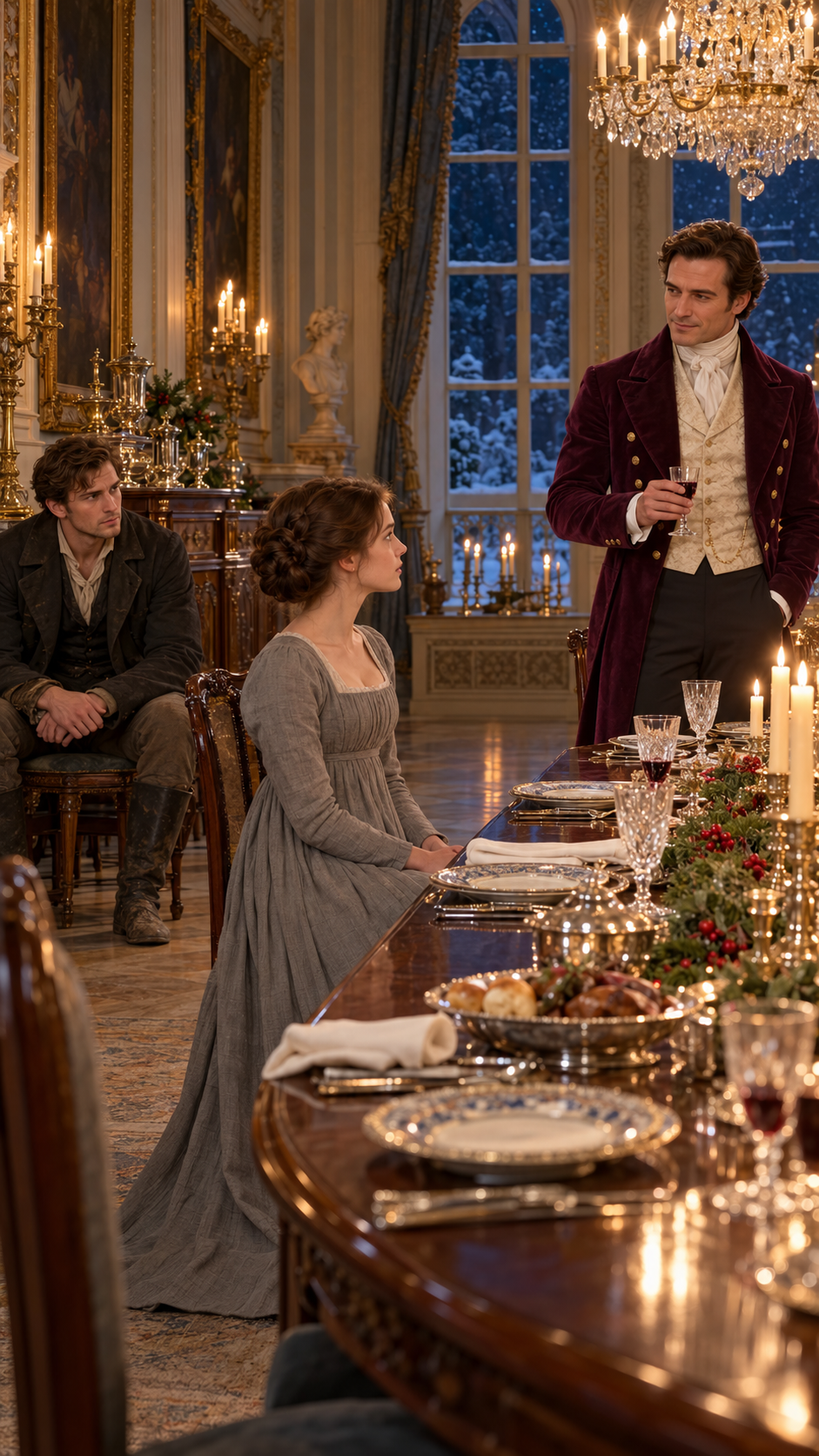
Part Two
“I have considered it,” Temperance said. “And there is something this room ought to know about your accounts.”
Rufus Crayle’s hand tightened around the stem of his glass.
For a moment, he said nothing. The fire cracked softly at the far end of the gallery, and somewhere behind Temperance, a chair creaked as one of the guests shifted.
Then Rufus smiled.
“My dear Miss Hallowell, I fear you have misunderstood some perfectly ordinary entries.”
Temperance looked at him across the table.
“Which entries would those be?”
“The repair expenses, perhaps. Or the grain sales. Estate accounts can be complicated.”
“I have kept them for seven years.”
“Yes,” Rufus said smoothly. “Under the steward’s direction.”
“Under my father’s direction first. After his death, I continued the work because there was no one else willing to do it properly.”
His smile thinned.
“Sit down, Temperance.”
She remained standing.
At the sideboard, Julian had risen from his stool. He did not approach her, but she could feel his attention upon her. He was waiting, she realized, for her to decide what she wished to say.
For seven years, other people had made decisions on her behalf. They had decided where she should live, where she should eat, which rooms she might enter, and how much of her work deserved to be noticed.
Tonight Rufus had decided that she would marry him.
“No,” she said.
The word carried farther than she expected. It reached the guests near the fireplace, and the quiet that followed seemed to move down the length of the table.
Rufus set his glass down.
“You have made your objection. I suggest we discuss this privately.”
“You announced our engagement publicly.”
“A misunderstanding, then.”
“There is no misunderstanding. I have never accepted an offer from you.”
A woman near the middle of the table lowered her eyes. Beside her, a gentleman cleared his throat and reached for his wine.
Rufus glanced toward them, then back at Temperance.
“You are distressed.”
“I am angry.”
The admission surprised her. Not because it was untrue, but because she had spent so long keeping her anger folded away that she had nearly forgotten what it felt like to show it.
“I am angry that you blamed Mr. Thorne for the flood,” she continued. “I am angry that you told the tenants the river wall was sound when my father’s notes said otherwise. And I am angry that you have announced a marriage I never agreed to.”
Rufus’s face lost some of its color.
“You ought to think carefully before accusing me in front of my guests.”
“Then perhaps you ought to have thought carefully before accusing Mr. Thorne.”
At that, Rufus turned toward Julian.
The surveyor stood beside the stool, his weather-worn coat dark against the polished wood of the sideboard. His hands hung loosely at his sides. Temperance had seen those hands grip a rusted chain in freezing water, and she had seen them turn the pages of her father’s survey book with care.
Rufus saw only the muddy boots.
“You have encouraged her,” he said.
Julian’s expression did not change. “Miss Hallowell is capable of speaking for herself.”
“She has been in this house far longer than you.”
“And she has been trying to warn you about the river for far longer than I have.”
Several guests looked away from Rufus and toward Temperance.
Rufus noticed. He noticed everything that might diminish him.
“The river wall failed after Mr. Thorne began work on the estate,” he said. “That is a matter of fact.”
“The wall failed because the sluice had been neglected,” Julian replied. “That is also a matter of fact.”
“You expect us to accept your word?”
“No,” Julian said. “You may examine Mr. Hallowell’s survey book.”
Temperance saw Rufus’s eyes flicker.
“My father recorded the damage in 1812,” she said. “I showed you the entry.”
“You showed me a great many entries.”
“And asked you to have the gate cleared.”
“I remember no such conversation.”
“I do.”
Rufus gave a short laugh. “You ask the company to choose between our memories?”
“No. I ask them to look at the book.”
Her father’s survey book lay in her room upstairs. Its leather cover was worn, and several pages bore the marks of rain and mud from the morning of the flood. It contained no elegant phrases and no attempt to impress anyone. Her father had written what he saw.
A field will tell you the truth if you know how to read it.
So will a man.
Temperance drew a breath.
“Mr. Thorne opened the old sluice by the mill,” she said. “He diverted the water into the east meadow. If he had not, the cottages by the bridge would have flooded more deeply.”
“The meadow was ruined,” Rufus said.
“It was grass.”
“It was valuable land.”
“And there were families in those cottages.”
His jaw shifted. “You have become rather attached to our surveyor’s opinions.”
Temperance felt heat rise to her face, but she did not lower her eyes.
“I have become attached to the truth.”
She heard a quiet movement behind her. Julian had stepped away from the sideboard, but he stopped before reaching the table.
Rufus’s gaze followed him.
“Did you hear me, Thorne? You are dismissed.”
Julian looked at him.
“I heard you.”
“Then leave.”
“I shall leave when Miss Hallowell has finished.”
Rufus gave a sharp breath through his nose. “You are a hired man.”
“Yes.”
“You have no authority here.”
“No,” Julian said again. “But Miss Hallowell has a right to answer an announcement made in her name.”
Temperance looked at him then. His voice had been steady, almost quiet, but there was something in his face she had not seen before. Not fear. Not even anger, exactly.
Expectation.
As though he had been waiting for something to happen in this room, and now that it had begun, he intended to see it through.
Rufus lifted his chin.
“I will not have this dinner turned into an inquiry because a disgruntled employee and a confused young woman wish to make a spectacle of themselves.”
Temperance’s fingers curled against the edge of the table.
“The accounts deserve an inquiry.”
“And what, precisely, do you claim to know about them?”
She hesitated.
The tin box beneath the still-room floor had been her secret for years. She had hidden it because she did not trust Rufus or Mr. Snell to leave her records untouched. At first she had told herself it was only a precaution. Later, when the figures became harder to explain, she had kept writing because the truth needed a place to remain safe.
But telling the room about it meant giving up that safety.
Rufus watched her hesitation and mistook it for surrender.
“There,” he said softly. “You see?”
Temperance thought of the tenants who had stood in black water outside their cottages. She thought of the families who had paid higher rents while the estate grain was sold away. She thought of Julian being ordered from the room after he had helped save them.
“I have kept a second ledger,” she said.
The words were not loud. They did not need to be.
Rufus went very still.
“A record of the rents, the grain sales, the timber and the repair expenses,” Temperance continued. “I copied the figures as they came to me. I kept the receipts I could find and noted the entries that did not agree.”
“You had no permission to do that.”
“I did not require permission to add.”
A few people at the table exchanged looks.
Mr. Jasper Snell, the steward, stood near the door. Temperance had almost forgotten he was there. He had been smiling earlier, when Rufus announced the engagement. Now his smile was gone.
Rufus turned toward him.
“Mr. Snell can confirm that the estate’s accounts are in order.”
Snell’s fingers worried the cuff of his coat.
“They are maintained according to instruction,” he said.
“Whose instruction?” Temperance asked.
Snell did not answer immediately.
“Mine, naturally,” Rufus said. “As the duke’s representative.”
“Then you can explain why grain sold in Bristol does not appear where it should in the estate ledger.”
The color drained from Snell’s face.
Rufus noticed that too.
“You are making an accusation you cannot support.”
“The record is in the tin box.”
“What tin box?”
“The one beneath the floor of the still room.”
Rufus’s eyes narrowed.
For the first time that evening, he looked uncertain. It lasted only a moment, but Temperance saw it.
Julian saw it too.
“Miss Hallowell showed me the ledger,” he said.
Rufus turned sharply. “You had no right to examine private estate papers.”
“Miss Hallowell asked me to check the figures.”
“And I am asking now that the family solicitor examine them,” Temperance said.
At the mention of the solicitor, a murmur passed along the table.
Mr. Hollis Bright had served the Ravensmere family for years. Temperance had met him only a handful of times, usually when she was carrying papers to the duke’s rooms. He was a precise man who listened more than he spoke.
Rufus folded his hands behind his back.
“Mr. Bright is not here.”
A dry voice answered from the doorway.
“I am, in fact.”
Every head turned.
Hollis Bright stood just inside the gallery, his dark coat still fastened and a packet of papers in his hand. He had entered so quietly that Temperance had not heard him. His face was composed, but his eyes moved at once to Julian, then to Rufus.
Rufus stared at him.
“Why are you here?”
“I was asked to come.”
“By whom?”
Mr. Bright did not answer immediately.
Temperance glanced at Julian. The surveyor’s expression remained unreadable.
The solicitor stepped farther into the room.
“I understand there is a question concerning the estate accounts.”
“There is no question,” Rufus said.
“There is,” Temperance replied.
Mr. Bright inclined his head toward her.
“Then I should like to see the ledger.”
Rufus let out a short laugh.
“You cannot seriously intend to interrupt this dinner on the strength of Miss Hallowell’s private scribblings.”
“I intend to look at the records,” Mr. Bright said. “That is rather different from reaching a conclusion.”
Tempy noticed the packet in his hand.
Its edges were worn, as if it had been opened and closed more than once. Mr. Bright kept his fingers wrapped around it even as he spoke.
There was something else he had come to say.
Rufus saw the packet too.
“What papers are those?”
“Family papers,” Mr. Bright said.
“Then give them to me.”
“No.”
The refusal was so quiet that Temperance almost wondered whether she had heard it correctly.
Rufus’s face hardened. “I am acting for the duke.”
“I am aware.”
“Then you will give them to me.”
“I think it would be better if I first spoke to Mr. Thorne.”
A small, unmistakable change passed over Rufus’s face.
“Why?”
Mr. Bright looked toward Julian.
“Because he brought certain matters to my attention.”
Temperance turned.
Julian met her gaze, and for the first time since she had stood, he seemed to struggle for words.
“Miss Hallowell,” he said, “there is something I have not told you.”
Her stomach tightened.
She had expected Rufus to deny the figures. She had expected him to threaten her position in the house. She had not expected Julian to look at her as though he feared her judgment.
Rufus seized the moment.
“There, you see? Our surveyor has secrets of his own.”
Julian did not look at him.
“I meant to tell you,” he said to Temperance. “I should have told you sooner.”
“Tell me what?”
Before he could answer, Mrs. Kindersley moved away from the doorway.
The housekeeper had been standing so quietly that many of the guests had not noticed her. She crossed the gallery with a careful, stiff-legged step, holding a small object wrapped in cloth.
Her eyes were wet.
“Mrs. Kindersley,” Rufus said sharply, “you have no reason to be here.”
“I have every reason.”
She stopped beside the table and unfolded the cloth.
Inside was a miniature in a battered gilt frame.
Temperance could not see the face from where she stood, but Julian’s expression changed at once. He took one step toward the housekeeper.
Mrs. Kindersley looked at him with a tenderness that seemed almost painful.
“I have watched you for weeks,” she said. “I told myself I was imagining it. I told myself an old woman’s memory was playing tricks.”
Rufus’s voice rose. “What are you talking about?”
The housekeeper ignored him.
“Your mother had the same eyes,” she said to Julian.
The gallery seemed to contract around Temperance.
Julian’s mother.
He had spoken of the man who raised him, but he had never spoken much about the woman who had given him life. Temperance had assumed she was dead and that his silence was born of grief.
Mrs. Kindersley raised the miniature.
“I knew Lady Mary Anne. I held her child in my arms.”
Rufus pushed back from the table.
“No.”
The word came out too quickly.
Mrs. Kindersley turned toward him.
“That is the St. Aubyn face,” she said, pointing at Julian with a trembling hand. “That is the child we were told had died at Lyme.”
A breath passed through the room.
Temperance looked at Julian.
He stood motionless, his gaze fixed on the old housekeeper. The light from the chandelier caught the rain marks on his coat and the dark strands of his hair. He looked the same as he had looked beside the river, and yet the room around him had changed.
Rufus’s voice was thin.
“The child died in the fire.”
“That is what everyone was told,” Mr. Bright said.
He loosened the cord around his packet of papers.
“I have here a letter written by the late Reverend Josiah Thorne and witnessed by his physician. It describes the removal of an infant from the nursery at the Dower House on the night of the fire.”
“Anyone could write such a letter,” Rufus said.
“Yes,” Mr. Bright replied. “Which is why I have not relied on the letter alone.”
He drew out a folded document.
Temperance watched his hands. They were steady, though the room had become so quiet that every movement seemed unusually loud.
“The letter names the nurse, Nan Yeo,” he said. “It names the clerk who arranged for the child to be taken. It records the payment made to her and the family with whom the boy was placed.”
Rufus looked at Julian.
“You expect us to believe this?”
Julian reached inside his shirt and drew out a cord. A small gold ring hung from it.
Temperance recognized the falcon stamped into the metal.
It was the Ravensmere crest.
She had seen it on seals and papers for years, and on the duke’s own hand whenever she had brought him the accounts.
Mr. Bright stepped closer to examine it, though his manner suggested he had seen it before.
“The signet was found among the ashes,” he said. “It was taken later and came into Reverend Thorne’s possession. He gave it to Julian with the other papers.”
Rufus stared at the ring.
“It proves nothing.”
“By itself, perhaps not,” Mr. Bright said. “But it is one part of the evidence.”
Mrs. Kindersley held the miniature beside Julian’s face.
Temperance could now see the woman painted within the frame: dark hair, a composed expression, a small falcon brooch at her breast.
The resemblance was not exact. A portrait could not establish a man’s identity. But Temperance saw enough to understand why Mrs. Kindersley’s hands were trembling.
The old housekeeper had cared for the child before the fire. She had remembered him for nearly three decades.
Mr. Bright addressed Julian.
“The papers name you as Julian Edward St. Aubyn, the son of Captain Edward St. Aubyn and Lady Mary Anne.”
Julian closed his fingers around the ring.
“Yes,” he said.
The word fell into the silence.
Temperance felt the edge of the table beneath her hand. She held it because the room had begun to feel strangely unsteady.
Julian Edward St. Aubyn.
The duke’s nephew. The child believed lost in the fire. The man whose absence had made Rufus the presumed heir.
She looked at Julian’s worn coat and the stool beside the sideboard. Then she looked at Rufus, who had spent the evening behaving as though the entire estate already belonged to him.
Rufus opened his mouth, then closed it.
“This is an imposture,” he said at last.
“An understandable concern,” Mr. Bright replied. “Which is why his grace has been informed and why I have undertaken to examine the papers carefully.”
“The duke knows?”
“He has been told what Mr. Thorne brought to me. He wished me to continue the inquiry.”
Rufus’s eyes flashed. “You went to him without consulting me?”
“He is my client.”
“He is ill.”
“He is also capable of deciding whom he wishes to see.”
Temperance turned back to Julian.
“How long have you known?”
The question escaped before she could decide whether to ask it in front of everyone.
Julian looked at her, and the guardedness in his face gave way to something more difficult.
“Four years.”
The answer hurt more than she expected.
“All that time?”
“The man who raised me told me before he died. He gave me the papers and asked me to come here quietly.”
“Why quietly?”
“He wanted me to see the place for myself before I made a claim. And I wanted to know whether the papers were true.”
“You might have told me.”
“Yes.”
He did not defend himself. That, more than any explanation, made her throat tighten.
“I meant to,” he said. “Then the flood came, and the accounts, and I kept finding another reason to wait.”
“Was I one of those reasons?”
His eyes held hers.
“You were the reason it became difficult to wait.”
Temperance did not know what to do with that answer. There were too many people watching and too many things she had not yet understood.
Rufus gave a bitter laugh.
“How touching.”
Julian turned to him.
“I did not come here to shame you.”
“You came here under a false name.”
“The name I was raised with.”
“And occupied yourself with papers that did not concern you.”
“The tenants concerned me. So did the river wall.”
“You knew who you were while you sat in this house accepting wages.”
“I worked for those wages.”
“You spied.”
Julian’s expression hardened slightly.
“I observed what was happening. And what I saw should concern every person who depends on this estate.”
He looked toward Mr. Snell, who stood near the door with his hands clasped so tightly that his knuckles had turned white.
“The accounts should be examined,” Julian said. “All of them.”
Rufus followed his gaze.
“Snell,” he said, “tell them.”
The steward swallowed.
“Tell them what, sir?”
“That the accounts are in order.”
Snell looked down.
Rufus took a step toward him. “You have overseen them.”
“Yes.”
“And you can confirm what I have said.”
Snell’s mouth moved, but no sound came.
Temperance had seen him behave with confidence toward tenants and servants. He had worn fine boots and a better coat than a steward’s wages seemed likely to purchase. Now he looked toward the open door as if measuring the distance.
Mr. Bright noticed.
“Mr. Snell,” he said, “I suggest you remain.”
“I have not said I mean to leave.”
“Then we understand one another.”
Temperance heard the careful tone in the solicitor’s voice. He was not accusing Snell before examining the records. But he was not willing to let the matter disappear into a private conversation either.
Rufus moved closer to the steward.
“Whatever Miss Hallowell has written in her little book, you know the truth.”
“Yes, sir,” Snell whispered.
“Then speak.”
Snell looked at Temperance.
She saw fear in his eyes, and something else: calculation. He was trying to decide which man could do him the most harm.
“I was instructed to enter the grain sales separately,” he said.
Rufus’s face went rigid.
“Separately from what?” Mr. Bright asked.
“From the usual accounts.”
“Why?”
“I was told it was temporary.”
“By whom?”
Snell did not answer.
Rufus’s voice was low. “Take care.”
The warning settled over the room.
Snell glanced at him, then at Mr. Bright.
“By Mr. Crayle.”
Rufus struck the table with his palm.
“That is a lie.”
The sudden sound made several guests jump. Temperance did not move.
Snell spoke more quickly now.
“The grain merchant in Bristol paid as agreed. The figures were entered in another book. I did as I was told.”
“And the rents?” Temperance asked.
Snell’s eyes shifted toward her.
“Mr. Crayle ordered the increases.”
“The duke was told they were necessary for repairs,” she said.
Rufus turned on her. “The repairs were necessary.”
“Then why was the sluice left untouched?”
“There were other priorities.”
“My father warned you what would happen.”
“Your father warned everyone about everything.”
“My father knew this land.”
“He was a steward.”
“He was a good one,” Julian said.
Rufus faced him. “You have no idea what it costs to maintain an estate.”
“I have spent years working on estates. I know what it costs to neglect one.”
Snell rubbed a hand over his face.
“The sluice was to be left,” he said.
Rufus wheeled toward him. “Be silent.”
But the steward had begun, and once he did, the words came faster.
“There was talk of buying land after the flood. The east meadow, and some of the low fields. If the tenants could not afford the repairs—”
“Enough,” Rufus snapped.
Snell stopped.
Temperance looked at Rufus. The possibility had crossed her mind when she saw the figures, but she had not wanted to believe anyone would knowingly leave the village exposed.
“Was that your intention?” she asked.
“You will believe him now?” Rufus said. “A man trying to save himself?”
“I will believe the records when Mr. Bright has examined them.”
Rufus looked around the table, perhaps searching for someone willing to intervene. Several guests lowered their eyes. Others watched him without speaking.
The room he had commanded at the beginning of dinner no longer seemed to belong to him.
Mr. Bright folded the letter again.
“Miss Hallowell, will you show me where the ledger is kept?”
“Yes.”
“I shall accompany you.”
Rufus stepped between them and the door.
“No one is leaving this room with estate records until I have spoken to his grace.”
Julian’s voice remained calm.
“You may speak to him. Mr. Bright can examine the ledger.”
“You are not giving orders here.”
“No,” Julian said. “I am asking that the accounts be preserved.”
Temperance looked at Rufus. His hand was still pressed against the tablecloth. The veins stood out along his wrist.
For years he had dismissed her questions because he could. He had expected her to accept his explanations and his decisions, just as he expected Julian to accept the stool by the sideboard.
She had never seen him uncertain about what would happen next.
“Move, Mr. Crayle,” she said.
He stared at her.
“You forget yourself.”
“I have spent seven years remembering myself exactly as you wished me to be.”
She stepped around him.
He did not stop her.
The still room was cold when Temperance entered it with Mr. Bright. Julian followed, carrying a candle. The door remained open behind them.
For a moment, Temperance stood looking at the flagstones.
She had lifted the same loose stone dozens of times, usually after the household had gone to bed. She had copied figures by candlelight, listening for footsteps in the corridor. She had hidden the box each time with a small, unreasonable fear that someone might discover what she had done.
Now she knelt and slipped her fingers beneath the edge of the stone while the family solicitor watched.
Julian set down the candle and helped lift it.
The tin box was where she had left it.
Its lid was scratched. A faint patch of rust marked one corner. Temperance had chosen it because it was plain and because no one would think it contained anything of value.
Mr. Bright crouched beside her.
“May I?”
She handed him the key.
Inside lay the ledger, several folded receipts, and pages of figures in her careful hand. Mr. Bright opened the book and turned through it slowly.
Temperance waited while he examined a column of rent payments.
“You have noted the dates of the increases,” he said.
“And the amounts collected.”
“These marks?”
“They indicate entries that did not match the receipts.”
He looked up.
“Do you know whether the receipts are complete?”
“No. I kept what I could. Some never reached me.”
“That is useful to know.”
He did not offer praise or reassurance. He asked another question, then another, and Temperance answered each as clearly as she could.
Julian stood nearby, silent.
At last Mr. Bright closed the ledger.
“I shall compare this with the estate books and speak to Mr. Snell again. What he has said tonight will need to be checked.”
“Do you believe him?” Temperance asked.
“I believe there is enough here to require a thorough examination.”
That was all he would say.
He wrapped the ledger and receipts in a cloth and took them with him. At the door, he paused.
“His grace has asked to see Mr. Thorne tonight, if his strength permits. I shall find out whether he is awake.”
When he had gone, Temperance remained beside the open space in the floor.
Julian replaced the stone. The scrape of it against the surrounding flags sounded loud in the small room.
“You should have told me,” she said.
He stayed kneeling for a moment, then rose.
“Yes.”
She faced him.
“I thought we were working together.”
“We were.”
“But you knew something that changed everything.”
“It changed my position,” he said. “I did not want it to change yours.”
“That was not your decision to make.”
He accepted the words without protest.
The candlelight touched the tired lines around his eyes. She remembered the morning at the river, when he had wrapped his coat around her shoulders and returned to the water without waiting for thanks. She remembered the evenings spent over the ledgers, his voice beside hers as they followed a column of figures.
Had all of it been part of some careful plan?
She wanted to ask, but she was afraid of sounding more wounded than she had any right to be.
Julian seemed to understand the question anyway.
“I came to Aldermere because I wanted to know what had happened to my family,” he said. “I stayed because the estate needed work. And because of you.”
Temperance looked down.
“You cannot say that now and expect it to answer everything.”
“I do not.”
“You let me believe you were simply a surveyor.”
“I am a surveyor.”
“You know what I mean.”
“Yes.”
He moved no closer.
“The name I gave you is the name I have used all my life. The work I have done is real. But I should have trusted you with the rest.”
Temperance folded her hands to keep them still.
“Did you think I would run to Rufus?”
“No.”
“Did you think I would treat you differently?”
“I was afraid you might feel obliged to.”
The honesty of it caught her off guard.
Julian looked toward the darkened passage.
“People have been telling me what that name means since I first showed the papers to Mr. Bright. They speak of the estate, the title, the duties. Some of them look at me as though they are trying to decide whether I am worth believing before they have asked what kind of man I am.”
“And what did you think I would do?”
“I did not know. That was part of the difficulty.”
Temperance gave a quiet, humorless laugh.
“I have spent seven years in this house feeling fortunate when someone remembers I am present. You might have trusted me not to change my opinion because of a title.”
“I know that now.”
She looked up at him.
He seemed tired, but he did not look away.
“I am sorry,” he said.
There was no grand speech in it. No attempt to make her forgive him before she was ready.
Temperance took a slow breath.
“I need time to understand what you have told me.”
“You shall have it.”
“And you need to see the duke.”
“If he wishes to see me.”
“He has wished for his nephew to come home for twenty-eight years.”
Julian’s face changed, and she understood that he had been thinking about the old duke not as an obligation, but as a man who had mourned him.
“I do not know what to say to him,” he admitted.
“Perhaps he does not know what to say to you either.”
That drew the faintest smile from him.
“You usually have an answer.”
“I usually have a ledger in front of me. People are less orderly.”
“I have noticed.”
The smile faded, but the room felt a little less cold.
From the corridor came the sound of footsteps. Mr. Bright appeared at the door.
“His grace is awake,” he said. “He would like to see you.”
Julian looked at Temperance.
She wanted to reach for his hand. Instead, she stepped aside so he could pass.
“Go,” she said.
He hesitated.
“Will you be here when I return?”
Temperance looked at the place where the box had been hidden.
“I think,” she said, “I have had enough of this room for one evening.”
Julian accepted the answer. He followed Mr. Bright into the corridor, and Temperance stood alone for a moment beside the extinguishing candle.
Then she lifted it and went upstairs to fetch her father’s survey book.
The Duke of Ravensmere lay propped against pillows, a blanket drawn over his legs. Age and illness had made him thinner than Temperance remembered from the years before he took to his bed, but his eyes were alert.
Julian stood just inside the door.
For several seconds, neither man spoke.
Mr. Bright had explained what he could. He had shown the duke the letter and the ring. He had told him that Mrs. Kindersley recognized the man who had come to Aldermere as Julian Thorne.
None of it had prepared Julian for the sight of his uncle’s face.
The duke studied him as though trying to find a child in the features of a grown man.
“You have her eyes,” he said at last.
Julian glanced at the miniature in his hand.
“Mrs. Kindersley said so.”
“She would remember. She was very fond of your mother.”
“I wish I could remember her.”
The duke’s expression softened.
“You were too young.”
“I know.”
The old man looked toward the window. Beyond the glass, the snow lay pale against the dark.
“I went through the ruins myself,” he said. “I thought that if I searched long enough, I would find something that told me what had happened.”
Julian did not interrupt.
“There was so little left. I buried my brother and his wife. And I buried an empty coffin because I could not bear the thought of leaving the child without one.”
His hand rested on the blanket. The fingers were thin, the Ravensmere signet loose against his skin.
“I was told there was no hope,” he continued. “After enough years, I stopped speaking of it. I never stopped thinking of him.”
Julian’s throat tightened.
He had rehearsed explanations for Mr. Bright and answers for anyone who might challenge the papers. He had not prepared for grief that had lasted longer than most of his own life.
“I am sorry,” he said.
The duke looked back at him.
“You have nothing to apologize for.”
“I did not come immediately when I learned the truth.”
“You came.”
“I wanted to know whether the story was real.”
“A sensible wish.”
“I also wanted to know what sort of place Aldermere was.”
“And what did you find?”
Julian considered the question.
“A great deal that needs attention.”
The duke’s mouth moved slightly. “Bright has told me about the accounts.”
“There are matters he must investigate.”
“And Rufus?”
“He announced that he would marry Miss Hallowell. She refused him.”
The duke’s gaze sharpened.
“Did she?”
“In front of the entire gallery.”
The old man’s hand tightened on the blanket.
“I should have paid closer attention to what was happening downstairs.”
“You have been ill.”
“I was not always so ill.”
Julian did not know how to comfort him, and he suspected the duke did not want comfort that required them both to pretend nothing had been neglected.
“Miss Hallowell kept records,” Julian said. “She has been trying to protect the estate for years.”
“Her father did the same.”
“She knows the land almost as well as he did.”
“And what does she think of you?”
The question was so direct that Julian almost laughed.
“At present, I believe she is deciding.”
“An intelligent woman.”
“She is.”
The duke watched him with more interest.
“You care for her.”
“Yes.”
There was no reason to conceal it here.
The duke closed his eyes briefly.
“Then do not make her wait while you decide whether your name permits it.”
“It is not the name I am concerned about.”
“Good.”
When the duke opened his eyes again, they were wet.
“I cannot give you back the years,” he said. “Nor can I tell you what your parents would have been to you. But if you are willing, I should like to know the man you became.”
Julian stepped closer to the bed.
The duke extended his hand.
It was not a grand reunion. The old man was too frail to rise, and Julian was too uncertain to speak easily. But when he took his uncle’s hand, the duke held it with surprising strength.
“I would like that too,” Julian said.
By the time Temperance returned to the gallery with her father’s survey book, the guests were beginning to leave.
The dinner had ended without anyone formally declaring it over. Cloaks appeared, quiet farewells were exchanged, and carriages were called. The house seemed caught between its usual rituals and the knowledge that nothing about the evening had been usual.
Mr. Bright stood near the fireplace with the estate ledger and Temperance’s book open before him.
“May I see the survey?” he asked.
She gave it to him.
He turned to the entry she indicated and read her father’s notes on the sluice. The ink had faded slightly, but the warning was clear. So was the date.
Mr. Bright compared it with a record of repair expenses.
“Was any work done on the gate after this?”
“Not enough,” Temperance said. “I asked for it to be cleared. Mr. Thorne examined it when he arrived.”
“And Mr. Crayle was told?”
“Yes.”
“Can anyone confirm that?”
“Mr. Snell was present for one conversation. There may be letters among the estate papers.”
Mr. Bright made a note.
“Good. We shall look for them.”
Temperance glanced toward the table. Rufus had gone. Mr. Snell was still in the room, speaking quietly with the solicitor after being asked to remain.
“Where is Mr. Crayle?”
“In his rooms, I believe.”
“Has he spoken to the duke?”
“Not yet.”
Mr. Bright closed the survey book.
“His grace wishes the accounts placed in my care for the present.”
Temperance exhaled.
She had not realized how much she feared the books might vanish before anyone could examine them.
“Thank you.”
“Thank yourself for keeping them.”
His voice was matter-of-fact, but the words warmed her.
“I did not know whether anyone would listen,” she said.
“You made it possible for us to check.”
Mr. Bright glanced toward the door.
“Mr. Thorne is with his grace.”
“How is the duke?”
“Tired. But pleased to see him.”
Temperance looked down at her father’s book. She imagined the two men upstairs, each trying to understand the years between them.
“Will the papers be enough?” she asked.
“They are substantial. I intend to verify every part that can be verified.”
“And until then?”
“Until then, we proceed carefully.”
It was not the swift, certain answer the guests downstairs might have expected after such a dramatic announcement. Temperance was grateful for it.
Mr. Bright touched the edge of the ledger.
“The same applies to these accounts. Mr. Snell has made statements tonight, but I shall not rest a conclusion on his word alone.”
“Nor should you.”
His mouth twitched.
“I begin to understand why Mr. Thorne asked for your help.”
The compliment brought Julian to her mind again, along with the hurt she had not yet settled.
Mr. Bright seemed to notice her expression, but he did not ask about it.
Instead, he said, “You should rest, Miss Hallowell. There will be work enough tomorrow.”
Temperance looked around the half-empty gallery.
For once, she did not feel obliged to remain and ensure that everything was put away.
“I think I shall.”
Sleep did not come easily.
Temperance lay awake listening to the house settle around her. She heard a carriage depart, then another. A door closed somewhere below. At last the sounds faded, leaving only the wind against the window.
She thought of Rufus announcing their engagement, of the look on Mr. Snell’s face, and of Julian holding the small gold ring.
She had imagined many possible futures for the surveyor. She had imagined him returning to the Fens when his work was done. She had imagined the estate finding reasons to keep him. Once or twice, when she was alone and permitted herself foolishness, she had imagined what it might be like if he stayed for reasons that had nothing to do with the river.
She had never imagined that he belonged to the family whose house had treated him as an inconvenience.
And she had never imagined how much it would hurt that he had kept the truth from her.
Near dawn, she rose and went to the window. The snow reflected a pale light. The drive was empty.
She thought of her father’s phrase.
Look at the furrow, not the fence.
She had always understood it to mean that a person’s work mattered more than the appearance of his position. Julian’s work had not changed because of the name he carried. Neither had the kindness he had shown her.
But the furrow was not made straight by ignoring what was crooked.
He had withheld the truth. He had admitted it and apologized. Temperance would have to decide whether she could trust him again, not because he was an heir, but because she knew the man he had shown her and wished to know the rest.
When morning came, she dressed in her gray gown and went downstairs.
The estate office smelled of paper, dust and the faint dampness that always lingered near the outer wall. Temperance had expected to find it empty.
Julian stood at the desk.
He had removed his coat and rolled back his shirt sleeves. A page of figures lay before him, though he did not appear to be reading it.
He looked up when she entered.
“Good morning.”
“Good morning.”
He waited.
Temperance set her father’s survey book on the desk.
“How is his grace?”
“Tired. Mr. Bright says he should rest today.”
“Did you speak for long?”
“Not as long as either of us wanted.”
There was a quietness in his voice that made her look more closely at him.
“He is glad you are here,” she said.
“He told me.”
“And are you glad?”
Julian glanced toward the window.
“I think so. I had imagined meeting him for years, but I never imagined how much he had lost.”
Temperance moved to the other side of the desk.
“He has lost a great deal. He has found something too.”
Julian looked at her.
“I hope so.”
She opened the survey book to the page describing the old sluice.
“Mr. Bright asked whether there were letters about the repairs. My father kept copies of some correspondence, but I do not know where all of it is now.”
“We can look.”
The word we rested between them.
Temperance traced a line of writing with her finger.
“I meant what I said last night,” she told him. “I need time.”
“I know.”
“But the letters still need finding.”
Julian’s expression softened.
“Yes, they do.”
They began with the drawers of the desk. Temperance knew where her father had kept most of his papers, but some had been moved after his death. Julian checked the shelves while she sorted through bundles tied with faded ribbon.
They worked in silence for a while.
It was not the comfortable silence they had once shared. Every now and then Temperance became aware of something she would have said easily the day before and stopped herself.
Julian did not press her.
At last she found a letter beneath a stack of old rent lists. It was addressed to Rufus and signed by her father. The writing described the damaged sluice and recommended immediate repairs.
She handed it to Julian.
He read it carefully.
“The date agrees with the survey book.”
“Yes.”
He turned the letter over.
“There is a note on the back.”
Temperance leaned closer.
In Rufus’s hand were the words: Can be deferred.
Beneath them was a short calculation concerning the cost.
They looked at each other.
“It does not tell us why he deferred it,” Julian said.
“No. But it shows he received the warning.”
Julian set the letter beside the survey book.
“Mr. Bright should have this.”
Temperance nodded.
Then she noticed something else on the page beneath it: a list of expenses connected to the river wall. Several sums had been marked as paid, but no receipt was attached.
“These are the repairs he told the duke about,” she said.
Julian drew the page toward him.
“Some work was done along the upper bank.”
“Not at the sluice.”
“No.”
Temperance looked at the figures.
“If the full amount was entered as spent, but only part of the work was done…”
“We need the receipts,” Julian said.
They searched again.
By midday, they had found enough papers to give Mr. Bright a clearer path through the accounts, though not every answer. The solicitor arrived, examined the letter, and took the documents away for comparison.
Before leaving, he said, “Mr. Crayle has requested a meeting.”
“With you?” Temperance asked.
“With his grace, Mr. Thorne, and myself.”
Julian’s face became still.
“When?”
“This afternoon, if his grace is well enough. Otherwise, tomorrow.”
Temperance closed the drawer.
“And Mr. Snell?”
“He has repeated his account. I am checking it.”
Mr. Bright looked at Julian.
“His grace has asked that you remain nearby.”
“I shall.”
After the solicitor left, Temperance gathered the loose papers into a neat pile.
“You need not stay in the office,” Julian said.
“I know.”
“I did not mean—”
“I know what you meant.”
He rested a hand on the back of a chair.
“Will you be at the meeting?”
“If his grace asks me.”
Julian studied her face.
“You are not obliged to speak to Rufus again.”
“He used my work to make his accounts look respectable. I should like to hear what he says about them.”
Julian nodded.
“I would like you there.”
Temperance met his eyes.
“Because I know the figures?”
“Because I trust you.”
The answer touched the place that had been sore since the night before.
She wished she could return it without hesitation.
Instead, she said, “Then let us hope Mr. Bright has found the receipts.”
The meeting took place the following morning in the duke’s sitting room. His grace was too weak to sit for long, so a chair had been placed near the fire, with cushions at his back.
Temperance stood beside a small table. Julian remained near the window. Mr. Bright had arranged the ledgers and several letters before him.
Rufus entered last.
He looked carefully dressed, his coat immaculate, his expression composed. Only the shadows beneath his eyes suggested that the night had troubled him.
He bowed to the duke.
“Your grace.”
“Sit down, Rufus.”
Rufus did not sit immediately. His gaze moved to Julian.
“I understand you have accepted this man’s story.”
“I have asked Mr. Bright to investigate it,” the duke said. “And I have spoken to him.”
“On the strength of a letter and a ring?”
“On the strength of evidence that deserves consideration.”
Rufus sat.
Mr. Bright opened the estate ledger.
“We are here first to discuss the accounts.”
“I have already told you there is no irregularity I cannot explain.”
“Then I hope you will.”
The solicitor pointed to a series of entries. He asked about the Bristol grain sale, the repair payments, and the rent increases. Rufus answered each question with practiced ease at first.
The grain had been sold to meet expenses.
The repairs had required more money than anticipated.
The rents had risen because the estate faced difficult conditions.
Then Mr. Bright placed Temperance’s ledger beside the official one.
“The amounts do not agree.”
“Miss Hallowell’s notes are incomplete.”
“They are in places. The receipts we have found support several of her entries.”
Rufus glanced at Temperance.
“She has no authority to keep a second set of books.”
“I was not aware accuracy required authority,” she said.
The duke turned his head toward her. Temperance had not intended to speak so sharply, but she did not withdraw the remark.
Mr. Bright continued.
“Mr. Snell has stated that some proceeds from the grain were recorded separately.”
“Snell is attempting to shift blame.”
“That may be so. We are checking his statement against the merchant’s records.”
Rufus’s fingers tapped once against his knee.
“Mr. Bright,” he said, “you cannot seriously believe I would steal from my own family.”
The duke’s voice was quiet.
“I would prefer not to believe it.”
Rufus turned toward him.
“Then do not let them persuade you with half a story.”
“I am asking for the whole one.”
The room fell silent.
Mr. Bright placed the letter from Temperance’s father on the table.
“This was sent to you in 1812.”
Rufus glanced at it.
“I received many letters from Hallowell.”
“This one concerned the sluice.”
“Yes.”
“You wrote that the work could be deferred.”
“It was an expensive repair.”
“And after the flood?”
“We faced greater expenses.”
Temperance spoke before she could stop herself.
“Because the repair had been deferred.”
Rufus looked at her.
“You think every decision is simple when you need not pay for it.”
“No,” she said. “I know the families who paid for it in other ways.”
The duke lowered his eyes to the letter.
“Your father brought this to my attention,” he said slowly. “I remember being told the matter was in hand.”
Rufus shifted.
“We did what we could.”
Julian spoke for the first time.
“You did not clear the gate.”
“There were other demands on the estate.”
“And the land you intended to purchase after the flood?” Mr. Bright asked.
Rufus’s expression changed.
“Snell told you that?”
“He did.”
“He misunderstood a discussion about damaged property.”
“Then perhaps you can explain it.”
Rufus looked at the duke, but the old man did not rescue him from the question.
At last Rufus said, “The land would have needed a buyer if the tenants could not afford to remain.”
Temperance felt her hands go cold.
“You knew the water would reach them.”
“I knew there was a risk.”
“And you left the gate.”
Rufus’s voice sharpened. “I did not cause the rain.”
“No,” Julian said. “You ignored the warning.”
Rufus stood.
“I have served this family for years. I managed the estate while his grace was unable to do so. And now a stranger arrives with a story and a ring, and you are prepared to cast me aside.”
The duke looked at him for a long moment.
“You were entrusted with the estate,” he said. “That is why these questions matter.”
Rufus’s gaze moved around the room. When it reached Temperance, the politeness fell away.
“You encouraged this.”
“I kept the records.”
“You hid them.”
“Yes.”
“You should have brought your concerns to me.”
“I did. You dismissed them.”
“You should have brought them to the duke.”
Temperance looked toward the old man. There had been times when she had considered it, when she had stood outside his rooms with a page of figures in her hand. But Rufus and Snell had assured her that the entries could be explained. The duke had been ill, and she had been afraid of troubling him without proof.
“I should have spoken sooner,” she said.
The admission surprised Rufus.
“But I am speaking now.”
The duke’s face softened briefly. Then he turned back to his cousin.
“Mr. Bright will complete his examination. Until then, you will have no further control over the estate accounts.”
Rufus stared.
“You cannot mean to put them in the hands of this man.”
“I mean to put them in Mr. Bright’s hands.”
“And afterward?”
“Afterward, we shall decide what must be done.”
Rufus looked at Julian.
“You think you have won.”
Julian did not answer.
“There is no victory in this,” the duke said. “There are tenants who need help and accounts that must be put right.”
Rufus bowed stiffly.
“Then I shall leave you to it.”
He walked out without looking at Temperance.
The door closed behind him.
The duke seemed suddenly very tired. Temperance moved toward him, but he lifted a hand.
“I am all right.”
Mr. Bright gathered the papers.
“I shall continue with the merchant’s records and the repair receipts.”
“Do so,” the duke said.
He looked at Temperance.
“Your father would have been proud of you.”
She felt her composure threaten to give way.
“He taught me to keep careful accounts.”
“He taught you more than that.”
Temperance lowered her gaze. For years she had carried her father’s memory quietly, afraid that speaking of him too often would sound like a request for pity. To hear the duke remember his work, and hers, meant more than she could say.
“Thank you, your grace.”
The old man looked between her and Julian.
“Now both of you go and see what the estate needs. I have taken enough of your morning.”
The days that followed were quieter than the dinner, but they were not easy.
Mr. Bright wrote to the Bristol merchant and reviewed the books with the help of the receipts Temperance had kept. Mr. Snell’s statements were checked against the records. Some figures remained difficult to trace, but others became clear enough.
Money had been entered improperly. Sales had been concealed. Repairs had been listed in ways that made them appear more complete than they were.
The estate could not recover every loss at once, but it could stop the losses from continuing.
Rufus remained at Aldermere while the solicitor completed his work. He did not address Temperance unless another person was present. Once, passing her in the corridor, he stopped as if he meant to speak. Then he saw Julian coming from the estate office and continued without a word.
Temperance was relieved, though she did not like feeling relieved in her own home.
Julian noticed.
“You should not have to avoid him,” he said one evening.
“I am not avoiding him.”
“You took the longer staircase.”
“It is a perfectly good staircase.”
“Tempy.”
She paused. He had used the familiar name quietly, without the carelessness she had heard from others.
“I do not wish to quarrel with him in a corridor,” she said. “There has been enough of that.”
Julian leaned against the office door.
“Mr. Bright expects the matter to be settled soon.”
“And what will happen to him?”
“I do not know yet.”
“Will you prosecute him?”
“The decision is not mine alone.”
“But you have thought about it.”
“Yes.”
Temperance waited.
“I think about the people who suffered because the repairs were not done,” he said. “And I think about what it means to be responsible for a family as well as an estate.”
“You need not excuse him because he is your cousin.”
“I do not intend to.”
“Nor must you punish him merely because others expect it.”
Julian looked at her.
“You make it sound very simple.”
“It is not simple. That is why you look so tired.”
He smiled faintly.
“You have been studying the furrow again.”
“I have.”
His smile faded into something gentler.
“And what have you found?”
Temperance felt the question reach beyond the matter of Rufus.
She could have stepped away. Instead, she looked at him honestly.
“I found a man who listens. A man who works when the work is unpleasant. A man who kept an important truth from me.”
Julian lowered his head slightly.
“All of those are true.”
“I am trying to make room for all of them.”
“I can wait.”
She believed he meant it.
That was part of what made the waiting difficult.
A week after the dinner, Temperance went down to the village with her father’s survey book. Julian accompanied her, carrying a notebook and a rolled plan of the river wall.
The floodwater had gone, but its marks remained. Mud stained the lower stones of several cottages. In one garden, a fence leaned toward the road. The east meadow lay bare and waterlogged beyond it.
Old Josiah Rudge stood outside the forge when they arrived. He removed his cap.
“Miss Hallowell. Mr. Thorne.”
His eyes rested on Julian for a moment longer than usual.
Temperance wondered how much of the story had reached the village. Aldermere was not a place where news remained inside a grand house for long.
Josiah settled the question.
“I hear I may have been calling you by the wrong name.”
“Thorne is still mine,” Julian said.
“And the other?”
“It is mine too.”
Josiah considered this.
“Well, you hauled that chain under the first name. I suppose the other will do no harm.”
Julian laughed, and Temperance felt an answering warmth.
They spoke about the cottages and the damage to the mill. Josiah showed them where the water had been deepest and told them which families had needed help cleaning their rooms.
“The rents?” Temperance asked.
“Still due, as far as anyone has told us.”
Julian’s expression changed.
“They will be reviewed.”
Josiah looked at him carefully.
“You can promise that?”
“I can promise they will be reviewed. I will not promise an amount until the accounts have been examined.”
The blacksmith nodded.
“That sounds like a promise worth having.”
They walked on toward the river. The air was cold, and the ground yielded under their boots. Temperance held her skirts clear of the mud while Julian spread the plan against a gate.
“The new work must begin here,” he said, pointing to the bank. “And the old sluice should be rebuilt properly.”
“In stone?”
“If the figures allow it.”
“They will have to allow it.”
He looked up.
“I thought you were the cautious one.”
“I am cautious about figures. I am less cautious about another flood.”
They stood together in the winter light, examining the plan. For a few minutes, the work returned them to the easy exchange they had shared before the dinner. Julian suggested a change; Temperance questioned it; he explained; she pointed out a note in her father’s book.
When they finished, he rolled the plan again.
“I missed this,” he said.
“We have worked together every day.”
“I missed speaking to you without wondering whether I had lost your trust.”
Temperance looked toward the river.
“You have not lost it entirely.”
The words seemed to surprise him.
“I am glad.”
“I am still angry.”
“You have every right.”
“And I do not want you agreeing with me simply because you feel guilty.”
“I agree because you are right.”
She gave him a look.
“Most of the time,” he added.
Temperance smiled despite herself.
The smile faded as she turned a page in the survey book.
“When you told me you wanted to be known,” she said, “I thought I understood what you meant.”
“I meant it.”
“But you kept such a large part of yourself hidden.”
Julian rested his hand on the gate.
“I wanted someone to know the man I was before they knew what I might inherit. That was honest. But I used it as a reason to postpone telling you the rest.”
“Were you afraid I would be disappointed?”
“I was afraid I would see you step away.”
“Why?”
“Because you have spent years being treated as though your place in this house is uncertain. I thought the truth might make you feel the distance between us.”
Temperance looked down at her gloves.
“And did it?”
“For a moment,” she admitted. “Not because I wanted your title. Because I could not understand why you had trusted me with the ledgers, the river and your hopes, but not your name.”
Julian was quiet.
“I was wrong,” he said. “I cannot make the choice again. I can only be honest from here.”
Temperance studied him.
The wind moved a loose strand of his chestnut hair. His coat was still the same weather-worn coat that had drawn Rufus’s contempt. It had been brushed, but a mark remained near the hem.
“I think,” she said slowly, “that is where trust begins again.”
He did not reach for her. He did not ask her to say more.
But when they walked back toward the village, he kept his pace beside hers.
Mr. Bright’s inquiry took longer than the guests at the midwinter dinner might have expected.
There was no single page that explained everything. Some papers had been misplaced; others required comparison with records held by the merchant or by tenants. Mr. Snell had signed entries that Rufus directed, and Rufus had relied on Snell to carry out much of the work.
The solicitor separated what could be proved from what had merely been suspected.
One afternoon, he came to the estate office and placed a stack of papers on the desk.
“The grain proceeds are accounted for now,” he said. “Not all of the money reached the estate.”
Temperance looked at the figures.
“And the repairs?”
“Several payments were overstated. Some work was done, but not what was represented.”
Julian stood beside the window.
“Can the estate recover it?”
“Some of it. Mr. Crayle has funds and property that can be used to settle part of the loss.”
“And Snell?”
“He has admitted to altering entries. The matter of forgery will be dealt with separately.”
Temperance touched the edge of her ledger.
“Was my father’s warning enough to show Rufus knew about the sluice?”
“It shows he received the warning and deferred the work. Mr. Snell’s account suggests he expected to benefit if the land became available afterward. I have found no reason to believe the tenants were warned of that possibility.”
Julian’s jaw tightened.
Mr. Bright closed the folder.
“His grace has considered what should happen to Mr. Crayle. He has also asked for your opinion.”
Julian looked at Temperance, then back at the solicitor.
“I will speak to him.”
Mr. Bright nodded.
“There is another matter. I have received confirmation concerning Reverend Thorne’s letter and the witnesses. Mrs. Kindersley has given her account, and the papers concerning the family have been examined.”
Temperance felt her breath catch.
Julian’s expression remained controlled, but his hand closed around the edge of the chair.
“And?” he asked.
“The evidence supports the claim. There are formal matters still to attend to, but I am satisfied that you are Julian Edward St. Aubyn.”
The room was quiet.
Julian looked down at the desk.
For years, a dying man’s words and a small packet of keepsakes had carried the weight of his identity. Now another man had placed the evidence in order and spoken the name aloud.
Temperance saw no triumph in his face.
“What are you thinking?” she asked.
“That I wish the man who raised me could have heard it.”
Mr. Bright gathered the papers.
“I shall tell his grace.”
After he left, Temperance moved around the desk.
“Julian.”
He looked at her.
“He gave you the truth,” she said. “And he taught you what to do with it.”
“He kept it from me for most of my life.”
“Yes.”
“I was angry with him when he told me.”
“That does not mean you loved him less.”
Julian took a slow breath.
“He was frightened. He and his wife had loved a child they were told to keep quiet about. I did not understand that at first.”
Temperance thought of the tin box beneath the floor and the truths she had hidden because she feared what might happen if they came to light.
“Perhaps he hoped he could protect you by waiting,” she said.
“Perhaps.”
“And perhaps he should have told you sooner.”
Julian looked at her, and the smallest smile appeared.
“You are consistent.”
“I try to be.”
He reached for her hand, then stopped before touching it.
Temperance saw the hesitation. She placed her hand in his.
His fingers closed gently around hers.
There was no need to say that everything was settled between them. It was not. But she wanted him to know that she was there.
He held her hand for a moment, then released it.
“Thank you.”
“You need not thank me for telling you the truth.”
“I am beginning to think I do.”
When the duke was strong enough, he asked Julian to join him in his room again.
“The accounts have been explained to me,” he said. “As much as they can be.”
Julian sat beside the bed.
“Mr. Bright has done careful work.”
“And Miss Hallowell.”
“Yes.”
The duke rested his hands on the blanket.
“Rufus will leave Aldermere.”
Julian waited.
“He has a small property in Yorkshire. There will be enough income for him to live there, after what can be recovered for the estate has been settled.”
“And the prosecution?”
“I have considered it.”
The duke looked toward the fire.
“I will not pretend he has done no harm. He will not manage this estate again, and he will not return here. But I do not wish to see him prosecuted.”
Julian thought of the tenants, the floodwater and the false entries.
“You are certain?”
“As certain as a man can be when there is no choice that repairs everything.”
Julian appreciated the answer. His uncle did not ask him to call mercy justice or to forget what Rufus had done.
“Then I will respect your decision,” he said.
“And you?”
“I want the tenants’ rents reviewed. Those who suffered from the flood should not carry the cost alone.”
“That can be done.”
“The sluice must be rebuilt before another winter.”
“It shall be.”
The duke studied him.
“You have a great many plans.”
“I have been looking at the river for months.”
“I meant for the estate.”
Julian glanced down.
“I do not know whether I am ready for all that comes with it.”
“Neither did I, when it came to me.”
“You were raised for it.”
“And still I made mistakes.”
The old man’s voice grew quieter.
“I trusted Rufus because he was family and because he was present when I needed someone. I did not ask enough questions. Do better than I did.”
Julian considered that.
“I will ask Miss Hallowell.”
The duke smiled.
“A wise beginning.”
Rufus left on a cold morning under a gray sky.
There was no crowd in the entrance hall when he came downstairs. His bags had already been placed in the carriage. Mr. Bright stood near the door, and Julian waited a little way behind him.
Temperance had not intended to see Rufus off. She had come to fetch a paper from the library and found him in the hall.
He stopped when he saw her.
For a moment she thought he might ignore her. Instead, he approached.
“You will remain here, then.”
“If his grace wishes it.”
“And if my cousin wishes it?”
Temperance held his gaze.
“My position is not yours to decide.”
“No,” Rufus said. “Apparently it never was.”
There was bitterness in his voice, but less certainty than before.
He looked toward Julian.
“You knew who you were and let me treat you as a hired man.”
“I was a hired man,” Julian said.
“You enjoyed it.”
“No.”
“You must have enjoyed knowing what would happen when the truth came out.”
Julian was silent for a moment.
“I did not know what would happen. I hoped to find a family. I found an estate that needed help.”
Rufus gave a short laugh.
“And now you have both.”
“My uncle is still here. You were part of his family too.”
Rufus’s expression tightened.
“You think I do not know what I have lost?”
Temperance looked at him. She could not tell whether his regret was for the people he had harmed or for the position he had expected to inherit.
Perhaps he did not know himself.
“You could have asked,” she said.
He frowned.
“The night of the dinner. If you wanted to marry me, you could have asked.”
Rufus looked away.
“You would have refused.”
“Yes.”
“Then what difference would it have made?”
“The difference was mine to make.”
He had no answer to that.
Mr. Bright opened the door. Cold air entered the hall.
Rufus picked up his gloves.
At the threshold, he turned back toward Julian.
“You will discover the estate is more difficult to manage than a river wall.”
“I expect so.”
“And you will discover that people ask for more than you can give.”
“I expect that too.”
Rufus held his gaze for a moment, then stepped outside.
The carriage rolled down the drive. Beyond the gates, a few tenants had gathered. Temperance heard them cheer as it passed.
Julian remained beside the door until the sound faded.
“Does that trouble you?” she asked.
“The cheering?”
“Yes.”
“I understand it.”
“But?”
“I wish they had not needed a reason to cheer.”
Temperance looked at him.
He closed the door gently.
Winter gave way slowly.
The snow melted, returned, and melted again. Work began on the damaged river wall whenever the ground allowed it. Julian walked the banks with laborers and checked measurements himself. Temperance remained in the office with the accounts, though she often joined him when a question concerned her father’s notes.
The tenants’ rents were reviewed. Those most affected by the flood received relief, and Mr. Bright helped arrange the estate’s obligations so that repairs could proceed without demanding the impossible from the families who lived there.
Mr. Snell was dealt with for the forged entries. The news reached the village, but Temperance found no pleasure in hearing it. She was relieved that he could no longer alter the books.
The duke watched the work from his rooms. On stronger days, he asked for reports and listened while Temperance explained the accounts. Once, after she had spent half an hour describing the cost of stone and labor, he said, “I believe your father would have argued with that estimate.”
“He did,” she replied. “In a note I found last week.”
“And was he right?”
“Unfortunately for the estate, yes.”
The duke laughed until he had to stop and catch his breath.
Julian began to visit him regularly. They spoke of Captain Edward and Lady Mary Anne, of the house at Lyme, and of the years Julian had spent with the Thornes. The duke wanted to know about the man and woman who had raised his nephew.
“They loved you?” he asked once.
“Yes,” Julian said. “Very much.”
“Then I am grateful to them.”
The words eased something Julian had carried since learning the truth. He had feared that claiming one family meant surrendering the other. His uncle did not ask him to choose.
Temperance saw the change in him. He still went out to the river in his worn coat, still returned with mud on his boots and figures in his notebook. But he no longer seemed quite so alone in the house.
And he no longer tried to hide his uncertainty from her.
One evening, while they worked in the office, he set down his pen.
“I have been asked where I intend to live.”
“Here, I assume.”
“That was my answer.”
“And?”
“The question was put to me as though the answer ought to involve redecorating half the house.”
Temperance looked up from her ledger.
“Does it?”
“I hope not.”
“The curtains in the gallery are rather formidable.”
“I had noticed.”
“They appear capable of governing the estate by themselves.”
Julian laughed.
It was a fuller laugh than she had heard from him before, and it made her smile.
He watched her for a moment.
“I have missed that.”
“My opinion of the curtains?”
“Your smile.”
Temperance lowered her eyes to the ledger, though the figures had become difficult to see.
“You have seen it recently.”
“Not as often as I should like.”
She set down her pen.
“Julian.”
He came around the desk, stopping at a respectful distance.
“I do not want to hurry you,” he said. “But I do not want to keep silent because I am afraid of making another mistake.”
The room seemed very still.
“I care for you,” he continued. “I cared for you before the dinner, before I knew whether Mr. Bright could establish anything, and before I knew whether my uncle would receive me.”
Temperance’s heart beat painfully against her ribs.
“I was angry with you,” she said.
“I know.”
“Some days I still remember that you did not tell me.”
“You may remind me whenever you please.”
“That sounds like an invitation you may regret.”
“I have made worse decisions.”
She looked at him, trying to hold on to the seriousness of the moment.
“I care for you too,” she said.
His expression changed, not with triumph, but with relief.
“I had hoped.”
“I was not certain whether I should tell you yet.”
“Why?”
“Because once I say something, you have a habit of listening.”
“I do.”
“And then I cannot pretend I did not mean it.”
Julian reached for her hand. This time he did not stop short, though he gave her time to withdraw.
She did not.
“I do not need you to pretend,” he said.
Temperance looked at their hands.
“I have spent so long being useful here that I sometimes do not know what else I am allowed to want.”
“You are allowed to want anything.”
“That seems an ambitious promise from a man who has just been told how much the river wall will cost.”
“I did not promise to pay for everything.”
She laughed softly.
Then she looked up.
“I want to remain here,” she said. “I want to keep working. I want the tenants to know that what happened will not simply be forgotten when the ground dries.”
“All of that can be done.”
“And I want to know you properly, even when the truth is uncomfortable.”
His fingers tightened gently around hers.
“I want that too.”
He lifted her hand and pressed a kiss to it. It was a small gesture, but Temperance felt it all the way to her heart.
Neither of them spoke for a while.
Outside, the evening darkened. The lamp on the desk cast a warm circle over the open ledger and the pages of her father’s survey book.
At last Julian said, “I should probably tell you that I have been thinking of asking you something.”
Temperance looked at him.
“Have you?”
“For some time.”
“And have you decided what it is?”
“Yes.”
“Then you ought not to look so worried. You have already solved the difficult part.”
“I am not worried about the question.”
“No?”
“I am worried about the answer.”
She considered him with deliberate care.
“I cannot help you until I know the question.”
Julian smiled, but he did not ask it that evening.
Instead, he said, “I should like to speak to my uncle first.”
Temperance’s breath caught.
“Very well.”
“And I should like you to know that whatever I ask, you may answer as you wish.”
“I am aware.”
“I thought it worth saying.”
She squeezed his hand.
“It was.”
The Ending
By the time the first signs of spring appeared in the hedges, the most urgent work at Aldermere was underway.
The river wall had been made secure enough for the remaining winter weather. Plans for the new stone sluice were complete. The accounts were no longer hidden beneath a floor, and Temperance had a proper place to keep them in the estate office.
Julian still wore his old coat when he went down to the fields. Mr. Bright suggested that a new one might be appropriate for certain occasions.
“I have another coat,” Julian said.
“I have seen it.”
“It is perfectly sound.”
“It has been repaired at the elbow.”
“Very well repaired,” Temperance observed.
Mr. Bright looked from one to the other.
“I withdraw the suggestion.”
“You need not,” Julian said. “I shall wear the better coat when the occasion requires it.”
“And the old one to the river?” Temperance asked.
“Certainly.”
She returned to her figures, satisfied.
It was a small exchange, but such moments began to make a life. There were decisions about drainage and grain, about wages and roofs and the timing of repairs. There were mornings when Julian came back with cold hands and evenings when Temperance discovered an error just as she had hoped to close the ledger.
There were also moments when he stood beside her at the desk and she looked up to find him watching her with an affection so plain that it still startled her.
One afternoon, the duke asked Temperance to come to his room.
She found him sitting by the window, wrapped in a blanket. The light was pale, but the day was clear enough for him to see the drive and the fields beyond it.
“Sit with me,” he said.
She took the chair beside him.
“I have been thinking about your father.”
Temperance folded her hands.
“He would have been pleased to see the work on the sluice.”
“He would have told us it should have been done years ago.”
“Yes,” she said. “He would.”
The duke smiled.
“I owe you both an apology.”
“You owe me nothing, your grace.”
“I do. Your father served this estate faithfully, and I promised you a home. I should have made certain that home was a comfortable one.”
Temperance looked down.
“You were kind to me.”
“I could have been more attentive.”
She thought of the years she had spent moving quietly through the house. She had been grateful for the shelter, but gratitude had sometimes made her reluctant to admit that she was lonely.
“I did not know how to ask for more,” she said.
“Nor should you have had to.”
The duke rested a hand over hers.
“Julian has spoken to me.”
Temperance felt warmth rise to her face.
“Has he?”
“He has.”
“And what did he say?”
“That depends. What do you hope he said?”
She looked at the old man. His eyes held the same dry humor that appeared in Julian’s when he was trying not to smile.
“I think,” she said, “you may already know.”
“I do.”
He gave her hand a gentle pat.
“He asked for my blessing. I told him he had it, provided he did not expect me to answer for you.”
“That was sensible.”
“I have been told I occasionally am.”
Temperance smiled.
The duke’s expression softened.
“My brother’s son has come home. Whatever happens next, that is more than I believed I would live to see. But I would be very happy to see you both happy as well.”
Her eyes stung.
She had not cried in the gallery when Rufus announced the engagement. She had not cried when Julian’s identity was spoken aloud. Yet the old duke’s quiet kindness threatened her composure more than either of those moments.
“I hope you will,” she said.
“So do I.”
Julian found her later in the estate office.
She had been trying to finish a column of figures, but she had added the same three sums twice and received different answers.
“You have been to see my uncle,” he said.
“I have.”
“He is pleased with himself.”
“He has reason to be.”
Julian closed the door behind him.
“The weather is fine. Will you walk with me?”
Temperance glanced at the ledger.
“The figures are not cooperating.”
“Then perhaps they need time to consider their behavior.”
She stood.
They walked through the grounds toward the water meadow. The air was cool, but the sharpness of winter had begun to soften. New green showed along the edges of the path, and the river moved steadily between its banks.
When they reached the old gate, Julian stopped.
“This is where you asked me why I stayed,” he said.
Temperance remembered the rain dripping from his hat and the pencil behind his ear.
“You told me you wanted to be known.”
“I did.”
“And have you found what you came for?”
He looked at her.
“Yes.”
The answer was simple enough that she felt it before she could think what to say.
Julian took her hands.
“I came to Aldermere with a name I scarcely knew how to use and papers I hoped would tell me where I belonged. I thought I needed to discover whether the house was worthy of the family I had lost.”
“And did you?”
“I discovered a great deal about the house. Some of it disappointed me. Some of it gave me hope.”
His thumbs moved lightly over her gloves.
“I found my uncle. I found work I care about. And I found you.”
Temperance’s throat tightened.
“You listened when I had no right to expect it,” he said. “You trusted me with your father’s book and with the records you had protected for years. When Rufus tried to send me away, you stood up in front of everyone.”
“I was angry with him.”
“I know. You were magnificent.”
“I was frightened.”
“I know that too.”
He released one of her hands and reached inside his coat. For an instant, Temperance expected the signet ring. Instead, he drew out a plain gold band.
“I do not want you to feel that I am asking because the house requires a mistress or because the estate requires someone who understands its accounts.”
“That would be a poor reason.”
“It would. Though the accounts would suffer without you.”
“They certainly would.”
He smiled.
“I am asking because I love you, Temperance. I love the way you look at a problem until you understand it. I love that you tell me when I am wrong. I love that you saw a man on a stool beside the sideboard and thought his work mattered more than the state of his coat.”
Her eyes filled despite her resolve.
“I loved you before I knew what you would become to this house,” she said.
Julian’s smile softened.
“Will you marry me?”
Temperance looked at the ring, then at him.
There were questions she might once have thought too bold to ask. She knew now that she could ask them.
“And if I say yes,” she said, “shall I have to give up the ledgers?”
Julian threw back his head and laughed.
“Madam, I would not dare take them from you.”
“Good.”
He waited, still holding the ring.
“Is that your answer?”
“It is part of it.”
“Tempy.”
“Yes,” she said.
His expression changed, and for a moment he simply looked at her.
“Yes?” he repeated.
“Yes, Julian. I will marry you.”
He slipped the ring onto her finger. It fit, though her hands were cold.
Then he drew her close, slowly enough for her to stop him if she wished. Temperance rested her hands against his coat and let him hold her.
The river moved quietly beyond the gate.
“I had a much longer speech prepared,” he murmured.
“I am glad you shortened it. The ground is damp.”
He laughed against her hair.
When he kissed her, it was gentle and certain. Temperance closed her eyes and thought of the woman who had once sat at the foot of the table, trying not to be noticed.
She was still that woman in many ways. She still preferred a well-kept ledger to a grand conversation, and she still felt more comfortable in the estate office than among two hundred guests.
But she no longer believed that being quiet meant she had no right to be heard.
They were married in the spring at the little church in Aldermere St. Mary.
May blossom filled the hedges along the road, and the tenants came from all eleven farms. Some stood in the churchyard when the pews were full. Josiah Rudge arrived early and helped make room for those who needed a place to sit.
Temperance wore a simple gown suited to the occasion. She had considered buying something grander, but when Julian saw her, the expression on his face made her forget every concern she had entertained about the dress.
The duke was carried down in a chair. He insisted on giving the bride away, though everyone worried that the journey would tire him.
“You have all been worrying about me for months,” he said. “You may continue to do so while I attend the wedding.”
Temperance went to him before the ceremony.
“Are you certain you are comfortable?”
“No,” he said. “But I am very happy.”
He took her hand.
“Your father should have been here.”
“I know.”
“He would have liked Julian.”
“He would have questioned his drainage plans.”
“Then he would have liked him very much.”
When the time came, the duke placed Temperance’s hand in Julian’s. His eyes shone, and he made no attempt to hide it.
Julian looked at his uncle.
“Thank you.”
The duke shook his head.
“Bring her back to me after the ceremony. I intend to congratulate my niece properly.”
The vows were spoken without hurry. Temperance heard every word.
Afterward, the churchyard filled with conversation. People offered their good wishes, and Julian accepted each one with the same care he had shown the tenants before they knew his name.
Josiah Rudge shook his hand.
“You will still come down to inspect the work yourself?”
“Yes.”
“Good. The men have grown accustomed to arguing with you.”
“They have grown accustomed to being right,” Temperance said.
Josiah grinned.
“And Miss Hallowell?”
“Mrs. St. Aubyn now,” Julian said.
Temperance looked at him.
“I shall answer to either.”
“Will you still keep the accounts?” Josiah asked.
“Every one.”
“Then we may all sleep easier.”
The duke watched them from his chair, wrapped warmly against the spring air. When Julian and Temperance came to him, he took both their hands.
“This is the happiest day of my life,” he said.
Julian knelt beside him.
“You must not tire yourself.”
“I have waited a very long time for this. I shall be tired later.”
He looked at Julian’s face.
“You have your mother’s eyes.”
Julian smiled.
“You have told me.”
“I intend to tell you again.”
Three weeks later, the duke died peacefully in his own bed.
Temperance was in the house when the message came. Julian had been with his uncle that morning, speaking about the work on the river wall. The old man had listened, asked two questions, and told him to make certain the tenants knew when the new gate would be opened.
“I do not want anyone surprised by your improvements,” he had said.
Julian had promised.
By evening, the duke was gone.
The house grew quiet in a different way than it had after the midwinter dinner. There was no uncertainty about what had happened, only the slow realization that a familiar voice would not be heard again.
Julian stood by the window in his uncle’s room after the others had left.
Temperance came to him.
For a while, she said nothing. She had learned that grief did not always need words placed around it.
“He wanted more time,” Julian said at last.
“Yes.”
“So did I.”
She took his hand.
“He knew you were here.”
Julian looked down at their joined hands.
“I keep thinking of all the questions I meant to ask.”
“You had only a few months.”
“I know.”
“He knew you wanted to know him.”
Julian drew a breath.
“He told me about my father on our last evening together. A story about a horse and a gate that refused to stay closed. He laughed so hard he had to stop twice.”
Temperance smiled through the ache in her chest.
“Then you have that story.”
“And not enough others.”
“No.”
She would not pretend otherwise.
Julian turned toward her, and she put her arms around him. He held her tightly, his face against her hair.
“He gave me more than I expected,” he said.
“And you gave him more than he thought he would ever see.”
They remained together until the light began to fade.
In the months that followed, Julian assumed the duties that came with the dukedom. There were papers to sign, people to meet and decisions that seemed to multiply as soon as one had been made.
He found that Rufus had been right about one thing: people often asked for more than an estate could give at once.
But they could be told the truth. They could be listened to. And when a promise was made, it could be recorded and kept.
Temperance remained in the estate office.
The first time a visitor addressed a question about the accounts to Julian while Temperance sat beside him, Julian looked at his wife.
“She can answer that better than I can.”
The visitor seemed surprised. Temperance answered anyway.
Afterward, when he had gone, Julian asked, “Was I too obvious?”
“Yes.”
“Shall I be more subtle next time?”
“No.”
The river work continued. The old sluice was rebuilt in stone, and the east meadow was drained and replanted. The work took time, and the first grass came through unevenly. Julian inspected it with the same attention he had given the water levels.
“It will recover,” he told Temperance.
“I know.”
“You sound certain.”
“My father wrote about this field after an earlier wet season. It recovered then.”
Julian looked down at the survey book in her hands.
“I should have guessed you had evidence.”
“I generally do.”
When the sluice was complete, a line was inscribed in the stone at Julian’s request:
LOOK AT THE FURROW, NOT THE FENCE.
Temperance stood beside him when she first saw it.
“You remembered,” she said.
“Your father taught us both.”
She touched the letters with her fingertips.
“He would have been embarrassed by the inscription.”
“Would he?”
“He would have said the money could have been spent on another length of stone.”
“Then we shall buy another length of stone.”
She smiled.
The tenants gathered near the river as the new gate was tested. The wheel turned smoothly beneath the men’s hands. Water passed through as it should, and Julian watched until he was satisfied.
No one cheered at first. There was nothing dramatic to see: only water moving where it was meant to go.
Then Josiah Rudge removed his cap.
“That,” he said, “is a sight I hope becomes very dull.”
The people around him laughed.
Temperance understood what he meant. A gate that worked properly would give them less to talk about and fewer reasons to fear the rain.
She slipped her hand into Julian’s.
“Your father would have approved,” he said.
“He would have checked the wheel twice.”
“I checked it three times.”
“Then perhaps he would have approved after all.”
The years that followed were not free of difficulty.
There were poor harvests and repairs that cost more than expected. There were days when Julian came home discouraged and evenings when Temperance found that careful accounts could not create money the estate did not possess.
They argued sometimes.
Once, Julian wished to begin a project before the funds had been fully set aside. Temperance told him so in terms that made Mr. Bright quietly leave the office.
“You might have waited until he had gone,” Julian said.
“You might have read the figures before he arrived.”
“I had read them.”
“Then you ought to have understood them.”
He stared at her. She stared back.
A minute later, he began to laugh.
“It is a serious matter,” she said.
“I know. I am laughing because my uncle warned me you would not let me have my way.”
“And did he think that a disadvantage?”
“He did not.”
They postponed the work until they could afford it.
There were happier interruptions too: children’s voices in the hall, questions asked at inconvenient hours, and small hands that wanted to handle every object on Temperance’s desk.
She taught the miller’s daughter to keep accounts, beginning with simple sums and moving patiently toward double-entry bookkeeping.
“Why must I write it twice?” the girl asked.
“So you can see where it came from and where it went.”
“And if the two sides do not agree?”
“Then you ask why.”
“Even if someone tells me not to?”
Temperance looked at the girl.
“Especially then.”
The girl considered this and bent over the page again.
Julian’s old surveyor’s coat eventually became too worn even for him to defend. Temperance thought it might finally be put away in a cupboard.
Instead, he had it hung in the hall.
“It looks very out of place,” she told him.
“That is why I like it.”
“A visitor may mistake it for something awaiting repair.”
“Then we can tell the visitor its history.”
“And if the visitor asks why the duke keeps a muddy coat on display?”
Julian looked toward it.
“Because it reminds me how I was received when no one knew my name.”
Temperance stood beside him.
“And how you received them?”
“That too.”
The coat remained.
In the evenings, a lamp often burned in the east window of the estate office. Temperance might be checking the accounts while Julian reviewed a plan, or they might simply sit together after the rest of the house had grown quiet.
One winter night, she looked up from her ledger to find him watching the window.
“What are you thinking?” she asked.
“That the light can be seen from the drive.”
“That is generally the purpose of a window.”
“I thought it might be useful to someone coming home after dark.”
Temperance closed the ledger.
“Then we shall leave it lit.”
Julian held out his hand. She rose and went to him, settling beside him as she had wished to do on the night of the midwinter dinner.
Outside, the drive lay quiet under the winter sky. Inside, the lamp shone over the desk, the accounts and her father’s old survey book.
They had both come to Aldermere searching for a place where they could belong. It had taken longer, and cost more, than either of them expected.
But when Julian drew her hand into his, Temperance no longer wondered whether she was welcome.
She was home.