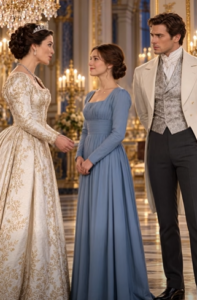
 “Then perhaps,” Queen Elener said, “it is time you learned.”
Edward had spent the evening wishing people would stop looking at his wife. Now he could feel an entire ballroom waiting for an explanation he did not possess.
The Queen still held Alice’s hands. There was nothing ceremonial about the gesture. Her thumb rested against Alice’s knuckles with the easy affection of someone remembering a kindness, and that small familiarity frightened Edward more than a public rebuke would have.
He knew how to answer a rebuke. He did not know how to stand beside a stranger wearing his wedding ring.
“Before my mother died,” Elener began, “she worried that I understood too little of the kingdom I would inherit.”
A servant brought a plain wooden chair at her signal. She guided Alice toward the edge of the musicians’ platform, where they could speak without straining to be heard. Alice remained standing. Edward followed because he could think of nothing else to do.
“My mother believed a person could learn the names of every village and still know nothing about the people who lived there. So, before I turned eighteen, she sent me away for a season.”
Someone behind Edward drew a surprised breath.
“Without my title,” the Queen continued. “Without attendants to arrange my meals or explain why my wishes mattered. I traveled under another name. I worked when I could find work, and discovered how quickly a purse becomes empty when you have never learned to judge the price of anything.”
Her expression softened, though not with amusement.
“It was a difficult autumn. By the time I reached the eastern hills, I was tired enough to make foolish decisions. I became ill. The innkeeper gave me shelter while I could pay him. When I could not, he put me outside.”
Edward looked at Alice.
She was watching the Queen closely now. The patient expression he knew had changed into something more vulnerable. Her eyes shone beneath the chandeliers, and her fingers tightened slightly around Elener’s hands.
“I remember the cold,” the Queen said. “Then very little, until I woke in a small room beside a fire. A young woman was sitting next to me with a damp cloth.”
Alice lowered her eyes.
“You were so frightened of taking our bed,” she said quietly.
The words carried farther than she intended.
Elener smiled at her. “I was frightened of many things. You made the bed seem the least important of them.”
A strange pressure settled beneath Edward’s ribs. Alice had spoken to the Queen without rehearsing, without searching for an impressive phrase. He remembered telling her to say little. He wished he could take the memory out of his head.
“She was sixteen or seventeen,” Elener told the listening company. “Her mother had died. Her father taught village children, and there was scarcely enough food in the house for the two of them. Yet she brought a sick stranger inside. She gave me her bed and slept near the hearth for three nights.”
Edward could see George beyond the Queen’s shoulder. His friend’s glass hung motionless at his side.
“When I recovered,” Elener continued, “Alice gave me coins she had saved. I tried to refuse. She told me a person who had just been ill should not begin another journey hungry.”
“It wasn’t very much,” Alice murmured.
“It was more than you could comfortably spare.”
The Queen looked around the hall. Nobody moved.
“She did not know who I was. Until tonight, she had no reason to know. I learned her family name after returning home, and from time to time I asked after her. I should have written. Perhaps I was too attached to the idea that she had given something without expecting a reward, and that I ought not interfere with it. But I remembered.”
Alice looked up again. Her surprise was unmistakable now.
“All these years?”
“All these years.”
There was no hidden title. No fortune waiting to be announced. Nothing Edward could understand by placing it beside the value of an estate or a profitable agreement. There was only an old act of generosity, offered in a house with too little food, and a woman who had never thought it worth mentioning.
The realization left him nowhere to hide.
“That is why I have held Alice Bennett in such affection,” the Queen said. “Fine clothes tell me what someone can purchase. That winter told me who she was.”
Edward remembered Alice washing dishes beside Dorothy. He remembered the dirt on her cuffs, the three dresses George had found so amusing, the little bag she had carried into his courtyard.
He had mistaken every one of those things for evidence.
Elener turned toward him.
“You are a fortunate man, Edward Hartley. I hope you come to understand that before understanding arrives too late.”
“Your Majesty—”
He stopped. An apology offered to the Queen would be easier than the one he owed his wife. Even now, his first instinct was to address the person with the greatest power to punish him.
Alice’s gaze met his for a moment. She looked neither pleased nor vindicated. Somehow that made the shame worse.
When the Queen moved away, promising Alice a private visit, the ballroom came alive around them. Conversations restarted in hurried fragments. People who had passed without acknowledging Alice now approached with careful smiles.
George reached them first.
“Alice, I had no idea. About what happened, I mean. I hope you know my earlier remarks were only—”
“Unnecessary,” Edward said.
George stared at him.
The word had escaped before Edward could weigh its effect. His pulse beat hard against his collar.
“They were unnecessary,” he repeated. “And I encouraged them.”
Charlotte adjusted a bracelet. “We certainly meant no harm.”
Alice gave them a small nod. “Then we need not repeat it.”
She did not linger to make them comfortable. Edward followed her toward the quieter edge of the room, aware that for once he was keeping pace with her rather than steering her somewhere he preferred.
“Alice,” he said, “may we speak?”
Her eyes moved over the faces still turned toward them.
“Not here.”
He accepted the answer. It felt like the first useful thing he had done all evening.
In the carriage, she sat opposite him, her hands folded around the gloves she had removed. Streetlamps passed across her face. Without the ballroom’s brightness, he could see how tired she was.
“Why didn’t you tell me?” he asked.
Alice looked at him for a long moment.
“That I once cared for a traveler?”
“That you knew the Queen.”
“I didn’t know she was the Queen.”
“You recognized her when she approached.”
“Yes. Then.”
He leaned back, hearing the accusation in his own questions. The evening had exposed his ignorance, and he was trying to make her responsible for it.
“Forgive me. That wasn’t fair.”
The wheels struck a rough patch of road. Alice steadied herself against the seat.
“I would have told you about my life if you had asked,” she said. “You rarely asked anything you didn’t believe you already knew.”
Edward stared at his gloves.
He had asked why she worked in the kitchen. He had asked whether she understood the importance of a royal invitation. Questions shaped like corrections. Nothing that gave her room to answer honestly.
“I’ve treated you terribly.”
“Yes.”
He waited, though he could not have said what he expected. An assurance, perhaps. Something to soften the discovery that an admission did not immediately make him better.
Alice looked out of the window.
“I did not mind the small room,” she said. “Or the plain meals when I ate alone. I understood that neither of us had chosen the circumstances. But you made certain I understood that you considered me an indignity.”
His throat tightened.
“I was angry with my father.”
“I know.”
“That doesn’t excuse it.”
“No.”
The carriage seemed smaller than before. He could not rearrange the conversation into something that would flatter him, and for the first time he tried not to.
“I don’t know how to repair what I’ve done.”
Alice turned back toward him. “You could begin by deciding whether you want to repair it because I was hurt, or because the Queen noticed.”
He had no immediate answer.
She did not ask for one.
At the manor, he stepped down first and offered his hand. Alice accepted it to descend, then released him. He walked beside her to the stairs, stopping when she stopped.
“Good night, Edward.”
“Good night.”
He watched her go toward the distant corridor where he had left her on their wedding night. For months, the distance between their rooms had suited him. Now it measured something he had done deliberately.
He slept badly.
By breakfast, the household knew enough about the reception to fall quiet when he entered. His mother’s eyes rested on him over her teacup. She did not ask whether Alice had embarrassed him.
That omission was more difficult than a question.
His father summoned him soon afterward.
Lord Grayson stood behind his desk with a letter open beside him. Edward did not ask who had written. News traveled quickly when it concerned a royal favorite and a foolish husband.
“I understand you were surprised last night,” Grayson said.
“I was.”
“By Alice’s kindness?”
Edward looked up.
“Or by discovering that someone important had benefited from it?”
“I deserved that.”
“Deserving it is not the question.” Grayson sat down heavily. “What do you intend to do?”
Edward stood before the desk as he had as a boy, waiting to be told the correct course. The familiarity embarrassed him.
“Apologize properly. Learn something about her.”
“And when she does not immediately forgive you?”
“Continue.”
His father studied him, measuring the answer.
“Her father pulled me out of water when he could barely keep his own footing. He ruined his health for weeks afterward. When I offered money, he asked me to remember the families who had lost their homes. I have wondered more than once how such a man raised a daughter like Alice. The answer seems obvious now.”
Grayson touched the edge of the letter without looking at it.
“I meant to give her security. I should have considered more carefully what kind of welcome she would receive.”
Edward felt a sudden impulse to let his father take some of the blame. He resisted it.
“You did not tell me to be cruel.”
“No. I did not.”
The silence that followed was less punishing than Edward expected. His father looked tired rather than triumphant.
“Earn her trust,” Grayson said. “And do not make your shame another burden she must carry for you.”
Edward left the study without making a promise. He had made plenty of promises he understood only as sounds.
He found Alice in the small garden behind the servants’ quarters. Her sleeves were rolled up, and a loose strand of hair had slipped against her cheek. A basket of weeds stood beside her knees.
She looked up at his shadow.
“Is something wrong?”
He deserved that question, too.
“No. May I stay?”
Alice glanced toward the path, as though searching for the condition attached to his request. Then she nodded.
He crouched beside an untidy patch of earth. There was nothing in his clothing suitable for kneeling, but worrying about it now would be absurd.
“Could you show me what to do?”
“You want to weed?”
“I want to understand what you spend your time doing.”
She considered him before placing a small trowel in his hand.
“These,” she said, pointing, “are seedlings. Those are weeds. Try not to confuse them.”
He almost smiled. “That sounds important.”
“To the seedlings, certainly.”
He laughed once, surprised by it. Alice’s mouth softened, though she returned to work before he could mistake the moment for forgiveness.
For a while they spoke only about the garden. He learned that plants he thought identical required different care. He loosened too much soil and had to press it carefully back around a root. Alice corrected him without making him feel foolish, and the contrast with his own behavior was impossible to ignore.
“Did your father teach you this?” he asked.
“Some of it. We needed the vegetables. I became better when we could not afford to lose many.”
He worked more carefully after that.
She told him about the little schoolroom, the children who arrived with bread wrapped in cloth, her father’s habit of forgetting his own dinner when a pupil struggled with a lesson. Edward listened. Once or twice she stopped, apparently expecting him to grow impatient.
He asked another question.
When she spoke of her father’s death, her voice changed.
“He would have liked this garden,” she said. “He would have complained about the crooked rows, then planted his own even more crookedly.”
Edward looked at the dark earth beneath his nails.
“I’m sorry I never asked about him.”
Alice rested the trowel against the basket. “Thank you.”
It was not absolution. It was enough to make him continue.
Over the following days, he discovered how awkward ordinary kindness could feel when he had spent months avoiding it. At breakfast, he asked whether she would join him instead of telling a servant to fetch her. When she declined an afternoon drive because she had promised Dorothy help, he accepted the refusal.
He began returning before dinner. Sometimes they ate together. Sometimes conversation failed, and they heard every movement of the cutlery. He learned not to blame her for the silences.
One evening she caught him watching her across the table.
“What is it?”
“I was thinking that I never knew you disliked the sweet wine.”
“You never offered me any other kind.”
He put down his glass. “Would you prefer water?”
“Tonight, yes.”
The exchange was so small that nobody else would have remembered it. Edward did. He had spent years imagining that understanding a woman required grand discernment. Sometimes it required allowing her to finish an answer.
At the club, the change proved more difficult. Henry greeted him with questions about the reception, then fell quiet when Edward did not share his amusement at the discomfort of their acquaintances.
“You might at least enjoy George being put in his place,” Henry said.
“I stood beside him while he spoke.”
“You answered him afterward.”
“After the Queen had made it impossible to agree with him.”
Henry turned his glass slowly against the table.
“What would you have me say?”
“Nothing clever. If someone speaks of Alice as though the only remarkable thing about her is that the Queen remembers her, perhaps you could remind them that she was the same woman before the reception.”
Henry looked at him more closely.
“I could do that.”
Edward thanked him and left earlier than usual. He was tempted to tell Alice about the conversation when he returned. He imagined her approval, then felt ashamed of needing applause for correcting a conversation he had helped create.
Instead, he asked whether she wanted the lamp moved closer to her book.
She looked up, surprised, and said yes.
Later, he found himself remembering her hands on their wedding day. He had seen how tightly she held the bag and decided she was grasping at a fortune. It had not occurred to him that a woman arriving among strangers might hold on to the last familiar things she possessed.
He could not stop discovering such omissions. Each memory required him to surrender another comfortable account of himself. He began to understand why real change felt less like an achievement than the repeated, unglamorous decision to look again.
The Queen’s invitation arrived the next week. Alice held the letter with visible pleasure, then looked at him as though preparing for an objection.
He felt it before he could stop it: the old fear of being excluded from something important, this time sharpened by the knowledge that Alice had somewhere she was wanted without him.
“You should go,” he said.
“I intended to.”
He nodded. “Of course.”
Her gaze lingered on him, and a small, honest smile appeared.
“She asked after the garden.”
“You may tell her I have endangered several vegetables.”
“I shall be discreet.”
When Alice returned from the palace, she told him about tea with Elener, about remembering a room neither had seen for years, about laughing at the difference between the frightened traveler and the composed Queen. Edward listened without pressing for details she did not offer.
Later, as she rose to leave the sitting room, she paused beside his chair.
“You may ask me things, Edward. You needn’t look so afraid of getting them wrong.”
“I am discovering there is a great deal to get wrong.”
“Then ask slowly.”
He looked up at her. For the first time, the hope between them felt like something neither had been ordered to provide.
Three weeks after the reception, a messenger arrived while Edward was reviewing a letter he scarcely understood. The man had ridden hard enough that dust covered his coat.
Edward rose before the message was finished.
His father had collapsed during a business meeting in the city. They were bringing him home. The physician had been sent for.
For a moment, the room lost its familiar proportions. The desk looked too large, the doorway too far away. Edward heard himself asking practical questions and understood none of the answers.
In the corridor, he met Alice.
She saw his face and stopped.
“My father,” he said. “Something has happened to his heart.”
She set down the basket she was carrying.
“Where is he?”
“On the way home. I don’t know—” His voice failed. “I don’t know what I should do.”
Alice moved closer. She did not offer the easy assurance that Grayson would recover.
“We will be ready when he arrives,” she said.
Then she took Edward’s hand, and he held on.