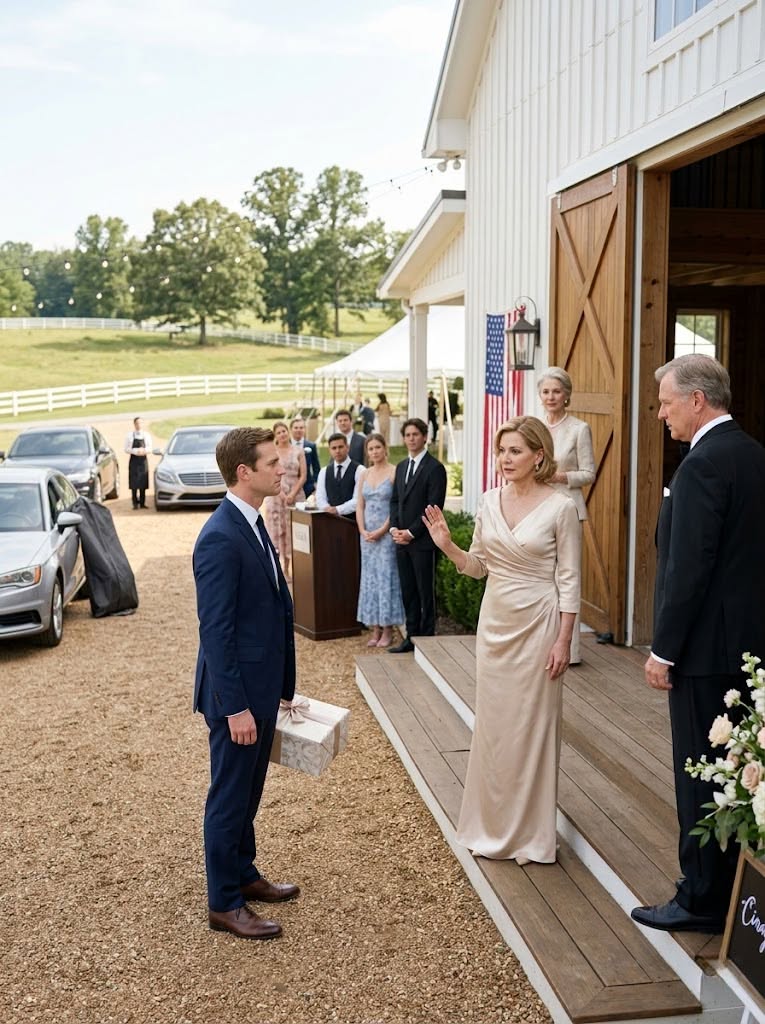
Part 1: The Night She Turned My Workshop Into A Muddy Lake
“Dig the ditch deeper. I want his shop knee-deep by midnight.”
That was what Trisha Lockwood Sterling told her contractor on the night she finally stopped pretending our dispute was about neighborhood appearances.
She stood beside my north property line in expensive white sneakers, pointing toward the workshop I had spent most of my retirement savings building. Then she kicked over a wooden survey stake my daughter had placed in the ground.

What Trisha didn’t know was that a camera had recorded her arrival, another had captured the work site, and a flow sensor buried beneath my pasture was measuring the water she intended to send toward my building.
By morning, six inches of muddy water covered my workshop floor.
My German bandsaw was ruined. The electronics on my table saw were damaged. The kiln controls had failed, and eighteen finished pieces of furniture waiting for delivery were soaked.
But the worst part was standing beside the empty rack where my late wife’s cherry lumber had been stored.
Her name was still burned into the wood.
Joanne Mercer.
I stood there with water around my boots, looking at her handwriting, and understood that Trisha had never considered what she was destroying.
She only wanted me gone.
My name is Garrett Mercer. I was seventy-two when this happened, and I had spent nearly fifty years making furniture in Lancaster County, Pennsylvania.
The Mercer family had owned our eighty-two acres along Pwick Run since 1798.
My ancestors built the farmhouse from limestone and yellow pine. Generations of Mercers worked the fields, repaired the fences, and buried their dead beneath the white oak behind the house.
I was born in the upstairs east bedroom in 1953.
My grandfather taught me woodworking when I was nine. He believed a boy should learn to sharpen a plane before he was trusted to push one.
“Bad tools make impatient men,” he used to say.
He made me sharpen the same blade three times before I touched my first board.
After high school, I apprenticed with a cabinetmaker in Lancaster and completed woodworking training near Philadelphia. I opened my own business in 1975.
I never became wealthy, but I made a living doing work I respected.
I built cabinets, tables, chairs, and occasionally something unusual enough to keep me awake at night figuring out the joinery.
Between 2008 and 2010, I constructed my final workshop on the southwest corner of our pasture.
It was eighteen hundred square feet, built with heavy oak timbers I had milled myself. Inside were the machines I had saved decades to purchase: a German bandsaw, an industrial table saw, a long-bed jointer, overhead dust collection, and a custom drying kiln.
The whole project cost nearly two hundred thousand dollars.
I expected that building to outlive me.
Joanne expected it too.
We were married forty-seven years before breast cancer took her in November 2019.
She was a quilter, a wonderful cook, and a woman who could tell whether I had eaten lunch simply by looking at me.
She had one rule about my workshop.
“No important project starts without coffee.”
She brought coffee out there even when I insisted I was only cleaning up.
The last thing we worked on together was a set of three cherry slabs cut from a tree along our south fence.
Joanne loved that tree. When a storm damaged it badly enough that we had to take it down, she stood beside the trunk and asked whether the wood could become something useful.
We milled three beautiful slabs, each two inches thick.
They were still drying when she entered hospice.
I finished drying them a week after her funeral.
For years, they remained on a special rack against the workshop’s east wall. I burned her name into the rack using letters traced from one of her grocery lists.
I couldn’t decide what to make from the wood.
So I waited.
The trouble began with the neighboring property.
In 2014, the old Hostetler dairy farm north of us became Sycamore Hollow Country Club and Estates.
A development company built luxury homes around an eighteen-hole golf course, with a clubhouse, swimming pools, tennis courts, and a gated entrance.
The eighteenth green was less than two hundred feet from my workshop.
The fifteenth fairway overlooked my pasture.
Before construction began, the developers approached me about drainage.
The land naturally sloped south toward Pwick Run. Water had always crossed portions of our property on its way downhill.
The developers wanted permission to install drainage culverts along my northern boundary while they constructed the course.
I agreed, provided they respected the natural watershed.
My attorney, Howard Garrick, prepared the easement.
He insisted on two protections.
The first allowed revocation after ninety days’ written notice if the drainage system materially changed the agreed flow or harmed my property.
The second prohibited piping or structures that diverted water contrary to the natural drainage gradient.
Howard read those provisions aloud at my kitchen table.
Joanne served coffee while the developer’s engineer and contractor signed.
After everyone left, Howard handed me my copy.
“Put this somewhere safe, Garrett. You might never need it. But if you do, you’ll be glad we took our time.”
I placed it in the farmhouse safe.
For several years, nothing happened.
Then Trisha Lockwood Sterling arrived.
She and her husband, Reed, purchased one of the largest homes at Sycamore Hollow in 2018.
Reed managed a hedge fund. Trisha became president of the homeowners association in 2020 and gradually gained influence over golf course management.
Her first objection was the appearance of my workshop.
In February 2021, I received a letter suggesting I relocate it because it was visually inconsistent with the community.
I wrote back explaining that my property was outside their association and that my workshop was legally established on land my family had owned for generations.
Two weeks later, a Philadelphia law firm sent a threatening letter about possible nuisance claims.
I forwarded it to Brennan Quill, the attorney who had taken over Howard Garrick’s practice.
Brennan called me after reading it.
“Garrett, keep the envelope. And don’t move your workshop.”
That should have ended the matter.
Instead, Trisha filed complaint after complaint.
County code enforcement investigated my workshop. Environmental authorities received allegations about my woodworking operations. State police received reports claiming I operated an unauthorized shooting range.
None of the complaints established the wrongdoing she alleged.
Every investigation cost me time, and every letter reminded me that someone with money and influence wanted to make my life difficult.
Then water began appearing in my workshop.
The first serious incident came after heavy rain in April 2022.
I discovered a quarter inch of water across one corner of the floor.
I spent hours cleaning it up.
My friend Bart Kungle, who operated a drainage business near Manheim, inspected the property.
He measured the slope and examined the soil.
“Something’s pushing water toward your foundation,” he told me. “Your original grade isn’t the problem.”
I asked whether the golf course might be responsible.
“Could be. But we’d need to investigate.”
Over the next two years, the flooding grew worse.
Fourteen storms brought water into the building.
I installed sump pumps, dug a French drain, sealed the concrete, and raised stored lumber above floor level.
By early 2024, I had spent eleven thousand dollars trying to keep a properly built workshop dry.
The water kept coming.
One evening, I called my daughter.
Annie worked as a watershed hydrologist with Pennsylvania’s Department of Environmental Protection.
She understood water in a way I understood wood.
I told her about the flooding, the repairs, and the crack that had developed in the southwest corner of the floor.
She listened without interrupting.
Then she said, “Dad, don’t spend another dollar until I come down.”
The following weekend, she arrived from Harrisburg with surveying equipment, a laptop, and enough coffee for both of us.
She spent hours walking our boundary and examining the neighboring drainage system where access was permitted.
She studied the original easement drawings, surveyed elevations, and traced the path of the water.
On Sunday evening, she sat beside me on the porch.
Her laptop displayed a map covered with colored lines.
“Dad, the approved system was supposed to use three twelve-inch culverts.”
I nodded.
“What they have now is substantially different.”
She showed me additional drains, retention structures, and a large underground pipe absent from the original plans.
The pipe discharged beneath my pasture, near the workshop foundation.
Annie had located and photographed it.
“That’s where the pressure is coming from,” she said.
I looked at the map.
“Are you telling me they’ve been draining the golf course into my shop?”
“I’m telling you the drainage configuration is directing water toward your foundation. We need the records and measurements to establish exactly when and how it changed.”
I asked what we should do.
“Document everything. Get independent confirmation. Let Brennan handle the legal side.”
Then she pointed to the original watershed line.
“If the unauthorized drainage is removed and the natural system is restored, the course will have to manage the water on its own land.”
I studied the drawing.
The simplest line was marked in red.
For the first time in years, I understood why the water kept coming.
And I understood that fixing the workshop would require more than another sump pump.
Part 2: We Followed The Water And Found Her Hidden Drainage Scheme
Annie and I began documenting every storm. Bart helped install a flow sensor at the underground outlet, while cameras monitored activity along my property boundary. I kept receipts, photographs, pumping records, and measurements. Annie prepared technical maps in her personal capacity, taking care not to turn her state position into a private investigation. Brennan reviewed the easement and arranged for independent specialists to examine the drainage evidence.
Then Earl Whitaker, Sycamore Hollow’s longtime golf course superintendent, came to my porch. He studied Annie’s map and recognized the unauthorized piping. “I’ve warned management about that system for years,” he said. He had saved dated maintenance reports and correspondence describing drainage modifications that had never been properly reviewed. “Would you testify?” I asked. Earl looked straight at me. “Under oath, Garrett. Every word.”
Financial records obtained through counsel raised further questions. The association had paid substantial consulting fees to a company connected to Reed Sterling, and contractors had billed for drainage improvements that appeared inconsistent with the approved plans. A proposed May 2024 expansion could send considerably more water toward my property. Brennan cautioned that suspicious payments were not proof of fraud. Annie agreed. “We need the contracts, the permits, and the actual flow measurements. We cannot guess our way through this.”
I wanted to stop the work immediately. Annie wanted the vulnerable equipment protected, and Brennan urged us to seek regulatory intervention before any further damage occurred. We moved Joanne’s three cherry slabs into the old dairy barn, using my hay wagon and help from two of Annie’s friends. I covered them carefully with canvas. We also photographed the workshop’s machinery and inventory for insurance purposes. The heavy equipment remained because moving it required professional riggers we had not yet arranged.
By mid-May, Brennan had prepared notices challenging the drainage changes and asserting my rights under the easement. Earl had copied years of maintenance records. Bart had tested the sensor. I had placed additional cameras on my own property. On the night of May 16, I sat outside with Beecher, our old hound, and watched the dark pasture. I thought about Joanne’s advice that water always found its way downhill. I hoped the evidence would finally persuade someone to make Sycamore Hollow manage its own water.
Part 3: Her Midnight Orders Became Evidence She Could Not Explain
On May 17, at 10:41 p.m., Trisha’s white Range Rover appeared near the service entrance. The cameras recorded her walking toward the boundary and meeting Hank Garber, a drainage contractor. The recording captured their discussion near the buried pipe. “Dig the ditch deeper,” she ordered. “I want his shop knee-deep by midnight.” Hank warned that deliberately flooding the building could bring criminal consequences. Trisha dismissed him. She wanted me gone by Christmas.
Hank operated a backhoe, cut a trench, altered existing drains, and installed a temporary discharge line pointing toward my workshop. The flow sensor recorded a dramatic increase in discharge. By dawn, muddy water covered six inches of my floor. The bandsaw motor, kiln controls, table saw electronics, finished commissions, and stored lumber suffered extensive damage. I stood in the doorway, looking at the empty cherry rack. Joanne’s burned signature remained above the waterline. I called Annie. “It’s happened.” She told me to photograph the scene and avoid disturbing the drainage equipment.
Annie arrived with independent investigators and regulatory personnel who began documenting the conditions. Dr. Ingrid Vogel, an environmental enforcement specialist, examined the trench, collected samples, and compared the altered drainage with the permitted configuration. Bart waited for authorization before pumping. Brennan organized the recordings, correspondence, and property records. Earl brought his boxes of maintenance reports. No one could restore my workshop that morning, but the evidence was no longer limited to my complaints.
Over the following days, investigators reviewed the recordings and traced the drainage alterations. The environmental agencies opened enforcement proceedings, while police examined whether the conduct supported criminal charges. Brennan served the formal easement revocation notice, beginning the ninety-day period specified in the agreement. Trisha circulated an email calling the allegations unfounded. Three days later, she left me a voicemail offering five thousand dollars for the inconvenience. I forwarded it to Brennan without replying.
Part 4: Ninety Days Later The Golf Course Faced Its Own Water
The next three months were spent dealing with insurance adjusters, investigators, engineers, and contractors. My documented workshop losses reached approximately $147,000. Bart pumped the building dry after the necessary inspections, and his crew helped construct a temporary work area inside the dairy barn. I finished three commissions there, including a memorial bench for a father whose son had died in Afghanistan. Working with hand tools gave my days structure while the legal process moved slowly.
Earl’s records became important to the investigation. They showed repeated warnings about drainage modifications and failures to obtain proper approvals. Hank cooperated with investigators, providing information about the midnight work. Financial investigators separately examined the consulting payments and contractor invoices. Trisha’s control over the association weakened as homeowners learned what had happened. Some began asking why their maintenance fees had supported projects they had never approved.
As the ninety-day period approached its end, Brennan coordinated with the relevant authorities over restoration of the drainage system. The approved work required removing unauthorized piping from my property and restoring the historical swale without creating a new unlawful discharge. Bart handled the excavation, Earl assisted, and Annie observed the hydrology. I watched from a pickup tailgate with a thermos of coffee. The work took most of the day. When it was finished, the underground pipe no longer carried the golf course’s excess water toward my workshop.
Heavy August rain tested the restored drainage. Water collected across portions of Sycamore Hollow’s thirteenth, fourteenth, and fifteenth holes. The course’s inadequate stormwater design became impossible to ignore. Trisha called, furious, accusing me of destroying her community. I told her the restoration had been reviewed and approved and directed future communications to Brennan. I didn’t celebrate the flooding. I had spent years cleaning up water that shouldn’t have been forced onto my property. I wanted the same problem solved properly for everyone.
By September, homeowners were circulating a no-confidence petition. Vernon Crowe, a retired engineer, helped organize the effort under the association’s bylaws. The enforcement proceedings brought public attention to the drainage violations, while criminal and financial allegations continued through their separate legal channels. Trisha had once counted on the community standing behind her. Now residents were demanding records, independent oversight, and a new board.
Part 5: The Land Recovered And Joanne’s Name Finally Found Its Place
The legal consequences unfolded over the following months. The state and federal enforcement matters produced substantial penalties and corrective obligations. The management company entered a settlement over its supervisory failures. In November, Trisha accepted a plea agreement addressing the criminal and financial charges. The resulting sentences included federal custody, state penalties, probation, and restitution obligations. She was barred from serving on Pennsylvania community boards. Reed filed for divorce, and his business came under separate scrutiny. None of those developments repaired my workshop, but they ended Trisha’s campaign to force me off my land.
Sycamore Hollow elected a new board. Earl returned as superintendent, and the association hired environmental engineers to redesign its drainage system. The solution required surrendering three golf holes and restoring an eight-acre wetland. The new board worked with our family and conservation partners to name it the Joanne Mercer Wetland Preserve. When Annie saw the first photographs of wood ducks settling there, she called me from Harrisburg. For a while, neither of us said anything.
My workshop was rebuilt by December. I added a small teaching classroom upstairs and established an apprenticeship fund in Joanne’s name. My first student was June Hadley, a sixteen-year-old who wanted to build acoustic guitars. I started her with traditional Finnish woodworking techniques, sharpening tools and cutting joints by hand. She made a walnut jewelry box for her grandmother and insisted on doing the dovetails without a jig. Joanne would have liked that stubbornness. I bought June a leather apron, the kind Joanne would have chosen.
The wetland dedication took place on a Saturday in May. Families, conservation workers, neighbors, and schoolchildren gathered beside the restored shoreline. Students planted native shrubs. June planted three pin oaks near a bench overlooking the water. A great blue heron began visiting the following weeks. Frogs returned, and dragonflies hovered above the shallows. Earl’s new superintendent’s office incorporated timber from an old sycamore that had fallen during the August storms. Something useful had come from another damaged tree.
That spring, I brought Joanne’s cherry slabs out of the dairy barn. I made a bench from one and placed it beside her grave beneath the family white oak. I carved her signature underneath the seat, where it would be protected from casual wear. The other two slabs remain in storage. I still haven’t decided what they should become. I am no longer troubled by that.
A Lancaster reporter later asked what the dispute had cost me beyond money. I told her it had cost years of patience and a workshop full of equipment, but it had also given us a restored creek, a working wetland, and a chance to teach another generation how to build something lasting. She asked whether I would do it again. “I’d act sooner,” I said. “And I’d tell anyone facing a drainage problem to document it and call the people who understand the watershed before the damage gets worse.”
These days, Annie visits every other weekend. Earl comes for supper when his schedule allows. Bart still owes me a poker night. Brennan sends a Christmas card, usually with a short note about Howard Garrick’s carefully written easement. I sit on the porch with Beecher and listen to the frogs in the preserve named for my wife. My family’s fence line still follows the old watershed. The land remembers. The water remembers. So do I.
THE END
Disclaimer: This story is fictional and created for entertainment purposes only. Any names, characters, places, or events are fictitious or used fictitiously. No real person or organization is intended to be portrayed.