Part 1: The Night Our Neighborhood President Turned Rules Into Violence
“She shot my daughter through her bedroom window, and now she’s calling it an accident.”
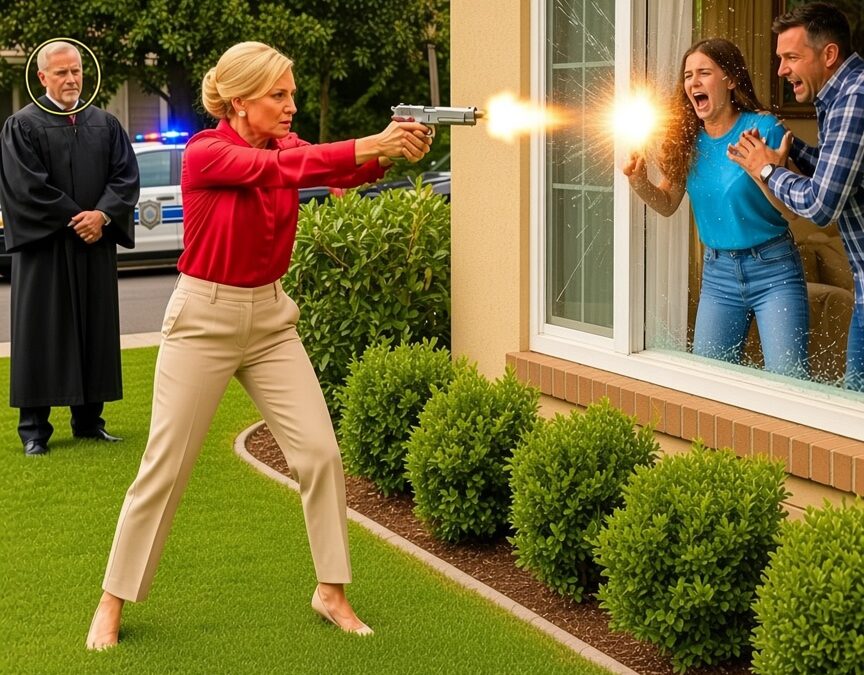
I said those words to Officer Boone while paramedics worked upstairs and broken glass covered my daughter’s bedroom floor. Lorraine Vexley stood beside the sidewalk, wearing her fluorescent community safety vest, with a revolver resting in the holster at her hip.
She didn’t look frightened. She didn’t ask whether Ava was alive. She simply folded her arms and said, “I saw an animal near the trash cans. I fired a warning shot.”
“A warning shot into a second-floor bedroom?” I asked.
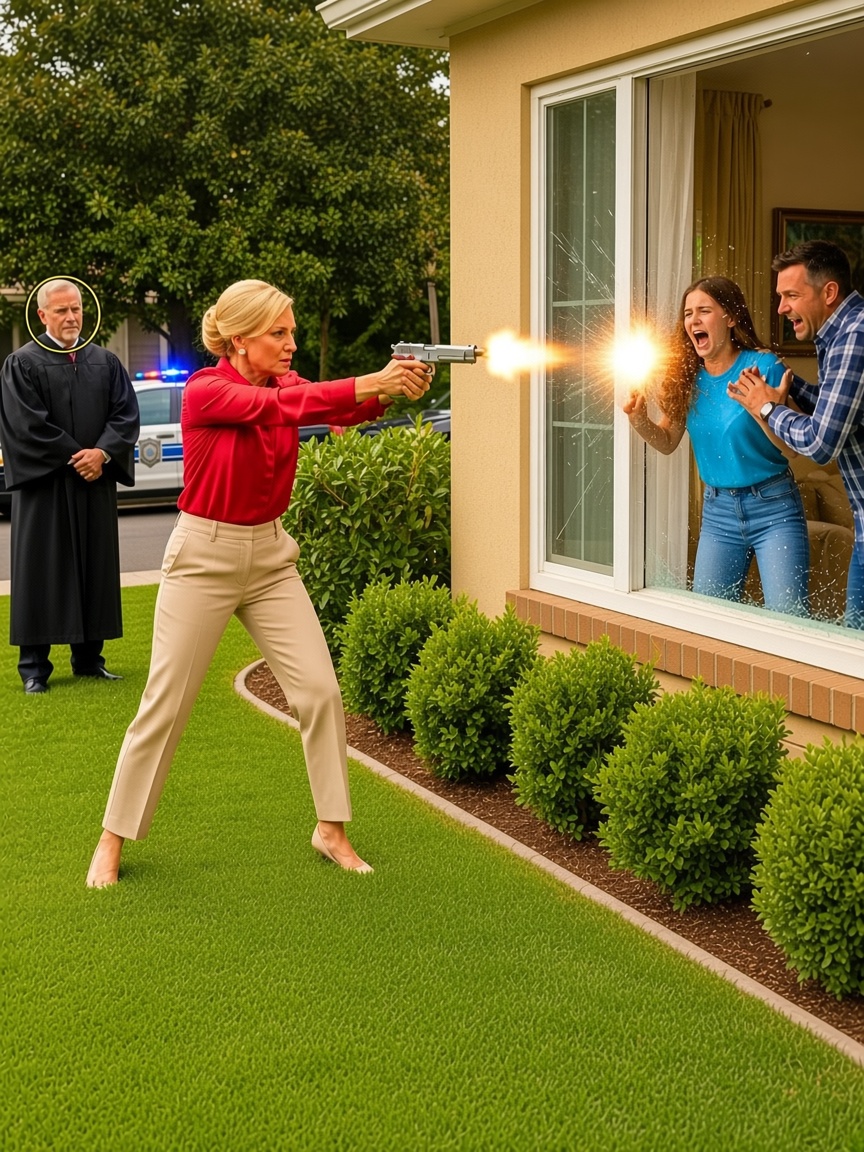
Lorraine looked at me with the same expression she used whenever I questioned an HOA citation.
“You can’t prove what I intended, Dr. Elridge.”
I looked toward the shattered window. I had spent twenty-two years examining shooting scenes as an FBI ballistics analyst. I knew the difference between an explanation and a physical possibility.
And Lorraine’s explanation had a serious problem.
But before I tell you what I found, you need to understand how a handful of colorful window stickers became the center of a dispute that nearly cost my daughter her life.
My name is Mason Elridge. Three months before the shooting, Ava and I moved into Willowmere Heights, a gated suburban community where the lawns were immaculate, the mailboxes matched, and the homeowners association seemed to have an opinion about everything.
I chose the neighborhood because it looked peaceful. After what Ava had experienced at her previous school, peace mattered more to me than a large house or an impressive address.
She was still working through the effects of that experience with a therapist. Certain routines helped her feel comfortable. So did familiar objects, especially the colorful window clings she arranged across her bedroom glass.
There were yellow suns, green frogs, and smiling moons.
Her therapist had encouraged her to use familiar symbols to make unfamiliar spaces feel safe. Ava took that suggestion seriously. On our second afternoon in the house, she spent nearly an hour deciding where each sticker belonged.
“Dad, the frog has to go here,” she told me, pressing it against the lower corner of the window.
“Why there?”
“Because he can see the driveway.”
I inspected the frog’s enormous cartoon eyes.
“Looks qualified for neighborhood surveillance.”
She laughed. It was a sound I hadn’t heard enough during the previous year.
I would have left a hundred frogs on that window to hear it again.
Lorraine Vexley disagreed.
The first citation arrived six days after we moved in.
It described Ava’s decorations as an unauthorized alteration to the exterior appearance of a street-facing window. The notice cited Article 3.2 of the Willowmere Heights architectural standards and demanded removal within seven days.
I assumed it was an automated complaint.
I emailed the association, explained Ava’s therapeutic needs, and requested an exemption.
Nobody responded.
Instead, another citation appeared on our front door.
This one included a photograph of Ava’s window, taken from the sidewalk.
I called the HOA office and eventually reached Lorraine herself.
“Those decorations are temporary,” I explained. “They don’t damage the glass or change the structure.”
“That’s not the standard,” she replied. “Visual uniformity applies to all residents.”
“My daughter’s therapist recommended them.”
“Medical circumstances don’t override architectural requirements.”
I remember looking through the kitchen doorway while she spoke. Ava was sitting at the table, carefully drawing another frog.
“Then I’d like to discuss an accommodation with the board,” I said.
“You’re welcome to submit your concerns in writing.”
She ended the call.
That became Lorraine’s favorite response whenever anyone challenged her authority.
Submit it in writing.
Wait for review.
Respect the established process.
The process, conveniently, always seemed to end wherever Lorraine wanted.
Over the following weeks, I learned that our family wasn’t her only target.
The Gonzalez family received a citation for leaving a small tricycle on their porch. The Myers family was warned about chalk drawings on their walkway. The Nairs removed their porch suncatchers after receiving repeated notices.
Lorraine called these things safety concerns.
She believed visible personal possessions advertised vulnerability and encouraged unwanted attention.
I considered the theory ridiculous, but I initially treated it as a neighborhood disagreement.
I had spent enough years dealing with serious investigations. I wasn’t interested in spending retirement fighting over frogs.
Then Lorraine began patrolling after dark.
She walked the sidewalks carrying a clipboard and a powerful flashlight. Sometimes she wore a vest labeled SECURITY LEAD, although I could find no board resolution creating that position.
She regularly stopped outside our house.
One evening, while I was bringing in the trash cans, she pointed toward Ava’s bedroom.
“You really should reconsider those stickers,” she said.
“We’ve already discussed them.”
“They advertise fragility.”
“They’re children’s decorations.”
“Some people don’t understand how criminals think.”
I nearly laughed.
Instead, I said, “Good night, Lorraine.”
I didn’t know she carried a revolver.
I didn’t know how far she would go to enforce her idea of order.
Two days before the shooting, we received a final warning.
The letter denied our exemption request and stated that Ava’s health was not grounds for architectural deviation.
I placed it with the previous citations in a folder on the kitchen counter.
I planned to attend the next board meeting.
That was all.
On the night of the shooting, I was outside adjusting a motion sensor near the backyard. Ava was upstairs finishing a sketch before bed.
The sound came shortly after nine.
One sharp crack.
I recognized it immediately.
I dropped the screwdriver and ran toward the house.
“Ava!”
She didn’t answer.
I took the stairs two at a time.
Her bedroom door was open. Glass covered the carpet. The window had a jagged hole near its center, and Ava was on the floor beside her bed, clutching her shoulder.
There was blood on her shirt.
“Dad,” she whispered.
I knelt beside her and grabbed a towel from the bathroom.
“Stay with me, sweetheart.”
“It came from outside.”
“I know. Help’s coming.”
I called 911, pressed the towel against her injury as instructed, and stayed beside her until I heard sirens.
She kept looking toward the broken window.
“I was just reading,” she said.
“I know.”
“I didn’t do anything.”
Those words hurt more than anything Lorraine said afterward.
The paramedics arrived and took over. One of them asked me to step aside while they prepared Ava for transport.
I followed them downstairs, then hurried outside to identify where the shot had come from.
Lorraine stood near the curb.
Her revolver was holstered.
Officer Boone was speaking with her.
Lorraine said she’d seen a raccoon near the trash cans and fired to scare it away. According to her, the shot had gone somewhere she hadn’t intended.
I looked at the trash cans.
They were near the street, well to the right of Ava’s window.
Then I looked up.
The broken glass was on the second floor.
“That’s not where a warning shot would go,” I said.
Boone turned toward me.
“Sir, we’re still establishing what happened.”
“I understand. But she fired toward my daughter’s room.”
Lorraine made an impatient sound.
“That’s an accusation.”
“My daughter has been shot.”
“And I have already explained the circumstances.”
She spoke as though we were discussing an overdue landscaping fee.
When the paramedics wheeled Ava toward the ambulance, Lorraine finally addressed me directly.
“I’ll let the insurance handle the damage. There’s no reason to make this bigger than necessary.”
I stared at her.
Then I climbed into the ambulance with my daughter.
At the hospital, the doctors treated Ava’s shoulder injury. She was stable, but the recovery would take time, and the emotional effects were impossible to predict.
I sat beside her bed while she slept.
Every few minutes, I looked at the bandage beneath her hospital gown.
I kept thinking about the towel.
The broken glass.
The way Lorraine had stood beside the sidewalk without asking whether the child she’d shot was going to survive.
By morning, Ava was resting under medical supervision, and I returned home to speak with the investigators.
Her bedroom was secured. I photographed what I could without disturbing the damaged areas.
The shattered pane had an identifiable entry region. The wall beyond the bed showed additional damage. Those features could help reconstruct the projectile’s path, although a complete assessment would require proper measurements and independent examination.
I knew better than to treat my first estimate as a final conclusion.
I also knew Lorraine’s account needed serious scrutiny.
On the kitchen counter sat a new HOA bulletin.
Its heading read, “Visual Uniformity Matters.”
The notice warned residents against decorative decals, signs, and other visible items that supposedly compromised community safety.
Lorraine’s name appeared at the bottom.
I placed it beside the three citations and the denied exemption.
Then I called Officer Boone.
She returned around noon.
“We’re documenting the discharge,” she told me. “But we don’t have footage of the actual shot yet.”
“What about the weapon?”
“That’s part of the investigation.”
I pointed upstairs.
“I want the bullet path examined.”
“We’ll have the scene reviewed.”
“Lorraine claims she fired toward the curb. The window is above street level. Those accounts need to be compared with the physical evidence.”
Boone studied me.
“You worked ballistics?”
“Twenty-two years.”
She glanced toward the stairs.
“Then you know your personal analysis won’t replace the department’s.”
“Absolutely.”
I went to the hall closet and retrieved an old laser level.
“But I can show you why I’m concerned.”
We stood outside while I indicated the window, the sidewalk, and the location of the trash cans.
I didn’t claim that a laser beam could settle every question about a fired projectile. Glass can affect a bullet’s path, and damaged surfaces must be interpreted carefully.
Still, the visible damage was nowhere near the direction Lorraine described.
Boone took photographs and wrote down my observations.
“I’ll request a closer forensic review,” she said.
“Thank you.”
She paused before leaving.
“How’s Ava?”
It was the first time anyone connected with the investigation had asked me that without immediately turning back to Lorraine’s explanation.
“She’s alive,” I said. “Right now, that’s what I have.”
After Boone left, I went upstairs.
The little smiling moon on Ava’s window had a hole through its face.
The frog was missing.
I stood there for several minutes, looking at the decorations my daughter had chosen because they made her feel safe.
Lorraine had called them a threat to neighborhood security.
Now I was standing in the one room where security had failed completely.
And the woman responsible was still trying to enforce the rules.
Part 2: One Board Member Finally Questioned Lorraine And Her Armed Patrols
The clubhouse meeting took place while Ava was recovering at home. Lorraine stood before the board in her usual pressed blouse, discussing property standards as though nothing unusual had happened.
She referred to the shooting as an unfortunate incident and suggested that resident noncompliance created unnecessary safety complications.
I stood.
“Are you suggesting my daughter’s window stickers caused you to fire your gun?”
Lorraine’s expression tightened.
“I’ve already provided my statement to the authorities.”
“Then stop implying Ava was responsible.”
Nobody answered.
Travis Mendel, a board member and former military medic, finally spoke.
“I want the record to reflect that I never approved armed neighborhood patrols.”
Lorraine turned toward him.
“We’re not discussing enforcement equipment.”
“We should be,” Travis replied.
The meeting ended early.
Outside, Travis caught up with me.
“I didn’t see her fire,” he said. “But I heard her say your daughter was lucky before the ambulance left.”
I waited.
“I installed a wide-angle camera recently. It might have recorded part of her patrol.”
“Have you checked?”
“Not carefully.”
“Please do.”
He looked toward the clubhouse.
“I’ve been on this board for years. I should have challenged her sooner.”
Two days later, Lorraine posted a new neighborhood watch bulletin announcing that volunteers could carry firearms within legal limits. It bore her signature but no indication of a board vote.
I photographed it and sent it to Boone.
That afternoon, Ava sat on the couch watching television with her arm in a sling.
“Dad?”
“Yeah?”
“Did you save my frog?”
I retrieved the damaged cling from an envelope upstairs. I’d found it among the debris after the investigators finished their initial work.
Ava examined its torn edge.
“Can we put it on the new window?”
“Of course.”
“Even if Lorraine says no?”
I sat beside her.
“Lorraine doesn’t get to decide what helps you feel safe.”
That evening, I revisited my measurements and began a formal reconstruction worksheet.
Travis appeared near the driveway.
“I checked the camera,” he said.
“Anything?”
He nodded.
“She’s there. I saved the recording.”
“Will you give it to the police?”
He hesitated.
“I need a little time.”
I wanted to argue. Instead, I looked toward Ava’s boarded window.
“Don’t wait too long.”
Part 3: The Camera Footage And Independent Experts Challenged Her Accident Story
I contacted Cal Witner, a former colleague who now operated a forensic consulting laboratory in Winston.
He listened while I explained the shooting, the damage pattern, and Lorraine’s account.
“Who’s the victim?” he asked.
“My daughter.”
He went quiet.
Then he said, “Send the measurements and photographs. I’ll review them independently.”
I wanted Cal to challenge my assumptions, not confirm them out of loyalty.
The preliminary reconstruction indicated an upward path toward the second-floor window, inconsistent with Lorraine’s description of firing toward the curb. Cal warned that the precise angle remained subject to uncertainties in the damaged glass and recovered projectile path.
That was fine.
A defensible conclusion mattered more than a dramatic one.
The police recovered the projectile and retained it for examination. Any comparison with Lorraine’s revolver would require appropriate laboratory procedures.
I handed Boone Cal’s preliminary findings.
She read them in silence.
“This is worth pursuing,” she said.
“Then pursue it.”
“We need the complete evidence, Mason.”
“I know.”
Soon afterward, Travis delivered a flash drive.
The recording showed Lorraine standing near the street, drawing her revolver and raising it toward the upper portion of our house.
The clip did not capture the actual discharge.
But it contradicted the picture she’d painted of an impulsive shot toward an animal near the trash cans.
I forwarded the original footage to Boone and asked Travis to preserve his camera files.
That night, he came to my door with another recording.
His second camera had captured a partial reflection in a parked vehicle.
It showed Lorraine taking a two-handed stance, facing upward.
“I’m willing to testify,” Travis said.
“Are you certain?”
He nodded.
“I saw Ava wearing that sling. Then Lorraine tried to authorize more armed patrols. I can’t keep pretending this is normal.”
Cal arranged for an independent review by Dr. Vishwani in Raleigh. Her assessment supported the main trajectory findings while identifying the limitations of the available evidence.
Boone subsequently informed me that investigators were seeking judicial authorization to examine Lorraine’s revolver.
For the first time since the shooting, Lorraine stopped walking the neighborhood with her visible sidearm.
Ava noticed.
“Is she gone?” she asked.
“Not yet.”
“Will she come back?”
“I don’t know, sweetheart.”
She pulled her blanket closer.
I hated that answer.
But I wasn’t going to make her another promise I couldn’t guarantee.
Part 4: The Evidence Reached Court And Lorraine Faced Public Accountability
The district attorney’s office eventually filed criminal charges arising from the shooting. Lorraine retained an attorney and continued insisting that she had fired without intending to harm anyone.
At a pretrial proceeding, her lawyer challenged the reliability of Travis’s footage and the relevance of the HOA dispute.
The judge permitted the prosecution to develop its evidence, leaving contested questions for further examination.
Cal met me afterward with Dr. Vishwani’s review.
“She agrees the reported ground-level warning shot doesn’t fit the reconstruction,” he said. “But the jury will have to decide what that means about intent.”
“I understand.”
He closed the binder.
“Remember that when you’re testifying. Explain what you know. Don’t claim the evidence answers questions it can’t.”
I appreciated the warning.
I had spent my career telling other witnesses the same thing.
The firearms examination subsequently linked the recovered projectile to Lorraine’s revolver, and prosecutors prepared to present that finding alongside the trajectory analysis, camera footage, and her statements.
Shortly before trial, Lorraine’s attorney proposed resolving the financial claims without admitting intentional wrongdoing.
I declined the proposed civil settlement after discussing it with counsel.
Ava’s recovery mattered more than an agreement designed to make the dispute disappear.
At trial, the prosecution presented the citations, Lorraine’s safety bulletins, Travis’s recordings, and the forensic findings.
Ava gave recorded testimony with appropriate support rather than appearing before a crowded courtroom.
She described sitting in her bedroom before the glass broke.
When asked what she remembered afterward, she said, “I thought somebody was coming through my window.”
I looked down at my hands.
Cal explained why the physical evidence contradicted Lorraine’s claimed direction of fire.
Travis authenticated his recordings and described what he’d heard after the shooting.
When I testified, I described finding Ava injured beside her bed and the steps I took afterward. I left the independent conclusions to the forensic witnesses.
Lorraine maintained that she’d perceived an animal near the property line and had never deliberately aimed at Ava.
Then she spoke about residents who refused to respect community standards and brought unnecessary problems into the neighborhood.
Several people behind me shifted in their seats.
I didn’t turn around.
I was watching the jury.
Part 5: A Guilty Verdict Gave Ava Back Her Bedroom Window
The jury deliberated for approximately three hours.
When the jurors returned, Lorraine sat completely still.
The foreperson announced a guilty verdict on the principal charge of reckless endangerment involving bodily harm.
I didn’t celebrate.
I thought about Ava at home, the bandage beneath her shirt, and the questions she still asked before bedtime.
Lorraine was taken into custody after the verdict. Sentencing followed two weeks later, with the court imposing a six-year custodial term, subject to applicable release and appeal procedures.
Her attorney indicated that an appeal remained possible.
The criminal judgment couldn’t erase what happened. But it meant Lorraine’s version of events had been tested against evidence rather than accepted because she held a position of authority.
Back in Willowmere Heights, the board announced a special election.
Travis was chosen as interim president.
At his first meeting, he addressed the residents without prepared remarks.
“I should have spoken sooner,” he said. “I won’t make that mistake again.”
The board repealed the restrictive window-decoration provision and ended HOA-sponsored armed patrols. It also established clearer procedures for complaints and resident participation.
The changes weren’t unanimous. A few neighbors still argued that Lorraine had been trying to maintain standards.
Others began talking openly about the citations they’d received and the years they’d spent avoiding conflict.
The neighborhood didn’t transform overnight.
But people started answering their doors.
They spoke during meetings.
They questioned decisions.
And nobody treated the president’s clipboard as a substitute for accountability anymore.
Ava’s recovery was slower.
Her shoulder healed gradually, but some nights she still woke frightened. We continued her therapy, and I learned not to rush her when she needed reassurance.
For a while, she preferred sleeping downstairs.
Then one afternoon she asked whether her bedroom window had arrived.
“It has,” I told her.
“Can I see it?”
The replacement glass was reinforced and designed to resist shattering. It also had a protective layer to reduce glare.
I showed Ava the completed installation.
She stood in the doorway for a moment before entering.
“Can we leave the blinds off?”
“Sure.”
“I want the sunlight.”
We brought out the surviving window clings.
She placed the yellow sun first, then the little moon with its damaged smile.
Finally, she took the green frog from its envelope.
One corner was missing.
She pressed it carefully against the glass.
It wouldn’t lie completely flat.
I reached forward to straighten it, but she shook her head.
“Leave it, Dad.”
“Okay.”
She stepped back and examined her work.
“It’s not perfect,” she said.
“No, it isn’t.”
“But I want it there.”
I stood beside her.
“Then it stays.”
She looked up at me.
“So we won?”
I thought about the trial, the years Lorraine would spend in custody, and the neighbors who had finally found the courage to speak.
Then I looked at the damaged frog.
“We made sure she couldn’t just walk away from what she did,” I said.
Ava considered that.
“That’s good.”
She returned to her desk and opened her sketchbook.
For the first time in months, she sat beside the window without asking me to check outside.
I remained in the doorway for a while, watching her draw.
Justice hadn’t repaired everything. It hadn’t erased the scar or restored the nights she’d lost to fear.
But the woman who had treated an HOA rulebook as permission to intimidate people no longer controlled our neighborhood.
And my daughter had reclaimed the room where she’d once been afraid to sit.
The sunlight came through the new glass, passing over the yellow sun, the smiling moon, and the little green frog with its torn corner.
Ava picked up a green pencil.
“Dad?”
“Yeah, sweetheart?”
“I’m drawing another frog.”
I smiled.
“Make him a big one.”
She bent over the page.
And I left the window exactly as she wanted it.
THE END
Disclaimer: This story is fictional and created for entertainment purposes only. Any names, characters, places, or events are fictitious or used fictitiously. No real person or organization is intended to be portrayed.