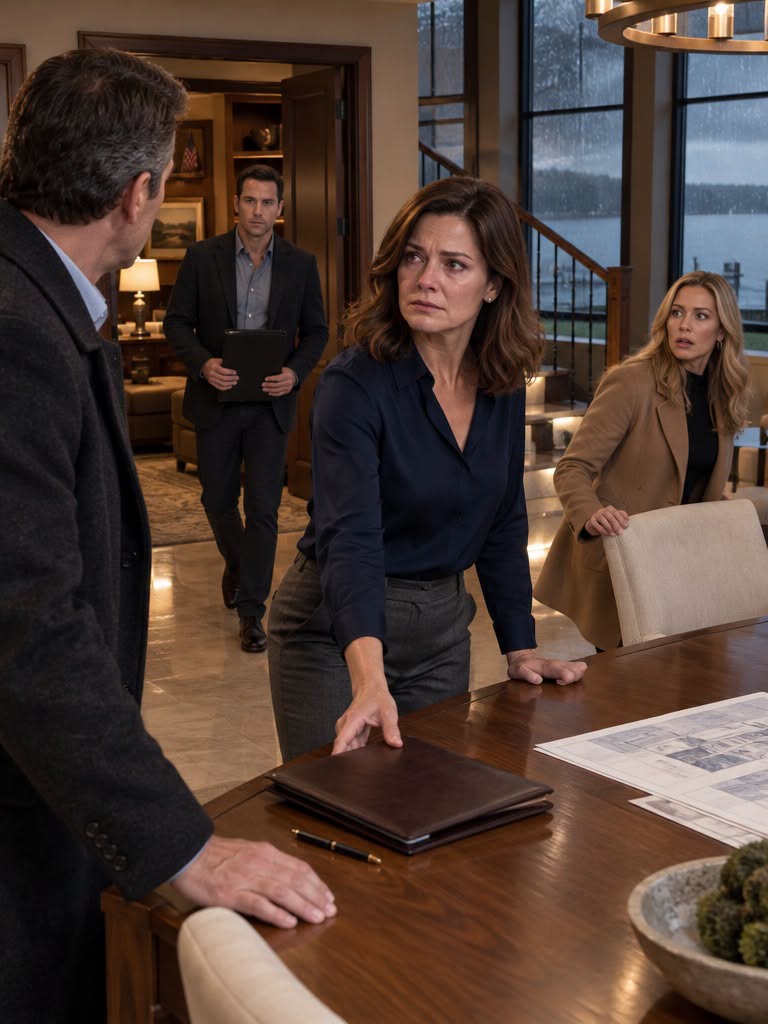
team is coordinating transport.”
I stood so quickly that my chair rolled backward.
“Is the baby okay?”
“The baby hasn’t been delivered yet. We need a clear staging location for the transport team. Is your bay operational?”
“Yes.”
“Dispatch has the location. The ambulance is approaching.”
I looked outside.
Rain swept across the new pavement.
“How long?”
“Several minutes. Stay out of the roadway and let the crews work.”
“Understood.”
I called Manny.
He was already awake.
“What’s happening?” he asked.
“Real emergency. They’re coming.”
“I’ll be there.”
By the time I reached the bay, Leo and Sam had arrived in a pickup truck.
The three of us stood beneath the shelter of my garage, watching the rain.
A siren sounded faintly in the distance.
Then Brenda appeared.
Her white Range Rover came around the corner, slowed, and stopped directly across the entrance.
For several seconds, I simply stared.
Then she climbed out.
She wore a cream-colored raincoat, dark sunglasses, and an expression of absolute determination.
“Mr. Peterson!” she shouted.
I walked toward her.
“Brenda, you need to move your car.”
“This structure is still under dispute.”
“There’s an ambulance coming.”
“Then it can use the main road.”
“That’s exactly what we’re trying to avoid.”
She pointed toward the bay.
“I have been advised that the association retains enforcement authority.”
“Your lawyer can discuss that with mine. Move the car.”
“No.”
The word was so simple, so casual, that I almost didn’t understand it.
“No?”
“Not until this matter is resolved.”
Manny arrived behind me.
“Ma’am,” he said, “you’re blocking an emergency access point.”
“I’m exercising my rights.”
“You’re obstructing a vehicle entrance.”
“This is private community property.”
“It’s Jack’s property,” Manny replied. “We’ve been over this.”
Brenda crossed her arms.
“Then let the police decide.”
I pulled out my phone.
“Gladly.”
I called dispatch, reported the obstruction, and gave the location.
The siren grew louder.
I could see flashing lights through the rain, approaching from the boulevard.
“Brenda,” I said, “listen carefully. A woman is in premature labor. The transport team needs this space. Whatever you think about me, whatever you think about this project, please move your car.”
For a fraction of a second, something shifted in her expression.
I thought she might finally understand.
Then she looked at the pavement, the lights, and the sign identifying the emergency staging area.
“You deliberately humiliated me,” she said.
I stared.
“What?”
“You went behind my back. You made a spectacle of this entire process. You encouraged people to laugh at me.”
“This isn’t about you.”
“Everything you’ve done has been about undermining my authority.”
The siren was nearly upon us.
And in that moment, I understood something I should have recognized weeks earlier.
Brenda didn’t see an ambulance bay.
She saw a challenge to her control.
She had spent eight years treating Whispering Pines like a private kingdom. Every violation notice, every fine, every architectural ruling reinforced the idea that she mattered because she could tell other people what they were allowed to do.
And now, standing in the rain, she would rather obstruct an emergency response than admit that she had lost.
“Brenda,” I said quietly, “this is your last chance to move voluntarily.”
She lifted her chin.
“Make me.”
That was when I heard the helicopter.
At first, it was only a distant mechanical vibration beneath the sound of the storm.
Then it grew louder.
I knew that sound.
I’d spent more than a decade around military rotorcraft.
I looked toward the coast.
Through the low gray clouds, a dark helicopter emerged, traveling along the shoreline toward Naval Air Station North Island.
A Navy MH-60S Seahawk.
And the sight brought back a conversation from the previous evening.
I’d spoken with an old Navy friend named Rick Riley, now a senior enlisted aviation crewman.
We hadn’t talked in months.
I’d called him to complain about Brenda, and he’d laughed so hard that he’d nearly dropped his phone.
“You built a secret ambulance garage?” he’d asked.
“Not secret anymore.”
“And some woman with a binder is trying to shut it down?”
“That’s the situation.”
“Jack, I spent twenty years thinking you were the most stubborn man alive. Congratulations. You found your competition.”
Rick had mentioned that his unit was conducting a scheduled flight along the coast the next morning, weather permitting.
I’d joked that he should fly over Whispering Pines and scare Brenda into behaving.
He’d told me to stop being an idiot.
At least, I thought he had.
Now a Navy helicopter was approaching.
I watched it with growing disbelief.
My phone buzzed.
A message from Rick.
“Training route nearby. Heard your neighborhood is having weather. Don’t do anything stupid.”
I looked up again.
The Seahawk continued along its route, well above the houses.
It did not descend toward Brenda.
It did not hover over her SUV.
And no Navy crew would have been authorized to use a military aircraft to settle my homeowners association dispute.
But Brenda didn’t know that.
She heard the rotors, looked up, and saw a large gray helicopter crossing the stormy sky.
At that exact moment, a powerful gust swept down the boulevard.
The wind caught her raincoat, flipped the hood over her head, and sent her sunglasses skittering across the wet pavement.
Leo shouted something I couldn’t hear.
The helicopter’s engines added to the noise.
Brenda ducked instinctively.
Her perfectly styled hair collapsed in the rain.
Another gust blew a plastic recycling bin into the curb behind her.
She turned, startled.
The approaching ambulance sounded its horn.
And finally, after weeks of threats, letters, arguments, and self-righteous speeches, Brenda Whitmore ran back to her Range Rover.
She climbed inside, started the engine, and moved.
Not gracefully.
Not willingly.
But she moved.
The entrance cleared just as the ambulance reached us.
Its driver turned into the bay.
A paramedic climbed out and hurried toward the waiting transport crew.
Nobody applauded.
Nobody celebrated.
The emergency was real, and the professionals had work to do.
We stepped aside.
For the next several minutes, I watched medical personnel coordinate with the family and local responders.
The Martinez home was only a short distance away. The ambulance crew had used the bay as a safe staging point while another team attended the mother.
I couldn’t see the patient.
I didn’t need to.
I could hear the urgency in the radio traffic, see the focused expressions on the paramedics’ faces, and understand that every person there had a specific job.
My job was to stay out of their way.
At 6:34, the ambulance departed.
The transport team was on its way to the hospital.
I stood in the rain until the flashing lights disappeared.
Then my knees began shaking.
Manny put a hand on my shoulder.
“You okay?”
I nodded.
He looked at me.
“You’re not okay.”
“No.”
“Good. Means you understand what just happened.”
A patrol car pulled up several minutes later.
Officers Miller and Davis climbed out.
Miller took one look at me, the bay, the scattered debris, and Brenda’s Range Rover now parked farther down the street.
Then he looked toward the sky.
“Was that a Navy helicopter?”
“Yes,” I said.
He stared at me.
“Why?”
“Because the Navy operates helicopters, Officer.”
“Jack.”
“It was passing along the coast.”
He studied my face.
“Did you have anything to do with it?”
“Not with its flight, no.”
Miller exhaled.
“Somehow, that answer doesn’t reassure me.”
Davis was speaking to Brenda.
She was pointing toward us, her raincoat dripping onto the sidewalk.
I could hear fragments.
“Intimidation.”
“Military aircraft.”
“Deliberate harassment.”
Miller rubbed his forehead.
“Tell me what happened with the vehicle.”
I explained.
Manny confirmed my account.
Leo and Sam provided statements.
The officers reviewed the site and spoke with dispatch.
Brenda continued insisting that the HOA rules gave her authority to block access.
Miller finally walked over to her.
“Mrs. Whitmore, whatever civil dispute you have with Mr. Peterson, you cannot obstruct an emergency response.”
“This was an unauthorized facility.”
“That’s a matter for the appropriate authorities and the courts.”
“I’m the HOA president.”
“That does not change what I just told you.”
She looked genuinely stunned.
It was as though nobody had ever explained that her title stopped carrying authority outside the boundaries of the association’s governing documents.
Miller asked whether she understood.
She said she wanted her attorney.
He told her she was free to contact one.
Then he documented the incident.
By eight o’clock, the storm was moving inland.
By nine, the neighborhood knew.
By ten, somebody had posted a video of Brenda running through the rain with her hood over her face while the helicopter passed overhead.
By noon, the video had been shared thousands of times.
The caption read:
“HOA PRESIDENT TRIES TO BLOCK BABY AMBULANCE. EVEN THE NAVY SHOWED UP.”
It was inaccurate in several ways.
The Navy hadn’t shown up for Brenda.
The helicopter hadn’t forced her to move.
And the emergency involved a premature delivery, not a baby already being transported.
But accuracy has never been the strongest feature of neighborhood social media.
By the following morning, people were calling me a hero.
I found that deeply uncomfortable.
Not because I disliked praise.
I had spent years in technology. I loved praise.
But this felt different.
The real work had been done by the paramedics, dispatchers, nurses, doctors, and emergency crews.
I’d paid for some pavement and fought an unnecessarily dramatic battle over it.
Still, people kept arriving.
A retired couple brought homemade banana bread.
A family from the next street delivered a case of bottled water for future emergency crews.
A woman I’d never met handed me a handwritten thank-you card.
Then came the stories.
Brenda had fined one neighbor for installing a birdbath without approval.
Another had been threatened with legal action over a mailbox that was supposedly the wrong shade of bronze.
A retired Marine named Frank had spent six months arguing with the association because his American flagpole was four inches taller than the guidelines permitted.
“Four inches,” Frank repeated, holding his fingers apart. “I measured it myself.”
A young couple told me they’d received three violation notices while caring for a parent undergoing chemotherapy because their lawn hadn’t been mowed on schedule.
As I listened, my amusement faded.
I’d thought my dispute with Brenda was unique.
It wasn’t.
It was simply the first time someone had enough money, free time, and stubbornness to challenge her publicly.
That afternoon, Rebecca called.
“I assume you’ve seen the video.”
“Unfortunately.”
“Your name is everywhere.”
“I noticed.”
“Brenda’s attorney has contacted me.”
“Of course he has.”
“She’s threatening to sue over emotional distress, reputational damage, and alleged misuse of a military aircraft.”
I closed my eyes.
“I didn’t misuse a helicopter.”
“Then we should have no difficulty establishing that.”
“She blocked an ambulance.”
“Yes. And the police report reflects that.”
“What happens now?”
“Now we proceed carefully. No public insults. No social media arguments. No jokes about helicopters.”
“You’re taking away everything that makes life enjoyable.”
“Jack.”
“Fine.”
“And one more thing.”
“What?”
“The association board has scheduled an emergency meeting.”
I smiled.
“Really?”
“Don’t get excited. Attend, tell the truth, and let the residents decide what kind of leadership they want.”
For once, I followed her advice.
The emergency HOA meeting was held the following Tuesday.
The community center was packed.
People stood along the walls and crowded near the doors.
Brenda sat at the front table beside two board members and an attorney.
Her hair was perfectly styled again.
Her expression was not.
The meeting began with a statement from the association’s legal counsel explaining the ongoing dispute and the need for a formal review of board procedures.
Then residents were invited to speak.
Frank went first.
He described his flagpole dispute.
The young couple spoke about the lawn violations during their family medical crisis.
A retired nurse questioned why the association had opposed an emergency medical staging area without consulting emergency services.
A local business owner asked for an accounting of the legal expenses incurred during the dispute.
One by one, residents described experiences that had left them frustrated, intimidated, or simply exhausted.
Brenda tried to respond.
At first, she defended the rules.
Then she defended her interpretation of the rules.
Then she defended her right to enforce the rules.
Finally, a woman in the third row stood up.
Her name was Maria Martinez.
I recognized her from a photograph Sarah Jenkins had sent with the family’s permission.
Maria was thirty-one, with dark hair pulled into a simple ponytail.
Her husband, Daniel, stood beside her.
The room became quiet.
Maria held a folded piece of paper.
“My daughter was born on Friday morning,” she began.
Her voice trembled slightly, but she continued.
“She arrived six weeks early. I was frightened. My husband was frightened. We knew the roads were dangerous because of the storm.”
Daniel put his hand on her back.
“The medical team got to us,” she said. “They took care of me. Our daughter needed special attention after she was born, but she’s doing well now.”
A collective breath seemed to move through the room.
“Her name is Chloe,” Maria continued. “She’s still in the neonatal intensive care unit, but the doctors are optimistic.”
She looked toward me.
“Mr. Peterson, thank you for helping make emergency access better for this neighborhood.”
I lowered my eyes.
Then she turned toward Brenda.
“I understand communities need rules,” Maria said. “I understand people want their homes to look nice. But when somebody tells you an ambulance is coming, you move your car.”
Nobody spoke.
Maria unfolded her paper.
“I wrote down what I wanted to say because I knew I’d be nervous.”
She glanced at it.
“Being president of a homeowners association should mean taking care of your neighbors. Not making them afraid of you.”
The applause began slowly.
Then the entire room rose.
I didn’t.
I couldn’t.
I sat there with my hands clasped together, looking at the floor, because I was suddenly overwhelmed by the knowledge that a little girl named Chloe was alive, receiving care, and had a future that might include birthdays, school plays, scraped knees, terrible teenage decisions, and everything else that made an ordinary life extraordinary.
The association board voted that evening to begin a formal leadership transition.
Brenda resigned as president two days later.
She did not apologize publicly.
Her attorney sent a carefully worded statement denying wrongdoing and expressing regret for any misunderstanding.
The neighborhood received it with the enthusiasm normally reserved for a utility bill.
But I didn’t feel triumphant.
Not exactly.
Because as the excitement faded, I began thinking about how close we’d come to turning a good idea into a disaster.
I’d been reckless at times.
I’d treated a serious project like a personal competition.
I’d enjoyed provoking Brenda more than I wanted to admit.
And if Manny, Rebecca, and the professionals involved hadn’t insisted on proper approvals and safe construction, I might have created more problems than I’d solved.
That realization stayed with me.
A week later, Rick Riley called.
“I hear I’m famous,” he said.
“Apparently.”
“Somebody sent me a video claiming I personally descended from heaven to defeat a homeowners association.”
“That’s a slight exaggeration.”
“Slight?”
“You were in the general area.”
“Jack, I was flying a scheduled route. We were nowhere near low enough to do what that video claims.”
“I know.”
“And I had no idea that woman was standing there.”
“I know.”
He was quiet for a moment.
“Did the baby make it?”
“She’s doing well.”
“Good.”
Then he laughed.
“Still, you have to admit the timing was incredible.”
“It was.”
“Your dad would’ve loved this story.”
I smiled.
“He would’ve asked whether the helicopter needed maintenance.”
Rick laughed again.
“Yeah. He would have.”
We talked for another half hour.
About the Navy.
About old friends.
About getting older.
And about the night in Bahrain when Rick had somehow become responsible for returning a goat to a local farmer after a spectacularly misguided shore-leave adventure.
That story remained between us.
Some things are better left out of official records.
Two weeks after the storm, I visited Chloe Martinez at the hospital.
Her parents had invited me.
I arrived carrying flowers for Maria and a stuffed sea turtle for Chloe.
The neonatal unit was quiet, bright, and filled with the soft electronic sounds I remembered from Emily’s birth.
Maria met me outside Chloe’s room.
“She’s having a good day,” she said.
Daniel shook my hand.
“Thank you for coming.”
Inside, Chloe lay in a small hospital bassinet, wrapped in a pale yellow blanket.
She was tiny.
Her fingers looked impossibly delicate.
She slept with the complete indifference of someone who had no idea she’d become the center of a neighborhood rebellion.
I stood beside her, suddenly unable to think of anything clever to say.
Maria smiled.
“You can hold her hand.”
I touched one finger gently to Chloe’s palm.
Her tiny fingers curled around it.
And something inside me shifted.
I’d spent years measuring success in revenue, market share, valuation, and growth.
I’d watched numbers climb on screens and felt briefly satisfied before looking for the next target.
But standing beside that bassinet, with a premature baby holding my finger, I understood why my father had loved fixing things.
It wasn’t the machinery.
It wasn’t the money.
It was the knowledge that something worked better because you’d been there.
I looked at Maria.
“There’s something I want to ask.”
“Of course.”
“Would you and Daniel be comfortable if I established a fund to help families with neonatal medical expenses? Transportation, lodging, whatever insurance doesn’t cover.”
Maria’s eyes widened.
“Jack, you’ve already done so much.”
“I know. But I’ve also spent a lot of money on very stupid things.”
Daniel laughed.
“Like what?”
I considered the question.
“A twelve-thousand-dollar espresso machine that makes coffee I don’t like.”
Maria smiled.
“That’s pretty stupid.”
“Exactly. I’d rather put the money somewhere useful.”
They agreed to help me understand what families actually needed.
Over the following month, I worked with Sarah Jenkins and a local nonprofit to establish a properly administered assistance fund.
It started with enough money to cover emergency lodging and transportation for dozens of families.
Then several neighbors contributed.
Then a local business matched donations.
By the end of the quarter, the fund had grown beyond anything I’d expected.
The ambulance bay became a formally recognized emergency staging location under an agreement with the appropriate medical transport and local authorities.
It wasn’t occupied every day.
Most days, it sat empty.
And I came to appreciate that emptiness.
An empty emergency bay meant nobody needed it at that moment.
It meant somewhere, hopefully, families were having ordinary mornings.
Making breakfast.
Arguing about homework.
Looking for lost car keys.
Living the kind of lives people take for granted until something threatens them.
Whispering Pines changed too.
The new HOA board published meeting minutes, reviewed enforcement practices, and created a more transparent architectural appeal process.
The association didn’t abandon its rules.
People still had to maintain their properties.
They still argued about landscaping.
One particularly passionate dispute involved whether a neighbor’s decorative fountain sounded too much like a public restroom.
But the atmosphere was different.
Residents attended meetings.
They asked questions.
They voted.
And when someone raised a concern, the board listened before reaching for the fine schedule.
As for Brenda, she left Whispering Pines that summer.
The official explanation was that she wanted to be closer to her sister in Arizona.
I wished her well.
Genuinely.
I also hoped her sister’s neighborhood didn’t have an HOA.
Manny, Leo, and Sam became regular visitors to my house.
We started having Saturday barbecues.
Manny insisted on cooking the steaks because he believed my expensive grill was wasted on a man who couldn’t distinguish medium rare from a software update.
Leo continued narrating ordinary activities as though they were military operations.
Sam developed a habit of bringing elaborate desserts that nobody believed he’d made himself.
One afternoon, as we sat beside the pool, Leo looked toward the ambulance bay.
“So what’s next, boss?”
I took a sip of beer.
“Next?”
“Come on. You’ve got that look again.”
“What look?”
“The look you had before we built a medical facility behind a photograph of grass.”
Manny groaned.
“Don’t encourage him.”
Sam leaned back.
“Secret fire station.”
Leo snapped his fingers.
“Helicopter landing pad.”
“Absolutely not,” Manny said.
“Underground hospital?”
“No.”
“Emergency submarine dock?”
“We’re on a bluff,” I said.
“Minor engineering challenge.”
Manny pointed at Leo.
“You’re banned from planning anything.”
We laughed until my stomach hurt.
It was the first time in years I’d been surrounded by friends who didn’t care what my company had sold for.
They cared whether I showed up.
Whether I kept my promises.
Whether I could take a joke.
And whether I remembered to buy enough charcoal.
Three months after the storm, I received a photograph in the mail.
Chloe Martinez was home.
She was wearing a tiny pink outfit and sleeping against her father’s chest.
On the back, Maria had written:
“Thank you for helping our family. Chloe is growing stronger every day. We hope she’ll meet you again when she’s old enough to hear the story.”
I put the photograph on my desk.
Beside it sat an old picture of my father in his garage, standing next to a restored Chevrolet pickup with grease on his hands and a proud smile on his face.
For the first time, the two photographs seemed connected.
One evening, I sat in my office watching the sun descend over the Pacific.
The house was quiet.
My computer displayed financial reports from companies I barely followed anymore.
I closed them.
Then I opened a satellite map of San Diego.
I wasn’t looking for investment opportunities.
I was looking for problems.
Not the glamorous problems that attracted venture capital and magazine profiles.
Ordinary problems.
A neighborhood without a safe playground.
A community center with a leaking roof.
A public park where the drinking fountain hadn’t worked in years.
I zoomed toward an inland neighborhood where apartment buildings crowded around a neglected patch of municipal land.
The park was little more than cracked pavement, dry grass, and a rusting swing set.
A few blocks away stood an elementary school.
I stared at the screen.
Then I opened a new document.
At the top, I typed:
COMMUNITY PARK RESTORATION PROPOSAL.
I considered the possibilities.
New playground equipment.
Accessible paths.
Shade structures.
A splash pad for hot summer days.
Solar lighting.
Maybe even a small kiosk where local organizations could distribute snacks during community events.
I smiled.
Then I stopped.
I remembered Rebecca’s voice.
Impatience is not a legal strategy.
I picked up my phone and called her.
She answered on the fourth ring.
“Jack?”
“Rebecca, I have an idea.”
There was a long silence.
“No.”
“You haven’t heard it.”
“I don’t need to.”
“It’s a park.”
“No.”
“A neglected park.”
“Jack.”
“Children could use it.”
“That is not a legal argument.”
“I’m not asking you to break any rules.”
Another silence.
“Are you feeling all right?”
“Perfectly.”
“What exactly are you proposing?”
“A fully permitted, publicly approved community park restoration, developed in partnership with the city and local residents.”
Rebecca said nothing.
“With proper inspections,” I added.
Still nothing.
“And no camouflage tarps.”
She finally laughed.
“Well, that’s a promising start.”
I leaned back in my chair.
Outside, the last sunlight caught the windows of Whispering Pines.
Somewhere beyond the boulevard, an ambulance passed on the main road.
No siren.
No emergency.
Just another vehicle traveling through an ordinary California evening.
I looked at Chloe’s photograph.
Then at my father’s.
For years, I’d believed that finding purpose required some extraordinary revelation.
A new company.
A new fortune.
A dramatic reinvention of my life.
But it turned out the answer had been much simpler.
Find something broken.
Find people who know how to fix it.
And get to work.
Preferably with permits.
Because I’d learned that lesson the expensive way.
And if a certain former HOA president ever happened to hear that Jack Peterson was planning another community project, I hoped she’d take comfort in knowing there would be no helicopters involved.
At least, none that I had requested.
THE END
Disclaimer: This is fictional AI-generated content created solely for entertainment purposes and is not intended to offend, target, defame, or harm any individual, group, or organization.
Disclaimer: This story is fictional and created for entertainment purposes only. Any names, characters, places, or events are fictitious or used fictitiously. No real person or organization is intended to be portrayed.