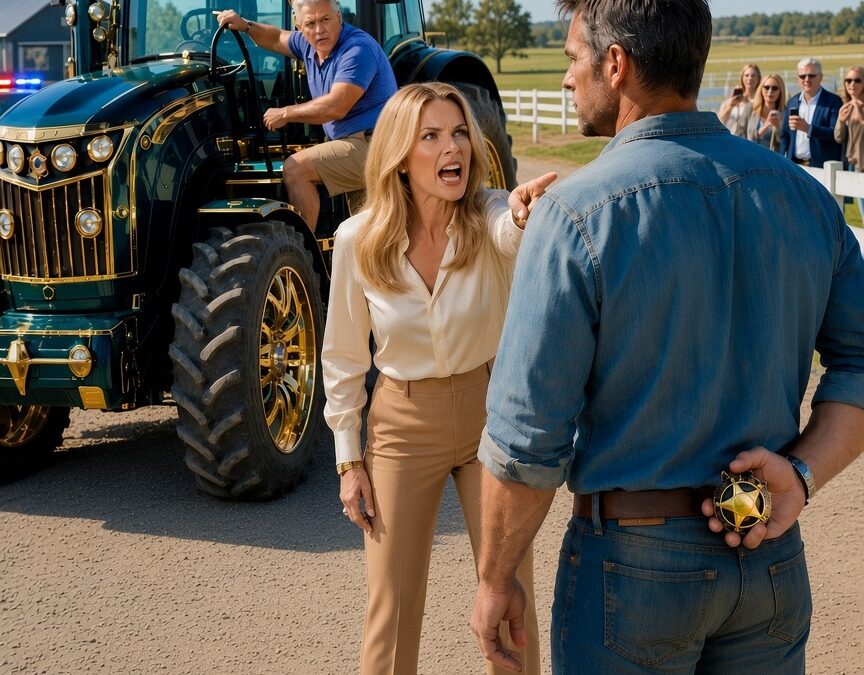
“Get off my porch. You reek.”
Rhonda Voss stood in the doorway of her $780,000 Mediterranean-style home, holding a glass of iced tea in one perfectly manicured hand. She didn’t bother hiding her disgust as she looked me over, from my sweat-stained work shirt to the muddy boots I’d been wearing since sunrise.
“Ma’am, I came to ask about my tractor. Your husband drove it off my property this morning.”
“Because I told him to.” She took a leisurely sip of tea. “That ugly orange machine has been dragging down property values since the day we moved here. Frankly, you should be thanking us.”
“That tractor cost me forty-five thousand dollars.”
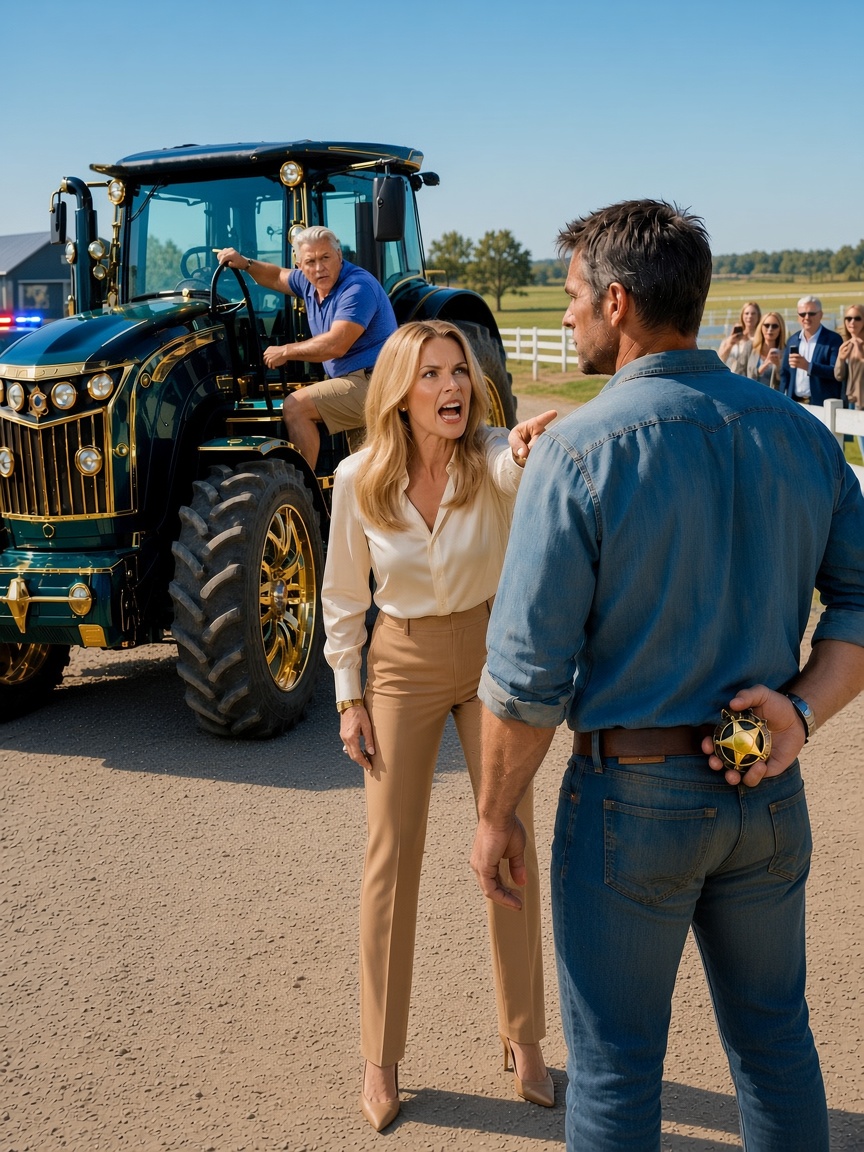
“And my home cost considerably more than that.” She smiled. “Sign the compliance agreement, Mr. Merritt, or sell your little dirt patch to someone who understands what this neighborhood is supposed to look like. Until then, your tractor stays exactly where Gary put it.”
She shoved a three-page document toward me.
I glanced at the title. STONE CREEK ESTATES AGRICULTURAL VISUAL COMPLIANCE AGREEMENT.
“Mind if I keep this?” I asked.
“Keep it, frame it, burn it. I couldn’t care less. Just understand that the fines will continue until you cooperate.”
“I’ll put it in my file.”
That made her laugh.
“What file? You’re a farmer with a dirt patch. You don’t have a file.”
I folded the papers carefully and slipped them into my shirt pocket.
“Have a good afternoon, Mrs. Voss.”
As I turned toward my truck, she called after me.
“And wash those boots before you come back. This isn’t a barn.”
Across the street, her husband Gary leaned against a black Chevrolet Silverado, arms crossed over his chest, wearing the satisfied expression of a man who believed he’d just watched his wife finish a fight he’d already won.
I looked at him. He gave me a mocking little salute.
I returned to my pickup without saying another word.
Neither Gary nor Rhonda knew what I did Monday through Friday. They knew about the cattle, the hayfields, the aging ranch house, and the muddy boots. They knew I drove an old Ford F-250 instead of a luxury SUV. They knew I lived alone and rarely attended neighborhood meetings.
What they didn’t know was that I had spent fourteen years as a Deputy United States Marshal, serving federal warrants, recovering stolen assets, tracking fugitives, and building criminal cases against people who believed rules applied only to everyone else.
And for nearly six months, I’d been collecting evidence against them.
By the time that Saturday morning arrived, Gary Voss would be sitting in the back of a sheriff’s cruiser, Rhonda would be staring at a search warrant with her name on it, and the homeowners she’d bullied for years would finally discover where their money had gone.
But none of that started with the tractor.
It started sixty-three years earlier, with my grandfather, a handshake, and a piece of Texas land nobody thought was worth much.
My name is Jacob Merritt, though everybody who knows me calls me Jake. I’m forty-three years old, and my family ranch sits on 240 acres outside Marble Falls, Texas, in the limestone hills of Burnet County.
My grandfather, Roy Merritt, bought the property in 1961.
Back then, the land wasn’t particularly desirable. It was rocky, heavily wooded with cedar, and divided by dry creek beds that filled up during hard thunderstorms. There wasn’t a paved road leading to it, and the nearest grocery store required a drive long enough that you made a list before leaving home.
Roy had grown up poor, worked conservation jobs during the Depression, and spent his later working years repairing farm equipment and building fences. By the time he found those 240 acres, he had accumulated enough savings for a down payment and established enough trust with a banker in Marble Falls to finance the rest.
He never described the purchase as an investment.
He called it home.
Roy built the original ranch house with two friends, a borrowed concrete mixer, and lumber hauled from a mill forty miles away. It had three bedrooms, one bathroom, a tin roof, and a front porch facing east.
Over the years, he added a barn, a cattle shed, two stock tanks, and miles of fencing. He planted pecan trees near the house and kept the live oaks standing wherever he could.
He also raised cattle, cut hay, repaired tractors, and married my grandmother, Evelyn, who could balance a household budget down to the penny and make enough food for twelve people with whatever happened to be in the pantry.
My grandmother died when I was nine.
After that, summers at the ranch became even more important to both of us.
My parents lived in San Antonio, where my father worked for a transportation company and my mother taught elementary school. Every June, they’d drive me to Roy’s place, unload my suitcase, and leave me there until August.
I loved those summers more than anything.
By seven, I knew how to collect eggs and feed calves. By ten, I could repair a gate latch without help. By twelve, Roy had me changing hydraulic hoses on his old Ford tractor.
He never treated work as punishment.
To him, work was simply how you took care of something that mattered.
One afternoon, when I was fourteen, we found that someone had cut through a section of fence along the northern boundary. The wire had been pulled back, and tire tracks crossed the pasture.
I was furious.
“Somebody came onto our land, Grandpa. We ought to go find them.”
Roy crouched beside the fence and examined the cut wire.
“Maybe.”
“Maybe? They broke our fence.”
“That’s what we know.”
He pointed to the tire tracks.
“We don’t know who. We don’t know why. And we don’t know whether they’re coming back.”
“So what do we do?”
“We fix the fence. Then we find out what happened.”
He stood, handed me his pliers, and added something I remembered long after he was gone.
“Never give somebody your anger when what you really need is the truth.”
At fourteen, I thought that sounded like an excuse for not confronting someone.
At forty-three, I understood it was a method.
After high school, I joined the Army.
I trained as military police at Fort Leonard Wood, served four years, including a deployment to Kuwait, and learned that most dangerous situations became worse when somebody allowed ego to make decisions.
I also learned to watch hands, read body language, preserve evidence, and distinguish what I suspected from what I could prove.
Those lessons stayed with me.
After leaving the Army, I attended Sam Houston State University, earned a criminal justice degree, and eventually entered federal law enforcement.
At twenty-five, I became a Deputy United States Marshal.
For the next fourteen years, my working life was divided between courthouse security, warrant operations, fugitive investigations, and assignments involving seized property and interagency task forces.
Some days were routine. Others required me to knock on doors knowing the person on the other side might be armed.
Once, we tracked a fugitive wanted on multiple federal charges through four states before finding him hiding in a rented storage unit outside Tulsa. He was sitting on an overturned bucket eating cold ravioli from a can.
Another time, a suspect in South Texas tried to convince us that the armored SUV in his garage belonged to his cousin.
The registration records disagreed.
People often tell lies with extraordinary confidence. I’ve found that documents tend to be less theatrical.
My supervisor, Chief Deputy Linda Vasquez, once described my investigative style during a commendation ceremony.
“Jake Merritt doesn’t hurry to the end of a case. He makes sure every piece is where it belongs before he closes it.”
She was right.
I didn’t always move quickly.
But when I moved, I wanted the facts to move with me.
In 2017, my grandfather died at eighty-seven.
He went peacefully in the bedroom where he’d slept for most of his adult life, with a framed photograph of Evelyn on the bedside table and his work boots placed neatly by the door.
He left me everything.
The ranch, the house, the cattle, the equipment, and the responsibility of keeping it all operating.
I was thirty-four, unmarried, and working full-time in Austin.
People told me to sell.
The land was valuable. Developers were expanding westward, and properties that once sold by the acre were beginning to attract offers measured in millions.
I refused.
Roy had spent most of his life keeping that ranch together.
I wasn’t going to turn it into somebody else’s subdivision because maintaining it required effort.
I moved into the ranch house, repaired the roof, upgraded the plumbing, and began spending nearly every free weekend doing agricultural work.
The old Ford 3000 tractor survived another year before its transmission finally failed.
Roy had kept that machine alive for decades with replacement parts, careful maintenance, and an unreasonable amount of optimism.
I tried to repair it.
Twice.
Eventually, a mechanic in Burnet took one look at the damage and shook his head.
“Jake, I can take your money, but I can’t promise you a tractor when I’m done.”
So I bought a Kubota M7060.
Orange body, black cab, front-end loader, sixty horsepower, and enough capability to handle almost everything the ranch required.
With the loader, attachments, and financing costs, the purchase represented roughly forty-five thousand dollars.
It was expensive, but it wasn’t a luxury.
I needed it to move hay, maintain ranch roads, clear brush, repair fences, and feed cattle.
Without it, routine work became much harder.
The first Saturday I drove it across the pasture, I caught myself looking toward the porch, expecting Roy to be sitting there with a cup of coffee, offering unsolicited advice about how I was operating the loader.
He wasn’t.
That took getting used to.
For two years, the ranch remained peaceful.
Then the Callaway family sold their property to a developer.
The Callaways had owned the neighboring acreage for generations. Their land stretched east of mine, separated from our pastures by an old barbed-wire fence and a narrow strip of cedar trees.
In 2019, a development company purchased approximately 110 acres from them for a reported $7.2 million.
Construction began almost immediately.
Bulldozers stripped cedar from the hillsides. Survey stakes appeared along the fence. Gravel trucks came and went from dawn until late afternoon.
Within months, streets had been cut into land where cattle had grazed the previous year.
The development was called Stone Creek Estates.
Its advertisements promised luxury living surrounded by the natural beauty of the Texas Hill Country.
The brochures featured enormous kitchens, stone fireplaces, swimming pools, landscaped entrances, and panoramic views of open countryside.
One promotional photograph showed a sunset across my pasture.
My cattle stood near a stock tank in the distance.
Nobody had asked permission to photograph them, but I didn’t particularly care.
I did find it amusing that the developer was selling views of a working ranch while advertising a lifestyle supposedly free from the inconveniences of rural life.
The homes started around $420,000, though some eventually sold for considerably more.
There were ninety-four lots.
HOA dues began at $290 per month.
The neighborhood had ornamental stone walls, decorative lighting, a community pavilion, manicured lawns, and an entrance sign large enough to make someone think they’d arrived at a private resort.
The marketing slogan was “Where Texas Meets Tranquility.”
For a while, that seemed accurate.
Most of the early residents were pleasant people. Some waved when I drove by. Others stopped to ask questions about the cattle.
A few brought their children to the fence to watch the calves in spring.
Then Rhonda Voss moved into Lot 47.
Rhonda was fifty-five, polished, attractive, and accustomed to being obeyed.
She had honey-blonde hair, carefully maintained nails, and a wardrobe that looked as though it had been selected for a corporate boardroom rather than suburban Texas.
Her husband, Gary, was fifty-seven, a semi-retired contractor with broad shoulders, expensive sunglasses, and a black Silverado he washed more often than I washed my truck.
Their house was one of the largest in Stone Creek Estates.
It had four bedrooms, a three-car garage, a curved driveway, and an upstairs balcony overlooking the western boundary.
Unfortunately for Rhonda, that meant it overlooked my barn, cattle pasture, and equipment shed.
She introduced herself one Saturday morning while I was repairing a water trough.
I heard someone calling from the fence.
“Excuse me! Are you the owner?”
I shut off the hose and walked over.
“Yes, ma’am.”
She held a wide-brimmed hat against the wind.
“Rhonda Voss. We just purchased the Mediterranean house on Stone Creek Drive.”
“Jake Merritt.”
She glanced past me toward the barn.
“Is all of this yours?”
“Yes.”
“All two hundred acres?”
“Two hundred forty.”
Her eyebrows rose.
“That’s quite a lot of land for one person.”
“Cattle take up more room than people.”
She gave a brief smile.
“Do you intend to continue operating it as a ranch?”
I looked at the cows standing behind me.
“That was the plan.”
“I see.”
She studied the barn.
“Have you considered painting that building? Perhaps something more neutral?”
The barn had been red since 1974.
“No, ma’am.”
“It’s very noticeable from our property.”
“It’s been there a long time.”
She looked at me as though I’d misunderstood the question.
“Well, perhaps once the neighborhood is fully established, we’ll be able to discuss improvements.”
I nodded.
“Have a good day.”
She walked away without returning the courtesy.
At the time, I thought she’d simply been disappointed to discover that the advertised countryside included an actual working ranch.
I underestimated her.
Within eleven months, Rhonda became president of the Stone Creek Estates Homeowners Association.
She ran unopposed after the previous president resigned during a dispute about holiday decorations.
The board consisted of Rhonda, two residents who rarely challenged her, and a management company that seemed to treat every statement she made as an official directive.
Gary had no formal board position.
That didn’t stop him from acting like the neighborhood’s enforcement officer.
He began accompanying Rhonda on property inspections, photographing lawns, checking fence heights, and leaving notices on doors.
Rhonda introduced a stricter fine schedule, expanded architectural review procedures, and established an Architectural Harmony Committee.
She appointed herself chair.
Residents who challenged a fine discovered that appealing it often required appearing before Rhonda herself.
Within months, people were receiving penalties for leaving garbage bins visible after collection day, planting flowers without approval, and parking work vehicles in their own driveways.
The first complaint about my ranch arrived in the mail.
It was printed on thick cream-colored paper, with the Stone Creek Estates logo embossed across the top.
The letter informed me that visible agricultural machinery constituted a violation of Section 7.4B of the neighborhood’s visual harmony requirements.
I was instructed to relocate all equipment to a screened location within fourteen days.
Failure to comply, it warned, could result in additional enforcement measures.
I read the letter twice.
Then I pulled my property deed from the filing cabinet.
Stone Creek Estates was a separate subdivision.
My ranch wasn’t included in its recorded plat.
I wasn’t a member of its HOA, hadn’t agreed to its restrictive covenants, and owed it no dues.
The association had no authority to regulate my barn, equipment, cattle, or operating schedule.
I wrote a short reply explaining those facts.
I included a copy of my deed and identified the recorded property boundaries.
I suggested that any legitimate concern involving my agricultural operation be directed to the appropriate county authority.
Nine days later, Rhonda sent a three-page response.
This one smelled faintly of perfume.
It cited something she called the “community impact doctrine,” claiming neighboring property owners had obligations to preserve the aesthetic character of surrounding residential communities.
She demanded that I attend a compliance meeting.
I searched for any legally applicable authority supporting her claim.
I found none.
I placed both letters in a manila folder marked STONE CREEK and went back to work.
But Rhonda didn’t stop.
She filed complaints with county officials about noise, dust, odors, drainage, and alleged unsafe agricultural equipment.
Inspectors came.
They reviewed the property.
They found no relevant violations.
The sheriff’s office received noise complaints about my tractor operating on Saturday mornings.
My agricultural equipment was being used for ordinary ranch work, and the complaints produced no citation.
Rhonda apparently interpreted each dismissal not as an answer but as an invitation to try another agency.
Then Gary began coming onto my property.
The first time I caught him, he was standing near my barn with a clipboard and measuring tape.
I was driving the Kubota along the fence when I noticed him.
I shut off the engine.
“Can I help you?”
He didn’t look up.
“Checking setbacks.”
“For what?”
“Your barn. It’s too close to our neighborhood.”
“That barn was built in 1974.”
He stretched his tape measure.
“Doesn’t mean it’s legal.”
“It means you need to check the records before making assumptions.”
That got his attention.
He straightened and looked at me.
“Listen, buddy. My wife runs this community. She’s got lawyers, and she’s got nearly a hundred homeowners who don’t want to stare at your junk every morning.”
“Your community doesn’t include this property.”
He smiled.
“Not yet.”
I watched him walk back through a gap in my fence.
Two strands of barbed wire had been pushed apart and loosened from a post.
Gary had created his own entrance.
That evening, I photographed the damaged fence and called a deputy to document the trespass.
Then I ordered four trail cameras.
My work had taught me the importance of preserving a clean, verifiable record.
I positioned the cameras around the barn, gate, pasture, and access road, keeping them on my property and covering the places where Gary had been entering.
I synchronized their timestamps.
I made backups of the recordings.
And I started a written incident log.
For the next several weeks, the cameras recorded Gary entering the ranch repeatedly.
Sometimes he photographed equipment.
Sometimes he measured structures.
Once he attached a laminated notice to a fence post declaring that my equipment had been scheduled for removal under an HOA directive.
There was no valid directive applying to my property.
Another morning, I found all four Kubota tires flat.
Someone had removed the valve cores.
The cores were lined up neatly on the tractor seat.
That wasn’t accidental damage.
It was a message.
I replaced them, photographed everything, and filed another report with the sheriff’s office.
The following week, Gary parked his Silverado across my private access road.
When I called and asked him to move it, he told me the HOA was conducting a visual impact assessment.
“Your truck is blocking my road.”
“File a complaint with the board.”
“Gary, move it.”
“Not until the assessment is complete.”
He hung up.
Deputy Luis Garza eventually contacted him and instructed him to clear the road.
Gary waited as long as he dared before moving his vehicle.
By then, I’d accumulated photographs, reports, correspondence, and multiple recordings of unauthorized entries.
A reasonable person would have stopped.
Gary escalated.
One Thursday morning in October, I left the ranch at 5:30 for a warrant briefing in Austin.
It was going to be a long day.
Our task force was coordinating several outstanding federal warrants, and I expected to remain at the office until late afternoon.
At 11:26, during a break, I checked a motion alert on my phone.
The image showed Gary Voss climbing into the cab of my Kubota.
I opened the video.
At 10:42 that morning, Gary’s Silverado had arrived near the barn.
He walked directly to the tractor.
At 10:47, he climbed into the cab and started the engine.
I’d left the key in the ignition.
That had been common practice on our ranch for decades, but watching Gary turn it taught me that some traditions don’t survive new neighbors.
At 10:49, he drove the tractor through the opening he’d created in my fence.
The second camera captured him crossing the pasture.
The third showed him turning onto the access road.
The fourth recorded him continuing toward Stone Creek Estates.
Later footage from the edge of my property showed him approaching the HOA common area.
When I finished reviewing the available recordings, I called the sheriff’s office to report the theft.
I also contacted a resident who could safely observe the common lot from the public street.
Within an hour, she sent me a photograph.
There was my Kubota, chained to a concrete bollard near the community pavilion.
A laminated sign had been placed beside it.
SEIZED PER HOA BOARD RESOLUTION.
VISUAL COMPLIANCE ENFORCEMENT.
DO NOT REMOVE.
I stared at the photograph for a long moment.
Gary hadn’t just taken the tractor.
He’d apparently prepared a sign in advance to justify doing it.
By evening, I had returned to the ranch, collected the original camera files, and received the first responding deputy’s report number.
Then I checked the mailbox.
Inside was another cream-colored envelope from Stone Creek Estates.
The postmark was two days old.
Rhonda had mailed it before Gary took the tractor.
The letter announced that the association had approved temporary impoundment of agricultural equipment creating an unauthorized visual intrusion.
Attached was a compliance agreement.
If I signed it, the tractor would supposedly be returned.
If I refused, the association claimed it could retain the equipment until the visual violations were resolved.
The agreement required me to repaint my barn in an approved neutral color, reduce my cattle herd, restrict tractor operations to weekday business hours, and pay a $500 processing fee.
It also demanded acknowledgment that the HOA possessed enforcement authority over activities affecting the neighborhood’s appearance.
That was the part Rhonda needed most.
My signature.
The document would have given her something to point to when she claimed I’d voluntarily accepted her rules.
I put the letter beside the camera footage.
Then I called Sheriff Tom Caldwell.
Tom and I had known each other for years through joint law enforcement operations.
I didn’t call him to ask for special treatment.
I called because my tractor had been taken, and his department had jurisdiction.
“Tom, I need to report a theft.”
“What happened?”
“Gary Voss drove my tractor off the ranch this morning and chained it to a bollard at Stone Creek Estates.”
There was a pause.
“He did what?”
“He’s claiming the HOA seized it.”
“Are you a member of that HOA?”
“No.”
“Did you give him permission to move it?”
“No.”
“Did anybody else?”
“No.”
“What’s the equipment worth?”
“Approximately forty-five thousand dollars.”
Tom exhaled.
“Tell me you have evidence.”
“Four cameras. The original recordings are preserved. I’ve also got a letter from the HOA explaining the plan. It was mailed before the tractor was taken.”
“You’re kidding.”
“Afraid not.”
“What about the tractor now?”
“Deputy Garza has the location. It’s still chained on the common lot.”
Tom was quiet for a moment.
“Jake, don’t go over there and start cutting anything loose. Let us document the scene and handle the recovery.”
“Understood.”
“And send the footage through the evidence portal. Don’t edit it.”
“Already working on it.”
Before hanging up, Tom asked one final question.
“Why would these people believe they could get away with something this obvious?”
“I think they’ve been getting away with smaller things for so long that they’ve stopped recognizing the difference.”
That night, I slept less than three hours.
Not because I was afraid of Gary.
I was thinking about the paperwork.
Rhonda’s letters looked professional. Her notices used official-sounding language. Her husband acted as though the neighborhood’s boundaries extended wherever he decided they did.
And yet the association had no authority over my land.
The more I considered it, the more I wondered whether her confidence had been rewarded elsewhere.
I had already heard stories about excessive fines.
Now I wanted to know whether money was involved.
The next morning, before leaving for work, I began examining the HOA’s publicly available filings.
The first thing I discovered was a business called Voss Property Solutions LLC.
Gary Voss was listed as its managing member.
Rhonda was its registered agent.
The registered business address was their home in Stone Creek Estates.
The company had been established after Rhonda became HOA president.
Its listed activities included landscaping and property maintenance.
That alone wasn’t a crime.
Plenty of homeowners operate legitimate businesses.
But the HOA’s available budget summaries showed that Stone Creek had been paying Voss Property Solutions for grounds maintenance.
The annual contract amount was $156,000.
I checked the scope of work described in the budget.
Mowing, irrigation upkeep, shrub maintenance, seasonal landscaping, and common-area services.
For a community of ninety-four homes, the number appeared unusually high.
I obtained several informal estimates from independent landscaping contractors.
Those estimates ranged from approximately $40,000 to $55,000 annually for broadly comparable services, depending on the exact contract terms.
That didn’t prove theft.
But it made the relationship worth examining.
Then I found a separate budget item.
Community Enhancement Fund.
Annual assessment: $250 per household.
Ninety-four households meant $23,500 each year.
The fund appeared in the assessment schedule, but the summary budget offered almost no detail about its use.
I searched the association’s documents for a description.
Nothing meaningful.
I searched the meeting minutes available to homeowners.
Again, nothing.
I began wondering whether the residents knew where that money went.
That Saturday, while the sheriff’s office continued its investigation into the tractor, I drove into Stone Creek Estates to speak with several residents who’d previously contacted me about Rhonda.
I went as a neighbor.
No badge.
No official identification.
No suggestion that I was conducting a federal investigation.
Any concerns about potential financial wrongdoing would need to be handled through proper legal channels, and I wasn’t going to use my position to obtain information I couldn’t lawfully access.
My first stop was Lot 22.
Priya Patel answered the door.
She was a nurse in her early forties, and her husband worked in information technology.
They’d moved to Stone Creek for the schools and quieter lifestyle.
Instead, they’d spent two years fighting the HOA over a vegetable garden.
“Four thousand two hundred dollars,” Priya told me, standing in her kitchen.
“For vegetables?”
“For refusing to remove raised garden beds from our backyard.”
She showed me the letters.
Rhonda had described the beds as an unauthorized agricultural installation.
Priya gave a tired laugh.
“We had tomatoes, peppers, and basil. My kids helped plant them.”
“Was there a specific rule against raised beds?”
“That’s what we asked. She kept referring to architectural harmony.”
“Did she show you the rule?”
“Never.”
Priya opened a drawer and pulled out a folder.
“Then Gary came over and said the fines would double if we didn’t pay.”
She handed me copies.
The signatures, dates, and letterhead were familiar.
I asked whether she’d ever received a complete annual financial report from the HOA.
“No.”
“Have you asked?”
“Three times.”
“What happened?”
“She told me financial information was restricted to authorized board members.”
I wrote that down.
The next family was the Orozcos at Lot 59.
Maria Orozco showed me a driveway with long cracks running from the sidewalk toward the garage.
She explained that homeowners had been charged an emergency repair levy supposedly intended for paving and drainage work.
Her household paid $1,500.
No work had been performed on her driveway.
“Rhonda said the assessment was mandatory,” Maria told me. “When I asked what repairs we’d be receiving, she said it was for neighborhood infrastructure.”
“Did she provide invoices?”
“No.”
“Any contractor information?”
“No.”
“Did you ask the board?”
“She is the board, apparently.”
Maria’s brother David, a certified public accountant, had been reviewing some of the association’s limited financial disclosures.
He joined us at the kitchen table.
“There’s a problem with how these expenses are categorized,” he said.
He spread several printed pages in front of me.
“Maintenance, enhancement, emergency remediation, administrative enforcement. The amounts change, but there aren’t enough supporting records to verify what was purchased.”
“Have you requested the underlying documents?”
“Repeatedly.”
“And?”
“They either don’t respond or tell me I need to submit a formal request through the management company.”
“Have you done that?”
“Twice.”
He pointed to a letter.
“Both requests were denied.”
The letter was signed by Rhonda.
I photographed it with David’s permission.
Later that afternoon, I visited the Washington family.
Tamika Washington had been denied access to the community pavilion despite being current on her dues.
The explanation was missing compliance documentation.
“What documentation?” I asked.
“That’s exactly what I asked Rhonda.”
“What did she say?”
“She told me to read the community handbook.”
“Did you?”
“There isn’t one. At least, nobody will give me a copy.”
Tamika folded her arms.
“You know what bothers me most? It’s not even the pavilion. It’s that she talks to us like we’re children who should be grateful she lets us live here.”
I understood.
Authority becomes dangerous when ordinary questions are treated as acts of rebellion.
My last visit was with James and Diana Kwan, both retired teachers.
They were in their early seventies and had moved to Stone Creek after downsizing from a home in Georgetown.
Diana kept a careful record of every assessment.
James had organized their HOA correspondence chronologically.
I liked them immediately.
“We’ve been charged twice for the same maintenance project,” James said.
He handed me two notices.
One was labeled a special assessment.
The other described an emergency infrastructure levy.
Both referred to repairs around the community pavilion.
“Did the repairs happen?”
“Some landscaping was done,” Diana said. “But nothing that looked like the projects described.”
James leaned back in his chair.
“I’m a retired math teacher, Mr. Merritt. Numbers don’t frighten me. What frightens me is being told I’m not allowed to ask what they mean.”
I spent nearly two hours with them.
As I was leaving, Diana mentioned something else.
“Gary has been bragging about your tractor.”
I stopped near the door.
“What did he say?”
“He told one of the neighbors that you wouldn’t get it back unless you signed Rhonda’s agreement.”
“Did you hear him yourself?”
“Not that time.”
I nodded.
“If he says it to you directly, keep a record of exactly what he says.”
Diana gave me a knowing smile.
“Oh, I already do.”
Over the next several days, the homeowners began coordinating their requests for financial records.
David Orozco helped organize the documentation.
The residents sought an independent review of the HOA’s contracts, assessments, bank accounts, and vendor relationships.
I provided the publicly available records I’d found, along with copies of the letters Rhonda had sent me.
I also gave the sheriff’s investigator information about the possible conflict of interest involving Voss Property Solutions.
The financial portion of the matter was separate from the tractor theft and needed independent verification.
That distinction was important.
Suspicion wasn’t proof.
A contract could be overpriced without being fraudulent.
A vendor could be related to a board member without every payment being illegal.
A special assessment could be unpopular and still be legitimate.
But missing records, undisclosed self-dealing, unexplained transfers, and false invoices could change the picture entirely.
Within days, David and a group of homeowners retained an attorney and a forensic accountant to review the association’s finances.
The attorney sent formal records demands and began pursuing the necessary legal process to obtain documents the board had refused to produce.
I continued collecting the materials relevant to my own property dispute.
Five days after Gary took the Kubota, another HOA letter arrived.
This one demanded that I pay $12,800 in accumulated penalties.
The violations included visual disturbance, agricultural noise, nonconforming structures, and failure to comply with architectural review.
The letter threatened further legal action and suggested the association might seek a lien against my property.
I read it at the kitchen table, then set it beside my deed.
I wasn’t a member.
There was no contractual relationship.
There was no applicable covenant.
And Rhonda was still pretending she could collect money from me.
I sent a copy to my attorney and another to the investigator assigned to the theft case.
Then I made coffee.
The following Thursday, Diana Kwan called.
“Jake, I have something I think you’ll want to hear.”
“What happened?”
“Gary was at the entrance this morning. He was talking about your tractor.”
“Did you record it?”
“Yes.”
She emailed me the file.
I played it on my laptop.
Gary’s voice was unmistakable.
“That farmer’s tractor is worth forty-five grand. We’ve got it locked up on the common lot. He’s not getting it back until he signs the agreement or sells the property.”
A second voice asked whether he thought I would actually sell.
Gary laughed.
“Either way, we win.”
I listened again.
The recording didn’t merely show that Gary knew where the tractor was.
It showed he was openly describing possession of another person’s equipment as leverage.
I forwarded the file to the sheriff’s investigator, including Diana’s contact information so the recording could be properly authenticated.
The investigator called that afternoon.
“Mr. Merritt, we’re adding this to the case.”
“Good.”
“And we’re coordinating with the district attorney’s office on the warrant request.”
“Understood.”
“Please don’t confront the Vosses.”
“I won’t.”
I didn’t tell him how badly I wanted to drive over there.
I didn’t need to.
Thirteen days had passed since Gary stole my tractor.
Thirteen days of watching rain clouds gather over equipment that belonged in my barn.
Thirteen days of arranging temporary help to move hay because the machine I needed was chained to a decorative bollard in a subdivision.
Thirteen days of receiving demands from people who had no right to make them.
But I remembered Roy.
Fix the fence.
Find out what happened.
Then act on what you can prove.
On Friday evening, Sheriff Caldwell called.
“Jake, the arrest warrant’s been signed.”
I closed the notebook in front of me.
“For Gary?”
“Yes. We’ll handle the arrest tomorrow morning if he can be safely located. We also have authorization to recover and document the tractor.”
“What time?”
“Eight fifteen.”
“I’ll be available.”
Tom paused.
“And Jake?”
“Yes?”
“Let my deputies handle the arrest. You’re the complainant in this case.”
“I know.”
“Badge or no badge, you’re not running this operation.”
That made me smile.
“Wouldn’t dream of it, Sheriff.”
The next morning, I woke at five.
I made coffee, fed the cattle, and stood for a few minutes on Roy’s porch.
The sunrise spread across the eastern ridge. A breeze moved through the live oaks, and the pasture smelled faintly of damp grass.
I wore clean jeans, a plain blue button-down shirt, and my usual boots.
My federal credentials stayed secured in my truck.
I wasn’t going there to perform an arrest.
I was going to recover my property.
At eight fifteen, Sheriff Caldwell and Deputies Garza and Trevino arrived at the Stone Creek common lot.
I followed in my pickup.
Gary was already there.
His Silverado stood beside the chained Kubota.
He leaned against the driver’s door holding a stainless-steel travel mug.
When he saw my truck, he straightened.
“Well, look who’s back.”
I parked and stepped out.
“Morning, Gary.”
He glanced at the sheriff’s Tahoe.
Then at the patrol car.
His expression changed slightly.
“What is this?”
Tom stepped forward.
“Gary Voss?”
Gary looked at him.
“Who’s asking?”
“Sheriff Thomas Caldwell, Burnet County.”
Gary forced a laugh.
“Sheriff, if this is about the tractor, we’ve already explained that it’s an HOA compliance matter.”
“I need you to step away from your vehicle.”
Gary didn’t move.
“There’s been a misunderstanding.”
“Step away from the truck, Mr. Voss.”
Gary looked at me.
“You called the cops over this?”
I said nothing.
He pointed toward the Kubota.
“That equipment was interfering with community standards. The association has a right to protect its residents.”
Tom held up the warrant.
“Mr. Voss, you’re under arrest for theft of property. Turn around and place your hands behind your back.”
Gary stared at him.
“You can’t be serious.”
“I am.”
“This is ridiculous. My wife authorized it.”
“Your wife doesn’t have the authority to authorize theft.”
Gary’s eyes moved between the deputies.
Then he looked directly at me.
“Tell them. This is a civil dispute.”
“No, Gary,” I said. “It’s a tractor you took without permission.”
He stepped closer.
“Listen, farmer, you don’t understand how things work around here.”
Tom moved between us.
“That’s enough.”
Gary’s voice rose.
“Rhonda knows people. She’s got attorneys. You’re making a huge mistake.”
Deputy Trevino reached for his handcuffs.
Gary finally seemed to understand that nobody was negotiating.
“Wait. Hold on.”
He turned toward me.
“Jake, come on. We can work something out.”
I looked at the Kubota.
The loader arm was scratched where the logging chain had rubbed against it.
One hydraulic hose appeared bent.
The laminated sign still stood beside the machine.
“You had thirteen days to work something out,” I said.
The handcuffs closed around his wrists.
His travel mug fell onto the gravel.
Coffee spilled across the pavement.
Gary looked down at it as though he couldn’t quite understand how an ordinary Saturday morning had become this.
The deputies walked him toward the cruiser.
A few homeowners had emerged from their houses.
Others stood along the sidewalk, keeping their distance.
Nobody cheered.
Nobody shouted.
They watched in silence as the man who’d spent years delivering threatening notices was placed in the back of a patrol car.
Then Rhonda arrived.
She pulled her white Mercedes SUV into the common lot so quickly that its tires scattered loose gravel.
She climbed out wearing cream-colored slacks, a fitted blouse, oversized sunglasses, and shoes entirely unsuitable for the surface beneath her.
“What is going on?”
Her voice carried across the lot.
“Why is my husband in handcuffs?”
Sheriff Caldwell approached her.
“Mrs. Voss, I’m Sheriff Caldwell. Your husband has been arrested in connection with the theft of Mr. Merritt’s tractor.”
Rhonda removed her sunglasses.
“Theft? Absolutely not. The association authorized the impoundment.”
“The association has no jurisdiction over Mr. Merritt’s property.”
She laughed sharply.
“That is a matter of legal interpretation.”
“No, ma’am. We’ve reviewed the relevant property records.”
She pointed at me.
“He has been harassing this community for months. He runs heavy machinery at inappropriate hours, keeps unsightly equipment along our boundary, and refuses to follow reasonable standards.”
I could see several residents exchanging glances.
Rhonda continued.
“This is private association business. The sheriff’s office has no reason to interfere.”
Tom didn’t raise his voice.
“Your husband took equipment from property he didn’t own. We have video evidence of him removing it, a statement from the owner denying permission, and supporting documents. The warrant was issued by a judge.”
Rhonda looked at me.
“Jake, tell them you’re willing to resolve this privately.”
I met her eyes.
“You had that opportunity before Gary drove my tractor away.”
Her expression hardened.
“I don’t appreciate your tone.”
“I don’t appreciate having my property stolen.”
She took a step toward me.
“Do you have any idea who you’re dealing with?”
It was the question Gary had been asking without words for months.
I reached into my truck and retrieved my federal identification wallet.
I opened it where she could see the credentials.
“My name is Jacob Merritt. I’m a Deputy United States Marshal assigned to the Western District of Texas.”
For the first time since I’d met her, Rhonda stopped talking.
Her eyes moved from the credential to my face.
Then back again.
“You’re a marshal?”
“Yes.”
She blinked.
“But you’re a farmer.”
“I’m both.”
Gary, watching from the patrol car, leaned toward the window.
Rhonda stared at me.
“Why didn’t you tell us?”
“You never asked what I did for a living.”
She looked briefly toward the neighbors gathering along the sidewalk.
I continued.
“My job doesn’t give me special ownership rights, Mrs. Voss. I have the same right to my tractor that any other property owner does. And your association has exactly the same limits on its authority, whether the land next door belongs to a federal officer or a retired schoolteacher.”
She swallowed.
Then she recovered enough to straighten her shoulders.
“Well, I’ll be contacting our attorney.”
“You should.”
As she turned away, a dark sedan pulled into the parking area.
A man in a gray suit stepped out, identified himself to Sheriff Caldwell, and presented legal documents.
He was an investigator working with the county attorney’s office on the financial complaints submitted by Stone Creek homeowners.
The homeowners’ attorney had secured a court order requiring preservation and production of specified HOA records. Additional investigative steps were underway concerning the association’s vendor contracts and missing funds.
The investigator served Rhonda with the papers.
Her eyes narrowed as she read.
“This is confidential association business.”
“Mrs. Voss,” he said, “the court has ordered the records preserved and produced through the legal process described here.”
“You can’t simply demand our accounts.”
He pointed to the judge’s signature.
“We’re not simply demanding them.”
Rhonda looked at the document again.
For a moment, she seemed unable to decide which argument to use.
Then she said the words that told me she finally understood the situation.
“I need my lawyer.”
“Yes, ma’am,” the investigator replied. “You do.”
The sheriff’s deputies documented the tractor, removed the chain after completing the necessary evidence procedures, and arranged its release to me.
I checked the fluids and examined the hydraulic connections.
One line would need repair, but the machine started.
The engine rumbled to life with the deep, familiar sound I’d missed for nearly two weeks.
I sat behind the wheel and looked through the windshield at Stone Creek Estates.
Homeowners stood on porches and sidewalks.
Gary’s Silverado remained parked beside the empty bollard.
The laminated sign had been collected as evidence.
Rhonda stood near her Mercedes talking rapidly into her phone.
I put the tractor in gear and drove home.
For the first time in thirteen days, the Kubota crossed the ranch gate in the right direction.
I parked it beside Roy’s old equipment shed and shut off the engine.
Then I walked into the house, sat at the kitchen table, and opened the Stone Creek folder.
The first letter Rhonda had sent me was still there.
So was the document she’d handed me on her porch.
I remembered her laugh.
“What file? You’re a farmer with a dirt patch.”
I added the property recovery paperwork.
Then I closed the folder.
The arrest wasn’t the end of the story.
It was the beginning of a much larger investigation.
The forensic review of Stone Creek Estates uncovered a pattern of questionable expenditures, vendor payments, special assessments, and financial reporting failures.
The records obtained through proper legal process showed that Voss Property Solutions had billed the association $624,000 across four years.
The company’s documented operating expenses associated with the work were approximately $170,000.
A large portion of the remaining money had been distributed into accounts controlled by Gary and Rhonda.
Investigators still had to distinguish legitimate profit from misappropriated funds, determine which contracts had been properly authorized, and identify whether services had actually been performed.
The contract wasn’t criminal merely because it was expensive.
But the investigators uncovered invoices describing work that residents and maintenance records indicated had never happened.
They found payments authorized through procedures that bypassed the board approval requirements.
They also discovered that Rhonda had failed to disclose her financial interest in her husband’s company when approving or presenting certain contracts.
Then there was the Community Enhancement Fund.
Over four years, the association had collected approximately $94,000 under that assessment.
The money had been deposited into a separate account that Rhonda controlled.
Some withdrawals were linked to payments to Voss Property Solutions.
Others lacked adequate documentation.
Additional emergency levies had been collected for projects that either weren’t completed or couldn’t be supported by invoices.
Improper fines and administrative charges had also been imposed on homeowners.
By the time investigators finished their initial accounting, the suspicious transactions and disputed charges approached $778,000.
That figure wasn’t the same as proven stolen money.
It included inflated contracts, questionable disbursements, unsupported charges, and amounts requiring further analysis.
But it was more than enough to justify an extensive investigation.
The most damaging evidence didn’t come from any single account.
It came from the pattern.
Rhonda had used the same approach with her neighbors that she’d attempted with me.
Create a violation.
Demand payment.
Refuse to explain the rule.
Threaten consequences.
Make resistance feel more expensive than compliance.
With me, she’d attempted to hold a tractor until I signed her agreement.
With her neighbors, she’d been collecting money under the appearance of association authority.
The documents gave investigators a way to separate legitimate assessments from unlawful transactions.
And once they began comparing the records, the discrepancies multiplied.
I was interviewed several times.
I provided the original camera recordings, copies of every HOA letter, photographs of damaged property, and the notes I’d made during each incident.
I also explained what I’d personally observed and what I’d learned from other residents, making sure investigators knew the difference.
The financial case was handled independently by the appropriate authorities.
I wasn’t assigned to it.
I didn’t direct it.
My role was that of a complainant and witness.
That mattered to me.
The law didn’t become more legitimate because I happened to carry a badge.
It became legitimate when the same standards were applied to everyone.
Over the following months, prosecutors filed charges connected to the tractor theft and the financial misconduct uncovered during the investigation.
Gary’s attorney initially argued that his client believed the HOA had authorized him to move the equipment.
The argument encountered several problems.
My ranch wasn’t subject to the HOA.
Gary had entered without permission.
He’d moved expensive equipment away from its owner.
He’d locked it in a place I couldn’t freely retrieve it.
And he’d publicly stated that he intended to keep it until I complied with unrelated demands.
The prerecorded notices and letters further weakened any claim that the incident had been an innocent misunderstanding.
Gary eventually accepted a plea agreement.
He pleaded guilty to the theft charge.
The court imposed a two-year state-jail sentence, suspended in favor of five years of community supervision under the agreement, along with community service, court-ordered conditions, and restitution.
He also had to pay for damage caused to the tractor.
The chain had scratched the loader assembly and damaged a hydraulic connection.
The repair bill was $2,200.
Gary paid it.
Rhonda’s financial case took longer.
Her defense maintained that the contracts had been approved and that she had acted in what she considered the association’s best interests.
But bank records, invoices, internal communications, and testimony from homeowners created serious difficulties for that explanation.
The prosecution focused on specific transactions it could prove, rather than treating every dollar of disputed spending as theft.
Ultimately, Rhonda entered a no-contest plea to a fiduciary-property offense.
Under the negotiated disposition, she received three years of deferred adjudication, restitution obligations, and conditions restricting her involvement in association financial management during supervision.
A separate civil settlement addressed additional homeowner claims.
The state licensing authorities also reviewed matters connected to her professional credentials.
I wasn’t present for every court appearance.
I had my own work, my own ranch, and enough experience with criminal cases to know that trials and plea negotiations rarely resemble the simple dramatic resolutions people expect.
But I attended one hearing.
Rhonda sat beside her attorney in a navy suit.
Her hair was neatly styled.
Her makeup was flawless.
She looked much as she had the day she’d told me to get off her porch.
Except she wasn’t running the room.
When the judge asked whether she understood the terms of her plea, she answered quietly.
“Yes, Your Honor.”
No lecture.
No invented doctrine.
No demand for special treatment.
Just four words.
I thought about Priya Patel’s vegetable garden.
Maria Orozco’s cracked driveway.
Tamika Washington’s denied pavilion reservation.
James Kwan asking to see a receipt.
And my tractor chained to a concrete post beneath a laminated sign.
There were a lot of people in that courtroom who had spent years being told their questions didn’t matter.
Now the answers were part of the public record.
Stone Creek Estates changed after the investigation.
The homeowners called a special election.
Seventy-eight of the ninety-four eligible households participated, a turnout far higher than any previous association vote.
David Orozco was elected president.
His first action was to commission a complete independent audit.
His second was to terminate the association’s relationship with Voss Property Solutions.
The replacement landscaping contract cost approximately $47,000 annually.
That was $109,000 less than the amount previously budgeted under Gary’s company.
The new board published detailed financial reports, introduced competitive bidding requirements, and established procedures for reviewing complaints without allowing one person to control every decision.
Homeowners were given regular access to budgets and meeting minutes.
The architectural committee was reorganized.
The fine schedule was revised.
And the association began returning improperly collected penalties and assessments as the audit and settlement process identified them.
Twenty-six households ultimately received refunds connected to disputed fines, totaling approximately $60,000.
The broader civil litigation resulted in a settlement of $312,000, distributed and administered according to the agreement.
Additional restitution addressed the enhancement fund and other identified transactions.
The money couldn’t erase what residents had experienced.
It could help repair some of the financial damage.
More importantly, the residents no longer had to be afraid of asking where their dues went.
I attended one of the new board’s public meetings at David’s invitation.
It took place at the same community pavilion where Gary had chained my tractor.
The room was full.
There were folding chairs, bottled water, printed agendas, and a projector displaying the annual budget.
David stood at the front.
He explained each major expense, answered questions, and told homeowners where they could inspect the underlying records.
When James Kwan asked about the reserve fund, David didn’t accuse him of being adversarial.
He pulled up the relevant spreadsheet.
When Priya asked whether backyard vegetable gardens were permitted, the architectural committee explained the actual restrictions and agreed to clarify confusing language.
When Tamika asked about booking the pavilion, she received a written copy of the reservation procedure.
It was an ordinary meeting.
That’s what made it extraordinary.
People were asking questions.
People were receiving answers.
Nobody was being threatened.
Afterward, David approached me.
“Jake, I wanted to thank you.”
“For what?”
He gestured toward the pavilion.
“This wouldn’t have happened without you.”
I shook my head.
“Your homeowners did the hard part. They kept records. They asked questions. They brought in people qualified to examine the finances.”
“You started it.”
“Gary started it when he took my tractor.”
David laughed.
“Fair enough.”
Then his expression grew serious.
“Rhonda told us for years that you were the problem. That you were ruining our neighborhood.”
I looked toward the ranch visible beyond the fence.
“Funny thing is, my cows never complained about your houses.”
He laughed again.
Then he extended his hand.
“From now on, we’re going to try being better neighbors.”
I shook it.
“That sounds good to me.”
The Vosses put their house on the market in December.
By then, Rhonda had resigned from the HOA and Gary’s legal troubles had become common knowledge around the development.
Their home was listed with professional photographs showing the sweeping staircase, polished kitchen, upstairs balcony, and landscaped patio.
One photograph included the view toward my ranch.
The barn was still red.
The tractor was visible beneath the equipment shed.
I wondered whether the real estate agent had considered removing it from the image.
The house sat on the market for sixty-three days.
It eventually sold below the original asking price.
The Vosses moved to a rental in Round Rock.
I heard that Gary’s contracting work had become difficult to maintain and that Rhonda was considering moving into consulting.
I didn’t follow their lives after that.
I didn’t need to.
What happened to them mattered less to me than what stopped happening to everyone else.
The threats stopped.
The false notices stopped.
Gary stopped entering my property.
The neighbors stopped treating an HOA letter like an unavoidable sentence.
And my ranch returned to being a ranch.
One Saturday the following spring, I was grading the access road with the Kubota when I noticed an unfamiliar vehicle slowing near the gate.
A man stepped out.
He looked to be in his late thirties and wore a baseball cap and work boots.
I shut down the tractor.
“Can I help you?”
He introduced himself as Daniel Foster.
He and his wife had recently bought a house in Stone Creek Estates.
“We’ve got two kids,” he explained. “They’re crazy about the cows. I wanted to ask if there’s a safe place they can watch them without getting in your way.”
I looked past him toward the western pasture.
The calves were gathered beneath a live oak.
“Sure,” I said. “There’s a section of fence near the gate where you can see the herd. Just stay on your side and don’t feed them anything.”
He smiled.
“Absolutely.”
Then he looked at the Kubota.
“Nice tractor.”
“Thanks.”
“I heard somebody once stole one from around here.”
I leaned against the tire.
“Something like that.”
He laughed.
“Must’ve been quite a story.”
“It had its moments.”
He glanced toward the barn.
“Anyway, I hope we’re not bothering you. We moved out here because we wanted the kids to grow up around some open land.”
I looked at him for a moment.
“Then you’ll probably like it here.”
He thanked me and drove away.
I climbed back into the tractor.
The engine started immediately.
As I worked along the gravel road, I thought about how differently that conversation had gone from my first meeting with Rhonda.
Daniel saw a ranch and wanted his children to experience it.
Rhonda saw a ranch and wanted to control it.
Same land.
Same cattle.
Same barn.
Same tractor.
The difference was never the property.
It was what people believed they were entitled to demand from someone else.
A few weeks later, I found an old notebook while cleaning out Roy’s desk.
It was one of his farm ledgers.
The cover was cracked and stained with oil. Inside were decades of entries recording cattle purchases, fence repairs, feed expenses, equipment maintenance, and weather conditions.
His handwriting was small and precise.
On one page, dated August 1978, he’d listed repairs to the Ford tractor.
Hydraulic fitting.
Fuel filter.
Left rear tire.
Underneath, he’d written a note in the margin.
“Good tools last if you take care of them. Good land lasts if you protect it.”
I sat at the desk for a long time.
Roy had never been a wealthy man by the standards of the people who eventually moved next door.
He didn’t wear expensive clothes.
He didn’t belong to exclusive clubs.
He didn’t care what anyone thought of his barn.
But he’d owned something far more substantial than a position on an HOA board.
He’d built a life he could defend with a deed, a lifetime of honest work, and the trust of people who knew him.
For decades, nobody had questioned whether his ranch deserved to exist.
Then a woman who’d lived nearby for barely a year decided its appearance offended her.
She assumed that because she controlled an association, she could control everything she could see from her balcony.
Her husband assumed that because he was bigger and louder than most people, he could enforce whatever she demanded.
They were both wrong.
But I don’t think they understood that until the consequences became unavoidable.
People often ask why I didn’t tell Rhonda immediately that I was a federal marshal.
Some believe showing my credentials at the first confrontation would have ended the trouble.
Maybe it would have.
But it also might have caused her to change tactics while continuing to mistreat everyone else.
More importantly, I didn’t want special treatment.
My job wasn’t the reason I deserved to keep my property.
An elderly widow deserved the same protection.
A young family with no savings deserved the same protection.
A retired teacher asking for financial records deserved to receive a lawful response without being threatened.
The right to own your property, question improper charges, and refuse unauthorized demands doesn’t depend on having connections.
It doesn’t depend on wealth.
It doesn’t depend on whether someone finds your boots offensive.
And it certainly doesn’t depend on whether you live in a house that costs more than your neighbor’s tractor.
That was the part Rhonda never seemed to understand.
She saw people in categories.
Useful.
Impressive.
Intimidating.
Disposable.
When she first looked at me, all she saw was a farmer wearing dirty clothes.
She concluded that I had no influence and no ability to resist.
She never imagined that the quiet man she’d been insulting spent his weekdays investigating people who used deception and intimidation to get what they wanted.
But the real mistake wasn’t underestimating my profession.
It was believing that someone who appeared ordinary could be treated as though his rights were optional.
One afternoon, nearly a year after the tractor was returned, Sheriff Caldwell stopped by the ranch.
He brought two coffees from a place in Marble Falls.
We sat on the porch looking toward the western pasture.
The cows were grazing near the fence, and the Kubota stood parked beside the barn.
Tom pointed toward it.
“Still running?”
“Like a champ.”
“Hydraulic line holding up?”
“Better than the original.”
He took a drink.
“Ever hear from the Vosses?”
“No.”
“Good.”
We watched a hawk circle above the field.
After a while, Tom said, “You know, Gary could’ve avoided the whole thing by just leaving that tractor alone.”
“He could’ve avoided it by staying off my property.”
“True.”
“But the tractor wasn’t really the beginning.”
Tom nodded.
“No. It was just the mistake that brought everything into the open.”
I looked toward the fence.
For years, that line had separated two pieces of land.
It should have been nothing more than a boundary.
Instead, Rhonda had treated it like a challenge.
She couldn’t tolerate the idea that someone could live next door and decline her instructions.
Gary had tried to solve that problem with a chain and a padlock.
All they’d accomplished was creating evidence.
Tom smiled.
“I still can’t get over that laminated sign.”
I laughed.
“Neither can I.”
“He actually wrote ‘seized’ on it.”
“Sure did.”
“Like he was issuing an official court order.”
“He even made it weatherproof.”
Tom shook his head.
“Some people spend more time preparing their excuses than thinking about whether they should do something in the first place.”
“That’s how a lot of cases get solved.”
He finished his coffee and stood.
Before leaving, he looked back toward the barn.
“Roy would’ve been proud of how you handled it.”
That caught me off guard.
Tom knew how much the ranch meant to me.
He’d met Roy years earlier during a community fundraiser.
I looked down at the coffee cup in my hands.
“I hope so.”
“He would’ve liked that you didn’t let them push you around.”
I shook my head.
“He would’ve liked that I fixed the fence.”
Tom laughed.
Then he drove away.
Later that evening, I walked the western boundary.
I’d repaired the gap Gary had created and replaced two damaged posts.
The wire was tight.
The cameras were still mounted.
Beyond the fence, lights came on in the houses of Stone Creek Estates.
Children played in a backyard.
Someone was grilling dinner.
A dog barked near the pavilion.
For the first time since the subdivision had been built, the sounds coming from that neighborhood seemed ordinary.
No shouting.
No threats.
No announcements about compliance enforcement.
Just people living in their homes.
I stopped near a live oak and looked toward the house Rhonda used to own.
The new owners had placed a small wooden bench beneath a tree.
There were potted flowers near the back patio.
A bicycle leaned against the garage.
Nobody appeared particularly concerned about the color of my barn.
I walked back to the ranch house as the sun dropped behind the limestone ridge.
The old Ford tractor was still sitting inside Roy’s equipment shed, its faded blue paint showing through years of dust.
I’d never sold it.
I doubted I ever would.
Beside it stood the Kubota, clean enough to recognize but marked by honest work.
The scratches on the loader had mostly disappeared after repair, though one small mark remained near the mounting bracket.
I could have replaced the panel.
I never bothered.
It reminded me of the thirteen days when a man tried to turn my own equipment into a bargaining chip.
And it reminded me of something more important.
The chain didn’t make the tractor Gary’s.
The sign didn’t make the seizure legal.
Rhonda’s signature didn’t give her authority over my land.
All those things did was document how far two people were willing to go to force someone else to submit.
Their downfall wasn’t caused by one dramatic confrontation.
It was caused by months of accumulated facts.
The letters.
The property records.
The recordings.
The invoices.
The bank statements.
The homeowners’ testimony.
Every document they ignored.
Every warning they dismissed.
Every small decision they made because they believed nobody would challenge them.
I still work for the United States Marshals Service.
I still get up early, drive to Austin, and spend my weekdays doing the job I trained for.
On weekends, I come home, put on my old boots, start the Kubota, and do whatever needs doing.
I cut hay.
I repair fences.
I check the cattle.
Sometimes I sit on the porch after sunset with a cup of coffee and listen to the wind moving through the oak trees.
Life on a ranch isn’t glamorous.
Equipment breaks.
Weather changes.
Cattle get sick.
A fence that was perfectly fine yesterday can be lying in the grass tomorrow.
Most problems can’t be solved by threatening someone.
They require you to figure out what’s wrong, take responsibility, and do the work.
Roy understood that.
And after everything that happened with Stone Creek Estates, I understood why he’d been so careful about teaching it to me.
There’s a particular kind of person who believes authority comes from being louder than everyone else.
They mistake fear for respect.
They mistake silence for agreement.
They mistake a title for permission to do whatever they want.
And when nobody challenges them, they begin to believe the entire world operates according to their preferences.
Rhonda had a board presidency.
Gary had a truck, a chain, and a laminated sign.
I had a deed, four cameras, and the patience to keep records.
In the end, those records mattered far more than anything they printed on HOA letterhead.
So when people ask me what I’d do differently, my answer is simple.
I’d lock the tractor key away.
That would’ve saved me thirteen days of trouble.
But as for everything else, I wouldn’t change much.
I wouldn’t shout at Rhonda on her porch.
I wouldn’t threaten Gary at the fence.
I wouldn’t give them an excuse to turn the dispute into a contest of tempers.
I’d document what happened.
I’d report crimes through the proper channels.
I’d verify claims before repeating them.
And I’d let the evidence speak where their threats couldn’t.
Because the most important thing my grandfather taught me wasn’t how to operate a tractor or mend a fence.
It was how to remain steady when somebody else wanted you to lose control.
The Saturday after the final civil settlement was completed, I finished cutting the southern hayfield just before dusk.
I drove the Kubota back toward the barn, passing the old pecan trees Roy had planted beside the house.
The evening air was cool.
The cattle were settling near the stock tank.
Across the fence, Stone Creek Estates was quiet.
I parked the tractor, turned off the ignition, and removed the key.
Then I climbed down and stood beside the machine for a moment.
Forty-five thousand dollars of steel, hydraulics, and orange paint.
To Rhonda, it had been an eyesore.
To Gary, it had been leverage.
To me, it was a tool that helped keep my grandfather’s ranch alive.
I slipped the key into my pocket and looked toward the porch.
For a second, I could almost hear Roy telling me to put the tools away before the rain came.
I smiled and closed the equipment shed.
The ranch was still mine.
The barn was still red.
The cattle were still grazing.
And the tractor was exactly where it belonged.
Nobody had to approve any of it.
THE END
Disclaimer: This is fictional AI-generated content created solely for entertainment purposes and is not intended to offend, target, defame, or harm any individual, group, or organization.
Disclaimer: This story is fictional and created for entertainment purposes only. Any names, characters, places, or events are fictitious or used fictitiously. No real person or organization is intended to be portrayed.

