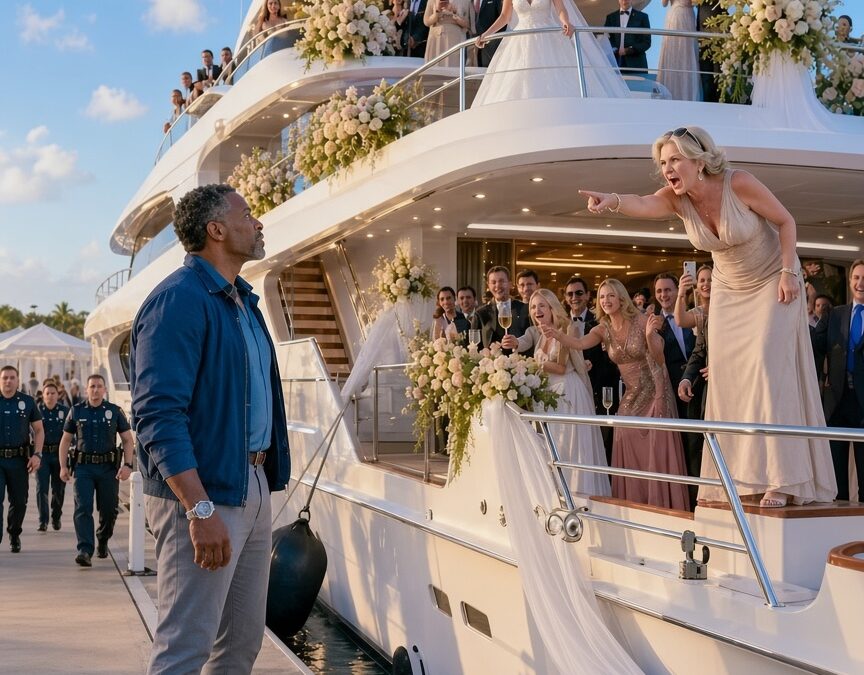
“Why is there a wedding on my boat?”
The woman standing on my stern didn’t even have the decency to look embarrassed.
“Because my daughter deserves the nicest venue in this marina,” Vivian Harcourt replied, adjusting the diamond bracelet on her wrist.
I looked past her. A three-tiered wedding cake stood on my bait-preparation station. White flowers were tied around the stainless-steel railings. A bartender was pouring champagne in my galley, and a bride in a dress that probably cost more than my engines’ annual maintenance was posing for photographs on my flybridge.
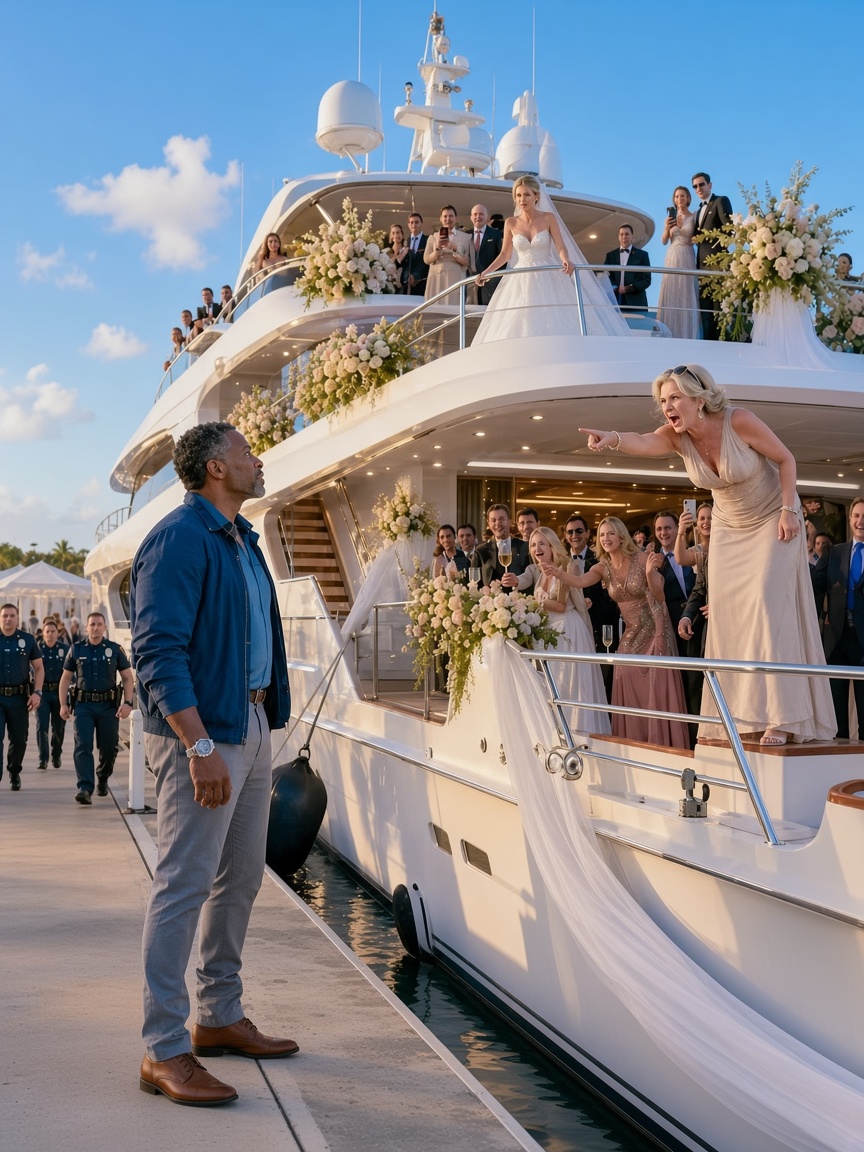
One hundred and forty people had been invited to celebrate a wedding aboard a boat that none of them owned.
“You need to get these people off my vessel,” I said.
Vivian smiled.
“Jack, don’t be dramatic. I borrowed it for one evening.”
“You don’t borrow a forty-four-foot sportfishing boat without asking its owner.”
“Then consider yourself asked.”
“No.”
Her smile disappeared.
“Listen carefully. This is my daughter’s wedding day. You are not going to humiliate her because you have some ridiculous attachment to an old fishing boat.”
I stared at the white fabric covering the name on my transom.
My late wife had painted those letters herself while chemotherapy was destroying her strength.
Vivian had covered them with a gold wedding monogram.
“Take it down,” I said.
“Absolutely not.”
“Vivian.”
She stepped closer, lowering her voice.
“I am the president of this homeowners association. I control what happens in this marina. Right now, this boat is part of a private community event, and unless you want to ruin a young woman’s wedding, you will turn around and walk away.”
I looked at her for several seconds.
Then I said something she clearly wasn’t expecting.
“Did you personally authorize your decorators to cover the federal identification markings?”
She blinked.
“What?”
“The numbers on the transom. The Coast Guard Auxiliary markings on the hull. The pennant on the mast. Did you order those removed?”
“Of course I did. They looked terrible in the photographs.”
“Thank you.”
“For what?”
“For answering.”
I stepped back onto the dock.
Vivian gave a satisfied little laugh, apparently convinced she had won.
She didn’t notice the Coast Guard response boat turning into Taylor’s Creek.
And she certainly didn’t understand why three uniformed officers were looking directly at her wedding reception.
My name is Jack Moran. I’m fifty-two years old, a retired Coast Guard chief warrant officer, and the owner of a forty-four-foot Carolina sportfishing boat named Sarah Grace.
Until that June evening, I thought the worst thing a person could do to me was take something that belonged to my wife.
I was wrong.
The worst thing was watching someone take it, destroy its meaning, and expect me to apologize for objecting.
To understand how a wedding ended with federal officers on a private dock, you need to understand what that boat meant to me.
And you need to understand the woman who decided she owned everything she could see.
Nine years earlier, my wife Sarah and I moved to Harbor Point Estates, a waterfront community near Beaufort, North Carolina.
The neighborhood had forty-six houses, thirty-two marina slips, and a long wooden dock extending into Taylor’s Creek. Live oaks shaded the streets. Marsh grass moved with the tides. On clear mornings, you could hear the engines of fishing boats heading toward Beaufort Inlet before you saw them.
Sarah loved the place immediately.
We had spent most of our marriage moving between duty stations. Key West. Charleston. Portsmouth. Kodiak. Wherever the Coast Guard needed me, we packed our belongings and went.
Sarah never complained.
She worked as a nurse whenever our assignments allowed it, learned the names of our neighbors, and somehow made every temporary house feel permanent.
But she had one request.
“When you retire,” she told me, “I want a house where I can smell the ocean before I get out of bed.”
So that was what we bought.
Our house stood near the marina entrance, with a screened porch overlooking the water and a kitchen window facing the channel.
I retired after twenty-six years of active service.
I had commanded patrol boats, inspected commercial vessels, investigated marine casualties, and spent more nights at sea than I could count. I had pulled frightened families out of disabled sailboats and stood on dark decks listening for voices in the water.
I was ready for quieter work.
Sarah and I decided to build a boat.
Not a little center-console fishing boat. We wanted a proper offshore sportfisher, something sturdy enough to work the Gulf Stream and comfortable enough to take families out for a day they would remember.
I found a partially completed forty-four-foot hull and spent nearly every spare dollar we had finishing it.
Twin Cummins diesels. A proper flybridge. Outriggers. A fighting chair. A galley large enough for Sarah to make breakfast while I checked the weather.
She chose the upholstery, the teak trim, and the navy-blue paint.
Then, fourteen months before we launched, Sarah was diagnosed with stage-three ovarian cancer.
I remember the doctor’s office more clearly than I remember some of my Coast Guard deployments.
There was a painting of a lighthouse on the wall. The air conditioner rattled. Sarah wore a blue sundress and had a little notebook in her purse containing measurements for the boat’s cabin curtains.
The oncologist explained the diagnosis, treatment options, and prognosis.
Sarah listened without interrupting.
When he finished, she looked at me.
“We need to get that boat in the water.”
I tried to smile.
“Sarah, we have other things to think about.”
“I know exactly what we have to think about.”
She reached for my hand.
“I’m not spending whatever time I have left watching you worry. We’re finishing our boat.”
So we did.
There were good weekends when she sanded teak beside me, complaining about the dust and insisting I had measured something incorrectly.
There were bad weekends when she sat in a folding chair wrapped in a blanket and supervised while I worked.
After her third round of chemotherapy, she couldn’t hold a paintbrush for very long.
She still insisted on painting the name.
Sarah Grace.
Navy-blue letters with narrow gold edges, hand-painted across the transom.
She worked slowly, resting between strokes.
I offered to hire a professional sign painter.
She told me to get out of her way.
We launched the boat on a bright Saturday in April.
Sarah arrived in a wheelchair, wearing sunglasses and a white shirt she’d bought specifically for the occasion.
A few friends gathered at the marina.
She insisted on breaking the champagne bottle herself.
The first swing missed.
So did the second.
On the third, the bottle cracked against the bow and champagne spilled into the creek.
Sarah laughed so hard she had to wipe her face.
That laugh stayed with me.
Eleven weeks later, she was gone.
During her final days, I had moved a hospice bed into our living room so she could see the water.
Every evening I switched on the Sarah Grace’s masthead light.
From her bed, Sarah could see that small white light through the window.
On her last night, she asked me whether the boat was ready for the morning.
I told her everything was secured.
“Good,” she whispered.
She died before sunrise.
After the funeral, I spent a long time sitting on the Sarah Grace without going anywhere.
Eventually, I started taking her offshore again.
I opened Moran’s Offshore Charters, a licensed fishing business operating out of Beaufort. I picked up customers at the public town dock and kept the Sarah Grace in my assigned marina slip at Harbor Point.
Four trips a week during the busy season. Fewer in winter.
It wasn’t a fortune, but it paid my bills and gave me a reason to get up before daylight.
I also enrolled the Sarah Grace as an approved Coast Guard Auxiliary operational facility.
That meant the boat could be offered for authorized volunteer missions, including safety patrols and search-and-rescue support. The Auxiliary was separate from my former active-duty career, but serving on the water still mattered to me.
The vessel carried the appropriate markings when operating under authorization, and I kept her federal documentation, inspection records, insurance, and safety equipment current.
I was particular about those things.
Twenty-six years in the Coast Guard will do that to a man.
The boat was registered in my name.
The name on the stern was Sarah’s.
And nobody had permission to use her without asking me.
Unfortunately, Vivian Harcourt had a very different understanding of property rights.
Vivian was fifty-eight, a luxury real estate agent, and president of the Harbor Point Estates homeowners association.
She wore expensive linen, drove a white Mercedes SUV, and spoke to people as though every conversation were a meeting she had already decided how to conclude.
She had been HOA president for seven years.
Most homeowners didn’t particularly like her, but few were willing to challenge her.
She had a talent for making disagreement exhausting.
If you questioned a fine, she scheduled a hearing during business hours.
If you requested financial records, she sent you three pages of procedures.
If you challenged a rule, she told you the board had already considered the matter.
And the board usually meant Vivian, her closest friend Patty Oaks, and Dennis Miller, a retired dentist whose principal qualification seemed to be an extraordinary ability to avoid expressing an opinion.
My first serious disagreement with Vivian came three months after Sarah’s funeral.
I was washing down the Sarah Grace after a charter trip when Vivian appeared on the dock.
“Jack, we need to discuss your commercial operation.”
I shut off the hose.
“What about it?”
“Clients coming and going. Fishing equipment. The appearance of the marina.”
“My clients board at the Beaufort town dock.”
“Nevertheless, this is a residential community.”
“And this is a boat slip.”
She lowered her sunglasses.
“The board believes your vessel may violate our residential-use restrictions.”
“My attorney reviewed those restrictions before I purchased the house. I’m allowed to keep my boat here.”
Vivian looked at the stern.
“And the lettering is rather prominent.”
I followed her gaze.
“You mean the name?”
“The graphics, yes. They have a commercial appearance.”
“Sarah Grace is the vessel’s documented name.”
“Perhaps something more discreet would be appropriate.”
“My wife painted that name.”
Vivian shrugged.
“Personal circumstances don’t exempt anyone from community standards.”
I remember looking at her and realizing that she genuinely believed she’d made a reasonable point.
“The name stays,” I said.
Three weeks later, I received my first violation notice.
The HOA described the name on my transom as noncompliant commercial signage and threatened daily fines if I didn’t remove it.
I took the letter to Elena Bradshaw, a maritime attorney in Wilmington.
Elena had spent two decades handling vessel disputes, marina contracts, and insurance litigation. She was precise, impatient with nonsense, and expensive enough that I tried not to call her unless something mattered.
She read the notice twice.
“Did they actually demand that you remove the documented vessel name?”
“Yes.”
She put down the paper.
“Jack, I think your HOA president needs a hobby.”
Elena sent a formal response explaining the applicable documentation requirements and demanding that the board identify the provision supposedly violated.
The fine disappeared.
Vivian never apologized.
Instead, she found new things to complain about.
My dock box was too large.
My shore-power cord was allegedly a tripping hazard.
My outriggers supposedly extended beyond my slip, although they were always secured when the boat was docked.
I received nine violation notices in eighteen months.
Every time, I documented the condition, disputed the allegation, and requested a hearing.
Every time, Vivian treated the hearing as an opportunity to remind me who controlled the neighborhood.
Then she contacted my customers.
One afternoon, a regular client named Frank Boulé forwarded me a letter he’d received from the HOA.
It advised him that my charter operation was under compliance review and suggested that customers consider other fishing services.
Frank added one sentence.
“Jack, is your HOA president out of her mind?”
Three customers canceled bookings after receiving similar letters.
I lost eighteen hundred dollars.
Vivian had used names and information from public testimonials on my business website to contact people who had never set foot inside Harbor Point.
Elena called it potential interference with business relationships.
I called it harassment.
Vivian called it community management.
A month later, an inspector from the North Carolina Division of Marine Fisheries arrived while I was preparing tackle.
He explained that someone had reported an unlicensed fishing operation.
I showed him my paperwork.
He checked everything, asked a few questions, and closed the complaint without finding a violation.
Before leaving, he looked toward the houses.
“Somebody around here really doesn’t like you.”
“That would be the HOA president.”
He sighed.
“I had a feeling.”
The next fight concerned my slip.
Slip One was near the marina entrance, where the water was deep enough for the Sarah Grace even at low tide.
It also gave me the shortest, safest route to the channel.
Vivian announced that the board intended to redesignate it as a courtesy slip for visitors and prospective homebuyers.
She wanted me moved to Slip Twenty-Nine.
That slip was exposed to wind and had a shallow approach.
At certain tides, I would have struggled to get the Sarah Grace in or out safely.
I objected.
Vivian informed me that the board had broad discretion over marina assignments.
Elena requested the governing documents, meeting minutes, and legal basis for the reassignment.
The supposed decision collapsed under scrutiny.
But two weeks later, something happened that was more serious than a threatening letter.
I returned from an offshore trip to find the Sarah Grace’s shore-power cable disconnected.
The freezer had thawed.
More than a hundred pounds of bait had spoiled. The refrigerator was warm, and the battery system had been carrying loads it shouldn’t have been carrying for nearly two days.
The damage cost me over two thousand dollars.
I photographed everything and filed a report with the Carteret County Sheriff’s Office.
There were no witnesses.
The marina security cameras had supposedly been offline for maintenance.
I couldn’t prove who had disconnected the cable.
Then Vivian mailed me a sympathy card.
Inside, beneath the printed message, she had written:
“So sorry about your freezer troubles. Perhaps a smaller boat would be easier to maintain.”
I sat at my kitchen table holding that card for a long time.
I wanted to drive straight to her house.
Instead, I called Elena.
“Keep the card,” she said.
“I was planning to.”
“And Jack?”
“Yes?”
“Stop giving her opportunities to control the record. Start making your own.”
That was the beginning of the investigation.
I installed four marine-grade cameras aboard the Sarah Grace.
Two covered the dock and flybridge. One watched the stern, shore-power connection, and boarding area. Another monitored the cabin.
The recordings went to storage I controlled, with a cellular backup independent of the HOA’s network.
Then I requested the association’s financial records.
Vivian ignored the first request.
She ignored the second.
After Elena sent a formal demand citing the homeowners’ inspection rights, a banker’s box of records appeared on my porch.
I took it to my neighbor Carl Hutchins.
Carl lived in Unit Twelve.
He was a retired forensic accountant who had spent part of his career examining financial fraud. He wore old fishing shirts, drank terrible instant coffee, and had an almost supernatural ability to notice when numbers didn’t belong together.
I asked whether he would help me understand the marina accounts.
He opened the first binder.
“Jack, I was beginning to worry retirement would kill me from boredom.”
For the next two weeks, Carl worked through bank statements, invoices, budgets, and payment records.
One Saturday morning, he called.
“Come over.”
His tone made me put down my coffee.
When I arrived, spreadsheets covered his dining room table.
Carl pointed to a column of payments.
“Have you ever heard of Coastal Heritage Marine Services?”
“No.”
“Your HOA has paid them thirty-one thousand two hundred dollars over three years.”
“For what?”
“Preventive dock maintenance and inspections.”
I looked at the invoices.
“Half these dates are during the winter. I never saw anyone working.”
“That’s interesting,” Carl said, “because I can’t find meaningful supporting records for the work.”
He slid another sheet toward me.
“Coastal Heritage is registered to Greg Turnbow.”
The name sounded familiar.
“Vivian’s brother-in-law?”
“Exactly.”
The company’s business address was a residential garage in Morehead City.
The only clearly documented work Carl found was a pressure-washing job that should have cost a fraction of the amount billed.
Then he showed me the Marina Enhancement Fund.
Every slipholder had paid an additional six hundred dollars annually for improvements.
Thirty-two slips.
Three years.
Fifty-seven thousand six hundred dollars collected.
The fund should have paid for dock lighting, electrical upgrades, and repairs.
Instead, the bank balance was only forty-two hundred dollars.
Carl had traced questionable withdrawals, unexplained transfers, and checks lacking adequate supporting documentation.
“I’m not calling every missing dollar stolen until we establish where it went,” he told me. “But the records don’t reconcile, and the board has a serious problem.”
“How serious?”
He looked up.
“Serious enough that somebody should have been asking questions years ago.”
I thought about the rotten dock boards, the broken lights, and the electrical pedestals that sparked during rainstorms.
Then I thought about Vivian’s expensive clothes and her constant insistence that the marina needed to maintain its luxury appearance.
“Can you put this into a report?”
Carl smiled without humor.
“I already started.”
We began speaking privately with other homeowners.
Tom and Linda Choy had been fined after a contractor damaged their sailboat.
Dave Espinosa, a retired Marine, had received a fifteen-hundred-dollar penalty for flying a POW/MIA flag from his mast.
Margaret Odum, an eighty-one-year-old widow, had temporarily lost her assigned slip while recovering from hip surgery. Vivian had given it to a prospective buyer.
Every household had a story.
By the time twelve families gathered on Tom Choy’s back porch, we had a thick collection of letters, receipts, photographs, and disputed charges.
Dave brought an audio recording from an HOA meeting.
He explained that he had recorded meetings after discovering discrepancies between what people said and what later appeared in the minutes.
On the recording, Vivian discussed having Greg’s company handle marina work.
Then came a sentence that made everyone stop moving.
“Nobody reads the invoices.”
A moment later, Patty asked about the enhancement fund.
Vivian replied, “It’s my reserve. If they wanted oversight, they should have run for the board themselves.”
Dave played the recording again.
Margaret set down her sweet tea.
“Well,” she said, “that tells us what she thinks of us.”
Elena reviewed everything before we took further action.
She warned us not to confuse suspicious behavior with proof of a crime. Financial discrepancies required proper investigation, and the recording’s admissibility would need to be assessed.
But we had enough to demand an independent audit and pursue formal remedies.
We prepared the paperwork.
Then Vivian announced her daughter’s wedding.
Kelsey Harcourt was twenty-eight and worked in pharmaceutical sales.
She was engaged to Todd Ashworth III, whose father was a North Carolina state senator.
The wedding was supposed to be the social event of the summer.
The ceremony would take place at a church in Beaufort. The reception would follow at Harbor Point.
Vivian announced the plans using the HOA’s official email account.
She attached a photograph of Kelsey’s engagement ring and described the celebration as an opportunity to showcase the community’s waterfront elegance.
At the March board meeting, she revealed the arrangement.
“The marina will be reserved for the wedding weekend,” she announced. “All vessels will need to relocate temporarily.”
I raised my hand.
“Under what authority?”
Vivian looked irritated.
“Under the board’s authority to manage common facilities.”
“You’re ordering thirty-two owners to move their boats for a private wedding.”
“Only for three days.”
“Some of these vessels can’t safely use the temporary moorings you’re proposing.”
“We’ll coordinate that.”
“Where’s the homeowner approval?”
“The board has discussed the matter.”
“That isn’t what I asked.”
Her expression hardened.
“Jack, must you turn every community initiative into a confrontation?”
“This isn’t a community initiative. It’s your daughter’s reception.”
A few people laughed.
Vivian didn’t.
Elena challenged the proposed closure in court.
The resulting order prevented the HOA from implementing the marina shutdown without following the required procedures.
Vivian left me a furious voicemail disguised as a request for cooperation.
She called my objection unnecessary, selfish, and disrespectful to her family.
Then she said something I saved immediately.
“I hope you’ll reconsider before this becomes something neither of us can take back.”
By then, I had stopped assuming Vivian would act reasonably.
Still, I didn’t imagine she would do what she did next.
Every June, I traveled to Wilmington to visit Sarah’s parents around the anniversary of her death.
Ruth and Gene were getting older.
We spent the day at the cemetery, brought flowers, and shared stories about Sarah.
It wasn’t a sad ritual exactly.
Some years we laughed more than we cried.
Gene always remembered some childhood incident Sarah would have been mortified to hear repeated.
Ruth made sweet tea and packed sandwiches no matter how often I told her she didn’t have to.
On June second, while I was sitting in their kitchen, my phone rang.
It was Tom Choy.
“Jack, where are you?”
“Wilmington.”
“You need to come home.”
I stood.
“What’s wrong?”
“There are people on your boat.”
“What people?”
“Decorators. Caterers. Men carrying furniture. Vivian’s directing them.”
For a moment, I thought I’d misunderstood.
“On the Sarah Grace?”
“Yes. They’re putting flowers everywhere. They’ve covered the stern.”
“What do you mean, covered?”
“White fabric. Some kind of wedding banner.”
I gripped the phone.
“Tom, can you see the name?”
“No.”
“Are the Auxiliary markings visible?”
“No. They’ve covered those too.”
I closed my eyes.
“Is the pennant still on the mast?”
“They took it down.”
I heard movement in the background.
Then Tom said, “Jack, they’re carrying a wedding cake onto your boat.”
I looked toward the kitchen window.
Ruth was arranging flowers on the table.
Gene was reading the newspaper.
Neither knew what I had just heard.
“Tom, don’t confront anybody. Take photographs from your property. Record whatever you can safely see.”
“What are you going to do?”
“I’m going to make some calls.”
My first call was to Elena.
My second was to my Coast Guard Auxiliary chain of leadership.
From there, I contacted the appropriate Coast Guard duty personnel and reported that my documented vessel had been boarded and taken over without permission.
I explained the circumstances, the apparent concealment of identification markings, and the fact that a large private event was being prepared aboard a vessel not authorized or configured to carry that number of guests.
That last point mattered.
The Sarah Grace was a sportfishing vessel.
She wasn’t a floating banquet hall.
She wasn’t inspected or arranged to accommodate a crowd of wedding guests, servers, musicians, photographers, and decorators.
The deck had load limits.
The boarding arrangements had limits.
The lifesaving equipment was intended for the number of people lawfully carried during my normal operations, not a crowd of strangers in formal clothing.
A person didn’t need twenty-six years of maritime experience to recognize the danger.
But I had those twenty-six years, and I knew exactly how quickly a crowded dock or vessel could become an emergency.
The duty officer asked detailed questions.
Who owned the vessel?
Was I aboard?
Had I authorized anyone to use it?
Had the boat moved?
Were guests already boarding?
Were the engines secured?
I answered every question.
He instructed me not to attempt a confrontation and said the report would be assessed for an appropriate response.
I also contacted the sheriff’s office and advised them of the unauthorized entry and use of my property.
Then I packed my bag.
Ruth was standing in the doorway when I turned around.
“What’s happened?”
“Vivian Harcourt put her daughter’s wedding on the Sarah Grace.”
Ruth stared at me.
“She did what?”
“They’ve covered the name.”
Her expression changed.
Not dramatically.
She simply stopped moving.
Ruth had watched Sarah paint those letters. She had sat beside her daughter while Sarah rested between strokes.
She knew what that name meant.
“Jack,” she said quietly, “go get our girl’s boat back.”
Gene was already reaching for his car keys.
“I’ll drive you.”
“No, sir. I’ll be all right.”
He looked at me for a long moment.
“Don’t do anything that’ll make Sarah mad at you.”
Despite everything, I smiled.
“That narrows the options.”
He handed me a thermos of coffee.
“Then do it properly.”
I drove back to Beaufort.
Along the way, Tom sent photographs.
I stopped at a gas station to look at them.
The first showed a white fabric panel hanging over the stern.
The second showed men securing flower arrangements to the railings.
The third showed the fighting chair wrapped in ivory satin.
I had to put the phone down after that one.
Sarah had sat in that chair on our final trip together.
She was too weak to fish, but she wanted to come offshore one more time.
We stayed close to shore, watched dolphins in the wake, and ate sandwiches she’d packed.
At one point, she leaned back in the fighting chair, closed her eyes, and said, “This is exactly what I wanted.”
Now someone had tied a decorative bow around it.
I got back into the truck.
When I reached Harbor Point, the sun was dropping toward the marsh.
The neighborhood entrance was crowded with expensive cars.
A valet attendant tried to direct me toward overflow parking.
I told him I lived there.
He asked whether I was attending the wedding.
“No,” I said. “But apparently my boat is.”
I parked at my house and walked toward the marina.
I could hear music before I reached the dock.
A string quartet was playing.
White flowers covered the railings. Electric lights hung from temporary supports. Catering staff moved between tables carrying trays of food.
And at the end of the dock sat the Sarah Grace.
For a moment, I barely recognized her.
The outriggers were wrapped in fabric.
The flybridge had become a photography platform.
Someone had set up a bar in my galley.
A large cake occupied the bait-preparation station.
The stern displayed two gold initials.
K and T.
Sarah’s name was hidden underneath.
I stood still.
I had expected to be furious.
Instead, I felt strangely calm.
It was the same feeling I used to get before a difficult boarding operation, when the important thing was to understand the scene before taking action.
I counted the people on the dock.
I noted the blocked access points.
I saw electrical extension cords running across wet boards.
I watched guests stepping onto the boat with champagne glasses in their hands.
Then I noticed a little girl, perhaps eight years old, standing near the edge of the dock while her parents posed for photographs.
She leaned backward against a decorative rope that wasn’t a safety barrier.
A few inches farther and she could have fallen into the water.
I approached a catering supervisor.
“Who’s in charge of safety here?”
He looked confused.
“I’m sorry?”
“The vessel and dock. Who’s controlling passenger access?”
“I think Mrs. Harcourt is handling the venue.”
“Of course she is.”
I asked him to move the child away from the edge.
Then I continued toward my boat.
Vivian saw me approaching.
Her smile was immediate and entirely artificial.
“Jack! I wondered whether you’d come back in time.”
I stopped a few feet from her.
“Why is there a wedding on my boat?”
“Because it’s the most beautiful vessel in the marina.”
“That isn’t an answer.”
“Don’t be difficult.”
I looked at the decorations.
“You boarded without permission. You brought contractors aboard. You’ve installed equipment, moved my fishing gear, and covered the vessel’s markings.”
Vivian sighed.
“Oh, Jack. Everything will be cleaned up tomorrow.”
“Get everyone off.”
“Absolutely not.”
“Vivian, this boat isn’t approved for a reception of this size.”
She waved a hand toward the guests.
“Most people are on the dock.”
“There are people in the cabin, on the foredeck, and on the flybridge. You have blocked access to safety equipment.”
“You’re exaggerating.”
“I’m not.”
She leaned closer.
“Let me explain something. My daughter has waited her entire life for this day. Her husband’s family is extremely prominent. There are people here who matter.”
I looked at her.
“So are the people standing on my boat.”
She frowned.
“You know what I mean.”
“Yes,” I said. “I do.”
She glanced toward the photographer.
“Please don’t make a scene.”
“You’ve already made one.”
Then came the exchange I would later repeat in a deposition.
Vivian told me she had borrowed the vessel.
I told her she had no permission.
She insisted that her authority as HOA president allowed her to control the marina.
I asked whether she’d ordered the federal identification and Auxiliary markings concealed.
She admitted she had.
I made no threats.
I didn’t touch her.
I stepped away.
I called the responding authorities to update them on the number of people present and the conditions I had observed.
Then I waited near the shore.
At approximately eight that evening, a Coast Guard response boat entered the creek.
Its engines dropped to idle as it approached the marina.
The orange stripe along its hull was visible even in the fading light.
People began turning toward the water.
The quartet continued playing for another few seconds before the musicians realized nobody was listening.
The response boat came alongside the dock.
Uniformed personnel stepped ashore.
A boarding officer introduced himself as Petty Officer Rivera.
He was compact, serious, and calm.
He asked to speak with the vessel owner.
I stepped forward, showed my identification, and confirmed the documentation details.
Rivera asked whether I’d authorized the event.
“No.”
“Any of the contractors?”
“No.”
“Anyone aboard?”
“No.”
He looked toward the crowd.
“Understood.”
He and his team began addressing the situation.
They instructed the event organizers to stop boarding additional guests and started arranging for people to leave the vessel in an orderly manner.
A local deputy arrived shortly afterward.
Vivian came down the dock, furious.
“Excuse me. Who authorized this interruption?”
Rivera turned toward her.
“Ma’am, are you responsible for this event?”
“Yes. Vivian Harcourt. HOA president.”
“Did you obtain the owner’s permission to use this vessel?”
“This is a community marina.”
“That wasn’t my question.”
Vivian looked at me.
“Jack, this is ridiculous.”
Rivera waited.
“Ma’am?”
“I arranged the reception. The boat wasn’t being used.”
“Did the owner give you permission?”
Vivian’s expression tightened.
“Not specifically.”
“Did he tell you that you could use it?”
“No, but—”
“Thank you.”
She stared at him.
“Are you seriously suggesting I’ve done something wrong?”
“We’re investigating an unauthorized use of a vessel and assessing the safety conditions aboard. Right now, we need the vessel cleared.”
“My daughter is on that boat.”
“Then we’ll help her disembark safely.”
“You can’t just end her wedding.”
Rivera didn’t argue.
“Ma’am, the reception cannot continue aboard this vessel.”
Vivian glanced around, searching for someone who might overrule him.
Her gaze landed on Todd’s father, Senator Richard Ashworth, who was standing beside a table with a plate in his hand.
“Richard,” she called. “Could you please explain to these gentlemen that this is a private family celebration?”
The senator set down his plate.
He looked at Rivera, then at the boat, then at Vivian.
“I think,” he said carefully, “you should cooperate.”
For the first time that evening, Vivian appeared uncertain.
Kelsey emerged from the flybridge stairs.
She was wearing a fitted white wedding gown and carrying a bouquet of pale pink peonies.
“Mom? What’s happening?”
Vivian hurried toward her.
“Nothing, sweetheart. There’s been a misunderstanding.”
Kelsey looked at the uniformed officers.
“Why is the Coast Guard here?”
Nobody answered immediately.
Then Todd, standing behind her, said, “Because apparently we weren’t supposed to be on this boat.”
Kelsey turned.
“What?”
Todd looked at Vivian.
“You told us the association had approved the venue.”
“It did.”
“Did the owner approve it?”
Vivian said nothing.
Kelsey stared at her mother.
“Mom.”
“Don’t start.”
“Did you ask him?”
Vivian lifted her chin.
“I handled the arrangements.”
Kelsey looked toward me.
Our eyes met across the dock.
She had never been especially friendly to me, but she had never harassed me either.
Mostly, she was someone I saw driving through the neighborhood during holidays.
Now she looked bewildered.
“Mr. Moran,” she said, “I thought this was a community boat.”
I shook my head.
“No, Kelsey. It’s mine.”
Her gaze moved to the white panel covering the transom.
“I’m sorry.”
Vivian grabbed her arm.
“You have nothing to apologize for.”
Kelsey pulled away.
“Yes, I do.”
The boarding officer began clearing the vessel.
Guests moved down the gangway in an embarrassed procession.
The bartender carried out his equipment.
The photographer kept taking pictures.
A bridesmaid tried to rescue the wedding cake before someone explained that nothing should be moved until the condition of the vessel had been documented.
Then Rivera examined the fabric covering the stern.
He asked who had installed it.
Vivian identified the decorating company.
The decorator explained that his crew had followed her instructions.
Rivera documented the obscured markings and other alterations.
The deputy spoke separately with Vivian, the contractors, and several witnesses.
I remained nearby, answering questions when asked.
At one point, Vivian approached me again.
“You’ve made your point,” she said. “Now tell them to leave.”
“It’s not my decision.”
“You called them.”
“Yes.”
“So call them off.”
I looked at her.
“Vivian, you brought a hundred and forty people to my property without permission. You altered my boat. You ignored me when I asked you to stop. What exactly did you expect?”
She took a step closer.
“I expected you to behave like a neighbor.”
I almost laughed.
“Is that what you’ve been doing for the last two years?”
Her face changed.
For a second, I saw the anger beneath the polished expression.
“You have been a problem since the day you moved here.”
“No,” I said. “I’ve been a homeowner who wouldn’t let you take his property.”
She opened her mouth.
Then the deputy called her name.
“Mrs. Harcourt, we need to speak with you.”
She turned.
“I’m busy.”
“Ma’am, please come over here.”
She refused at first.
Then she began arguing loudly enough that several guests stopped walking.
She insisted the boat belonged to the community, that the HOA had authority over the slip, and that I had deliberately sabotaged her daughter’s wedding.
The deputy asked her to lower her voice.
She refused.
He instructed her to remain where she was while he completed his investigation.
Vivian tried to push past him toward the boat.
He stopped her.
“Ma’am, do not interfere.”
“Get your hands off me.”
She pulled away and tried again.
That was when the situation changed.
The deputy warned her clearly.
Vivian ignored him.
A moment later, she was being placed in handcuffs.
The entire dock seemed to fall silent.
Her diamond earrings flashed beneath the lights.
The photographer lowered his camera, hesitated, then raised it again.
Kelsey covered her mouth.
Todd stared at his mother-in-law as though he had never seen her before.
Vivian kept talking.
“This is an outrage. Do you know who I am?”
The deputy answered without raising his voice.
“Yes, ma’am. You’ve told us.”
She was escorted away for processing in connection with the incident and her conduct during the investigation.
The exact legal consequences would take months to determine.
But one thing was settled that night.
Vivian Harcourt’s authority ended at the boundary of property she didn’t own.
After the guests had left the vessel, Rivera allowed me to inspect it with him.
I stepped aboard slowly.
There were scratches in the hull finish.
A mounting bracket near the flybridge had been damaged.
Someone had moved emergency equipment to make room for decorations.
The teak deck had deep marks from furniture legs.
In the galley, sticky champagne residue covered the counter.
And above the navigation station, in the little holder where it had sat for years, was Sarah’s coffee mug.
It had a chipped handle and a faded Coast Guard emblem.
Somebody had moved it behind a stack of catering supplies.
I picked it up.
For a moment, the entire marina disappeared.
I could almost hear Sarah asking whether I wanted another cup.
Rivera stood quietly beside me.
“Your wife?” he asked.
I nodded.
“She helped build this boat.”
He looked around.
“I’m sorry, sir.”
“Thank you.”
I put the mug back where it belonged.
Then I went to the stern.
Rivera had already photographed the fabric panel.
With his permission, I removed it.
The white material came away in my hands.
Underneath were the navy-blue letters with their gold edges.
Sarah Grace.
Exactly as she had painted them.
I ran my fingers along the lettering.
The paint was undamaged.
That was when I finally had to sit down.
I sat on the stern bench while the Coast Guard crew finished documenting the scene.
The dock lights reflected on the water.
Somewhere behind me, the caterers were packing equipment into trucks.
I could hear Kelsey speaking to Todd.
She was crying, but she wasn’t screaming.
She kept saying the same thing.
“She told me it was approved.”
I believed her.
That didn’t excuse what had happened, but it mattered.
I didn’t want revenge against Kelsey.
I wanted my boat back.
And I wanted Vivian held accountable for what she had done.
The next morning, my phone wouldn’t stop ringing.
A guest had posted a video of Vivian arguing with the officers.
Another had recorded the moment she was handcuffed.
By lunchtime, the footage was circulating across social media.
The caption on one version read:
“HOA president commandeers neighbor’s boat for daughter’s wedding.”
People shared it thousands of times.
Local reporters called.
A television producer from Raleigh wanted an interview.
Someone offered me money for exclusive photographs.
I declined.
Elena advised me to keep my statements short.
“The facts are enough,” she said. “Don’t turn this into a performance.”
She was right.
I had a damaged boat, a criminal investigation, and a much larger financial matter still waiting.
Carl called two days later.
“Jack, everybody’s looking at the wedding.”
“I noticed.”
“Good. Because while they’re looking, we’re going to make sure somebody looks at the books.”
The wedding incident had shaken the neighborhood.
Homeowners who previously refused to discuss Vivian were suddenly willing to attend meetings.
People began asking why one person had been allowed to control the association for so long.
Carl completed his preliminary financial report.
Elena helped arrange for the evidence to be submitted to the appropriate investigators and for the homeowners to demand an independent forensic audit.
The audit uncovered a pattern of payments lacking legitimate supporting documentation.
Coastal Heritage Marine Services had received substantial sums for maintenance work that could not be verified.
The enhancement fund had been depleted through transfers and expenditures that the board could not adequately explain.
Investigators examined bank accounts, invoices, and communications.
Greg Turnbow, Vivian’s brother-in-law, became part of the inquiry.
Patty Oaks was questioned about approvals and meeting minutes.
Dennis Miller retained an attorney.
I found that last development particularly interesting.
For seven years, Dennis had managed to avoid taking a position on almost anything.
Now he had discovered the value of professional advice.
The homeowners called an emergency meeting under the association’s governing procedures.
The community center filled before the scheduled start.
People stood along the walls.
Some brought folding chairs.
Margaret Odum arrived with a thick folder of documents and announced that she intended to stay until every question had been answered.
Tom Choy chaired the meeting because the remaining board members were facing questions about their involvement and conflicts of interest.
Carl presented the financial findings.
He didn’t dramatize them.
He showed invoices, payment dates, account balances, and the absence of records supporting claimed work.
Then he explained what the association had collected.
What it had supposedly spent.
And what remained unaccounted for.
A man near the back stood up.
“So we’ve been paying extra fees for improvements that never happened?”
Carl nodded.
“That is what the records indicate.”
Another homeowner asked about the maintenance contractor.
Carl explained the family relationship and the apparent lack of documented services.
People began talking over one another.
Tom had to ask for quiet.
Then Margaret stood.
She didn’t raise her voice.
She didn’t need to.
“My husband bought our boat thirty years ago,” she said. “After he died, sitting on that boat was one of the few things that made me feel close to him. Vivian took my slip while I was in the hospital because she thought somebody else’s money mattered more than my rights.”
The room went silent.
Margaret looked toward Patty.
“And now we learn that the money we paid to maintain this marina may have been going somewhere else.”
Patty stared at the table.
Margaret continued.
“She treated our homes like they belonged to her. She treated our boats like they belonged to her. And when Jack wasn’t here, she covered his wife’s name so she could have a prettier party.”
She sat down.
Nobody spoke for several seconds.
Then Dave Espinosa stood and began applauding.
The entire room joined him.
The meeting continued for almost three hours.
The homeowners voted to remove Vivian through the procedures available under the governing documents and applicable law.
Patty resigned shortly afterward.
Dennis stepped aside pending further review.
A new board was elected.
Tom became president.
Linda Choy became secretary.
Carl became treasurer.
Their first decision was to commission a complete independent audit.
Their second was to inspect the marina.
The marine survey was worse than anyone expected.
Fourteen structural deficiencies.
Six significant electrical problems.
Two pilings with serious deterioration.
Dock hardware that should have been replaced years earlier.
The money supposedly spent on preventive maintenance had not prevented much of anything.
One electrical pedestal was in such poor condition that the inspector recommended taking it out of service immediately.
Tom called me after receiving the report.
“Jack, if we’d waited another couple of years, somebody could have gotten hurt.”
I looked out my window toward the dock.
“I know.”
That was the part of the scandal that bothered me most.
The financial losses were serious.
But money could be recovered.
A failed dock during a storm, an electrical fire, or a person falling into the water because a railing gave way could have been much worse.
Vivian had spent years demanding that the marina look expensive.
She had neglected the things that made it safe.
The legal proceedings took longer than the internet expected.
Online commenters wanted a dramatic courtroom scene the following week.
Real investigations don’t work that way.
Witnesses were interviewed.
Records were obtained.
Financial transactions were traced.
Attorneys filed motions.
Experts evaluated the vessel damage and marina accounts.
The authorities considered the appropriate state and federal issues, including the unauthorized boarding and use of the Sarah Grace, the alterations to the vessel, and the safety concerns created by the reception.
Elena made sure I understood that federal documentation and Auxiliary status did not magically turn every property dispute into a federal crime.
The law was more complicated than that.
What mattered was what Vivian had actually done, what could be proved, and which statutes applied.
I appreciated Elena’s insistence on accuracy.
I had spent my career enforcing rules.
I didn’t want those rules exaggerated just because the facts made a good story.
The state property case and the HOA financial investigation proceeded on their own tracks.
Eventually, Vivian accepted responsibility for portions of her conduct through negotiated resolutions.
She faced probationary supervision, substantial financial penalties, restitution obligations, and restrictions arising from the proceedings.
Her professional conduct also came under scrutiny.
The real estate licensing authorities reviewed the complaints and the evidence relevant to her business.
Her reputation suffered long before every legal issue was resolved.
Clients stopped returning calls.
Listings disappeared from her website.
The real estate office where she had worked for years removed her photograph from its promotional materials.
Greg Turnbow faced his own legal problems over the questionable maintenance invoices.
The association pursued recovery of misapplied funds through civil proceedings and insurance claims where coverage was available.
Not every dollar came back immediately.
Some funds were recovered through settlements.
Other amounts required prolonged collection efforts.
The new board published regular financial statements so homeowners could see exactly what had been recovered and what remained outstanding.
Carl refused to let anyone describe an expected payment as cash already received.
“Money isn’t recovered,” he said at one meeting, “until it’s in the account.”
That became something of a neighborhood joke.
Whenever anyone announced good news about the marina, someone would ask whether Carl had verified the deposit.
But the transparency changed everything.
The association began repairing the docks.
Electrical systems were upgraded.
Damaged pilings were replaced.
The new board reviewed the fee structure and eventually reduced the monthly charges once the actual operating costs were established.
Residents received credits or refunds where the financial recovery and association finances permitted.
More importantly, they received explanations.
For the first time in years, a homeowner could ask where money had gone and get an answer supported by a bank statement.
Dave Espinosa got his flag back.
The new board clarified that properly displayed military and memorial flags were permitted.
One Saturday morning, Dave raised his POW/MIA flag above his sailboat.
Tom sounded his horn.
Then I sounded mine.
Within seconds, nearly every vessel in the marina was blowing its horn.
Dave stood on his deck with one hand on the halyard and the other raised toward his face.
Nobody made a speech.
Nobody needed to.
Margaret’s slip was restored.
Her late husband’s Boston Whaler returned to its proper place.
She still visited every Sunday.
Sometimes I saw her sitting on the dock with a thermos of coffee, speaking quietly toward the empty boat.
I never interrupted.
Some conversations aren’t meant for anyone else.
As for Kelsey and Todd, their wedding became a subject neither family enjoyed discussing.
The couple had exchanged vows at the church before the reception disaster, so they were already married.
But their celebration had ended with guests leaving early, a ruined schedule, and Kelsey’s mother being escorted away by deputies.
They later held a small dinner for close friends.
No waterfront decorations.
No elaborate staging.
No borrowed boats.
A few weeks after the incident, Kelsey came to my house.
I opened the door to find her standing on the porch holding an envelope.
She wore jeans and a plain blue blouse.
Without the wedding dress and photographers, she looked younger.
“Mr. Moran, do you have a minute?”
“Of course.”
I invited her inside.
She glanced toward the framed photograph of Sarah on the mantel.
“Is that your wife?”
“Yes.”
“She’s beautiful.”
“Thank you.”
Kelsey sat on the edge of the sofa.
For a moment, she seemed unsure where to begin.
Then she placed the envelope on the coffee table.
“It’s a letter. I wanted to apologize properly.”
“You don’t have to do this.”
“Yes,” she said. “I do.”
She looked down at her hands.
“My mother told me the boat belonged to the association. She said it was available for community events and that she’d arranged everything with the marina.”
“I understand.”
“I should have asked more questions.”
I didn’t answer.
She looked toward the window, where the Sarah Grace was visible in her slip.
“When I saw your wife’s name under that fabric, I realized what we’d done.”
“You didn’t put the fabric there.”
“No. But I stood on that boat smiling for photographs while people were using your things.”
Her voice shook.
“I can’t stop thinking about that.”
I leaned back.
“Kelsey, your mother made the decision. She lied to you about having permission. That’s on her.”
She nodded, but I could see she wasn’t entirely convinced.
“I don’t know what to do about her,” she said.
I considered the question.
“That’s something you and Todd will have to decide.”
“She’s furious with me for not defending her.”
“Did she ask whether you were all right?”
Kelsey looked up.
Then she looked away.
That answered the question.
I didn’t offer a speech about family or forgiveness.
I knew too little about their relationship to pretend I could solve it.
Instead, I said, “You can love someone and still refuse to excuse what they did.”
She sat quietly for a while.
Before leaving, she asked whether she could see the boat.
I hesitated.
Then I agreed.
We walked down to Slip One.
The Sarah Grace was clean again, though the repairs were still underway.
Kelsey stood on the dock looking at the stern.
“Your wife painted that?”
“Yes.”
“By hand?”
“Every letter.”
She stepped closer.
The gold edges caught the afternoon sunlight.
“I’m glad it wasn’t damaged.”
“So am I.”
She turned toward me.
“I’m sorry, Mr. Moran.”
“I know.”
She left a few minutes later.
I never became close friends with Kelsey and Todd, but I appreciated that she came.
An apology doesn’t erase damage.
Sometimes it does make it easier to distinguish the people who caused it from the people caught in the middle.
The Sarah Grace required more than an apology.
The decorators had scratched the hull finish in several places.
Furniture legs had gouged the teak.
A VHF antenna bracket was bent.
There were adhesive marks on the railings and small punctures where decorations had been secured.
The damage estimate came to roughly eleven thousand four hundred dollars.
Insurance and restitution issues took time to resolve.
I didn’t wait to begin the repairs.
I spent three days removing every remaining decoration.
I took down the ribbons one by one.
I cleaned adhesive from the stainless steel.
I scrubbed the galley until the counters no longer smelled of champagne.
I removed the satin from the fighting chair and checked the mounting bolts.
Then I sat in that chair for a while.
I remembered Sarah leaning back with her eyes closed.
I remembered her telling me that the ocean smelled different when you knew you didn’t have to be anywhere else.
I remembered how carefully she’d chosen the upholstery, as if the right shade of blue could make the boat last forever.
The repairs took several weeks.
I hired a professional to handle the hull finish and structural checks, but I did much of the smaller work myself.
I replaced damaged fittings.
I refinished sections of teak.
I checked the wiring and electronics.
I restored the vessel markings and ensured the Auxiliary equipment and identification were properly maintained.
Then I washed the entire boat from bow to stern.
When I finished, I stood on the dock with the hose in my hand.
The Sarah Grace looked like herself again.
Not brand-new.
She still had the little imperfections that came from years of honest use.
A faint scratch near the rod holders.
A repaired seam in the upholstery.
A patch of teak that was slightly darker than the rest.
I liked those things.
They were evidence that the boat had lived.
One evening, Ruth and Gene came to visit.
They hadn’t seen the Sarah Grace since the wedding incident.
Gene walked slowly down the dock, carrying a small canvas bag.
Ruth stopped at the stern.
She looked at the name.
Then she reached out and touched the gold edging.
“It’s still hers,” she said.
“Yes.”
Gene cleared his throat.
“I brought something.”
He opened the bag and removed a small wooden box.
Inside was a photograph of Sarah from the launch day.
She was sitting in her wheelchair, laughing, with the broken champagne bottle in her hand.
I had seen the photograph before.
What I hadn’t seen was the note tucked behind it.
Gene handed it to me.
“Sarah wrote this a few weeks after the launch. Ruth found it in a drawer.”
I unfolded the paper.
Sarah’s handwriting was uneven, but I recognized it immediately.
“Jack, if you’re reading this because I’m not there to tell you what to do, here’s one last instruction. Don’t turn the Sarah Grace into a museum. Take her fishing. Take people out. Let kids catch their first fish. Let her get dirty. Let her come home smelling like salt and diesel. That’s what we built her for. And when something breaks, fix it and go again. I love you.”
I read it twice.
Then I sat down on the dock.
Ruth sat beside me.
Gene stood looking out toward the channel.
For several minutes, none of us spoke.
Finally, Ruth said, “She knew you pretty well.”
I laughed.
“She knew I’d spend the rest of my life polishing the railings if she didn’t tell me otherwise.”
“She certainly did.”
I folded the note carefully.
That night, I put it in the navigation desk aboard the Sarah Grace.
Not in a safe.
Not in a display case.
In the place where I kept my charts, tide tables, and logbook.
Where it belonged.
A month later, I took the boat offshore alone.
I left before sunrise.
The marina was quiet.
Tom’s porch light was on, and Dave’s flag moved gently in the breeze.
I started the twin diesels and let them warm.
The engines settled into their familiar rumble.
I checked the instruments, released the lines, and eased away from Slip One.
The Sarah Grace moved through Taylor’s Creek as the sky turned pale above the marsh.
I passed the Beaufort waterfront and headed toward the inlet.
There was a light southwest breeze.
The water was calm enough to make the early run comfortable.
I cleared the channel, brought the engines up, and felt the bow rise.
Spray broke against the hull.
The boat settled onto plane.
For the first time since the wedding, I wasn’t thinking about Vivian.
I wasn’t thinking about the investigation, the HOA meetings, the lawyers, or the photographs circulating online.
I was thinking about Sarah.
About the first time she stepped aboard the unfinished hull.
About the way she stood with her hands on her hips and announced that the galley was too small.
About the arguments we had over upholstery.
About her stubborn insistence on painting the name herself.
I ran southeast until the coastline became a thin strip behind me.
Then I slowed and shut down one engine.
The boat rocked gently.
I took Sarah’s note from the navigation desk and read it again.
“Let kids catch their first fish.”
I smiled.
She had always known how to give me work worth doing.
The following week, I contacted a local organization that helped families of military members and first responders.
I offered several complimentary fishing trips for children who had lost a parent in service.
The first group came aboard on a Saturday morning.
Three children, two mothers, and a grandfather.
The youngest boy was nine.
He stood on the dock staring at the Sarah Grace.
“Is this really your boat?”
“Yes, sir.”
“It’s huge.”
“She’s a good size.”
“Does she go fast?”
“Fast enough.”
He looked at the name.
“Who’s Sarah?”
I glanced toward the stern.
“My wife.”
“Does she fish with you?”
I paused.
“She used to.”
He seemed to consider that.
Then he nodded.
“My dad used to take me fishing.”
I crouched so we were at eye level.
“Well, how about we see whether we can catch something today?”
He grinned.
Three hours later, he caught his first king mackerel.
It wasn’t a record fish.
It wasn’t even particularly large.
But when he brought it alongside the boat, he shouted so loudly that everybody on deck started laughing.
His mother took photographs.
His grandfather wiped his eyes.
I helped the boy hold the fish for a picture.
Behind him, the navy-blue letters on the transom were visible.
Sarah Grace.
I looked at them and thought about the wedding.
For months, I had believed the most important thing I’d done was protect the boat from Vivian Harcourt.
But watching that boy smile, I understood something else.
Protecting the Sarah Grace wasn’t only about keeping other people from taking her.
It was about making sure she continued doing what Sarah wanted.
Going offshore.
Carrying people safely.
Giving families something good to remember.
The legal case eventually became old news.
Vivian moved away from Harbor Point.
Her house sold after several months on the market.
I watched the moving truck leave one afternoon while I was repairing a reel in the cockpit.
I didn’t wave.
I didn’t celebrate.
I simply went back to work.
The neighborhood changed after she left.
Not all at once.
There were still arguments about budgets, landscaping, parking, and whose guests were using which slips.
That’s what happens when people share a community.
But the arguments were different.
Homeowners could attend meetings and speak without being threatened with fines.
Financial records were available.
Marina rules were applied consistently.
And when somebody wanted to hold a private event on the dock, they submitted a request and waited for proper approval.
Nobody treated another person’s boat as community property.
One afternoon, Tom Choy came down the dock carrying two cups of coffee.
He handed me one.
“New board meeting next Thursday.”
“I know.”
“Carl’s presenting the quarterly budget.”
“Good.”
Tom leaned against the railing.
“Would you believe we’ve already had three people volunteer for the maintenance committee?”
“People love a committee.”
“Apparently they do when it actually maintains something.”
We watched a sailboat ease into its slip.
After a while, Tom said, “You know, Vivian really thought she’d get away with it.”
“Yes.”
“Even after the Coast Guard arrived.”
“Yes.”
He shook his head.
“I still can’t believe she put a wedding cake on your bait station.”
I laughed.
That was the detail that never seemed to get old.
Not the expensive flowers.
Not the musicians.
Not the white fabric.
The cake.
A three-tiered wedding cake sitting where I usually prepared cut bait.
Tom grinned.
“Did you ever find out what happened to it?”
“No.”
“Shame. Looked expensive.”
“Tom, I don’t care about the cake.”
“I know. I’m just saying.”
He took a sip of coffee.
Then his expression became serious.
“Sarah would be proud of you.”
I looked toward the transom.
“Maybe.”
“No maybe about it.”
I didn’t answer.
I thought about the years Sarah and I had spent together.
We’d had our share of disagreements.
We’d been tired, frustrated, worried about money, and occasionally convinced the other person was being impossible.
But we had always understood one thing.
A home wasn’t something you built so other people would admire it.
It was something you built so the people you loved would have a place to belong.
For Sarah, that place had been a boat.
For me, it still was.
That evening, after Tom left, I finished cleaning the deck.
I checked the lines, secured the hatches, and switched on the masthead light.
Then I walked back toward the house.
Halfway up the dock, I turned around.
The Sarah Grace rested in Slip One, her name visible across the stern.
Beyond her, the creek was darkening.
A few lights glowed from houses along the shoreline.
The white masthead light shone above the water.
It looked exactly as it had on the last night Sarah was alive.
I stood there for a while.
I could still remember her voice from the hospice bed.
“Is the boat ready for morning?”
Back then, I’d told her yes because I wanted her to feel at peace.
Now, after everything that had happened, I finally understood how much she’d meant by the question.
The boat was never supposed to sit untouched.
It was supposed to keep going.
And so was I.
The next morning, I had a charter scheduled for six-thirty.
A father and his two teenage daughters were coming down from Raleigh. They wanted to catch mahi-mahi, and the weather forecast looked promising.
I had fresh bait in the freezer, ice in the fish boxes, and fuel in the tanks.
Before bed, I set the coffee maker for four-thirty.
I placed Sarah’s chipped mug beside it.
Then I looked out the kitchen window one last time.
The masthead light was still burning.
And for the first time in a long while, I wasn’t looking at it because I was afraid of losing something.
I was looking at it because I knew exactly what I still had.
A good boat.
A good life.
Friends who showed up when it mattered.
And a name on the stern that no one would ever cover again without answering to me.
THE END
Disclaimer: This is fictional AI-generated content created solely for entertainment purposes and is not intended to offend, target, defame, or harm any individual, group, or organization.
Disclaimer: This story is fictional and created for entertainment purposes only. Any names, characters, places, or events are fictitious or used fictitiously. No real person or organization is intended to be portrayed.

