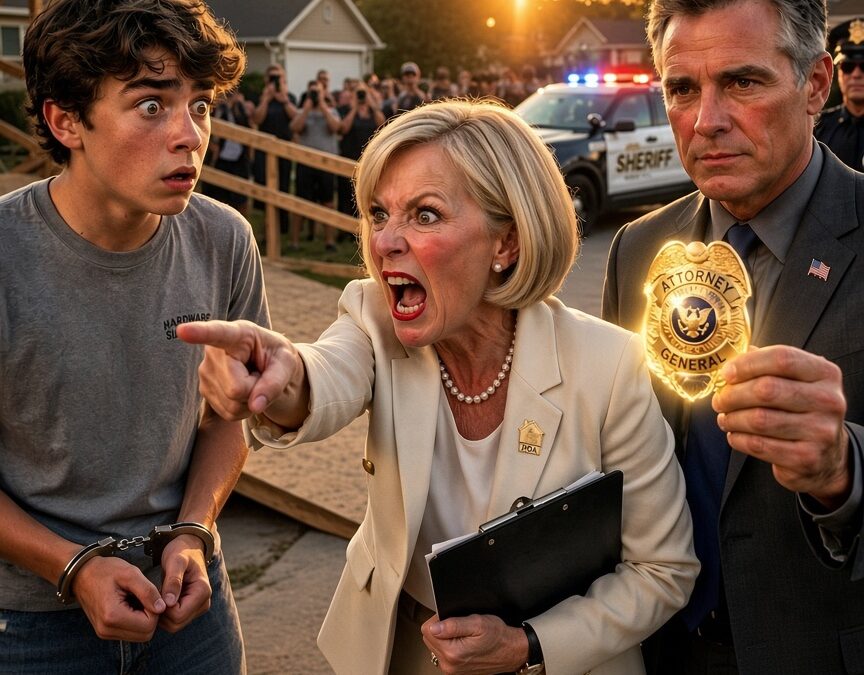
The first thing I heard was the click of the handcuffs.
Not my grandfather calling my name from his wheelchair. Not the neighbors whispering behind their hedges. Not even the engine of the sheriff’s cruiser idling at the curb.
Just that sharp metallic click as Deputy Brent Kowalski locked my wrists behind my back on my own driveway.
“You’ve got the wrong guy, Deputy,” I said.
“Keep moving, Landon.”
“I haven’t done anything.”
“Then you can explain that at the station.”
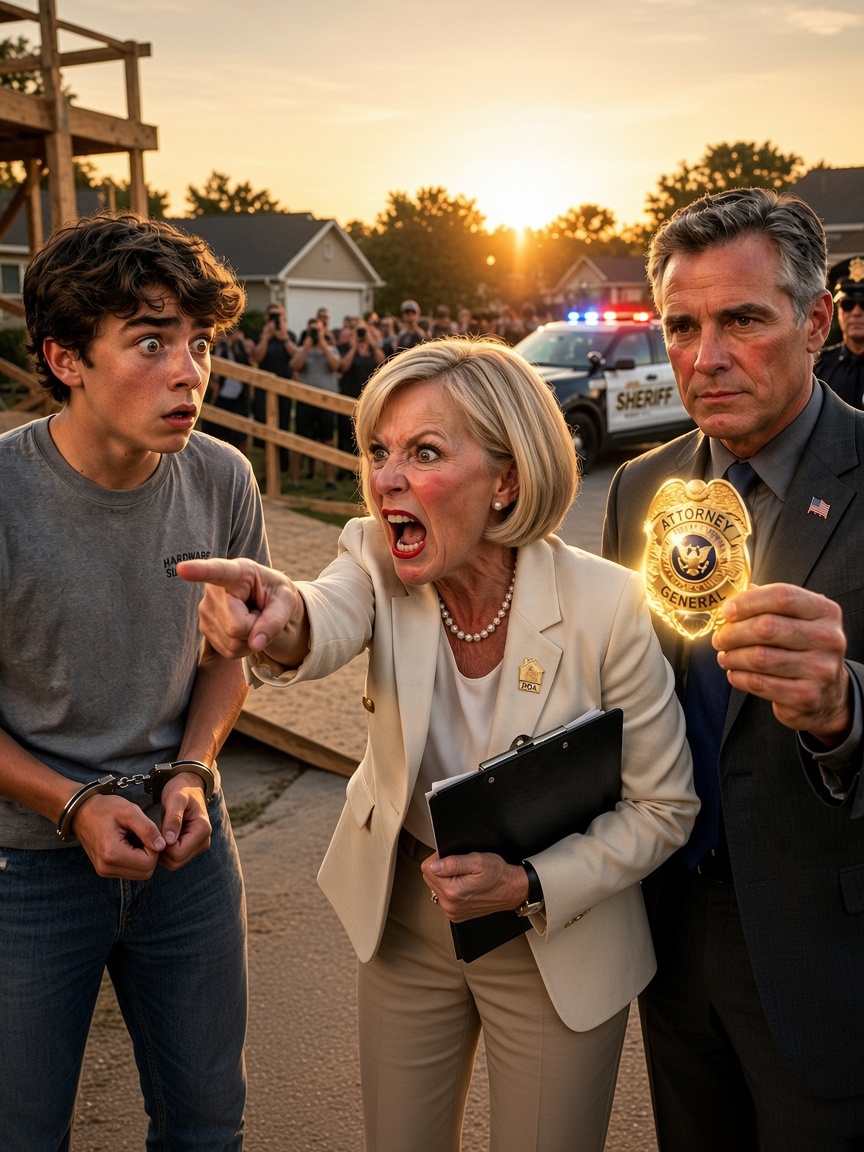
Across the driveway, Darlene Fitch stood beside her golf cart, watching with the satisfied expression of someone who had finally collected a debt.
She was smiling.
I was seventeen years old. It was my birthday. And apparently, building a wheelchair ramp for my eighty-one-year-old grandfather was enough to get me arrested in Willow Creek Estates.
What Darlene didn’t know was that my phone was still recording.
She also didn’t know that a man she had never met was already on his way.
Three hours earlier, my biggest problem had been getting a stubborn piece of pressure-treated lumber to sit flush against a support post.
I remember that because I had been arguing with the board for almost ten minutes.
“Come on,” I muttered, adjusting the clamp. “You are literally a piece of wood. This shouldn’t be complicated.”
From the porch, Grandpa Walt made a noise that sounded suspiciously like a laugh.
I looked up.
“You think that’s funny?”
He raised one eyebrow.
“Yeah, well, you’re welcome to come down here and show me how it’s done.”
He lifted his right hand about an inch from the armrest of his wheelchair, then let it fall again.
I immediately regretted the joke.
Grandpa didn’t seem offended. He just watched me with those pale blue eyes that had seen eighty-one years of things I could barely imagine.
Before his stroke, Walter Mercer had been the loudest man in any room.
He was a retired Marine, a former construction supervisor, and the only person I knew who could identify a loose engine belt by sound alone. He had spent forty-one years in our house, raised my mother there, buried my grandmother, and fixed nearly everything that had ever broken.
Then, last winter, a stroke had taken away most of his speech and much of his ability to walk.
The man who had once carried refrigerators upstairs now needed help getting through his own front door.
That was why I was building the ramp.
Not because it would improve our property value.
Not because I needed a school project.
Because every time Grandpa wanted to leave the house, my mother and I had to maneuver his wheelchair down three concrete steps.
And every time we did, I could see how much he hated needing our help.
My name is Landon Mercer. I was born in a small Colorado town about an hour outside Denver, and Willow Creek Estates had been my home for as long as I could remember.
It was the kind of neighborhood people imagined when they talked about the American dream.
Wide sidewalks. Maple trees. Basketball hoops. American flags hanging from front porches. Lawns cut so neatly they looked artificial.
And a homeowners association that treated a misplaced trash can like a federal offense.
For nine years, the HOA had been controlled by one woman.
Darlene Fitch.
Darlene was fifty-eight, wore expensive sunglasses regardless of the weather, and drove a white electric golf cart with a miniature American flag attached to the roof.
She carried a black clipboard everywhere.
The clipboard was famous.
Every Friday, Darlene drove through the neighborhood issuing violation notices.
She called them compliance inspections.
Everybody else called them Fines Friday.
Nobody thought it was funny.
A trash can left beside the garage too long could cost you $150. A basketball hoop positioned six inches outside an approved boundary could cost $300. Holiday decorations left up past the deadline could trigger daily penalties.
Once, Darlene fined my mother seventy-five dollars because a ceramic garden gnome near our flower bed was supposedly inconsistent with the neighborhood’s visual standards.
Grandpa had bought that gnome for my grandmother thirty years earlier.
My mother paid the fine.
She paid all of them.
Four thousand three hundred dollars in fourteen months.
I knew the exact number because I had added every violation notice myself.
My mother, Claire Mercer, was a registered nurse who worked overnight shifts at St. Catherine’s Medical Center. She spent twelve hours at a time helping strangers, then came home to take care of Grandpa and make sure I had something resembling a normal childhood.
She was exhausted almost all the time.
Fighting Darlene required energy she didn’t have.
“It’s cheaper to pay her than hire a lawyer,” Mom used to say.
I hated hearing that.
I hated that a woman with a clipboard could make my mother afraid of opening her mailbox.
But I was sixteen when most of those fines arrived.
What could I do?
Then Grandpa’s wheelchair changed everything.
In early September, Mom applied for a county building permit to construct an accessible ramp from our porch to the driveway.
The county approved the plans after reviewing the measurements, slope, landing, and structural requirements.
We had the permit.
We had the deed.
We had a licensed contractor review the design.
What we didn’t have was the money to hire someone to build it.
So I decided to do it myself.
I worked part-time at Henson’s Hardware after school, stocking shelves, mixing paint, and carrying bags of concrete into customers’ trucks.
I saved nearly every paycheck.
By October, I had enough for lumber, brackets, fasteners, concrete footings, and the textured decking Grandpa would need for traction.
Mr. Henson gave me a discount after hearing what I was building.
“Your grandfather helped my dad rebuild a roof in 1996,” he told me. “Wouldn’t take a dime. Least I can do is sell you some lumber at cost.”
I spent two weekends digging footings and setting posts.
Then came my seventeenth birthday.
October 15.
Mom had finished a night shift and was sleeping upstairs. Grandpa sat on the porch under a blanket, supervising my work through the open screen door.
My father was supposed to come for dinner at seven.
I wasn’t counting on it.
His name was Thomas Ashby.
He lived three hours away, and although he called regularly, his visits were less predictable.
When I was younger, I used to wait at the living room window whenever he promised to come.
Sometimes he made it.
Sometimes an emergency meeting, a court hearing, or a state crisis kept him away.
By thirteen, I had stopped waiting by the window.
By fifteen, I had stopped telling my friends when he was supposed to visit.
Dad wasn’t cruel. He wasn’t absent in the way some fathers are absent. He remembered birthdays, paid for school expenses, and asked about my grades.
But he always seemed to be somewhere important.
Somewhere more important than wherever I was.
My mother never spoke badly about him.
“He loves you,” she would say.
“I know.”
“He’s doing difficult work.”
“I know that too.”
What I didn’t know was why his work always seemed to win.
My parents had separated when I was four. Mom kept her last name, and when I was old enough, I asked to use Mercer rather than Ashby.
It wasn’t an act of rebellion.
Mercer was the name on Grandpa’s military photographs. It was the name on the mailbox outside the house where I grew up.
It felt like mine.
My father agreed without arguing.
I appreciated that more than I ever told him.
At two that afternoon, I was tightening a galvanized bracket when I heard the faint electric whine of a golf cart.
I didn’t have to look up.
I knew that sound.
Grandpa heard it too.
His expression changed.
Darlene’s cart stopped at the end of our driveway.
She climbed out wearing white slacks, a navy blouse, and sunglasses with oversized gold frames.
Her black clipboard was tucked under one arm.
“Stop working,” she said.
I set my hammer on the sawhorse.
“Good afternoon, Mrs. Fitch.”
“Did you hear me?”
“Yes, ma’am.”
“Then stop.”
I stepped away from the ramp.
Darlene walked toward the porch, examining the lumber as though she had discovered a toxic waste dump.
“What exactly do you think you’re doing?”
“Building an accessibility ramp for my grandfather.”
“I can see that. Who authorized it?”
“The county.”
She gave a short laugh.
“The county?”
“Yes, ma’am. We have a permit.”
“That’s not what I asked.”
I wiped my hands on my jeans.
“I’m not sure what else you need.”
“Form Fourteen. Architectural modification request. Sixty-day review period. Written approval from the board.”
I had expected this conversation.
I had even prepared for it.
“The ramp is covered by disability accommodation protections,” I said. “My mom submitted the plans and the permit. The HOA was notified.”
“Notification is not approval.”
“It’s necessary for Grandpa to access the house.”
“Necessary according to whom?”
I looked toward the porch.
Grandpa sat less than twenty feet away in his wheelchair.
“According to the fact that he can’t walk down those steps.”
Darlene followed my gaze.
Her eyes rested on Grandpa for barely a second.
“Not my problem.”
The words were so casual that for a moment I wasn’t sure I had heard them correctly.
“Excuse me?”
“Your family’s personal circumstances do not exempt you from community standards.”
Grandpa’s right hand tightened around his wheelchair armrest.
I took a slow breath.
“Mrs. Fitch, he’s lived here since 1985.”
“And?”
“He helped build half the houses on this street.”
“That doesn’t make him special.”
“No. But he should be able to get into his own home.”
Darlene opened her clipboard.
“Young man, I don’t think you understand who you’re speaking to.”
I nearly answered.
Instead, I reached into my pocket and took out my phone.
I tapped the recording button and placed it faceup on the sawhorse beside the hammer.
Then I picked up the permit.
“Here’s the county approval.”
She took the paper, glanced at the seal, and immediately frowned.
“This doesn’t supersede HOA authority.”
“I didn’t say it did. But the ramp is permitted, and it’s on our property.”
She pinched the top corner of the document.
Then she tore it.
Not in half.
Just enough to rip off the stamped corner.
She dropped the scrap into the sawdust.
“County paper means nothing here.”
I stared at the torn permit.
“Why would you do that?”
“Because you people refuse to listen.”
“You people?”
“Residents who think the rules are optional.”
She pointed toward the narrow strip of grass between our driveway and the sidewalk.
“That area belongs to the association.”
“No, ma’am. It doesn’t.”
Her sunglasses came off.
“What did you say?”
“Our deed shows the property line extending to the sidewalk. There’s a utility easement, but the land still belongs to us.”
Darlene smiled.
It wasn’t a friendly smile.
It was the expression of someone who had just decided to teach a lesson.
“You’ve been reading documents you don’t understand.”
“My grandfather showed me the survey.”
“Your grandfather is hardly in a position to interpret legal records.”
That was the first moment I felt real anger.
Not irritation.
Not teenage frustration.
Anger.
I could handle her insulting me.
I couldn’t stand there while she treated Grandpa like he was no longer a person.
“Don’t talk about him like that.”
Darlene’s face hardened.
“Excuse me?”
“He can hear you.”
“I am aware of that.”
“Then act like it.”
She took out her phone.
For a second, I thought she was going to photograph the ramp.
Instead, she selected a contact and pressed call.
“Brent,” she said. “Come to the Mercer property. Now.”
A pause.
“Yes. The boy is refusing to comply.”
Another pause.
“Bring cuffs.”
I almost laughed.
Cuffs?
For a wheelchair ramp?
But Darlene wasn’t laughing.
She put her phone away and folded her arms.
“You should have filled out Form Fourteen.”
I looked at Grandpa.
He was watching me closely.
I gave him a small nod.
Everything was fine, I wanted to tell him.
I had the permit. I had the deed. I hadn’t threatened anyone.
Everything was fine.
Four minutes later, a sheriff’s cruiser turned onto our street.
Four minutes.
In Willow Creek, you could wait twenty minutes for someone to respond to a report of a suspicious vehicle.
But apparently, Darlene’s phone calls traveled faster than everyone else’s.
Deputy Brent Kowalski stepped out.
He was a broad-shouldered man in his early thirties with a shaved head and mirrored sunglasses.
I recognized him immediately.
He had attended the HOA Christmas party the previous year.
I’d seen him standing beside Darlene, eating cookies and laughing at something she’d said.
He called her Aunt Darlene.
“What’s going on?” he asked.
Darlene answered before I could.
“Unauthorized construction. Trespass on association property. Refusal to obey a lawful directive.”
Kowalski looked at the ramp.
Then at me.
“Son, step away from the easement.”
“Deputy, this is my family’s property.”
“Don’t argue.”
“I’m not arguing. I can show you the deed.”
He glanced at Darlene.
She shook her head.
“The association owns that strip.”
Kowalski nodded as if the matter had been settled.
“Then you need to stop building on it.”
I held up the damaged permit.
“The county approved the ramp.”
“HOA approval is a separate issue.”
“I understand that, but this isn’t trespassing.”
Darlene reached into her clipboard and produced a laminated map.
“Here,” she announced. “Recorded plat amendment.”
She waved it in front of the deputy.
He barely looked at it.
I stepped closer.
“Can I see that?”
Darlene hesitated.
Then she held it where I could read the heading.
Willow Creek Estates, Amended Common Area Plat.
Recorded April 2024.
There was a seal near the bottom and a notary signature.
Something bothered me immediately.
The font looked different from the other county documents Mom had shown me. The subdivision name wasn’t formatted the way it appeared on our deed.
And the boundary line seemed to cut straight across the front of several existing houses.
“Where was this recorded?” I asked.
“Rio County,” Darlene replied.
“What’s the instrument number?”
She blinked.
“The what?”
“Recorded documents have instrument numbers.”
Kowalski stepped between us.
“Enough.”
“But—”
“I said enough.”
Grandpa’s screen door creaked.
He had pushed himself closer to the edge of the porch.
His mouth moved.
At first, nothing came out.
Then he managed a rough, broken sound.
“L… Lan…”
I turned.
“Grandpa, stay there. I’ve got this.”
He shook his head.
His right hand pointed toward Darlene’s map.
He was trying to tell me something.
Darlene looked annoyed.
“Take that man inside. He’s a liability.”
I turned back to her.
“Don’t talk to my grandfather like that.”
My voice was louder than before.
Not a shout.
But loud enough for the neighbors gathering across the street to hear.
Darlene took one quick step backward.
Then she grabbed Kowalski’s sleeve.
“He threatened me!”
I stared at her.
“What?”
“He raised that hammer!”
The hammer was still on the sawhorse.
I hadn’t touched it since she arrived.
Kowalski could see it.
Darlene could see it.
Everyone could see it.
“I didn’t raise anything,” I said.
“He became aggressive,” she insisted. “I feared for my safety.”
Kowalski looked at the hammer.
Then at me.
“Turn around.”
I thought I had misunderstood him.
“Sir?”
“Hands behind your back.”
“For what?”
“Disorderly conduct, suspected trespass, and threatening behavior. We’ll sort out the details at the station.”
I looked toward the houses across the street.
Mrs. Alvarez was standing beside her mailbox with her phone raised.
Eddie Banks had come out of his garage.
A teenager from two houses down was filming from his bicycle.
“Deputy, I’m seventeen.”
“I’m aware.”
“I haven’t threatened anyone.”
“Don’t make this worse.”
I wanted to run.
I wanted to shout.
Mostly, I wanted my mother.
But Grandpa had taught me something years earlier, when we watched a man get arrested outside a grocery store.
“Never give somebody a reason to turn one bad decision into ten,” he’d said.
So I turned around.
The cuffs closed around my wrists.
Cold metal.
Too tight.
I flinched.
“Can you loosen them?”
“Keep moving.”
Behind me, Grandpa made a sound I had never heard from him before.
I looked over my shoulder.
He was crying.
My grandfather, who had survived combat, buried his wife, and endured months of rehabilitation without complaining, was crying because he couldn’t get out of his wheelchair to help me.
That hurt worse than the handcuffs.
“It’s okay, Grandpa,” I called.
It wasn’t okay.
But I said it anyway.
Darlene approached as Kowalski guided me toward the cruiser.
She waited until he was opening the rear door.
Then she leaned close enough that only I could hear.
“Next time, fill out Form Fourteen.”
I looked at her.
She smiled.
“By Monday, that ramp will be firewood. And your mother’s house will be mine to fine into foreclosure.”
I stopped walking.
For a second, I forgot about the deputy.
“You want our house?”
“Get in the car,” Kowalski ordered.
Darlene straightened.
“Some families simply don’t belong in Willow Creek.”
The deputy pushed me gently but firmly into the back seat.
The door slammed.
Through the window, I saw Darlene return to her golf cart.
I saw Grandpa sitting alone on the porch.
And I saw my phone lying on the sawhorse.
Its screen was still glowing.
Still recording.
I had set it to back up recordings automatically after Mom lost several important photos when her old phone broke.
At that moment, I had no idea whether the upload was working.
I only knew the phone had heard everything.
The ride to the sheriff’s office took fifteen minutes.
Kowalski didn’t speak.
I watched the familiar streets pass through the reinforced glass.
The school football field.
The gas station where Grandpa used to buy me root beer.
The diner where Mom took me after every report card.
It felt strange seeing those places from the back of a police car.
I kept thinking someone would realize there had been a mistake.
The deputy would pull over, apologize, and take me home.
Instead, we arrived at the station.
He walked me through a side entrance.
A woman behind a desk looked up.
“How old?”
“Seventeen,” Kowalski answered.
Her eyebrows rose.
“Guardian notified?”
“Working on it.”
I was placed in a small interview room.
The cuffs finally came off.
My wrists had red marks around them.
There was a metal table, three chairs, and a clock that ticked loudly enough to make me want to pull it off the wall.
I sat there for almost half an hour.
Then a different deputy brought me water.
“Can I call my mom?” I asked.
“We’re contacting her.”
“I want to call her myself.”
He hesitated.
Then he handed me a phone.
My mother’s number was the first one I thought of.
But she was coming off a twelve-hour hospital shift, and I knew how frightened she would be.
I also knew she would try to solve everything by agreeing to whatever they demanded.
I needed someone who wouldn’t be intimidated by Darlene or Sheriff Pickett.
There was only one other number I knew by heart.
I dialed it.
One ring.
“Landon?”
My father’s voice.
For a moment, I couldn’t speak.
“Dad?”
“What’s wrong?”
I swallowed.
“They arrested me.”
Silence.
Then his voice changed.
“Where are you?”
“Rio County Sheriff’s Office.”
“Are you injured?”
“No. I don’t think so.”
“What happened?”
“I was building Grandpa’s wheelchair ramp. The HOA president came over. She called a deputy. She said I threatened her with a hammer, but I didn’t. I swear I didn’t.”
“I believe you.”
He said it immediately.
No hesitation.
No demand for an explanation.
Just four words.
I nearly lost control of my voice.
“They put handcuffs on me.”
Another silence.
“Have they questioned you?”
“Not really.”
“Have you signed anything?”
“No.”
“Good. Don’t sign anything. Ask for an attorney if anyone tries to question you. I’m coming.”
“Dad, you’re three hours away.”
“I’m closer than you think.”
“Why?”
“I was driving to your birthday dinner.”
I looked at the clock.
It was a little after five.
He should have been at least an hour away.
“Where are you?”
“Eleven minutes.”
I gripped the receiver.
“Eleven?”
“Yes.”
Then, more quietly, he said, “Stay put, son.”
I almost laughed at that.
As though I had anywhere else to go.
The call ended.
I sat back down.
Eleven minutes.
I didn’t know what Dad could do when he arrived.
I just knew I wasn’t alone anymore.
Meanwhile, my mother was having the worst afternoon of her life.
I learned the details later.
She had been asleep when the sheriff’s office called.
The deputy told her I was being detained following an incident involving an HOA official.
He mentioned threats.
Possible assault.
Property violations.
Mom didn’t even change out of the scrubs she had worn to work.
She grabbed her keys and drove straight to the station.
When she entered the lobby, Darlene Fitch was already there.
So was Sheriff Harold Pickett.
And a lawyer named Spencer Boyd.
Pickett had been sheriff for almost twelve years. He was a large man with thinning gray hair and the easy smile of someone accustomed to being reelected without serious opposition.
Mom found him standing beside Darlene near the reception counter.
They looked comfortable together.
Too comfortable.
“Where is my son?” she demanded.
Pickett turned.
“Mrs. Mercer, we’re working through an unfortunate situation.”
“Is he hurt?”
“No.”
“Then I want to see him.”
“We need to resolve a few matters first.”
Darlene stepped forward.
“Claire, none of this needed to happen.”
Mom stared at her.
“What did you do?”
“Your son became aggressive.”
“My son was building a ramp for his grandfather.”
“Without proper authorization.”
“We have a county permit.”
Darlene waved her hand.
“You know the association has additional requirements.”
Mom moved closer.
“Did you have my seventeen-year-old son arrested over a wheelchair ramp?”
“Your son made threats.”
“He wouldn’t.”
“You weren’t there.”
“No,” Mom said. “I wasn’t. But I know my son.”
Spencer Boyd cleared his throat.
He was a thin man in an expensive gray suit, with a briefcase that looked polished enough to reflect the overhead lights.
“Mrs. Mercer, perhaps we can avoid making this more complicated.”
He placed a document on the counter.
Mom looked down.
It was a proposed settlement agreement.
She began reading.
Her expression changed.
“Eighteen thousand dollars?”
Boyd nodded.
“Accumulated violations, legal expenses, and corrective-action penalties.”
“That’s insane.”
“The association is willing to establish a payment plan.”
She kept reading.
“Remove the ramp?”
“Yes.”
“My father needs that ramp.”
“The board may consider an alternative design after the proper review period.”
Mom looked up.
“And this paragraph?”
Boyd adjusted his glasses.
“Acknowledgment that the current HOA covenants and recorded amendments govern the property.”
“For how long?”
“The agreement confirms their continuing applicability.”
Mom stared at him.
“You want me to admit that Darlene owns part of our front yard?”
“That’s not precisely how I would characterize it.”
“Then how would you characterize it?”
Boyd didn’t answer.
Sheriff Pickett stepped closer.
“Claire, your son is young. Nobody wants to see this affect his future.”
Mom looked at him.
“What are you saying?”
“I’m saying people sometimes make poor choices. We can resolve things informally if everyone cooperates.”
She looked down at the paper.
“If I sign, Landon comes home?”
Pickett exchanged a glance with Darlene.
“We can recommend that the matter be handled without further charges.”
It was a carefully worded answer.
Mom was too frightened to notice.
She picked up the pen.
Her hand was shaking.
Then the glass doors opened.
A tall man in a charcoal suit walked into the lobby.
Two uniformed Colorado State Patrol officers followed him, along with a woman carrying a leather portfolio.
My father didn’t look angry.
That was what everyone remembered afterward.
He looked focused.
Like someone who had already decided exactly what needed to happen.
“Where is my son?” he asked.
Sheriff Pickett turned.
Darlene looked irritated.
“This is a private legal matter,” she announced.
My father ignored her.
“Sheriff Pickett?”
“Yes?”
“Thomas Ashby.”
Pickett blinked.
The woman beside my father opened her portfolio.
Darlene folded her arms.
“And who exactly are you supposed to be?”
My father took out his official identification and placed it on the counter.
“I’m the attorney general of Colorado.”
For a moment, nobody moved.
Then Sheriff Pickett’s face changed.
He recognized the name.
He recognized the credential.
And he recognized the two state officers standing behind my father.
Darlene gave a brittle laugh.
“Oh, please. Anyone can claim to be—”
“Mrs. Fitch,” the woman with the portfolio interrupted, “I’m Investigator Elena Castillo with the Attorney General’s Office.”
Darlene stopped talking.
My father looked at the unsigned settlement agreement.
Then at Mom.
“Claire?”
She dropped the pen.
“Thomas.”
“Where’s Landon?”
Pickett cleared his throat.
“General Ashby, I assure you this is a routine local matter.”
“My seventeen-year-old son was taken into custody while constructing an accessibility ramp for his disabled grandfather.”
“There are allegations of threatening conduct.”
“Then I expect those allegations to be documented and supported by evidence.”
“Of course.”
“I also expect the arrest report, dispatch records, body-camera footage, and the legal basis for his detention to be preserved immediately.”
Pickett shifted his weight.
“We can certainly arrange—”
“Now, Sheriff.”
My father spoke quietly.
He didn’t threaten to fire anyone.
He didn’t pretend his office gave him the authority to order a local sheriff around.
He knew the law too well for that.
Instead, he looked at Investigator Castillo.
“Please contact the county prosecutor and the independent review team. Given my personal relationship to the juvenile involved, I will not make charging decisions in this case.”
Castillo nodded.
“Already initiated.”
Dad turned back to Pickett.
“You can cooperate with an independent investigation, or you can explain why your department refused to preserve evidence in a case involving a minor and potentially falsified property records.”
The sheriff said nothing.
Mom was still staring at my father.
“You came,” she whispered.
He looked at her.
“I should have been here sooner.”
A few minutes later, an officer opened the interview-room door.
“Landon, your parents are here.”
I stood so quickly that my chair scraped the floor.
When I entered the lobby, I saw Mom first.
She crossed the room and wrapped her arms around me.
“Are you okay?”
“I’m fine.”
“Let me see your wrists.”
“Mom—”
“Landon.”
I showed her.
The red marks were still visible.
She looked furious.
Then I saw Dad standing behind her.
He had taken off his glasses.
For a second, neither of us moved.
Then he stepped forward.
“Hey, buddy.”
He hadn’t called me that in years.
I tried to answer.
Instead, I said, “You came.”
His face changed.
It was the first time I had seen him look uncertain in a room full of people.
“Of course I came.”
“You always say that.”
The words escaped before I could stop them.
He looked down.
Then back at me.
“I know.”
He placed a hand on my shoulder.
“I’m sorry.”
I wanted to say something clever.
Something mature.
Something that would make him understand how many birthdays I had spent pretending not to care.
But I was seventeen, my wrists hurt, and I had just been arrested.
So I hugged him.
He held on tightly.
Behind us, Darlene made an impatient noise.
“This is touching, but the boy still violated community regulations.”
Dad released me.
He looked at her for the first time.
“Mrs. Fitch, you’ll have an opportunity to provide your account to investigators.”
“I’ve already provided it.”
“Good.”
She didn’t seem to understand why that answer should worry her.
I suddenly remembered my phone.
“Dad.”
He turned.
“My phone was recording.”
The lobby went quiet again.
“What?”
“I started recording when she came over. I left it on the sawhorse.”
Investigator Castillo stepped forward.
“Was the recording saved?”
“I think it uploaded automatically.”
“Can you access your account?”
I nodded.
She handed me a tablet.
My fingers trembled as I entered my login information.
The cloud storage folder opened.
There it was.
A video file created at 2:07 p.m.
Forty-three minutes long.
Castillo checked that the file could be preserved without altering the original.
Then she played a copy.
Darlene’s voice filled the lobby.
“Stop working.”
My own voice answered.
“Good afternoon, Mrs. Fitch.”
We listened.
The county permit.
The sixty-day review.
Grandpa’s wheelchair.
Then Darlene’s words came through clearly.
“Not my problem.”
Mom covered her mouth.
The recording continued.
“County paper means nothing here.”
Then came the phone call.
“Brent, come to the Mercer property. Now. Bring cuffs.”
Deputy Kowalski was standing near the hallway.
He looked at the floor.
A few minutes later, Darlene’s accusation played.
“He threatened me! He raised that hammer!”
Castillo paused the recording.
“Landon, where was the hammer?”
“On the sawhorse. The camera should show it.”
She moved the video back.
The image was steady.
The hammer sat in the lower right corner of the frame.
I was standing several feet away.
My hands were empty.
Darlene was pointing at me.
Castillo looked at Kowalski.
“Deputy, did you observe the juvenile raise a hammer?”
He swallowed.
“I relied on the complainant’s statement.”
“Did you observe any threatening movement?”
“I’d need to review my report.”
“You were present.”
“I understand.”
She resumed the video.
The final exchange played through the speakers.
Darlene’s voice was quieter but still clear.
“By Monday, that ramp will be firewood. And your mother’s house will be mine to fine into foreclosure.”
Mom turned toward her.
“You wanted our house?”
Darlene’s expression had lost some of its confidence.
“That recording is being taken out of context.”
“What context?” Mom demanded.
“It was a figure of speech.”
Castillo stopped the playback.
“We’ll preserve the complete recording.”
Then she looked at Darlene.
“Mrs. Fitch, I’d like to examine the plat amendment you presented at the property.”
Darlene clutched her clipboard.
“That’s an HOA document.”
“If it was recorded with the county, it is also a public record.”
“Then get it from the county.”
“We’ve already requested the official records.”
Castillo opened a second file on the tablet.
The original Willow Creek subdivision plat appeared.
Then a list of recorded amendments.
She scrolled through them.
There was no 2024 amendment transferring residential front yards to HOA ownership.
Not one.
Darlene’s jaw tightened.
“Your database must be incomplete.”
“That’s possible,” Castillo said evenly. “Which is why we’ll verify the instrument number with the clerk and recorder.”
Boyd, the HOA attorney, moved closer.
“Darlene, may I see that map?”
She ignored him.
“Mrs. Fitch,” Castillo continued, “the notary named on your document died in 2021.”
Nobody spoke.
“The purported acknowledgment is dated April 2024.”
Darlene looked at the map.
For the first time, she seemed genuinely surprised by something.
Boyd reached for the document.
She pulled it away.
“It’s a clerical issue.”
Castillo nodded once.
“Then the records examination should clarify it.”
My father looked toward the sheriff.
“Who provided this document to your deputy?”
Pickett cleared his throat.
“The association.”
“Was it verified before my son was detained?”
The sheriff didn’t answer.
Kowalski shifted near the hallway.
Dad waited.
Finally, Pickett said, “That will need to be reviewed.”
“Agreed.”
The county prosecutor arrived twenty minutes later.
By then, I had been released to my mother’s custody, with no charges filed against me.
The prosecutor examined the initial reports and the video, then requested that the matter be referred for independent investigation.
Castillo arranged for the suspected plat amendment to be secured as evidence.
Darlene was told not to destroy or alter association records.
She protested loudly.
She demanded to call the HOA board.
She insisted the attorney general was abusing his office.
My father didn’t argue with her.
He had already stepped away from direct control of the case.
He knew that if the investigation was going to survive scrutiny, it needed to be handled by people without his personal conflict of interest.
That restraint made Darlene even angrier.
She wanted a shouting match.
She wanted to claim she was being persecuted.
Instead, she got evidence preservation notices, independent investigators, and a county prosecutor who had stopped smiling.
When Mom finally drove me home, it was after nine.
Grandpa was waiting in the living room.
Our neighbor Eddie Banks had stayed with him.
The moment I walked through the door, Grandpa reached out.
I knelt beside his wheelchair.
“Hey, Grandpa.”
He touched my cheek.
His hand trembled.
“I’m okay,” I said. “Really.”
He shook his head.
Then he pointed toward the front door.
“The ramp?”
I nodded.
“Still there.”
He exhaled.
Eddie stood beside the fireplace, holding a folded piece of paper.
“Landon, there’s something you should know.”
He handed it to Mom.
It was an HOA violation notice.
Issued that afternoon.
Unauthorized structural modification.
Immediate stop-work order.
Potential daily penalties.
At the bottom was Darlene’s signature.
Mom stared at it.
Then she started laughing.
Not because it was funny.
Because she had reached the point where anger and exhaustion had become almost indistinguishable.
“She’s unbelievable.”
Eddie nodded.
“You know, Claire, I think a lot of us have been afraid of her for too long.”
Mom looked at him.
“What do you mean?”
He pulled another envelope from his jacket.
Inside were six violation notices from his own property.
A fence color.
A mailbox replacement.
A driveway repair.
A flower bed.
A flagpole.
A supposed common-area encroachment.
“Twenty-one hundred dollars,” he said. “That’s what I’ve paid her in the last two years.”
I looked at the notices.
Several referenced the same amended plat Darlene had shown me.
“Eddie,” I asked, “have you ever seen the actual recorded amendment?”
He shook his head.
“She told me the county had approved it.”
I looked at Mom.
She looked at me.
For the first time, I understood that this wasn’t just about our house.
It was about the whole neighborhood.
The following morning, the story began spreading.
Not because Dad held a press conference.
He didn’t.
Not because Mom posted about it.
She hadn’t even opened Facebook.
It spread because twenty-three people had filmed some part of my arrest.
One video showed Kowalski placing me in handcuffs.
Another showed Grandpa reaching toward me from his wheelchair.
A third captured Darlene standing beside her golf cart, smiling.
By breakfast, the clips were circulating through neighborhood group chats.
By noon, local reporters were calling.
And by evening, residents from across Willow Creek were gathering outside Eddie Banks’s garage.
I stood beside Mom as people arrived carrying folders.
Every folder contained HOA notices.
Every notice told a story.
Mrs. Alvarez had paid $1,200 because Darlene claimed her wheelchair-accessible garden path crossed a common-area boundary.
A retired teacher named Martin Cole had been fined for repainting his front door the same shade of blue it had been for twenty years.
A young couple had paid nearly $3,000 after Darlene threatened a lien over a disputed landscaping requirement.
Some people had borrowed money.
Others had canceled vacations.
One elderly widow had sold her car to clear an assessment she didn’t understand.
The amounts varied.
The fear was the same.
“Why didn’t anyone fight?” I asked Eddie quietly.
He looked at the crowd.
“Some tried.”
“What happened?”
“Legal letters. More fines. Threats of liens. People got tired.”
I thought about Mom.
About her night shifts.
About the way she used to open HOA envelopes over the kitchen sink, as though she didn’t want me to see.
Eddie placed a hand on my shoulder.
“Your grandfather would be proud of you.”
I looked toward our porch.
Grandpa was watching the gathering through the window.
“I hope so.”
“He is.”
That weekend, investigators began reviewing the association’s financial records.
At first, the case appeared to involve a questionable property map and a potentially false complaint against a minor.
Then the accounting records opened another door.
For years, Darlene had controlled the HOA’s architectural committee, enforcement process, and most of its financial approvals.
The board technically had seven members.
In practice, Darlene made nearly every significant decision.
Two members had resigned after disagreements.
One had moved away.
Another admitted he rarely attended meetings.
The remaining members generally approved whatever she placed in front of them.
That arrangement had allowed a remarkable amount of money to move without serious scrutiny.
The association had paid hundreds of thousands of dollars to Fitch Property Services, a landscaping and maintenance company owned by Darlene’s husband, Raymond.
Some payments were legitimate.
Others were not.
Invoices described work that residents said had never happened.
Several invoices contained duplicate descriptions with different dates.
Maintenance contracts had been renewed without competitive bids.
Investigators also discovered that Darlene had been communicating with a regional development company interested in acquiring narrow strips of land along Willow Creek’s main entrance.
The developer wanted to expand access to a proposed commercial project on the neighboring parcel.
The land was valuable because of its location.
But much of it belonged to individual homeowners.
Darlene had a different idea.
She began producing purported plat amendments that reclassified portions of private lots as association common areas.
Eleven properties were affected.
Ours was one of them.
The plan was ambitious.
And illegal.
According to the evidence eventually presented in court, Darlene intended to use the false maps and mounting HOA penalties to pressure homeowners into signing agreements relinquishing disputed land rights.
In some cases, she threatened liens and foreclosure proceedings.
In others, she offered to “settle” fines if owners acknowledged the association’s boundary claims.
Once enough land had been consolidated, she hoped to negotiate a multimillion-dollar transfer to the developer.
The proposed deal was valued at approximately $2.3 million.
Our property mattered because it sat near the corner where the access route would connect to the main road.
The strip of land beside our driveway wasn’t just a convenient place to put a ramp.
It was part of the corridor Darlene wanted.
Suddenly, everything made sense.
The fines.
The pressure.
The false map.
Her obsession with making Mom sign a permanent acknowledgment of the amended covenants.
She wasn’t enforcing neighborhood standards.
She was trying to manufacture ownership.
And Grandpa’s ramp had put a permanent structure directly in the middle of her plan.
The discovery of the forged documents led investigators to examine the conduct of the sheriff’s office.
Kowalski’s body-camera footage became important.
He had activated the camera before arriving at our house.
The recording showed him taking a phone call from Darlene while still in his cruiser.
Her voice was clear.
“Brent, I need you to make this boy understand.”
He asked what the boy had done.
“He’s building on association land. If he refuses to stop, take him in.”
Kowalski replied, “I’ll handle it.”
There was no mention of a hammer.
No mention of threats.
No indication that anyone was in immediate danger.
Investigators also reviewed messages between Darlene and Sheriff Pickett.
Some were ordinary.
Others were troubling.
One discussed increasing patrols around homes whose owners had disputed HOA penalties.
Another referred to a resident as a “problem property.”
A third suggested that enforcement action would help persuade certain families to cooperate with association demands.
The most damaging message concerned our house.
Darlene had written, “The Mercer kid is blocking the access plan. Brent needs to make the ramp disappear.”
Pickett’s reply was brief.
“Tell him to keep it clean.”
That message didn’t prove every allegation by itself.
But combined with the records, body-camera footage, and witness statements, it raised serious questions about whether law enforcement had been used to support a private financial scheme.
The sheriff was placed on administrative leave during the investigation.
Kowalski was suspended.
Eventually, both left their positions and faced separate legal proceedings.
My father refused to discuss the details with me while the cases were active.
“Why?” I asked one evening.
We were sitting on the back porch.
“Because I don’t want you to hear something from me that could interfere with a fair process.”
“But you’re the attorney general.”
“Which is exactly why I need to be careful.”
I considered that.
“Do you think Darlene will go to prison?”
“I think the evidence should be presented, the defendants should have counsel, and the court should decide.”
“That sounds like something you’d say on television.”
He smiled faintly.
“Occupational hazard.”
I looked down at my hands.
The marks from the cuffs had faded.
But I could still remember how they felt.
“Dad?”
“Yeah?”
“What if you hadn’t come?”
He didn’t answer immediately.
Then he said, “You still would have had rights. You still would have had evidence. And you still deserved to be treated fairly.”
“But would anybody have listened?”
He looked toward the yard.
“That,” he said, “is the question I keep asking myself.”
For the first time, I understood that he wasn’t proud of what had happened simply because he’d been able to help.
He was disturbed by what might have happened to someone whose father wasn’t a public official.
A kid who didn’t have a recording.
A mother who signed the paper because she was frightened.
A family that lost its home without understanding why.
My father rubbed his hands together.
“I’ve spent years believing my job was to protect people through the work I do,” he said.
“Isn’t it?”
“Partly. But sometimes I used that as an excuse for not showing up for the people closest to me.”
I didn’t know what to say.
He continued.
“I can’t change the birthdays I missed.”
“No.”
“I can’t pretend an apology fixes that.”
“No.”
“But I can stop making promises I don’t keep.”
I looked at him.
He didn’t ask me to forgive him.
That mattered.
Over the following weeks, the HOA was placed under court-supervised receivership.
An independent administrator reviewed its contracts, bank accounts, and enforcement records.
Homeowners were invited to submit disputed fines and documentation.
Sixty-one formal complaints were filed in the initial review period.
More followed.
Some fines had been authorized under valid rules but imposed inconsistently.
Others had no defensible basis.
Several were connected directly to the false property amendments.
The process took time.
There were hearings, audits, legal notices, and months of document review.
But eventually, the court approved restitution and repayment procedures.
Mom received a letter stating that her $4,300 in disputed penalties would be refunded.
She read it three times.
Then she sat at the kitchen table and cried.
I sat across from her.
“Mom?”
She shook her head.
“I’m okay.”
I waited.
She wiped her face.
“Do you know how many extra shifts that money represents?”
I didn’t answer.
“Do you know how many nights I worked because I thought we were falling behind?”
I looked at the refund letter.
“I knew it was bad.”
She smiled sadly.
“You were a kid, Landon. You weren’t supposed to carry that.”
“But you were carrying everything.”
She reached across the table and took my hand.
“I was doing my best.”
“I know.”
“And you were doing yours.”
We sat there for a while.
Then Grandpa rolled into the kitchen.
He saw the letter.
Mom held it up.
“We got it back, Dad.”
Grandpa studied her face.
Then he nodded.
Slowly.
Deliberately.
His mouth moved.
“G… good.”
It wasn’t a complete word.
Not yet.
But it was close.
The criminal proceedings took several months.
Darlene initially denied wrongdoing.
She claimed the plat amendments had been prepared by outside consultants.
She blamed accounting errors on former employees.
She accused the homeowners of organizing a personal vendetta.
Her attorney argued that the disputes were civil matters rather than criminal conduct.
But investigators had recovered emails, draft documents, financial transfers, and communications that contradicted her explanations.
The supposed notary acknowledgment had been created using an old stamp image.
Several of the false amendments contained identical formatting mistakes.
Digital records linked their preparation to a computer in the HOA office.
And financial documents showed payments and promised commissions associated with the proposed land transaction.
Spencer Boyd, the HOA attorney, became a cooperating witness after investigators determined that he had relied on information Darlene supplied without independently verifying the property records.
His own professional conduct was separately reviewed.
He admitted that he should have questioned the documents much earlier.
By the time Darlene entered a plea agreement, the evidence against her was substantial.
I attended the sentencing hearing with Mom.
Dad did not sit with the prosecution.
He had remained recused from the case.
Instead, he sat beside us as my father.
Darlene looked different in court.
Her carefully styled blonde hair had grown out at the roots.
She wore a plain beige jail uniform.
There was no clipboard.
No golf cart.
No sunglasses.
For the first time since I’d known her, she couldn’t interrupt everyone in the room.
The prosecutor described the forged records, the misuse of association funds, and the pressure campaign against homeowners.
Several residents submitted statements.
Mrs. Alvarez spoke about the anxiety of receiving fines while caring for her disabled husband.
Eddie Banks described years of intimidation.
Mom spoke about the extra shifts she had worked to pay penalties she believed she couldn’t challenge.
Then I was given an opportunity to address the court.
I had written a statement.
Three pages.
I had practiced it at home.
But when I stood at the microphone, I folded the pages and put them in my pocket.
I looked at Darlene.
“I used to think you hated our family,” I said.
She stared straight ahead.
“I thought you just didn’t like our house or our lawn or my grandfather’s old garden gnome.”
A few people shifted in their seats.
“But you weren’t angry about a garden gnome. You wanted something from us. And you knew my mom was too busy taking care of people to spend every week fighting you.”
I took a breath.
“On my birthday, I was building a ramp so my grandfather could leave his house without feeling helpless.”
My voice tightened.
“You looked at him in his wheelchair and said he wasn’t your problem.”
Darlene lowered her eyes.
“I don’t know if you understand how much that hurt him.”
I paused.
“Then you had me arrested. And for a little while, I believed you could do anything you wanted because you had a title and knew the right people.”
I looked toward the judge.
“I don’t believe that anymore.”
I unfolded the paper in my hand but didn’t read it.
“I don’t want anyone else in our neighborhood to be afraid of opening their mailbox. And I don’t want another kid to think that doing something decent for someone they love can get them thrown into a police car.”
I stepped away.
Mom took my hand when I sat down.
Darlene eventually pleaded guilty to multiple felony offenses arising from the forged records, fraud, embezzlement, and conspiracy.
The court imposed an eight-year prison sentence and ordered restitution under the terms of the judgment.
Raymond Fitch faced separate charges connected to the financial transactions involving his company.
The legal proceedings against the former sheriff and deputy continued on their own timelines.
Not every wrong was resolved in a single courtroom.
But the system Darlene had built was dismantled.
The false property amendments were invalidated.
The disputed land remained with its rightful owners.
And Willow Creek Estates finally held an HOA election without Darlene Fitch controlling the ballot.
Eddie Banks became the new president.
He didn’t want the job.
That was one reason people trusted him.
His first proposal was simple.
All enforcement notices had to identify the actual rule, provide supporting evidence, and explain the appeal process.
The board’s financial records would be available for homeowner review.
No single officer could approve major contracts without oversight.
And residents requesting reasonable disability accommodations would receive prompt, documented consideration consistent with the law.
At the first meeting, Eddie placed a small cardboard box on the table.
Inside were the old black clipboards Darlene had used.
He looked around the room.
“Anybody want one?”
Nobody raised a hand.
“Good,” he said.
Then he carried the box to the recycling bin.
The whole room laughed.
It was the first time I had ever heard people laugh at an HOA meeting.
Through all of that, one thing remained unfinished.
Grandpa’s ramp.
After my arrest, Mom had insisted I stop construction until the property dispute was resolved.
I argued.
She refused.
“I am not watching you get arrested twice,” she said.
So the frame sat beside our porch for weeks, wrapped in a blue tarp.
Every time I came home from school, I saw it.
A half-finished promise.
Then, one Saturday morning in late November, a pickup truck pulled into our driveway.
I was eating cereal when I heard the engine.
I looked through the window.
My father stepped out.
He wasn’t wearing a suit.
He had on jeans, work boots, and a faded gray sweatshirt.
There was a toolbox in the truck bed.
Mom appeared behind me.
“What’s he doing here?”
I checked the time.
Eight fifteen.
Dad walked to the front door and rang the bell.
When I opened it, he held up a pair of work gloves.
“Morning.”
“Morning.”
“Still need help with that ramp?”
I stared at him.
“You know how to build a ramp?”
“No.”
I laughed.
He smiled.
“But I know how to follow instructions.”
I looked past him.
There were bags of concrete, boxes of fasteners, and several lengths of lumber in the truck.
“You bought all that?”
“Mr. Henson helped me make a list.”
I folded my arms.
“Did he charge you full price?”
“Absolutely not. He told me your grandfather once repaired his father’s roof.”
I grinned.
“Grandpa’s apparently done work for everybody.”
“Seems that way.”
Dad looked at the unfinished frame.
“So. Are you hiring?”
I pretended to consider it.
“Depends.”
“On?”
“Can you show up on time?”
He nodded.
“Fair question.”
“Can you listen to instructions?”
“Usually.”
“Can you admit when you’re wrong?”
He looked at me.
“I’m getting better at that.”
I stepped aside.
“Then you’re hired.”
We worked all day.
Dad was terrible with the power drill.
He overtightened the first three screws and stripped one completely.
He measured a board from the wrong end and cut it two inches short.
At one point, he dropped a socket into the grass and spent fifteen minutes searching for it.
I laughed so hard I had to sit down.
“Are you sure you’re the attorney general?”
“I’m beginning to understand why nobody elected me attorney general of carpentry.”
Grandpa watched from the porch.
Sometimes he pointed at a joint or a support bracket.
Sometimes he shook his head when Dad made a mistake.
Once, when Dad tried to install a railing backward, Grandpa made a sharp noise.
We both looked up.
He was pointing.
I followed his finger.
Then I looked at Dad.
“You installed it backward.”
Dad studied the railing.
“Apparently.”
Grandpa smiled.
A real smile.
Not the faint expression I’d seen months earlier.
A broad, unmistakable grin.
Mom came outside around noon with sandwiches and lemonade.
She stood watching us for a moment.
Dad was kneeling beside a post, holding a level.
I was adjusting a bracket.
Grandpa was supervising.
For the first time in years, all four of us were together without someone checking a clock.
Mom sat on the porch steps.
“This looks good.”
“Thanks,” I said.
Dad glanced at her.
“Your son knows what he’s doing.”
“He gets that from his grandfather.”
“Clearly not from me.”
Mom laughed.
It was a small sound.
But I hadn’t heard her laugh that easily in a long time.
By late afternoon, the decking was complete.
We installed the final handrail as the sun dropped behind the houses.
Then I walked the full length of the ramp, checking every connection and making sure the surface was secure.
We had followed the approved plans and arranged for the required final inspection before Grandpa would use it independently.
When the county inspector signed off, Dad came back for the first official trip.
We gathered on the porch.
Grandpa sat in his wheelchair wearing his old Marine Corps sweatshirt.
Mom stood beside him.
Dad waited at the bottom of the ramp.
I knelt in front of Grandpa.
“Ready?”
He looked at the ramp.
Then at me.
His hand moved toward mine.
I held it.
For a moment, I thought he was going to cry.
Instead, he nodded.
I moved behind the wheelchair.
Slowly, carefully, I guided him onto the ramp.
The wheels rolled smoothly over the textured surface.
No lifting.
No struggling with steps.
No awkward maneuvering through the doorway.
Just a gentle slope leading from his home to his driveway.
Halfway down, Grandpa raised his hand.
I stopped.
He looked out over the neighborhood.
The maple trees were almost bare.
A few houses already had Christmas lights along their roofs.
An American flag moved in the breeze outside Eddie Banks’s home.
Grandpa sat there for a long moment.
Then he nodded for me to continue.
At the bottom, Dad crouched beside him.
“How’s that, Walt?”
Grandpa looked up.
His mouth moved.
He took a breath.
“Good.”
One word.
Clear.
Complete.
Good.
Mom covered her face.
Dad looked at me.
I couldn’t speak.
Grandpa smiled.
Then he said it again.
“Good.”
I had spent months imagining how it would feel when the ramp was finished.
I thought I’d be proud of the construction.
I thought I’d be relieved that Darlene couldn’t stop us anymore.
I thought maybe we’d take a picture and send it to Mr. Henson.
But standing there, watching Grandpa say that one word, I realized the ramp had never really been about wood or permits or property lines.
It was about giving a man back a little piece of the life he’d lost.
That evening, Dad took us to dinner.
Three weeks after my birthday.
We went to the old steakhouse near the highway where Grandpa used to take Mom when she was a girl.
The waitress brought a chocolate cake with seventeen candles.
I told her I didn’t need the whole birthday routine.
She ignored me.
Mom sang.
Dad sang badly.
Grandpa tapped his fingers on the table.
I blew out the candles.
Then Dad handed me a small rectangular package.
It was wrapped in brown paper.
I opened it.
Inside was a wooden picture frame.
Behind the glass was our original county permit.
The one Darlene had torn.
The missing corner had been carefully taped back into place.
Beside it was a photograph of the completed ramp.
I stared at it.
“Where did you get this?”
“Your mother kept the permit,” Dad said. “And I thought it deserved better than a drawer.”
I ran my thumb along the edge of the frame.
The torn corner was still visible.
Dad leaned forward.
“I’ve got something else to tell you.”
I looked up.
“I’ve changed my schedule.”
Mom watched him.
“How?”
“Friday evenings are blocked off.”
I waited.
“Every Friday at seven, I’m coming here. Unless there’s a genuine emergency, I’ll be at your house.”
I smiled a little.
“You’re making another promise.”
“No.”
He shook his head.
“I’m telling you what I’ve already started doing.”
I thought about the previous three weeks.
He had come twice.
He’d helped Mom review the contractor paperwork.
He’d taken Grandpa to a rehabilitation appointment.
He’d called me every evening, even when he only had five minutes.
Maybe he really was changing.
“Okay,” I said.
Dad looked relieved.
Then I added, “But if you’re late, Grandpa gets to make you do the dishes.”
Dad laughed.
“Fair enough.”
Grandpa lifted his hand.
Thumbs-up.
We all laughed.
For the first time in a long time, I didn’t feel like I was waiting for my family to become something it wasn’t.
We were simply there.
Together.
The following spring, I visited the state capitol with my school government class.
I had been there before.
But this time, I paid attention.
I watched lawmakers argue over budgets.
I listened to attorneys explain constitutional protections.
I sat in a courtroom and watched a judge patiently explain a procedural issue to someone representing himself.
The law looked different to me now.
Before my arrest, I had imagined it as a collection of rules written by people in expensive offices.
Afterward, I understood that rules alone weren’t enough.
People had to follow them.
Officials had to be accountable.
Evidence had to matter.
And ordinary families needed a way to defend themselves when someone powerful decided they were inconvenient.
One afternoon, my civics teacher asked us to write about a career we might pursue.
Most of my classmates chose engineering, medicine, business, or technology.
I wrote about becoming an attorney.
Not because my father was the attorney general.
Not because I wanted a title.
Because I remembered the feeling of standing in my driveway with my hands cuffed behind my back, trying to explain that I had done nothing wrong.
I remembered how nobody wanted to hear me until someone important walked through the door.
And I couldn’t stop thinking about the kids whose fathers wouldn’t be able to do that.
When I told Dad I wanted to study law, he looked surprised.
“Are you sure?”
“Pretty sure.”
“You know it’s a lot of reading.”
“I’ve seen your office.”
“And a lot of paperwork.”
“I’ve seen Darlene’s clipboard.”
He laughed.
Then he grew serious.
“Landon, don’t choose this because of me.”
“I’m not.”
“Good.”
I looked at him.
“Actually, I’m choosing it because of Grandpa.”
Dad nodded slowly.
“I think he’d like that.”
I smiled.
“Me too.”
By summer, Willow Creek Estates looked almost exactly as it had before.
The lawns were still trimmed.
The sidewalks were still clean.
Flags still hung from front porches.
But the atmosphere had changed.
People talked to one another again.
Neighbors helped neighbors repair fences without worrying about who had approved the paint.
The HOA still existed. It still maintained shared spaces, collected dues, and enforced legitimate community rules.
But the board published its finances, held open meetings, and allowed residents to challenge decisions.
Nobody called Fridays Fines Friday anymore.
And the strip of grass beside our driveway remained exactly where it belonged.
On our property.
One evening, I found Grandpa sitting at the bottom of the ramp.
He had rolled himself outside to watch the sunset.
I sat beside him on the grass.
For a while, neither of us spoke.
Then he reached into the pocket of his sweatshirt and handed me something.
A small brass keychain.
It had the Marine Corps emblem on one side.
On the other, engraved in worn letters, were the words Semper Fidelis.
Always faithful.
I’d seen him carry it for years.
“Grandpa?”
He placed it in my palm and closed my fingers around it.
I looked at him.
“You sure?”
He nodded.
I swallowed.
“Thank you.”
He watched the sunset.
Then he spoke.
Slowly.
With effort.
“Stand… tall.”
Two words.
They took him several seconds.
But they were clear.
I nodded.
“I will.”
He squeezed my hand.
And for the first time, I understood something he’d been trying to teach me since I was little.
Standing tall didn’t mean shouting the loudest.
It didn’t mean having the biggest title or knowing the most powerful people.
Sometimes it meant staying calm when someone wanted you to lose control.
Sometimes it meant keeping evidence when everyone else expected you to surrender.
Sometimes it meant telling the truth even when nobody seemed interested in hearing it.
And sometimes it meant picking up a hammer, buying lumber with your own paychecks, and building a ramp because someone you loved deserved to leave his house with dignity.
Darlene Fitch had believed her position made her untouchable.
She had mistaken fear for respect and obedience for loyalty.
She had controlled a neighborhood for nine years because people were exhausted, frightened, and convinced that fighting back would cost more than surrendering.
But she made one mistake.
She underestimated a seventeen-year-old boy who knew where his grandfather’s property line was.
She underestimated a nurse who had spent years protecting her family.
She underestimated neighbors who were tired of being afraid.
And she underestimated the power of a recording that showed what really happened.
My father helped me when I needed him most.
But the lesson he left me wasn’t that justice required knowing someone important.
It was that justice should never depend on that.
I’m eighteen now.
The ramp is still there.
Grandpa uses it every day.
Mom works fewer overtime shifts.
Dad shows up on Fridays.
Sometimes he arrives with takeout. Sometimes he helps around the house. Sometimes we just sit in the garage talking about school, sports, or absolutely nothing important.
He still makes mistakes.
So do I.
But he keeps showing up.
And that matters more than any title he could ever hold.
The framed permit hangs above my desk.
Every time I look at its torn corner, I remember the afternoon I was arrested on my own driveway.
I remember the cold handcuffs.
I remember Darlene’s smile.
I remember Grandpa reaching toward me from his wheelchair.
But I also remember the moment he rolled down that ramp for the first time.
The sound of the wheels moving smoothly across the boards.
The look on Mom’s face.
My father standing at the bottom, waiting.
And Grandpa’s voice.
One clear word.
“Good.”
That’s the part I choose to remember.
Because in the end, the most important thing we built that year wasn’t a wheelchair ramp.
It was a family that had learned how to stand together.
THE END
Disclaimer: This is fictional AI-generated content created solely for entertainment purposes and is not intended to offend, target, defame, or harm any individual, group, or organization.
Disclaimer: This story is fictional and created for entertainment purposes only. Any names, characters, places, or events are fictitious or used fictitiously. No real person or organization is intended to be portrayed.

