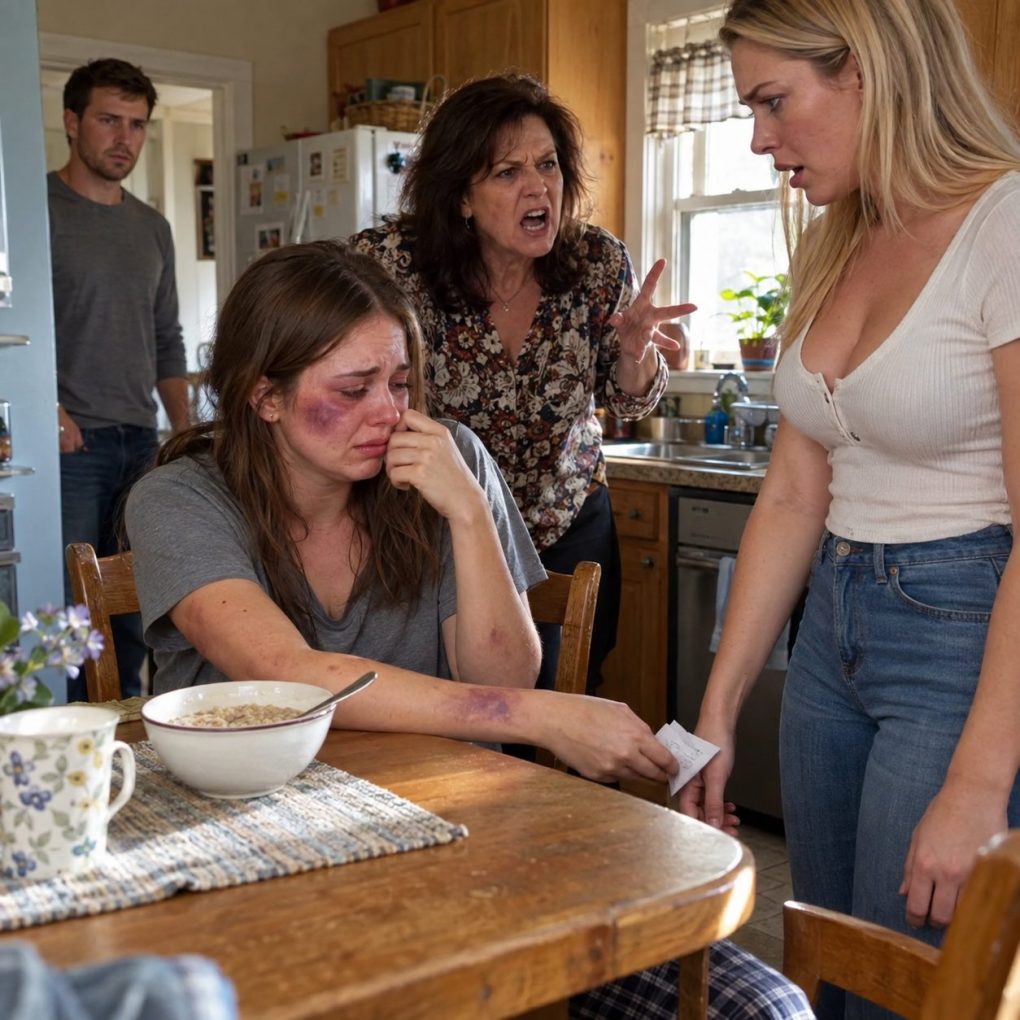
Her mother called from the kitchen, and Nora looked down at the bowl of watery oatmeal in front of her. There were bruises around her wrists. Another one was clearly visible above the collar of her fleece jacket.
I met Ethan’s parents for the first time. Just ten minutes after entering their home in Ohio, I wanted to leave with his sister.
Ethan stepped between us. “Nora is recovering from a fall. She tends to get confused when she’s tired.”
“I’m here,” Nora said.
His father, Paul, snatched the spoon from her hand. “Then finish your breakfast and don’t bother our guest anymore.”
It was almost six o’clock in the evening.
Nora gave me a cold, sharp look. I understood that trying to correct him would only make things worse.
In the hallway, I told Ethan I wanted to make a phone call. He grabbed my elbow quite forcefully, making me stop.
“Please,” he said. “My family is dealing with a private matter.”
I stared at his hand until he let go.
As I reached for my coat, Nora appeared by the door. Paul was standing behind her, holding a bunch of keys. She quickly hugged me and pressed a folded piece of paper into my palm.
I opened it outside, in the porch light.
Come back at 10 PM, and you’ll see what you need to see.
Below that, in smaller font: DON’T TELL ETHAN.
I drove to a gas station two blocks away and called my friend, Maya. I sent her a picture of the note and the address. Then I sat in my car, watching the minutes tick by.
At 9:58, Maya stopped her car behind me. We walked towards the house together. The side gate was open, just as Nora had written on the back of the note.
Through the kitchen window, I saw Paul pull Nora to the table. His wife stood beside her with a stack of documents. Nora shook her head and tried to pull away.
Then, the front door opened.
Ethan walked in, carrying a black bag, and Paul said, “Good. She still won’t sign.”
I thought I understood who Nora was afraid of. Then I heard Ethan’s voice in that kitchen, and everything I believed about the man I was going to marry began to crumble.
Ethan placed the bag on the table. “She doesn’t need to sign if we can access her account.”
Maya clutched my sleeve tightly. I raised my phone to film through the glass, but the screen reflected my face. We crouched low behind the bushes.
In her heart, Nora thought, “You told Claire I fell.”
“She wants an explanation,” Ethan replied. “You could just keep quiet.”
Paul’s wife, Diane, took a piece of paper from the file and pointed to a line near the bottom of the page. Nora pushed the paper away. Paul grabbed her wrist, right where the bruises were.
I almost ran out the door. Maya stopped me. “Call 911 first.”
I gave the dispatcher the address and described what I could see. She asked whether Nora could leave. I watched Paul put the keys in his pocket.
“I don’t think so,” I said.
Ethan opened the black bag and took out Nora’s phone. He held it in front of her face.
“Unlock it,” he said.
Nora refused. Diane said, “The hospital needs the payment before Friday.”
That stopped me. Ethan had told me Nora’s medical bills had drained the family’s savings. For months, I had been helping him cover what he called their expenses.
Nora laughed once, without humor. “Tell her whose hospital bill it is.”
Paul hit the table. “Enough.”
Ethan leaned close to Nora. “Claire doesn’t know where the money comes from. Keep her out of it.”
I felt my stomach turn. My money wasn’t paying for Nora’s care. Whatever was happening in that house, Ethan expected me to help finance it without asking questions.
A car slowed on the street. Maya and I stepped behind the fence. It kept moving. When we looked back, Nora had slipped off her chair. Ethan blocked the kitchen doorway while Paul hauled her up by the arm.
The dispatcher told me officers were on their way. Then Nora looked straight toward the window and mouthed one word.
Basement.
Diane closed the blinds before I could see more.
A few seconds later, my phone lit up with a message from an unknown number: Check the folder Ethan left in your car.
I looked at Maya. Ethan had borrowed my car that afternoon to pick up groceries. I had watched him carry that same black bag inside.
We ran back to the gas station. Beneath the passenger seat was a manila folder. The first page was a bank transfer request bearing Nora’s name. The receiving account was labeled with mine.
I had never opened an account for her.
Then I saw the second page: a copy of my driver’s license, with my signature traced beneath a statement I had never signed.
Maya photographed every page while I spoke to the dispatcher again. I told her about the folder, the copied license, and the signature. She asked us to stay where we were until the officers reached the house.
I wanted to go back for Nora. Maya stopped me. We stayed in the car, watching the street.
Two patrol cars turned the corner a few minutes later. I waved them down and showed the officers Nora’s note. I also showed them the brief video I had managed to record: Paul gripping Nora’s wrist, Ethan holding her phone, Diane placing the document in front of her. Ethan’s demand to unlock the phone was audible.
One officer radioed for another unit. The other went to the front door with his partner. Maya and I waited across the street.
Paul answered. Ethan stepped behind him. The officers separated them and asked to speak with Nora alone. Paul protested. Diane said her daughter was asleep.
Then a pounding sound came from inside the house.
The officers moved past them. Moments later, Nora came out with an officer beside her. Her sweatshirt was torn at one shoulder, and she was holding a small spiral notebook against her chest. She saw me and began to cry.
“I thought you wouldn’t come,” she said.
“I’m here.”
An ambulance arrived to examine her injuries. Nora asked to talk away from her family, so an officer stood with us beside it. She was thirty-two, employed, and had lived on her own until a car accident six months earlier. She’d stayed with her parents while she recovered from surgery. They had kept her house key, phone, and debit card after she was well enough to return home.
She showed the officer the notebook. Each page listed a date, the money Ethan had taken from her account, and what happened when she asked for access to it. She had recorded the bruises whenever Paul and Diane denied hurting her.
“Why didn’t you call the police?” I asked.
“I tried.” Nora’s voice cracked. “Dad took my phone. Ethan told me nobody would believe me if I said my whole family was doing it.”
The unknown message had come from an old phone Nora kept hidden in the laundry room. It still worked on the house Wi-Fi. She had sent the message while they were pulling her toward the basement, just before Diane found it.
The officer asked about the bank papers in my car. Nora closed her eyes.
“Ethan said he was moving the rest of my insurance settlement into a new account,” she said. “He told me Claire agreed to hold it until my bills were paid.”
I told her I had agreed to no such thing. I’d never seen the papers or given Ethan permission to use my identification. Nora nodded. That was what she had suspected when she slipped me the note.
She explained the rest slowly. Her accident claim had paid out enough to cover her medical bills and help her start again. Ethan managed some online payments for her after surgery. Once she recovered, he refused to give her the passwords. Paul and Diane backed him, insisting he knew what was best. The hospital bill Diane had mentioned was real, but it belonged to Paul. Ethan had been using Nora’s settlement to pay his father’s expenses and other family debts.
For weeks, Ethan had told me his family was struggling to afford Nora’s care. I had sent him money three times. Nora had never received any of it.
The officers took separate statements from us. They documented Nora’s injuries and photographed the notebook and the folder. Nora gave them access to the hidden phone, which held messages from Ethan about the transfers and a recording of Paul threatening to keep her in the basement until she signed. The officers told us they would preserve the evidence and contact investigators. They did not promise how quickly charges would follow.
Nora refused to go back inside. Maya offered her the spare room at her apartment for the night. The officer helped Nora collect her medication and identification while Paul remained on the porch. Ethan tried to speak to me as she passed.
“Claire, this got out of hand,” he said. “I was going to fix it.”
I looked at Nora’s bruised wrist. “You had tonight to stop.”
He said my name again, but I walked away. At Maya’s place, I called my bank and reported that my license and signature had been used without my permission. I froze my credit, changed the passwords Ethan knew, and ended our engagement in one short message. Then I blocked his number. Nora listed the accounts Ethan could access for the investigators.
The next morning, Nora went to her bank with a victim advocate and requested statements for every account linked to the settlement. She changed her passwords and arranged for her checks and notices to go to an address her family could not access. The bank flagged the attempted transfer and began reviewing earlier withdrawals. I gave an investigator the original folder, along with records of the money I had sent Ethan.
Nora also had a lawyer review her lease and property records. Her house was still hers. By the end of the week, she had changed the locks and gone home with Maya and me beside her. She carried her own keys through the door.
The investigation took longer than that night on the porch. The records, messages, and our statements led to charges against Ethan and Paul over the money and threats. Diane was questioned about her part in keeping Nora from leaving. Their cases were still moving through court when Nora invited me over for dinner a few months later. Nora was making her own choices again.
She had cooked pasta, and there were leftovers in the fridge. At the table, she set down a full plate for herself and smiled at me.
“I’m sorry I pulled you into this,” she said.
“You gave me a chance to see it,” I told her. “I’m glad you did.”
She reached into a drawer and took out the folded note, its edges worn from being handled. She had kept it after an officer returned her belongings.
“At ten,” she said, “I thought I might lose my nerve.”
I folded my hand over hers. “You didn’t.”
Nora put the note away, picked up her fork, and began to eat. This time, no one was watching over her shoulder.

