PART 1: THE DAY FRANCINE DESTROYED OUR DAM AND FLOODWATERS CAME RUSHING
The day the HOA bulldozed my dam, the frogs went silent.
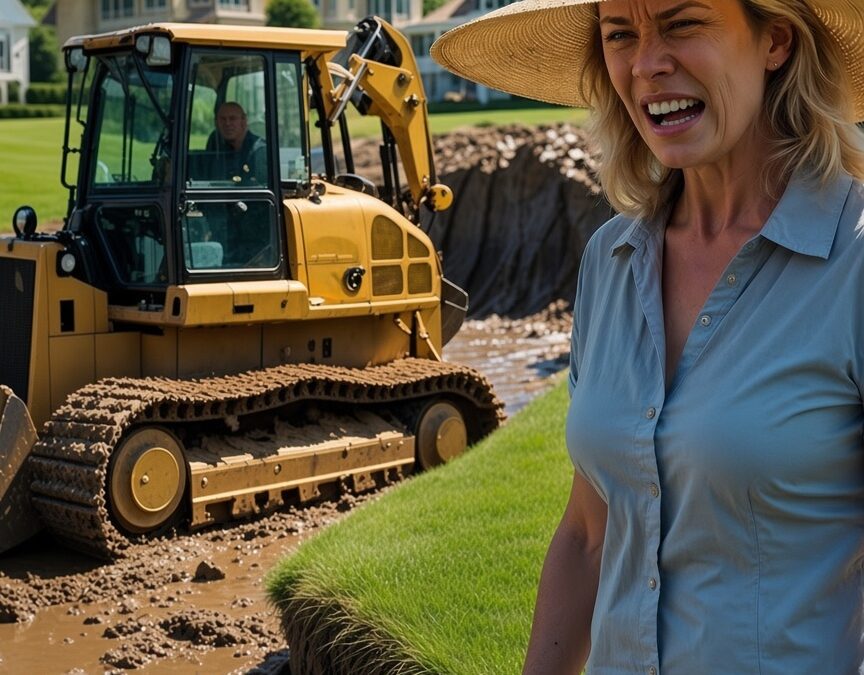
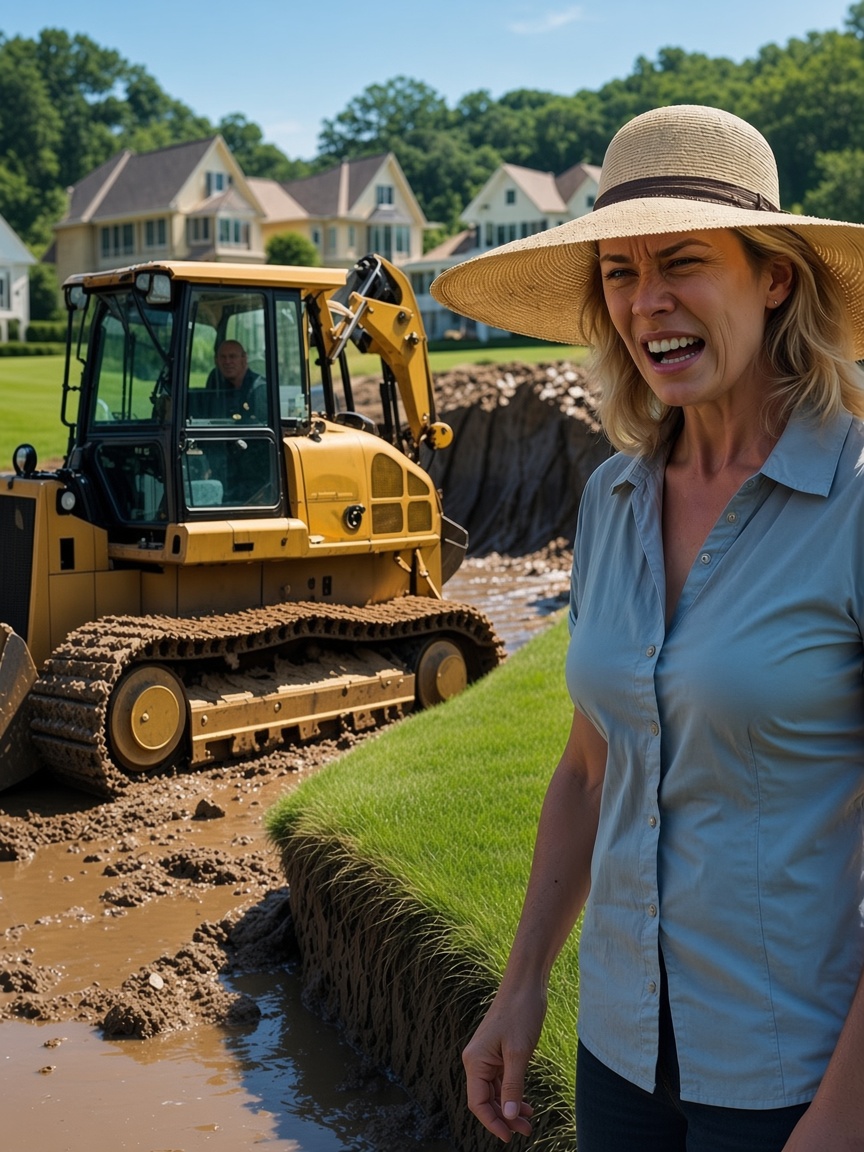
I noticed because I’d spent eight years listening to them. Every spring evening, they gathered along the drainage channel behind my house, making enough noise to drown out the traffic on the county road. That morning, three bulldozers had turned their habitat into a trench of exposed clay and broken stone.
Francine Lot stood beside the machinery wearing a wide-brimmed sun hat.
“There,” she announced. “Finally, something we can all be proud of.”
I looked past her at the ruined embankment.
“You just destroyed the neighborhood’s drainage system.”
She adjusted her sunglasses.
“Reagan, it’s a pile of dirt. Don’t make this another engineering lecture.”
My name is Reagan Voss. I’m a civil engineer, and I owned the lowest residential parcel in our development. Eight years earlier, an unusually severe seasonal flood had overwhelmed the natural drainage route behind the houses. Water collected across several backyards before finding its way toward the creek.
My property received most of it.
After that flood, I spent months studying the runoff, working with the city, and developing a permitted drainage structure that controlled how water moved through the low ground.
People called it a dam, although it was really a compact earthen embankment with a controlled outlet. It held back sudden surges and released water into the channel at a rate the downstream soil could handle.
It wasn’t especially attractive. Neither were the flooded basements we’d had before it existed.
For years, nobody complained.
Then Francine became HOA president.
She cared about coordinated shutters, approved flower beds, and whether trash cans were visible from the street. She also believed that anything she disliked could be prohibited through a board vote.
At our last association meeting, she’d projected a photograph of my dam onto the clubhouse wall.
“This structure compromises our community’s appearance,” she’d said.
I’d raised my hand.
“It prevents stormwater from collecting around your foundations.”
“That’s your opinion.”
“It’s a permitted engineering design. I brought the drainage calculations.”
She hadn’t looked at them.
Instead, she’d cited an old landscaping provision and called for a vote.
The board approved removal.
Ten days later, I received a formal notice demanding that I demolish the structure.
I appealed immediately, attaching the permits, survey, and inspection records. I also contacted the city inspector who had reviewed the original work.
He confirmed that the structure was authorized and operating as designed.
I forwarded his response to the board.
Nobody answered.
Then, on a clear Tuesday morning, the machines arrived.
I came outside when I heard the first engine. By the time I reached the rear property line, the crew had already cut through the embankment.
I told the operator to stop.
He pointed toward Francine.
“She says the association authorized it.”
“This is private property.”
He lowered the machine’s bucket, but another operator continued moving soil.
Francine approached with her clipboard.
“The board has resolved this matter.”
“You don’t have a demolition permit.”
“We have a majority vote.”
“Those aren’t the same thing.”
She turned toward the crew.
“Finish the job.”
I photographed the equipment, the workers, the damage, and the exposed drainage channel. I recorded the time and called the city.
By the time someone returned my call, the machines were leaving.
What remained was a wide opening where the controlled outlet had stood. Muddy water moved through it in a shallow, steady stream.
Francine inspected the site from the dry side of the property line.
“Much better,” she said.
I asked her one final question.
“Did anybody on that board check where the water would go?”
She didn’t answer.
That night, I walked the perimeter with a flashlight.
The weather forecast showed more rain in the coming days, but the ground was already saturated from the previous week’s showers. Without the embankment, the water had begun spreading across the low ground.
I checked the outlet elevation and photographed the flow.
Around midnight, I heard a neighboring sump pump switch on.
Then another.
I didn’t sleep much.
By morning, the lawn edges were soft enough to leave deep boot prints. Water stood in shallow depressions that had been dry the previous afternoon.
Francine’s property lay directly along the newly exposed flow path.
Her house was an expensive colonial with white shutters, a wraparound porch, and a stone patio she’d installed the previous summer. She’d once told me the patio alone cost more than most people’s kitchens.
Now water was collecting beneath its outer edge.
I watched from my porch as a section of the paving settled.
A crack appeared between two rows of stones.
Then the outer corner slipped several feet into the saturated ground.
Francine came running out.
She stopped at the patio doors and screamed for her husband.
I set down my coffee and called the city inspector again.
By noon, Francine’s backyard looked like a shallow pond. Her patio chairs had shifted, one garden lantern leaned at an angle, and muddy water surrounded the decorative shrubs.
She spotted me at the edge of my driveway.
“Reagan! Could we talk?”
I pulled on my boots and walked over.
She was standing on her porch in a pressed linen outfit, trying to look composed.
“We’re evaluating several options,” she said. “I wondered whether you might have suggestions for temporary flood control.”
“Sandbags around vulnerable openings. Keep people away from the unstable ground. Have an electrician assess any equipment exposed to water.”
She nodded quickly.
“And the yard?”
“The yard needs a drainage system.”
Her expression tightened.
“You know what I mean.”
“Yes. I do.”
She looked toward the damaged patio.
“Can you rebuild it?”
“Eventually. But first we need authorization, a site assessment, and a plan that doesn’t put workers in unstable soil.”
“Surely you can do something today.”
“Yesterday, I tried.”
She folded her arms.
I continued.
“Code enforcement called me this morning. They can’t find a demolition permit.”
“We followed association procedure.”
“You authorized machinery onto my property and removed a permitted structure. Association procedure doesn’t replace municipal approval.”
Her face changed.
“I’ve filed a police report and given the city my photographs.”
“You’re doing this because you’re angry.”
“I’m doing it because the damage is spreading.”
Behind her, the outdoor air-conditioning unit made an uneven buzzing sound and stopped.
Francine turned toward it.
For the first time since I’d known her, she had nothing to say.
By midafternoon, neighbors were walking between houses in rubber boots.
A man two doors down had water in his crawl space. Another homeowner reported wet insulation beneath the first floor. A woman across the street had discovered moisture along her basement wall.
People compared photographs and called insurance companies.
Some asked me whether the dam could really have prevented this.
I showed them the runoff map.
Most listened quietly.
They had supported its removal because Francine had described it as an unauthorized landscaping problem. Few had seen the engineering records I’d submitted.
That evening, the board called an emergency meeting.
The clubhouse smelled of damp carpet and stale coffee. Folding chairs filled the room, and Francine sat behind a table with two board members.
I stood near the back holding my permits and correspondence.
A maintenance worker raised his hand.
“My living room smells like pond water. What’s the plan?”
Francine straightened her papers.
“We are investigating remediation options.”
A woman near the front interrupted.
“My basement’s flooded. My insurance company wants to know who authorized the demolition.”
“We acted to protect property values,” Francine said.
The woman stared at her.
“My property is underwater.”
Francine looked toward me.
“Let’s remember that Mr. Voss never obtained formal HOA approval for his structure.”
I walked forward and placed my documents on the table.
“Here’s the city permit. Here’s the inspection record. Here’s the runoff analysis. And here’s the letter my attorney sent this morning disputing the association’s authority to enter my land and remove the structure.”
I didn’t raise my voice.
“The city is investigating the demolition. The sheriff’s office has taken my report. The association’s insurer is also reviewing the circumstances.”
One board member began reading the attorney’s letter.
Francine pushed it away.
“You’re trying to frighten everyone.”
“No. I’m trying to make sure they understand what happened.”
Someone asked whether board members could be personally responsible.
“That depends on the facts, their conduct, and the applicable law,” I said. “My attorney is reviewing it.”
An older woman stood.
“Then we need a different board.”
Several people agreed.
Francine objected, but residents began discussing the removal procedure in the bylaws. They arranged to circulate the necessary petition and call a properly noticed membership vote.
I returned to the back wall.
For the first time, the people in that room were reading the rules instead of simply accepting Francine’s interpretation of them.
PART 2: THE NEIGHBORS REMOVED FRANCINE AS HIDDEN DEMOLITION RECORDS SURFACED
Two days later, after the required membership process, Francine and the remaining board members lost their positions. Harold, a retired contractor who usually wore a fishing vest, agreed to lead an interim board.
His first question to me was practical.
“What do you need to fix the drainage?”
“Access to the original plans, confirmation from the city, and a stretch of workable weather.”
“Can we start?”
“After the site is cleared for construction.”
The new board approved the restoration plan and hired a mitigation company to assess affected houses. I offered my engineering time without charge. Material costs would be documented for the association’s claim against those responsible, rather than decided through a personal invoice.
Three days after the demolition report, a sheriff’s deputy visited Francine. I watched him hand her an envelope and speak with her on the porch. I couldn’t hear their conversation.
The following morning, a small moving truck appeared.
Francine loaded boxes and drove away. Her house remained surrounded by sandbags.
Two weeks later, county compliance officer Marble Cortez asked to meet me at the damaged embankment.
She showed me a map on her tablet.
“The demolition equipment entered from the east slope,” she said.
“That’s city greenbelt.”
“Correct. We found no public works permit authorizing access.”
She enlarged a scanned work order.
“Someone submitted this as proof of permission. The approval signature doesn’t match our records. We’ve referred it for investigation.”
I studied the document.
“Who submitted it?”
“We’re still establishing that.”
Within the following week, investigators began examining the contractor. The business was registered out of state under Francine’s cousin’s name, and county officials could find no active local license for the work.
The new board also discovered reimbursement requests exceeding $20,000 for demolition-related work described as landscaping restoration.
Harold brought the records to our next meeting.
“We need to preserve everything,” he said. “Invoices, emails, bank records, meeting minutes. Nobody deletes anything.”
Afterward, a neighbor named Todd approached me with photographs he’d taken from his attic window.
They showed the demolition crew arriving at dawn. Francine wasn’t alone. The former treasurer and secretary were standing near the equipment, pointing toward the embankment.
“I heard them talking the night before,” Todd said. “They were worried you’d get a court order if they waited.”
I forwarded the photographs to Marble, along with Todd’s contact information.
Investigators interviewed him and obtained additional records. Warrants were subsequently issued for the two former officers, who were taken into custody on charges connected to the demolition and alleged misuse of association funds.
I didn’t celebrate.
Several houses still needed repairs, and the original dam was still a pile of broken earth.
PART 3: THE NEW DRAINAGE PLAN REVEALED MORE THAN WATER DAMAGE
At the next community meeting, Harold laid the problems out without pretending they were small.
The association faced repair bills, disputed insurance claims, and an investigation into its former officers. The county was evaluating whether any public assistance could support restoration of the damaged drainage corridor.
A woman asked how long her kitchen would remain unusable.
The mitigation contractor gave her an estimate, explaining that drying and mold remediation had to come before rebuilding.
Nobody liked the answer, but at least it was an answer.
Once the city approved the revised design and the weather cleared, I rebuilt the embankment over six working days with an authorized crew. We widened the controlled outlet, installed a properly sized spillway, and added a planted filtration strip using native reeds.
Neighbors volunteered for safe work outside the construction area. Some brought water and meals. Others helped establish a pollinator garden after the grading was complete.
Within weeks, the standing water receded.
Francine’s house didn’t recover. Prolonged saturation had damaged its foundation, and mold had spread through the interior. Months later, after foreclosure and the necessary municipal proceedings, the unsafe building was demolished.
The cleared parcel eventually became a small community garden overlooking the drainage channel.
I thought that might be the end of the story.
Then subpoenas began arriving.
Investigators were examining five years of HOA spending, not merely the demolition invoices.
Harold came to my kitchen carrying copies of the association’s financial records.
“Look at this,” he said.
One payment listed $15,000 for an Architectural Harmony Initiative.
I checked the contractor information.
The telephone number was disconnected. The business address led to a private mailbox. Registration documents linked the company to Francine’s brother-in-law.
“There’s no report showing what they delivered,” I said.
Harold turned another page.
“Here’s another one.”
Over the following weeks, investigators identified inflated bids, duplicate payments, and maintenance charges for work residents couldn’t verify. One invoice claimed thousands of dollars for aquatic vegetation treatment during a period when the neighborhood had no managed pond.
The state brought in a forensic accountant.
What had begun as an illegal demolition investigation was becoming a financial fraud case.
PART 4: THE FRAUD INVESTIGATION FORCED OUR COMMUNITY TO REBUILD TRUST
Assistant district attorney Eliza Grant called me to testify before a grand jury.
I brought the original permits, photographs, correspondence, and engineering records. She asked about the dam’s purpose, the board’s objections, the demolition, and the flooding that followed.
I answered what I knew and said when I didn’t know something.
There were no speeches. The documents mattered more than anyone’s opinion of Francine.
Afterward, Eliza spoke with me briefly in the hallway.
“Your records helped establish the timeline,” she said.
“Will the homeowners get their money back?”
“Some restitution may be possible. I can’t promise how much.”
Eventually, indictments named five former board members, including Francine, along with her cousin and brother-in-law. The charges concerned alleged conspiracy, misuse of association funds, fraudulent transactions, and the unauthorized demolition.
Separate civil claims addressed damage to private and municipal property.
At her arraignment, Francine’s attorney argued that she’d relied on contractors and other board members. The court proceedings continued, with each defendant’s responsibility to be determined through the legal process.
Meanwhile, homeowners received difficult insurance decisions. Some claims were partially covered; others remained disputed. The association’s available funds couldn’t pay every repair bill.
Harold called another outdoor meeting beside the new dam.
“We can’t undo what happened,” he told everyone. “But we can decide how this place operates from now on.”
A retired accountant volunteered to review historical spending. A construction foreman offered inspections. Two teachers organized child care during meetings.
Then Harold nominated me to chair architectural review.
“I don’t care what color anybody paints their fence,” I said.
A neighbor laughed.
“That’s why we want you.”
I accepted on the condition that decisions would be documented, appeals would be meaningful, and no committee would treat private property as its personal project.
Working with legal counsel, residents revised the bylaws through the required voting process. They narrowed property-entry powers, clarified notice requirements, capped fines, and established independent financial audits every two years.
We also created a volunteer oversight group to review budgets and publish meeting summaries.
For the first time, homeowners could easily see where their dues were going.
PART 5: THE FROGS RETURNED AS THE NEIGHBORHOOD FINALLY FOUND ACCOUNTABILITY
The criminal cases eventually ended in plea agreements. Francine received an eighteen-month state prison sentence and was ordered to pay more than $100,000 in restitution. Her co-defendants received penalties reflecting their individual roles.
Recoveries from seized assets and other settlements returned part of the missing money to the association. The new board directed those funds toward the households facing the worst remaining repair costs.
Not everyone recovered everything they’d lost.
Some families replaced flooring themselves. Others spent months disputing insurance decisions. A few residents moved away.
But the neighborhood no longer pretended that maintaining appearances was the same as maintaining a community.
We renovated the old clubhouse into a community center with bookshelves, meeting space, and a coffee machine. On one wall, we displayed the revised charter signed by the residents who’d approved it.
Someone called it the Reckoning Wall.
Above the documents were the words: “Power unchecked will always sink. Communities don’t have to.”
That spring, the rain came hard.
I checked the drainage channel through several storms, measuring water levels and inspecting the spillway. The system worked as designed. Runoff moved through the controlled outlet, past the reed-lined filtration strip, and into the creek.
No basements flooded.
No patios collapsed.
And one evening, while I was checking the embankment, I heard the frogs again.
A girl from three houses down stopped her bicycle beside the gravel path.
“My teacher said you saved the neighborhood,” she told me.
I shook my head.
“Your neighbors helped rebuild it.”
She looked across the water toward the community garden.
“It’s prettier now.”
I followed her gaze.
The reeds moved in the breeze. Monarch butterflies drifted above the flowers, and Harold sat on the bench with his fishing rod resting across his knees.
Francine had wanted the dam removed because she thought it made our neighborhood look ugly.
Now the place she had tried to erase was where people gathered on weekends, where children learned about runoff and native plants, and where neighbors who once barely spoke sat together after dinner.
I finished checking the water level and closed my notebook.
The dam was holding.
So was the community we’d built around it.
THE END
Disclaimer: This story is fictional and created for entertainment purposes only. Any names, characters, places, or events are fictitious or used fictitiously. No real person or organization is intended to be portrayed.

