PART 1: I Bought A Quiet Lakefront And Inherited Someone Else’s War
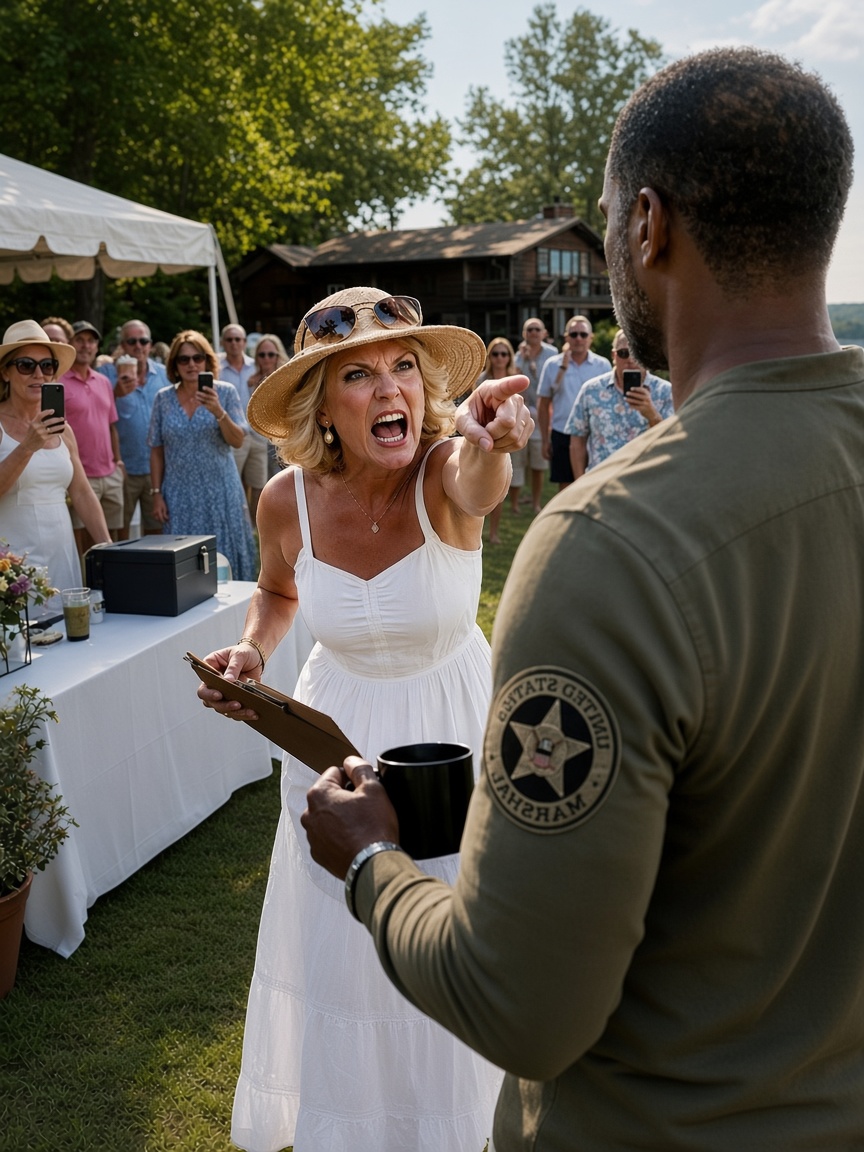
“Get off my lakefront.”
The woman standing in front of me wore a white sundress, expensive sunglasses, and the expression of someone accustomed to getting her way. Behind her, dozens of people occupied my grass, and a metal cash box sat on a folding table beside a sign advertising admission.
“Ma’am,” I said, holding my coffee, “this is my property.”
“Your property? That’s adorable.” She laughed. “I’ve been organizing events here for four years. Sixty people paid to be here today. You’re just some man living in a cabin.”
I looked past her toward my dock. People I had never met were climbing onto it.
“I’m asking you politely to leave.”
“Politely?” She stepped closer. “Honey, you don’t matter here. Take your fishing rod and go back to that miserable shack before I have you removed.”
I didn’t raise my voice. I took another photograph of the admission table.
My name is Garrett Holloway. I’m forty-five, and I’ve spent eighteen years working as a deputy United States marshal. My job has taken me into abandoned houses, crowded apartment buildings, and remote places where fugitives hoped nobody would look.
It taught me something useful: when somebody wants a confrontation, you don’t have to give them one.
You need to know what happened before that afternoon.
Two years earlier, my wife, Renee, had been diagnosed with pancreatic cancer. She was forty-two. Six months later, she was gone.
I had spent most of my adult life believing that difficult problems could be solved through preparation and persistence. Her illness destroyed that assumption.
We tried everything her doctors recommended. We kept appointments, asked questions, and organized medications in a plastic container on the kitchen counter. Renee made jokes about my spreadsheets until she was too tired to joke.
After the funeral, I went back to our house outside Richmond and discovered how much noise one absent person could make.
Her reading glasses remained beside the bed. The tomato plants she’d started were still growing behind the house. Every morning, I reached for a second coffee mug before remembering.
Eventually, I sold the house.
With the equity, I bought 3.2 acres on Smith Mountain Lake in Bedford County, Virginia. The property included a cedar-sided cabin, an aging dock, and a shoreline facing south.
Renee had always wanted to retire beside a lake.
I figured one of us ought to make it there.
During my first week, I replaced rotten porch boards, repaired a loose railing, and fished before sunrise. I left my phone inside whenever work allowed.
For the first time in months, I could sit somewhere without feeling I needed to leave.
On my third day, a white Cadillac Escalade stopped across my driveway.
A woman climbed out carrying a clipboard.
“Cheryl Peton,” she announced. “I’m the heart and soul of Stillwater Bluffs.”
“Garrett Holloway. I just bought this place.”
“Oh, I know. We know everything that happens here.”
She explained that she was president of the homeowners association. Then she described the neighborhood’s traditions, community standards, and annual gatherings.
Finally, she reached the reason for her visit.
“Your lakefront has always been our favorite location for community events. Naturally, we’ll want to continue using it.”
I set down my paintbrush.
“I’m not comfortable with that.”
Her smile remained, but her eyes changed.
“It’s a longstanding arrangement.”
“Was there a written agreement with the previous owner?”
She glanced at her clipboard.
“Everybody understands how things work around here.”
“Then everybody needs to understand that I haven’t agreed.”
For several seconds, she studied me.
“We’ll see about that.”
She returned to her SUV and drove away.
I thought that was the end of it.
My neighbor Nolan Briggs corrected that assumption a few days later.
Nolan was sixty-two, a Navy veteran and retired carpenter who’d lived in Stillwater Bluffs for twenty-two years. He came over to inspect my dock and stayed for coffee.
When I mentioned Cheryl, he shook his head.
“She’s been president nine years. Doesn’t handle disagreement well.”
“How badly?”
“She fined a family over a garden gnome once.”
I stared at him.
“Seriously?”
“Two hundred dollars. Said it didn’t fit the neighborhood’s appearance standards.”
He told me about homeowners who had challenged her and eventually moved away. He also mentioned her husband, Todd, who served on the county planning commission.
“People don’t like making enemies of both of them,” Nolan said.
I looked at the lake.
“I didn’t come here to make enemies.”
“Neither did the people who left.”
Ten days later, work sent me to Charlotte to locate a fugitive wanted in connection with an armed robbery case. I was gone three days.
When I returned, deep tire tracks crossed the grass beside my driveway.
I followed them toward the water.
Disposable cups covered the shoreline. Crushed cans lay beneath the picnic table. My dock had fresh scrape marks, and wooden stakes had been hammered into the lawn.
Near the water, a large patch of grass was blackened by charcoal.
I called Nolan.
“Did somebody throw a party here?”
He sighed.
“Cheryl. She’s been doing it for years.”
“On this property?”
“Yep. Charges admission, too. Twenty or thirty dollars a person.”
“Where does the money go?”
“That’s a question nobody gets answered.”
That evening, I spread my deed and survey across the kitchen table.
The shoreline was mine. The property description was clear, and I could find no recorded access agreement authorizing the HOA to use it.
I wrote Cheryl a certified letter withdrawing any claimed permission and instructing her not to enter or organize events on my land. I enclosed the relevant property documents and copied the HOA board.
Five days later, an envelope arrived containing $4,350 in alleged violations.
There were penalties for dock appearance, parking, grass height, and cabin paint. Some included daily charges.
I compared every notice with the association’s governing documents.
I couldn’t find the restrictions Cheryl claimed I’d violated.

