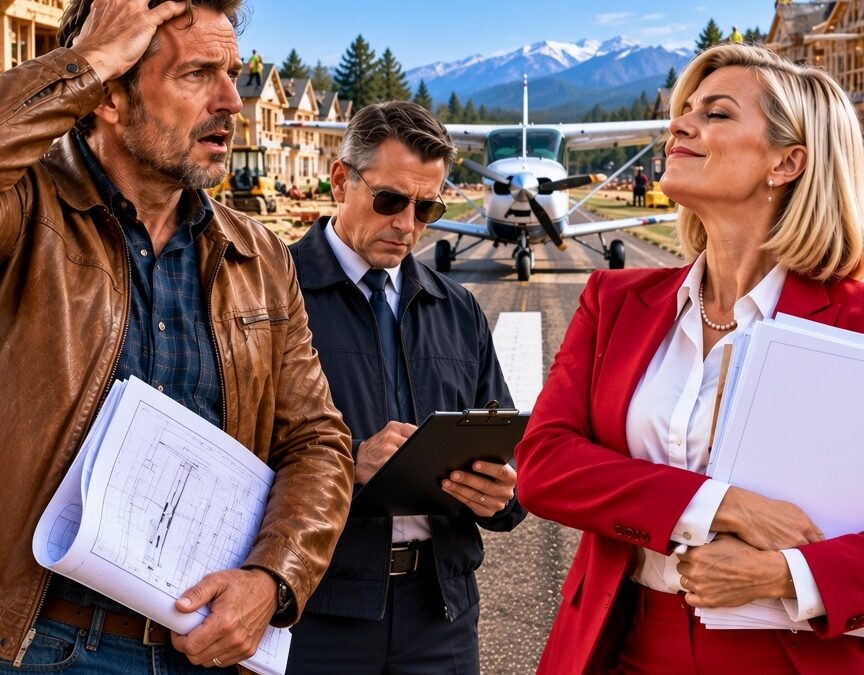
« Qui vous a dit que cette piste d’atterrissage allait fermer ? »
Michael Turner a posé la question si bas que Rebecca Sloan a presque répondu sans réfléchir.
Presque.
Nous nous trouvions à l’extrémité est de ma piste d’atterrissage en herbe, par une matinée claire de Virginie. Derrière moi s’étendaient les 39 hectares de terrain dont j’étais pleinement propriétaire. Au-delà de la clôture se dressaient les maisons les plus récentes de Brookstone Ridge, leurs façades fraîchement peintes et leurs fenêtres haut de gamme donnant sur une piste d’atterrissage qui existait bien avant que quiconque n’ait l’idée d’y construire un lotissement.
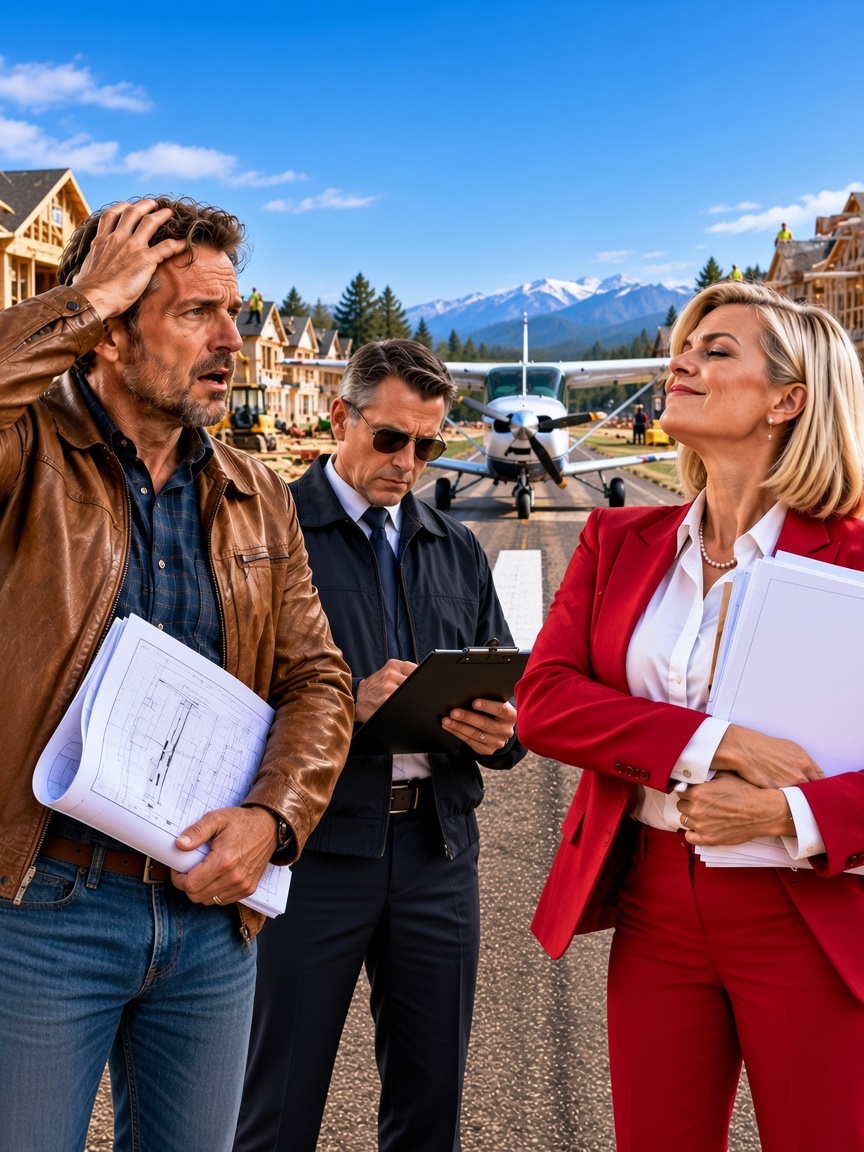
Rebecca, vêtue d’un blazer cramoisi, se tenait à trois mètres de là, un dossier rouge serré contre sa poitrine. Six propriétaires étaient rassemblés près de la clôture. Deux membres du conseil d’administration de l’association se tenaient derrière elle.
Michael, inspecteur de la sécurité aérienne, était arrivé ce matin-là pour enquêter sur des plaintes concernant ma piste. Je m’attendais à des questions sur le bruit des avions, les procédures d’exploitation et la conformité de ma propriété aux réglementations aéronautiques en vigueur.
Au lieu de cela, il demandait à la présidente de l’association des propriétaires de Brookstone Ridge de s’expliquer sur une promesse qu’elle avait insisté pendant près de deux ans sur le fait que j’étais obligé d’honorer.
« Ce projet a été planifié en partant du principe que les vols réguliers finiraient par cesser », a répondu Rebecca.
Michael jeta un coup d’œil au document qu’il tenait à la main.
« Ce n’était pas ma question. »
Rebecca ajusta sa prise sur le dossier.
« Il y a eu une coordination tout au long du processus de développement. Le promoteur était impliqué. Le service d’urbanisme du comté était impliqué. La communauté a été construite en fonction de certaines attentes. »
Michael attendit.
Il avait cinquante-quatre ans, des cheveux gris aux tempes et une patience qui mettait mal à l’aise ceux qui avaient l’habitude de gagner les débats par la persévérance.
Finalement, il a demandé à nouveau.
« Qui vous a dit que M. Holloway avait accepté de fermer sa piste d’atterrissage ? »
Rebecca regarda en direction des maisons les plus récentes.
« La question est plus complexe que de savoir si Grant a signé un document en particulier. »
« Alors montrez-moi la version compliquée. Qui a pris cet engagement ? »
Elle ouvrit son dossier.
Pour la première fois depuis que je l’avais rencontrée, Rebecca Sloan semblait hésiter sur la page qu’elle souhaitait consulter.
Je n’ai rien dit.
Six mois plus tôt, je serais intervenu. J’aurais expliqué que ma propriété se trouvait en dehors de son association, que la piste d’atterrissage était antérieure au quartier et que je n’avais jamais promis à personne d’arrêter de voler.
Mais Laura Bennett, mon avocate, m’avait appris quelque chose d’important.
When someone claimed authority over my property, I needed to stop arguing about what they wanted and start asking what gave them the right to demand it.
Michael turned toward the subdivision.
“When was the western phase approved?”
“I would need to check the development records.”
“And was this airstrip shown on the planning materials?”
“Everyone was aware there was aviation activity nearby.”
“That’s not what I asked.”
One of the board members shifted his weight.
Rebecca opened her folder wider.
“Yes. I believe it appeared on some of the earlier materials.”
Michael turned to me.
“Mr. Holloway, did you move your runway during the development of Brookstone Ridge?”
“No.”
“Shorten it?”
“No.”
“Relocate the approach area toward those houses?”
“No.”
He looked back at Rebecca.
“Then I need to understand what changed.”
Rebecca gestured toward the rooftops.
“What changed is that families live there now.”
“That is obvious,” Michael replied. “I’m asking what changed in the records.”
She removed a planning sheet from her folder.
“The project materials anticipated changing conditions.”
Michael accepted it.
“Anticipated by whom?”
“The planning team.”
“Based on whose commitment?”
Rebecca looked toward the two board members.
Neither answered.
Michael placed the sheet on the folding table beside my property survey and an old aerial photograph.
“Mr. Holloway, did you sign an agreement promising to discontinue regular aviation operations?”
“No.”
“Did you tell the developer you intended to close the airstrip?”
“No.”
“Did you authorize anyone to tell future homebuyers that you would?”
“No.”
Rebecca exhaled.
“Grant, circumstances change.”
I looked past her toward the houses.
“They certainly do. My runway didn’t.”
Michael studied the three maps spread across the table.
Then he said something that changed the entire direction of the dispute.
“Before we decide whether this airstrip became incompatible with the neighborhood, I want to understand whether the neighborhood was planned on the assumption that the airstrip would disappear.”
He looked directly at Rebecca.
“And if it was, I want to know where that assumption came from.”
Less than twenty minutes earlier, Michael had arrived because someone had filed complaints about my property.
Now he was examining the planning history of Brookstone Ridge.
And I was beginning to understand that the argument had never really been about a grass runway.
It was about how an expectation concerning my land had somehow become a promise that everyone believed I had made.
The problem was simple.
Nobody had ever asked me to make it.
My name is Grant Holloway. I was forty-five years old when the dispute reached that point, and I had owned my ninety-six acres in rural Virginia for almost twelve years.
I bought the property because I wanted space.
Not prestige. Not a spectacular mansion. Not a gated entrance with stone columns and landscaping that required three different contractors.
Space.
The farmhouse was a two-story white building with a wraparound porch, a kitchen that needed updating, and a roof I replaced during my second year there. Behind it stood an old equipment barn that had been built when the property was still part of a larger farm.
The land itself was the reason I signed the closing papers.

