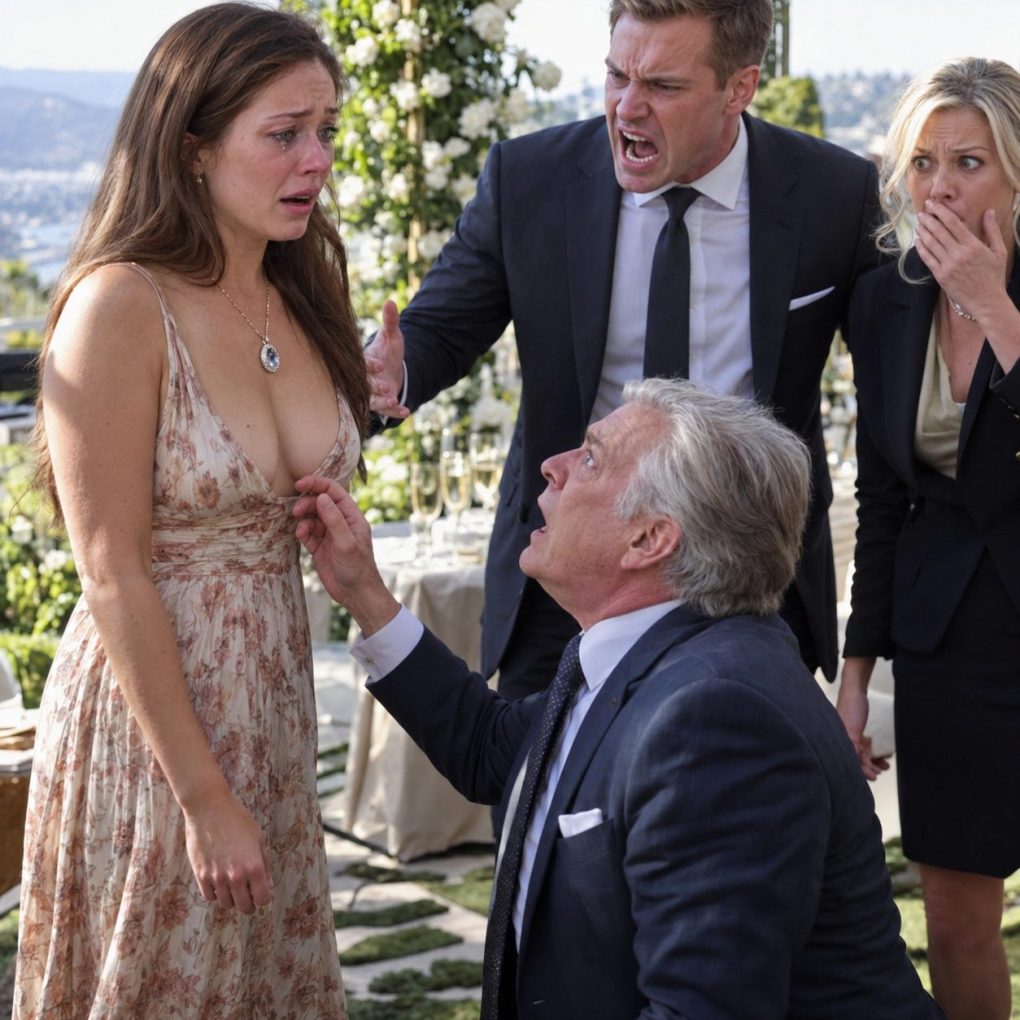
Throughout the ballroom, everyone was raising their glasses to celebrate Ryan’s promotion. He had taken me to the company party in Chicago, then hidden me behind a staff door.
My dress cost thirty dollars. He knew that. He’d seen me put it on.
“So why did you invite me?” I asked.
“Because married men seem more stable. Just leave this to me.”
He left before I could answer.
I stood there, clutching my wallet with the broken clasp, watching him smile at people who had never heard my name.
Then a waiter pushed the door open behind me. I stepped aside, and the necklace slipped from my collar.
“Sorry.”
An elderly man stopped in the middle of the room.
I recognized him from the company’s website: billionaire founder William Mercer.
He didn’t even look at my dress.
He kept staring at the small silver pendant pressed against my chest.
“Where did you get that?”
“My mother.”
His glass tilted. A waiter quickly caught it before it fell to the floor.
“What is her name?”
“Rose Bennett.”
He reached for a chair, but couldn’t reach it, and his knees buckled.
The room fell silent.
Ryan hurried towards us. “Sir, my wife is often confused about family matters. Let me take her home.”
I pulled my hand away from his.
“I didn’t mistake my mother’s name at all.”
Mercer looked up, his eyes filled with tears.
“Rose has given birth to a baby girl. A baby girl named Claire.”
“That’s me.”
Ryan’s fingers tightened around my wrist.
Mercer has noticed
“Release her.”
Ryan obeyed, but his face was ashen.
“Your mother played a key role in building this company,” Mercer told me. “Thirty years ago, someone made sure she disappeared from the company’s history.”
He turned toward Ryan.
“Last month, he told our lawyer that Rose Bennett’s daughter had died.”
My husband opened his mouth but said nothing. Somewhere in that company there was a file with my mother’s name on it – and Ryan suddenly seemed more afraid of that file than of losing his job.
“I said she couldn’t be found,” Ryan replied.
Mercer remained kneeling until I helped him stand up. His hand trembled as it touched mine.
“No,” he said. “You signed a statement saying she died without children.”
No one moved.
Ryan laughed heartily. “This is a company party. We shouldn’t be discussing confidential business deals in front of everyone.”
“You’re right,” Mercer said. “Claire, will you come with me?”
Ryan stepped between us. “She’s my wife.”
“And she can answer that herself.”
“I’ll come,” I said.
We entered a meeting room next to the ballroom. Mercer called his legal counsel, Diane Brooks, and asked her to bring in Bennett’s files. Ryan followed us inside.
“Claire,” he whispered, “think carefully before you embarrass us.”
For once, I didn’t lower my voice.
“Who is us?”
Diane arrived with a folder and a security manager. She laid a photograph on the table: my mother, young and laughing, standing beside Mercer outside a rented warehouse.
Around her neck was my pendant.
“I had it made for her,” Mercer said. “Turn it over.”
Three tiny initials were engraved on the back: R.A.B.
“Rose Anne Bennett,” I said.
Diane nodded. “The photograph helps explain the recognition. We’ll still need records to establish your identity.”
“My birth certificate is at home.”
Ryan reached for the folder. Diane moved it away.
Mercer told me my mother had helped develop the inventory system that became the company’s first successful product. She owned part of the original business.
“Then why did she clean offices until her knees gave out?” I asked.
He looked down.
“That is a question I should have answered long ago.”
Diane slid a copy of a letter toward me. It offered a settlement to my mother’s estate over disputed ownership records.
The address was ours.
“I never saw this.”
Ryan folded his arms. “You were grieving. I handled the mail.”
My mother had died eight months earlier.
Diane placed another page beside it.
A response bearing my name and signature declined the settlement and authorized Ryan to speak for me.
“That isn’t my signature.”
Ryan stopped looking at me.
“Your husband requested the file after learning we were searching for Rose’s heirs,” Diane said. “His promotion review was already underway. This discovery led us to check his other submissions.”
She opened a second folder.
There was my mother’s old notebook, scanned page by page.
Beside it lay the proposal Ryan had called his breakthrough.
The diagrams matched.
Mercer’s voice hardened.
“Claire, did you give your husband permission to submit your mother’s work as his own?”
“No,” I said. “I gave him that notebook because he said he could help me understand what Mom had been working on.” Ryan pushed his chair back. “Those were old ideas. I updated them.” Diane placed a dated email beside his proposal. In it, he had described the designs as his original work and denied using outside material. I remembered him celebrating the submission at our kitchen table. I had bought a small cake. He had let me thank him for giving my mother’s work some meaning.
“Ryan, your access is being suspended pending investigation,” Diane said. “Security will collect your badge and company devices. You may arrange a time to retrieve your personal belongings.” He looked at Mercer. “You’re throwing away years of performance over a necklace?” “The necklace made me recognize someone,” Mercer answered. “The records made us question you.” Ryan turned to me then, searching for the frightened wife who usually smoothed things over. “Tell them this is a misunderstanding.” I took my wrist out of his reach. “You told them I was dead.”
After security escorted him out, Mercer asked whether I wanted water or someone to sit with me. I wanted answers. He pulled his chair closer, leaving space between us. Thirty years earlier, my mother had been a systems analyst with a newborn daughter. Mercer had been a salesman trying to build a business. She designed the software; he found their first customers. They signed an agreement giving her a twenty percent ownership interest. The pendant had been a thank-you gift after their first major contract. Her initials were on the back because she disliked wearing anything flashy.

