My father said that while I was standing outside the bridal shop, my dress still pinned at the waist.
“There are three weeks left,” I said. “We’ve already paid everyone.”
“Your sister has already booked her tickets to Bali. Learn to put family first.”
Behind the glass, my future husband, Ethan, witnessed the change in my expression.
I told Dad that we should keep the date as it is.
He was silent. Then he said, “Two empty chairs can teach you a lesson about respect.”
For the next twenty days, Mom didn’t text. My sister, Brooke, posted links to swimwear in the family group chat. Dad called twice. Both times, he asked if I had “come to my senses” yet.
I have stopped replying.
On the morning of our wedding in Charleston, the ceremony coordinator asked who would walk me down the aisle.
“Me,” I said.
She glanced at the two chairs that had been reserved.
“Leave them alone.”
I don’t want anyone to have to guess whether we’ve forgotten my parents or not. They made that choice.
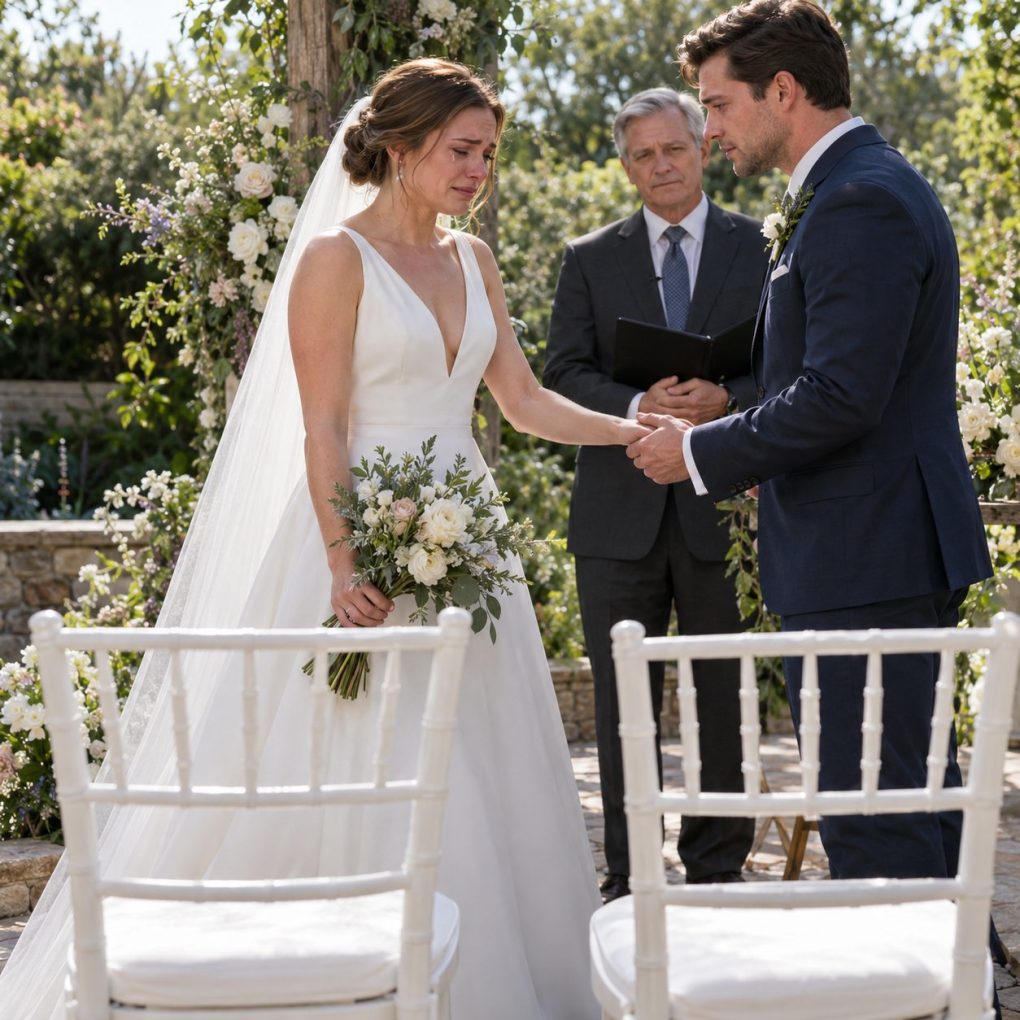
When the doors opened, I was almost paralyzed. Two hundred people turned toward me. My father’s chair was empty. My mother’s chair was too.
Then Ethan stepped away from the altar and held out his hand.
He met me in the middle of the street.
I completed the vow-taking ceremony. I even laughed when he cried before I cried.
At the reception desk, my phone lit up.
Father: Hopefully this lesson was worthwhile. Don’t expect a single penny from us.
We paid for the entire wedding ourselves.
Ethan read the message. His jaw tightened, but he kissed my forehead and asked a question.
“Can I explain to them why those chairs are empty?”
I nodded.
A few minutes later, he picked up the microphone. The room fell silent.
“My wife deserves to know the truth tonight.”
He reached into his jacket and unfolded a piece of paper.
I recognized my father’s handwriting.
But I’ve never seen that letter.
Ethan looked at me before reading the first line.
“This letter arrived at my office eleven days ago. This afternoon I showed her the envelope and asked permission to read it. She doesn’t know what’s inside.”
My hands were ice cold. Before that, I thought it was just another request to reschedule the appointment.
“Ethan,” he read, “you seem to be a sensible man. Please help me stop this wedding until Claire understands that marriage does not free her from her obligations.”
A fork bumps into another fork.
“Her sister needs monthly support. We’ve relied on Claire for years, and we’re not going to let her husband interfere with the arrangements that keep this family together.”
I stared intently at the page.
Monthly support?
For four years, I sent my parents $800 every month. My father said his working hours had been cut and my mother’s medication wasn’t covered by insurance. Sometimes I even skipped lunch to transfer the money.
Brooke had never needed help. According to Dad, she had a great job.
Ethan continued.
“If Claire won’t postpone, let her walk alone. Humiliation will bring her back. You can help us make that happen.”
The room became so quiet I heard the microphone catch his breath.
“He asked me to hurt her,” Ethan said. “And to keep taking her money.”
My aunt Susan stood beside the front table.
“Claire. I need to tell you something.”
Her face had gone pale.
“Your mother told us you canceled their invitations. She said you refused to include Brooke.”
Someone behind her whispered, “That’s what she told me, too.”
I couldn’t speak. They hadn’t simply stayed home. They had given everyone a reason to blame me for their absence.
Susan came closer.
“Your father’s hours were never cut. I work in payroll at the same warehouse. He was promoted last spring.”
That was the year I’d sold my grandmother’s bracelet to cover his supposed overdue electric bill.
My phone began ringing.
Dad.
Then Mom.
A cousin quietly admitted she’d texted them about the letter.
I stepped into the hallway with Ethan. Susan followed, holding her own phone.
“There’s more,” she said.
She showed me a message Mom had sent her that morning.
Don’t mention the account. Once she’s married, she might start asking questions.
“What account?” I asked.
Susan swallowed.
“The one your grandmother set up for you.”
My grandmother had been dead for six years.
Dad had told me she left nothing.
Before Susan could explain, the front doors opened.
My parents walked in, still wearing the clothes I’d seen in their morning photos from home.
Dad spotted the paper in Ethan’s hand.
“Give me that,” he said. “Before you ruin something you don’t understand.”
Ethan folded the letter and stepped beside me. “She understands what you wrote.” Dad reached for it anyway. I moved between them. For once, I wasn’t thinking about how to keep him calm. I was thinking about every lunch I’d missed, every bill I’d postponed, every time he’d called me selfish while cashing my money. “What account?” I asked. Mom looked straight at Susan. “This is her wedding. Why would you bring that up now?” “Because you lied,” Susan said. My mother opened her mouth, but no answer came out.
Dad lowered his voice. He always did that when he wanted something to sound reasonable. “Your grandmother left some money. We handled it while you were in college.” “You told me there wasn’t any.” “There were expenses.” Susan held up her phone. “It wasn’t estate money, Robert. It was a bank account with Claire named as the beneficiary. Mom showed me the paperwork before she died.” I looked at my father. “How much?” His eyes flicked toward the ballroom doors. “We’re not discussing private finances in a hallway.” “Then answer quietly.” Mom gripped his sleeve. “It was forty-two thousand dollars,” she said.

